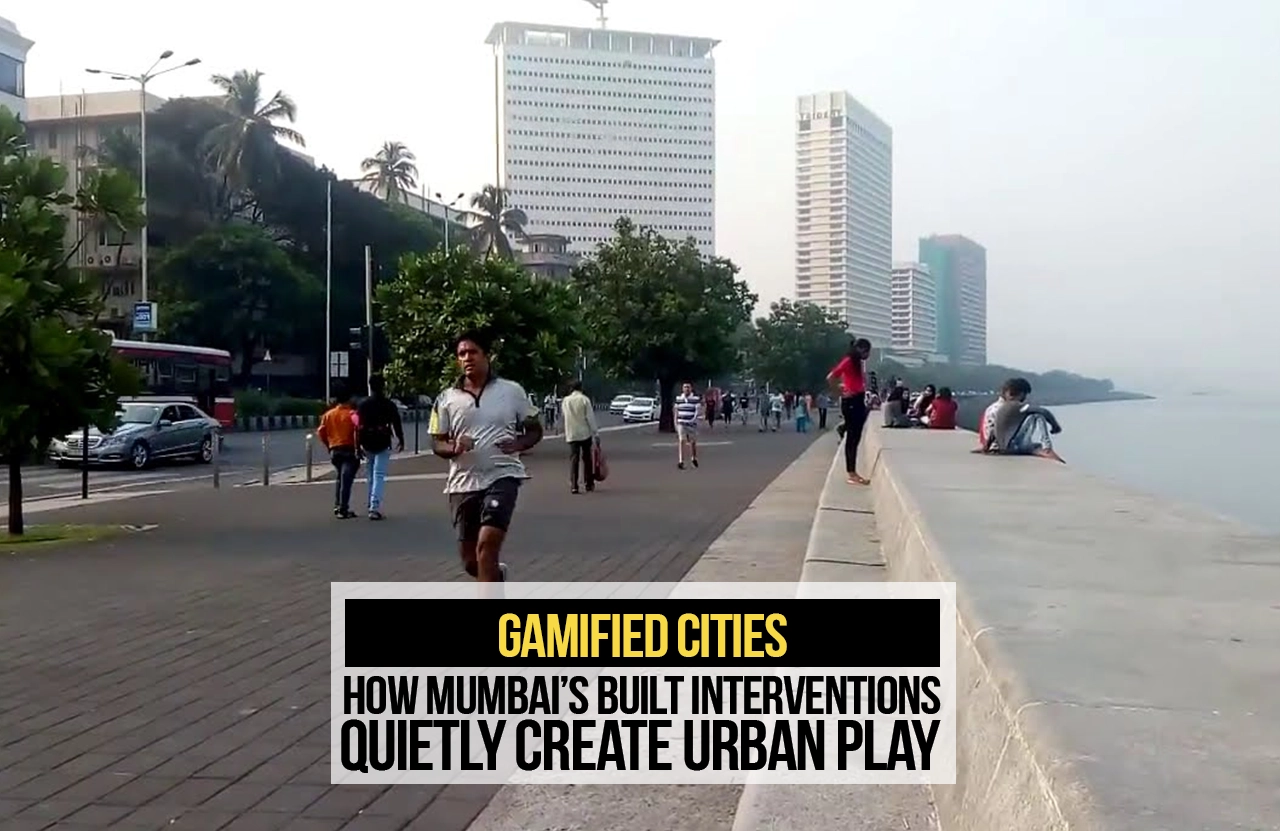
By observing how people actually use space, Mumbai reveals that play is not an add-on; it is a spatial instinct.
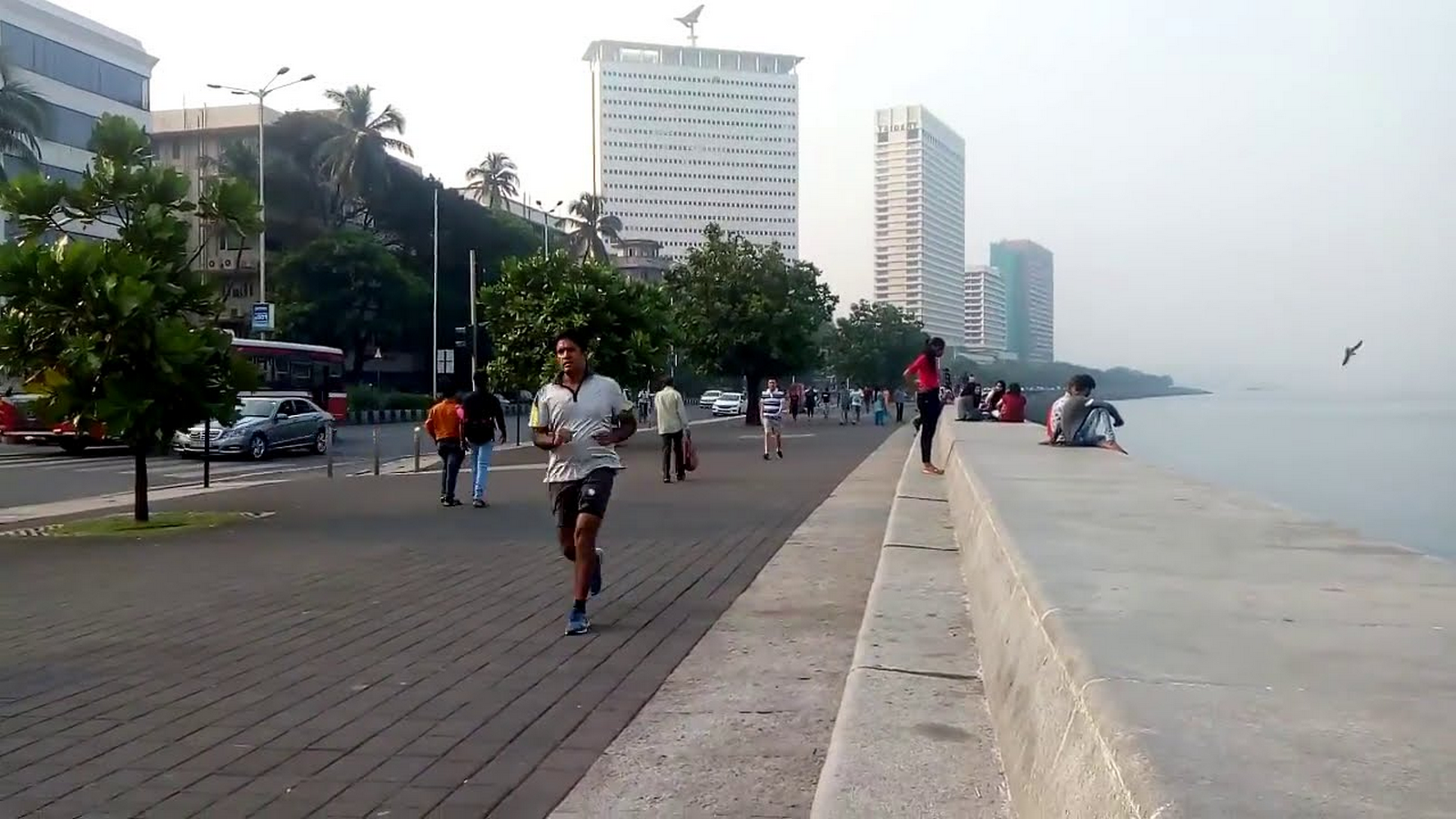
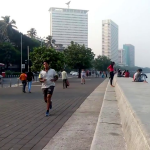
At first glance, Marine Drive at 6:40 AM is a fitness track. But watch closely: runners begin their sprint not anywhere, but precisely from Lamp Post 128 to Lamp Post 141. They know the distance by heart. These evenly spaced, repetitive poles behave like embedded level markers. The promenade’s geometry, straight line, low edge, open sea, becomes an accidental “game map”. This behaviour wasn’t designed. But Mumbai’s structure made it possible. Across the city, the same pattern repeats: the built environment quietly creates rules, sequences, rhythms, and Mumbaikars turn these into play, ritual, movement challenges, and navigation strategies. The city is already gamified; architecture simply sets the stage. And this becomes most visible in places where designers have intervened.
1. One Green Mile, Lower Parel – Turning Transit Infrastructure Into a Level Map
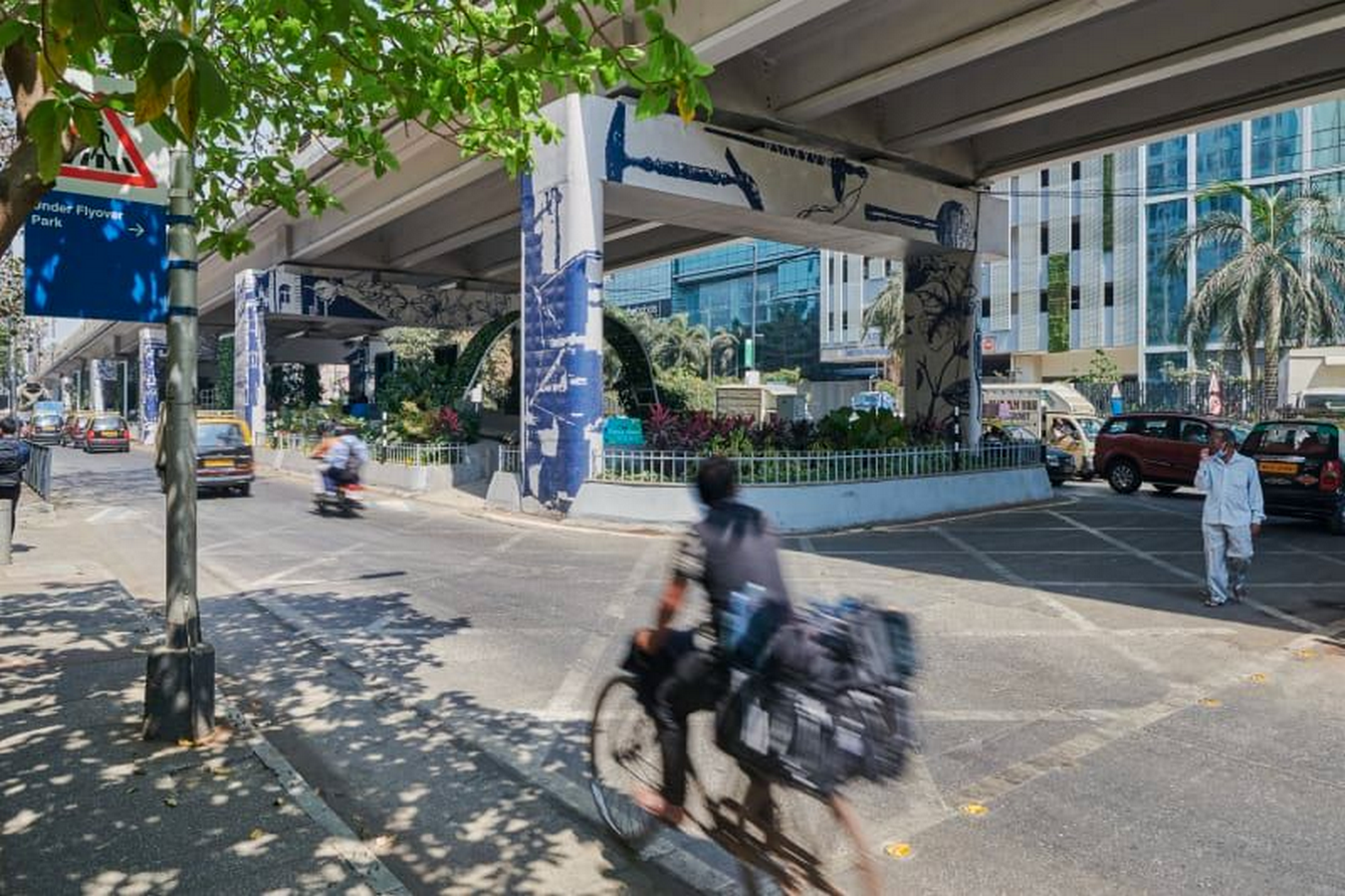
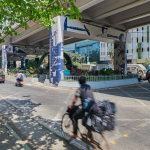
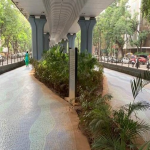
Under the flyover at Senapati Bapat Marg, what was once a dim, leftover space is now One Green Mile: a 1.8 km reimagined stretch designed by MVRDV and StudioPOD. Children don’t just walk here; they loop, dart, race. Adults drift into pockets of shade, treating the long spine as a continuous promenade. But what makes this truly gamified is not the beautification, it’s the clarity of spatial cues:
- Flyover columns create “checkpoints”.
- Painted lines and rubberised strips form “movement lanes”.
- Curved seating pods act like “rest nodes” between levels.
- Planting buffers offers soft boundaries to reduce risk.
This is the city teaching us that micro-programming + predictable geometry = emergent play.
-
Carter Road Promenade: Designing Edges That Invite Risk and Joy
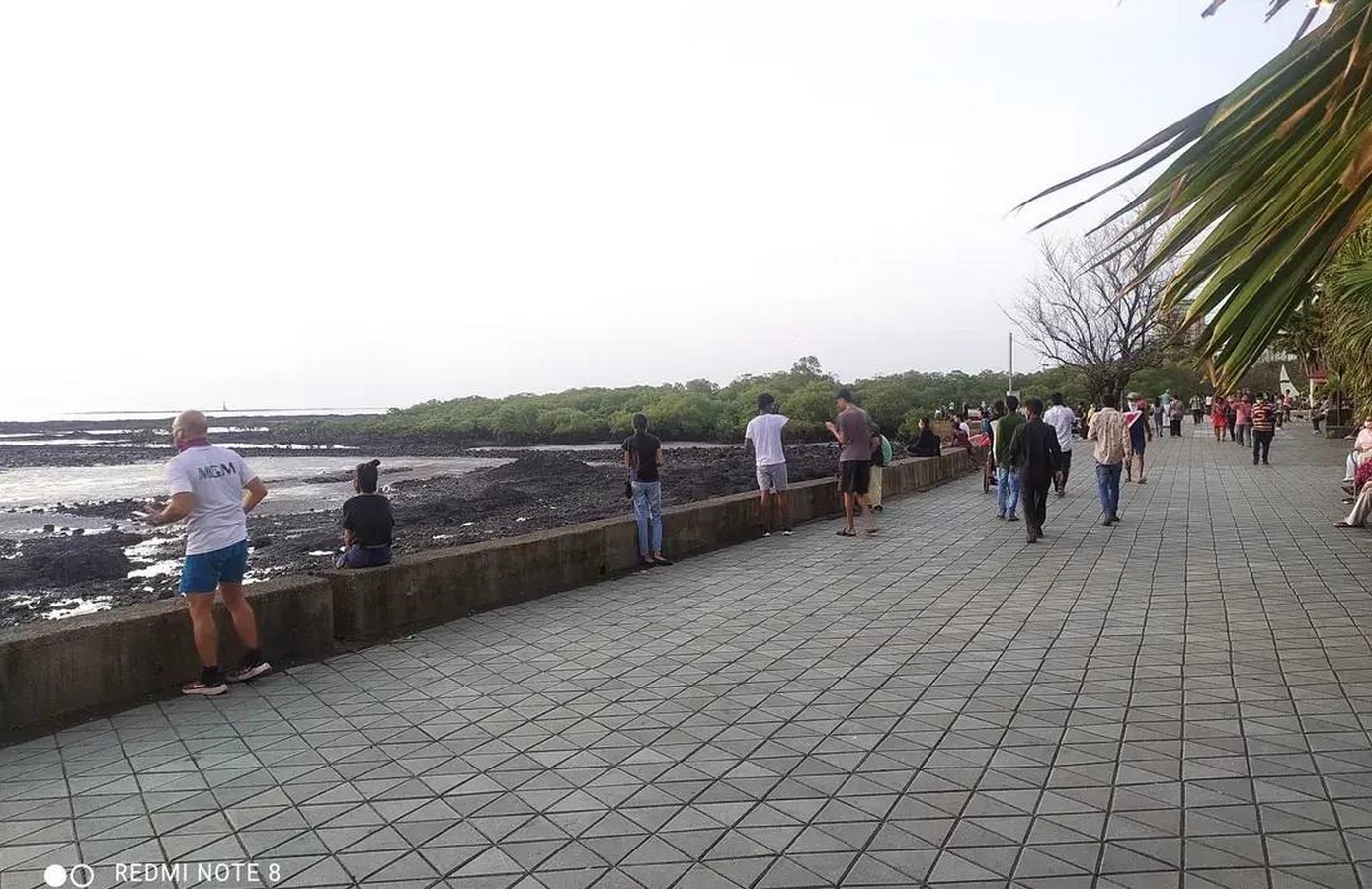
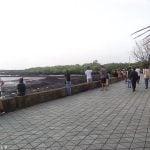
At Carter Road, teenagers use the low sea-facing wall as a balancing beam. It’s not a sanctioned playground, yet it functions like one because the architecture supports calibrated risk:
- Low enough to be safe.
- Straight enough for rhythm.
- Varied enough for a challenge.
The promenade’s design, with a wide pedestrian spine, accessible edges, and stepped seating, creates a movement corridor where people self-impose goals. Urban design didn’t place a game here, it enabled one.
-
St+art India Interventions: When Art Becomes Urban Gameplay
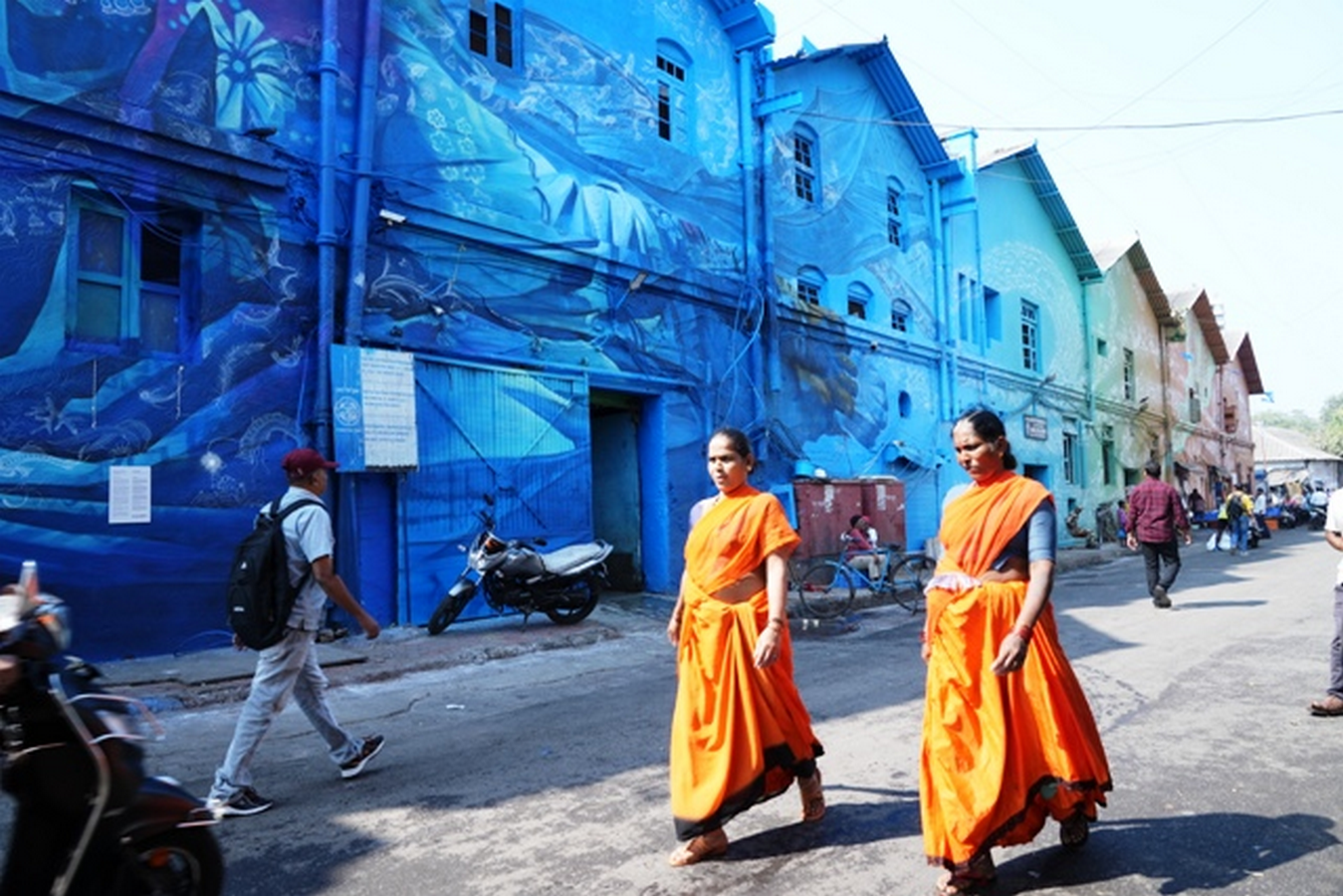
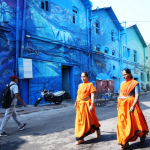
In Sassoon Dock, Mahim, Byculla and Bandra, St+art India’s murals do more than beautify. They invite interaction, search, movement:
- Hidden icons in murals → citizens hunt for details.
- Pavement graphics → children follow patterns like hopscotch.
- Art-wrapped alleys → people photograph specific sequences.
These are visual gameboards. They transform abandoned or unsafe lanes into culturally charged, participatory public spaces, without adding a single playground. The intervention proves that gamified cities don’t require tech. Colour and pattern can shift behaviour.
-
Matunga Under-Flyover Play Zone : When Shade + Safety = Instant Game
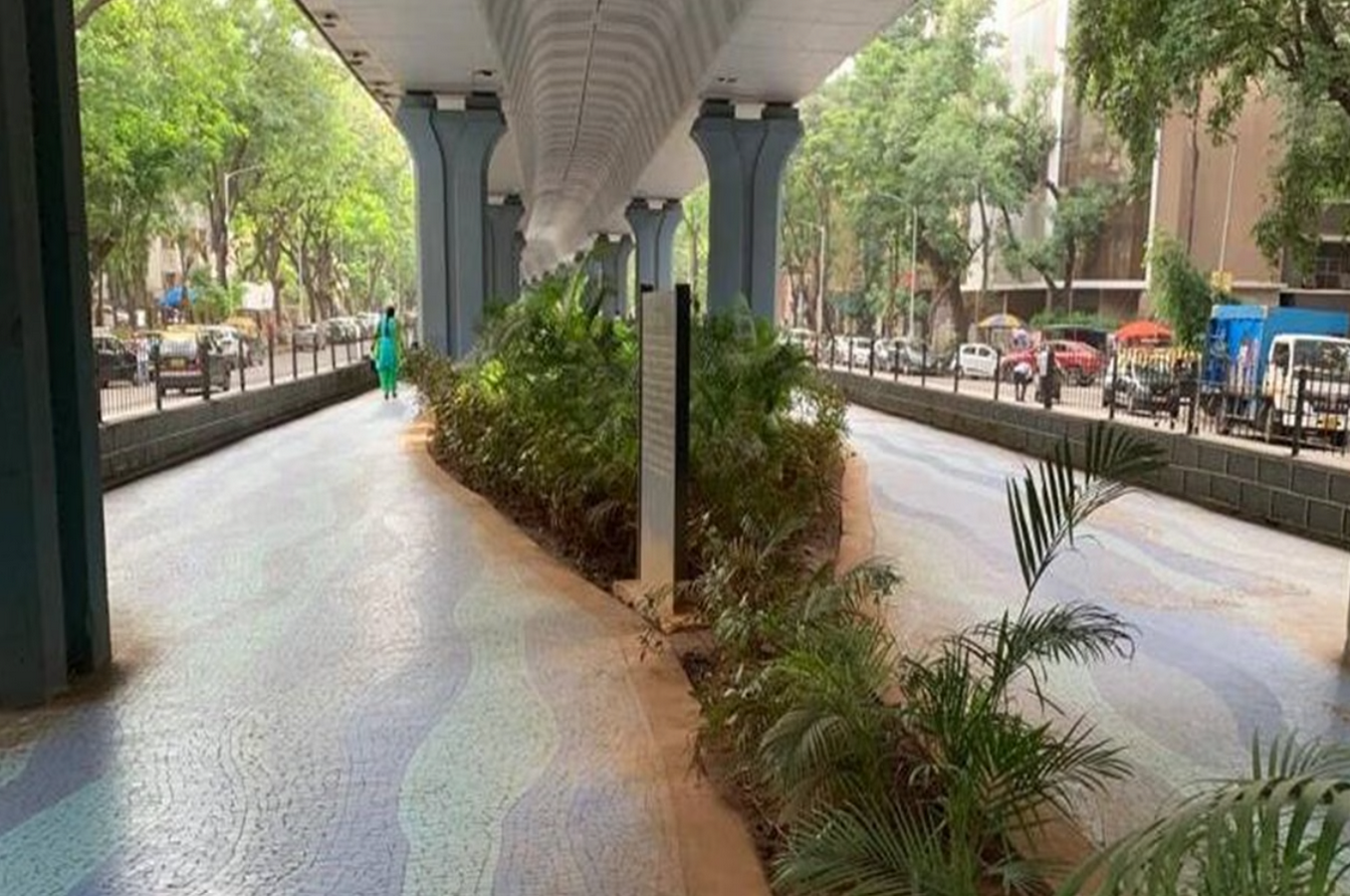
Near Five Gardens, simple surface markings – figure-8 loops, hopscotch paths, sprint lanes activate what was once an intimidating undercroft. This works because architecture provides the base conditions:
- Consistent shade.
- Strong perimeter definition.
- Clear sightlines for parents.
- Sound-dampening from surrounding greenery.
Children convert this into races, circuits, and role-based games. Adults use the edges for conversations and routines. This is micro-urbanism at its best: cheap to build, expensive in impact.
Mumbai Doesn’t Need to “Become” a Gamified City : It Already Behaves Like One
Between One Green Mile, Carter Road, St+art lanes, and Matunga under-flyover games, Mumbai shows that playful urbanism is not whimsical; it is deeply architectural:
- Predictable geometry → makes rules
- Vivid surface design → creates cues
- Consistent edges → create challenges
- Wider footpaths → birth social play
- Art → becomes interactive navigation
People convert everyday infrastructure into movement rituals, challenges, stories, social competitions.
So the planner’s task is not to propose play. It is to reveal it. To design knowing that Mumbai will gamify whatever it touches. To amplify what already exists, instead of importing new visions of “playable cities”. Because in Mumbai, the city is not a container. It is the first player.
Resources:
- MVRDV (n.d.). MVRDV – One Green Mile. [online] www.mvrdv.com. Available at: https://www.mvrdv.com/projects/787/one-green-mile.
- StudioPOD. (n.d.). Senapati Bapat Marg. [online] Available at: https://studiopoddesign.com/portfolio-item/one-green-mile/.
- Patel, A. (2022). Mumbai’s Neglected Space Beneath Flyover to be transformed Into A Community Space by MVRDV And StudioPOD. [online] RTF | Rethinking The Future. Available at: https://www.re-thinkingthefuture.com/architectural-news/a7651-mumbais-neglected-space-beneath-flyover-to-be-transformed-into-a-community-space-by-mvrdv-and-studiopod/ [Accessed 23 Nov. 2025].
- Sharma, S. (2023). The Mumbai Urban Art Festival 2022-2023 Was About Making Art Accessible And Inclusive. [online] Elle India. Available at: https://elle.in/mumbai-urban-art-festival/.
- philip (2023). Mumbai Urban Art Festival by St+art India – I Support Street Art. [online] I Support Street Art. Available at: https://www.isupportstreetart.com/mumbai-urban-art-festival-by-start-india/.
- URBAN DESIGN RESEARCH INSTITUTE. (n.d.). URBAN DESIGN RESEARCH INSTITUTE, MUMBAI. [online] Available at: https://www.udri.org/.