Marine Drive, often referred to as Queen’s Necklace, is a 3.6 km long, graceful curve of reclaimed land, where the city of Mumbai seems to pause, just for a moment. In this hustling city, this stretch of land is a living, breathing civic space that has grown with the city, and it continues to evolve even today. This historic urban edge, adjacent to the Art Deco precinct, plays a significant role in the city’s social life.
The Birth of Marine Drive
Before becoming a picturesque promenade, it was nothing but a stretch of sea. Bombay (now Mumbai), in the 20th century, was emerging as a commercial hub, which resulted the city to expand faster. This pushed the urban planners to think beyond the land and turn to the sea to make space. This emerged as the Back Bay Reclamation Scheme, an engineering marvel that eventually became Marine Drive. Although not born out of leisure, but out of necessity, the city has shaped the shoreline into a statement.

Architecture in Sync with the Sea
While not a traditional architectural structure, Marine Drive is a subtle arc that follows the sea, softening the city’s sharp edges. Looking from above, the layout forms a C shape, embracing the Arabian Sea. This curve justifies its famous nickname, Queen’s necklace, by looking like a string of pearls when streetlights are lit at night.
The double-lane road for vehicular transit in the center divides the promenade from the seaward shoreline to the soft, rhythmic Art Deco skyline. The promenade with no fences or barriers invites every individual from morning walkers to tourists. Even the concrete sea breakers, i.e., the tetrapods, have become an urban symbol. Today, where the city is growing vertically, the horizontal openness of Marine Drive feels like comfort, telling people to slow down in the city’s chaos.

Marine Drive’s Art Deco Facade
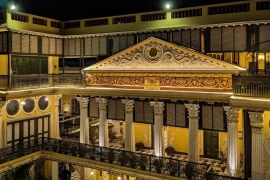
Marine Drive elevates from just a road to a heritage precinct, from the series of art deco buildings that form a background to the sea. The entire marine drive stretch houses the world’s largest art deco residential precincts, which were built between the 1930s to 1950s.
Sona Mahal, Kapur Mahal, and Zaver Mahal, built by Gujrati, Parsi, and Marwari families, narrate the story of Bombay’s global aspirations, when the city was imagining itself as a port metropolis. In 2018, this Art Deco precinct was recognized by UNESCO as part of the Victorian and Art Deco ensemble of Mumbai. Yet today, many facades are suffering from salt damage, illegal alterations, and back of structural maintenance, on which process of conservation has started.

The People’s Promenade
Beyond the urban design, Marine Drive is a living mosaic of Mumbai’s everyday humanity. In the morning, it becomes a joggers’ track, by noon, students and delivery riders take a break, letting the sea ease their mind, and in the golden hour, it transforms instantly where artists sketch, photographers wait for a picture-perfect frame, and influencers interact with the public. From yoga sessions, community performances, to street musicians jamming on Bollywood tunes, on weekends, the stretch transforms into a festival of life. People lean, sit, and lie on it using it as an urban bench, a place for introspection, romance, or community engagement.

Preserving the Curve with Care
Marine Drive doesn’t need any restoration; it needs to be taken care of. Its future lies in small design interventions that can respect both its historical significance and its charm. Shaded benches, universal design features, and interpretive signage are some of the small changes that can have a huge impact without disturbing its natural beauty. Conservation-led development for restoring the Art Deco buildings can bring back their long-lost beauty. Greener spaces, smart lighting, and better accessibility can make it more welcoming for everyone.

City’s edge, besides the sea
Marine Drive is a blend of architecture and nature where the city and the sea shake hands every day. The curve of this bay holds memories of laughter, love, and resilience. It is a reminder that public spaces can heal, connect, and inspire.
As Mumbai is growing vertically faster, Marine Drive shows a horizon where land ends and the sea beautifully begins. It connects people of all kinds, rich or poor, young or old, with one shared view of the endless sea. Mumbai, being the city that never sleeps, Marine Drive reminds one to pause, breathe, and take in the rhythm of the sea.
Citations:
Centre, U.W.H. (no date) Victorian Gothic and Art Deco ensembles of Mumbai, UNESCO World Heritage Centre. Available at: https://whc.unesco.org/en/list/1480 (Accessed: June 2025).
The making of marine drive – art deco (2023) Art Deco – Digital diarist showcasing Mumbai’s Art Deco. Available at: https://www.artdecomumbai.com/research/the-making-of-marine-drive/ (Accessed: June 2025).
Mallya, S. (2023) Pride of mumbai: Marine Drive, The Urban Anecdotes. Available at: https://www.the-urban-anecdotes.com/post/pride-of-mumbai-marine-drive (Accessed: June 2025).
Patil, G. (2017) On Marine Drive…, IES’s College of Architecture. Available at: https://www.ies.edu/architecture/2017/08/19/on-marin-drive/ (Accessed: June 2025).