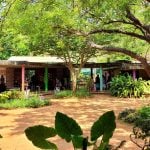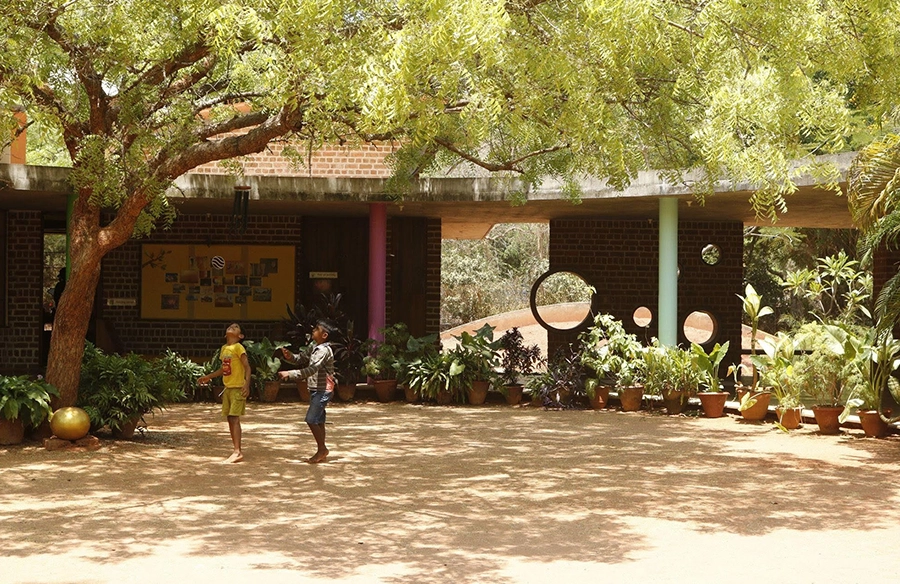
Designing spaces for children calls for special care. Instead of just offering shelter or a place to learn, architecture influences how children grow, explore, and develop. Most schools are just neutral settings for teaching, but Nandanam Kindergarten goes further. Here, the environment itself plays an active role in a child’s development.
Nandanam Kindergarten is located in Auroville, Tamil Nadu. PATH Architects and Planners, led by Shailaja Sudhalkar Bhati and Lalit Kishor Bhati, designed the school for children between 2.5 and 6.5 years old. More than a typical school, it is an environment shaped by a thoughtful view of childhood. The design draws from Integral Education, a concept by Sri Aurobindo and The Mother, which sees education as developing the whole person, not just teaching facts.
Instead of relying on isolated design features, Nandanam achieves its effect through the holistic atmosphere it creates. The calm, open space is attuned to children’s movement and observation. Rather than conforming to institutional norms, the building becomes an extension of the landscape, reinforcing the project’s core argument: space itself shapes educational experience.
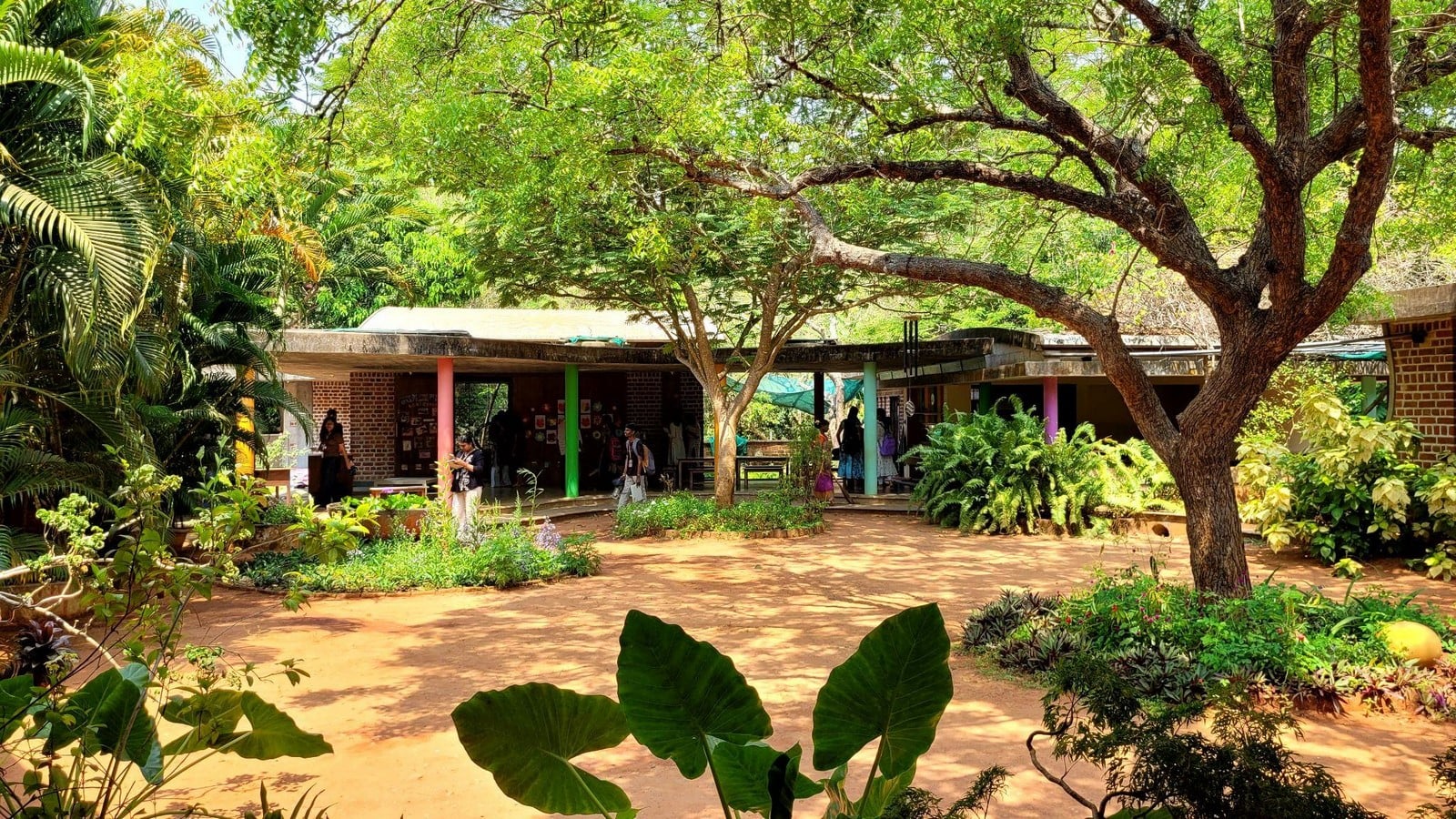
Integral Education understands the learning potential that the environment holds, along with formal teaching techniques. Curiosity is shaped by such aspects as space, light, textures, and nature. The Nandanam Kindergarten brings the concept of Integral Education into its architecture in a most impressive manner.
There is nothing forced and rigid in the building. There are no long corridors or repetitive classrooms. Spaces flow into each other; there are no harsh transitions but gentle thresholds. Children are encouraged to explore their environment freely and spontaneously.
Conscious design takes on a special meaning in such circumstances. It is not only about aesthetics or sustainability. Rather, it is about understanding the impact that architecture can have on behavior, emotions, and relationships. In Nandanam, the building has been designed with an understanding that space can nurture confidence and independence.
The Neem Tree as the Heart of the School
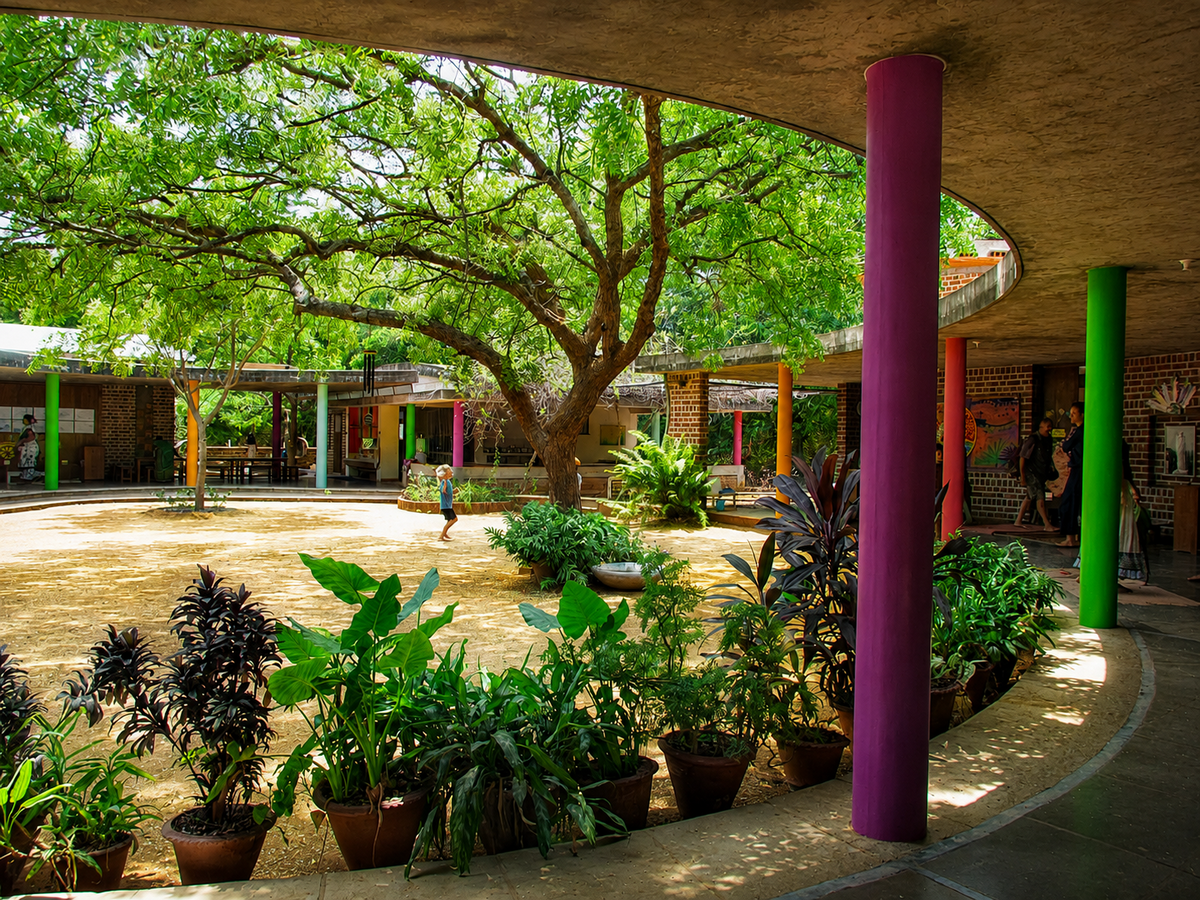
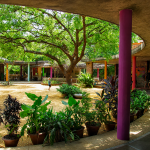
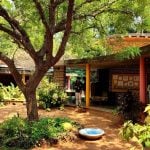
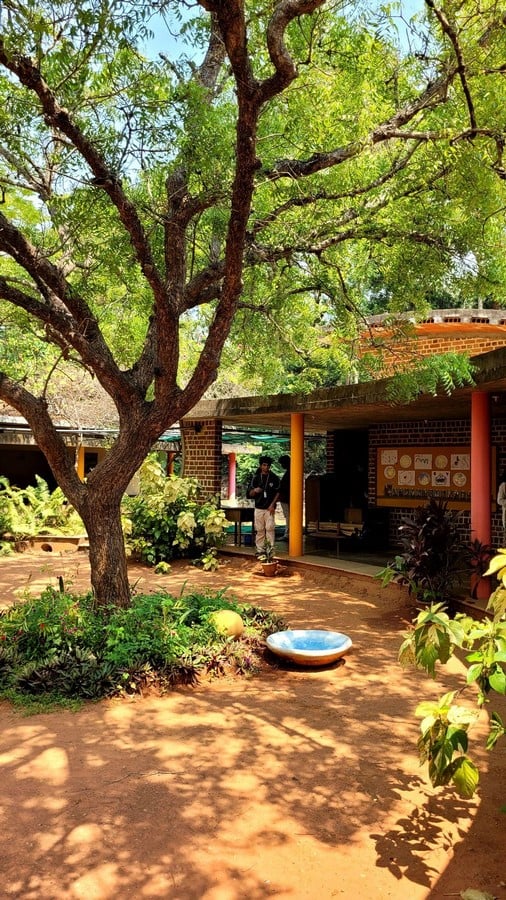
Another unique feature of Nandanam Kindergarten is the fact that the kindergarten revolves around the existing neem tree on site. Instead of clearing the tree and making the design simpler, the designers decided to use the tree as the focal point of the design. The courtyard built around the tree acts as a meeting place as well as a constant reminder of the relationship of the kindergarten with nature.
The fact that the design of the kindergarten revolves around the existing tree tells us a lot about the philosophy behind the design. Unlike other designs that take control of their sites, the site here takes control of the design. The children will see and feel the presence of the tree whether they are in classrooms or outside.
In practical terms, the courtyard makes ventilation and daylight easier to achieve. In a philosophical sense, it gives the feeling of being rooted. Nature here is not taught separately but within the context of the school’s center.
A Building That Feels Like a Playmate
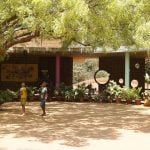
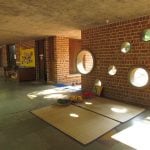
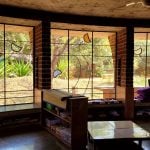
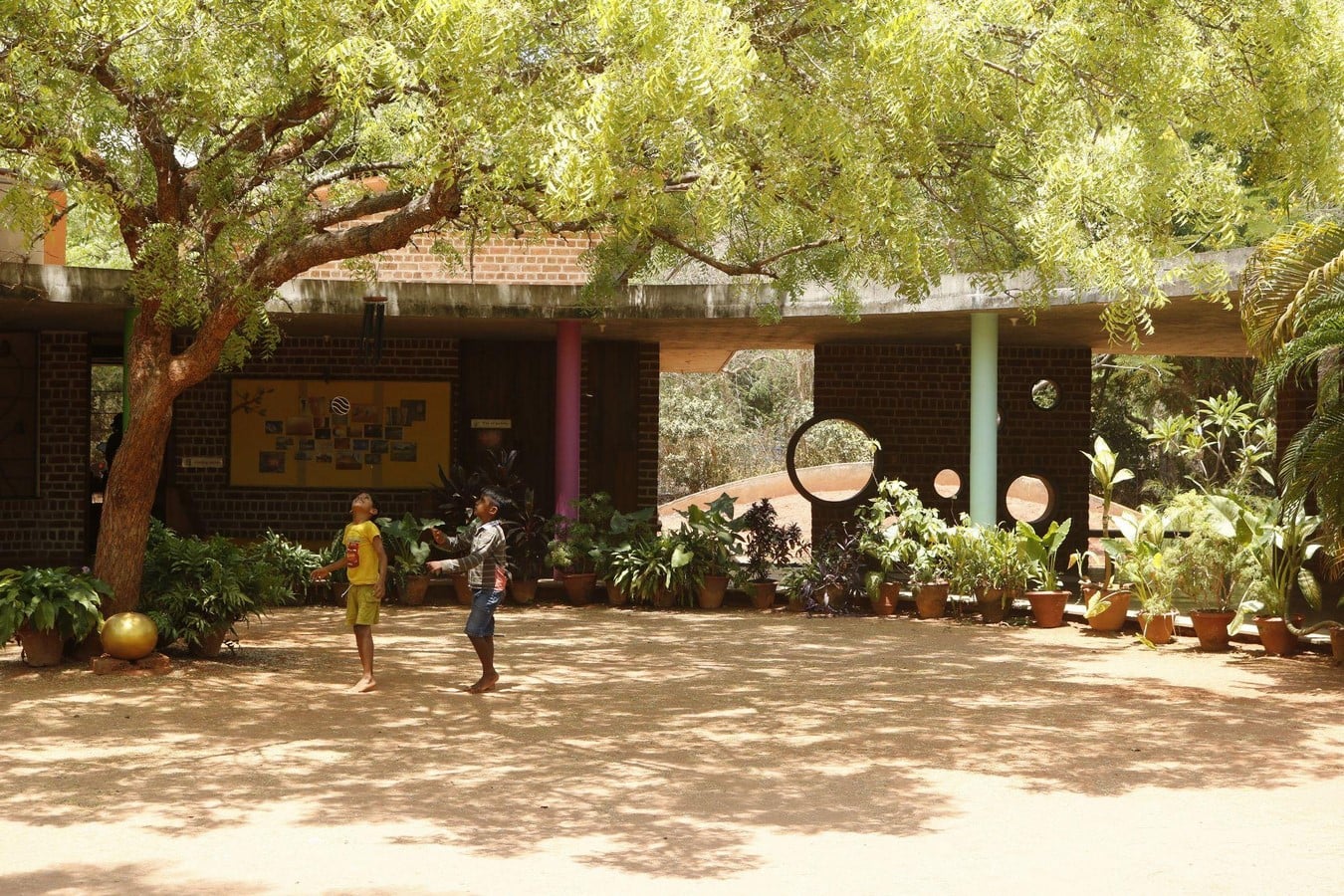
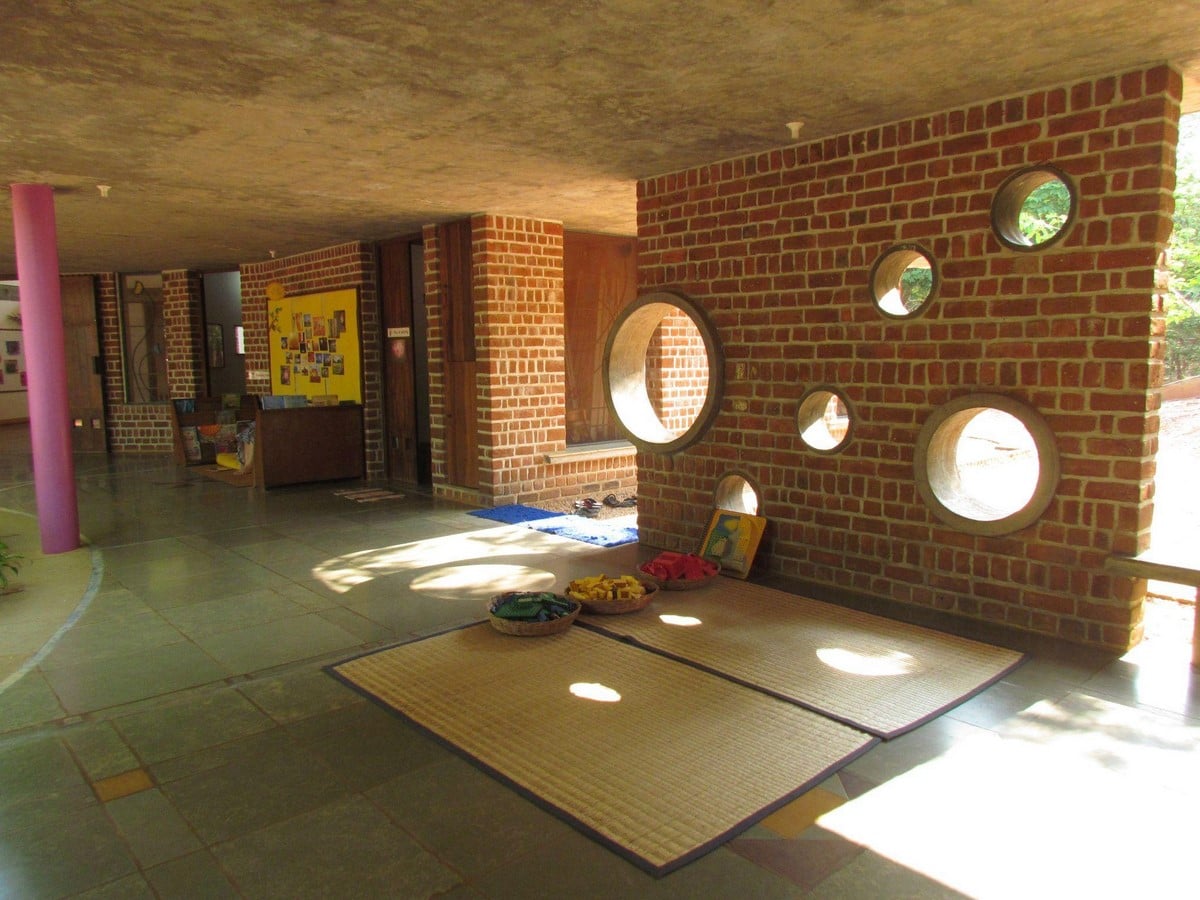
The architecture of the project can be considered a “playmate,” and it seems very relevant to the description. The architecture gives the children hints and opportunities, but does not give directions. Circular openings in the walls reveal surprising landscapes. Low windows provide easy access for looking out for kids. Curved walls direct movement, but do not dictate it.
It seems that everything has been made on the scale of the child. The school architecture lacks the rigidity usually seen in institutions. Instead of trying to force children to behave properly through geometry, the architecture creates a friendly and explorative environment.
This feature is hard to quantify, but easy to notice. Kids are not just accommodated, but understood.
Materials That Invite Touch
The choice of materials plays an important role in shaping the identity of the school. The exposed brickwork adds a warm and tactile feel to the structure, and the use of natural materials avoids the clinical nature of many educational spaces. The surfaces are strong yet inviting.
Young children experience materials in a tactile way before they become intellectual. Rough brickwork, cold floors, diffused lighting, and shaded courtyards make up a tactile and sensory experience. This building can be deciphered not only with the eyes but also with the touch.
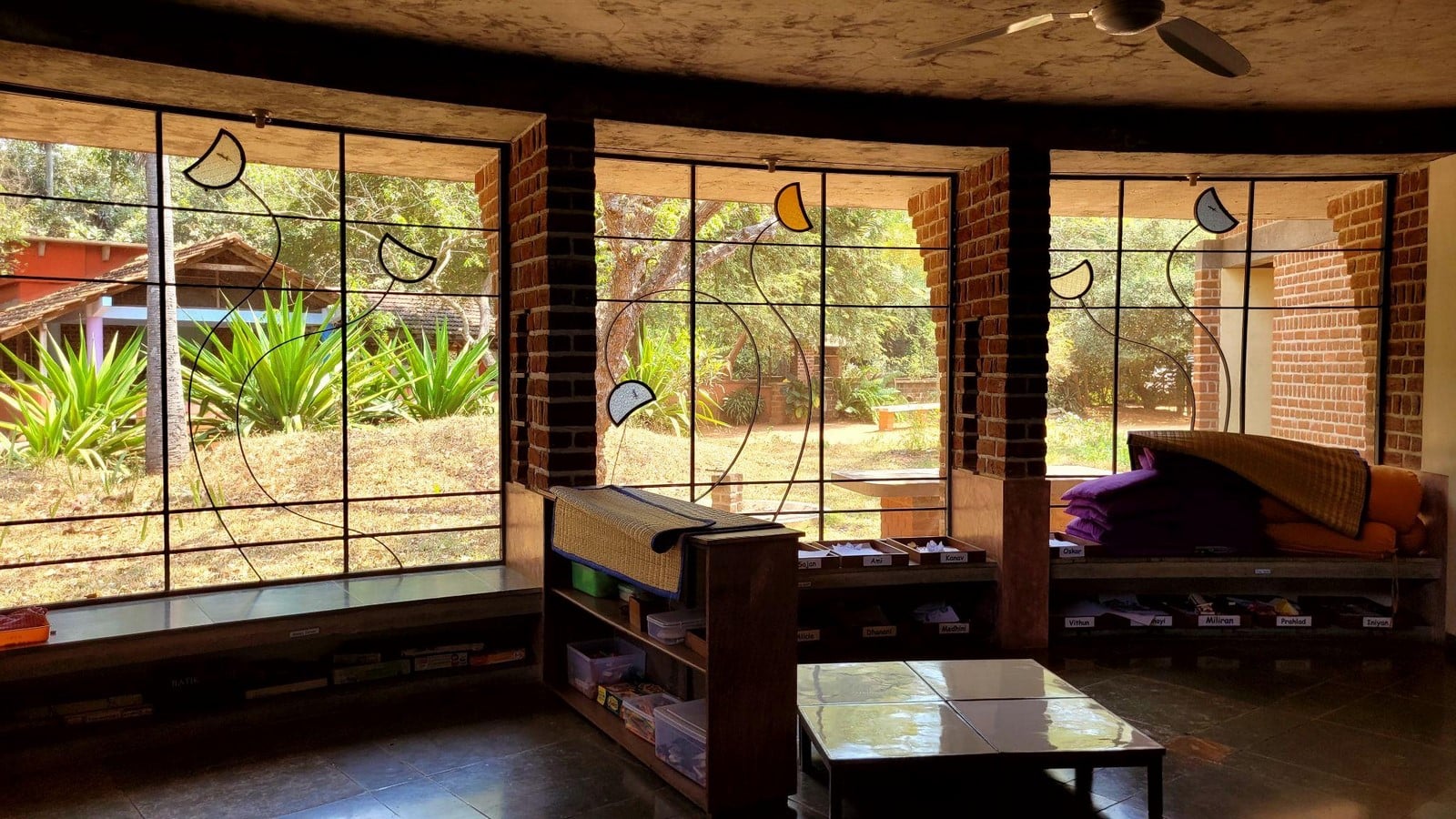
The concept is reminiscent of the book Eyes of the Skin by Juhani Pallasmaa, who believes that meaningful architecture is not limited to the eye but includes all other senses. The Nandanam Kindergarten successfully demonstrates such architecture in practice.
Construction as Part of the Architectural Expression
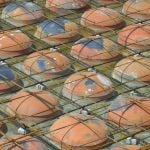
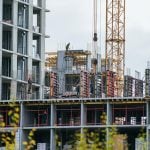
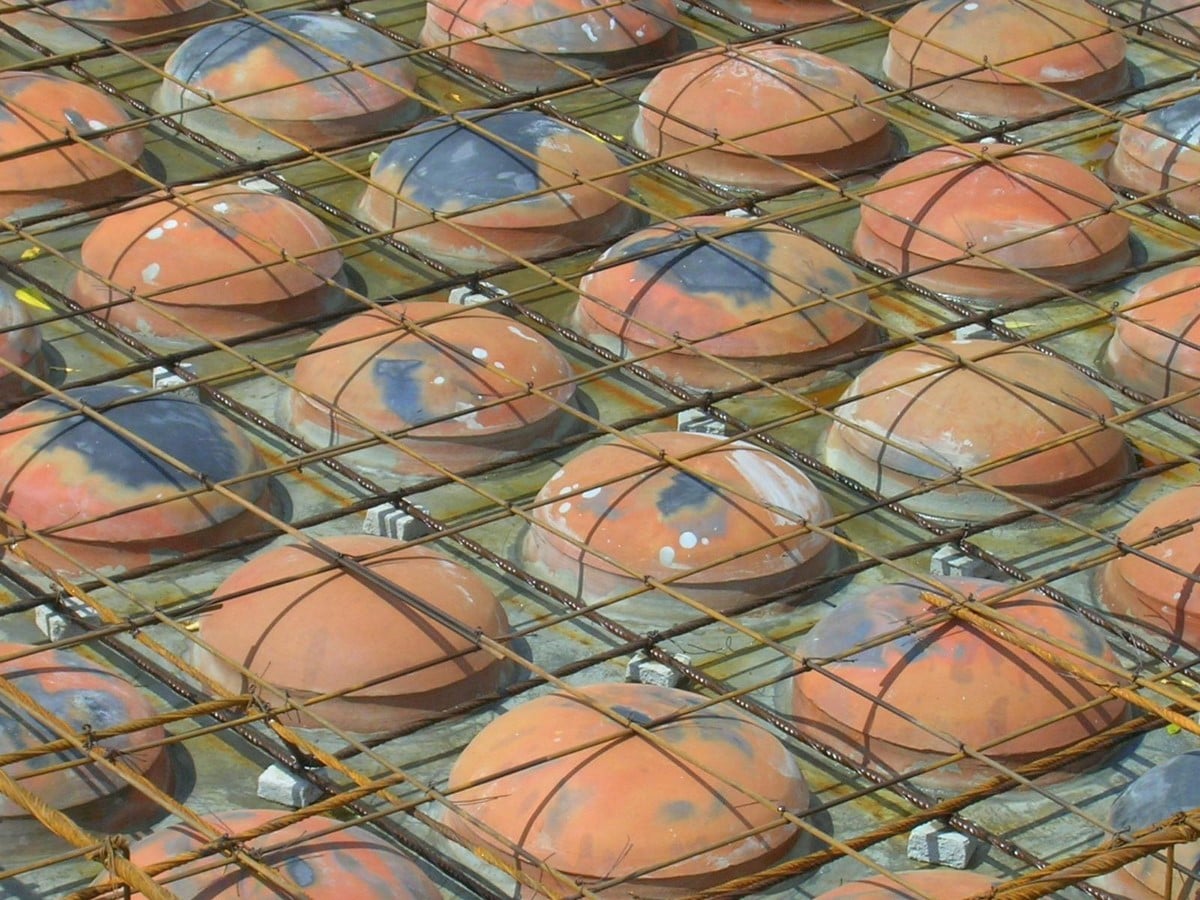
Construction techniques employed in the project are both pragmatic and expressive. As seen in the pictures, the building makes use of brick masonry, steel trusses, block roof, and filler slab construction techniques. This construction technique reduces material requirements while increasing thermal efficiency.
The most attractive aspect of the building is its legibility. The building does not hide its construction methods. It expresses its roof systems, masonry, and openings. There is honesty in the architectural language used, something which is becoming increasingly rare.
Legibility is especially fitting for a school building. Without being explicitly told, one finds oneself in a building whose construction method is evident to them.
Sustainability as an Everyday Experience
The Nandanam Kindergarten is sustainable from an environmental perspective, although this is not very apparent. There are no obvious signs of technological sustainability. The building uses passive design principles such as shaded courtyards, natural ventilation, lighting, and materials suited to the local context.
It is the subtlety of the approach that makes it attractive. The children grow up amidst environments that have been linked to the tree, weather, and natural materials. Sustainability is thus learned in a subtle manner.
This way, the building sustains sustainability without necessarily naming it.
More Than a School
While many school buildings function effectively without making much of an emotional impact, the Nandanam Kindergarten creates a different impression. There is a feeling of delicacy and thoughtfulness that cannot be separated from its educational mission.
The project shows how architecture goes beyond providing a place for education and actually helps to create conditions under which education can take place. Through creating an environment based on the concepts of Integral Education, the building ensures the development of both cognitive and sensory skills as well as respect for nature.
The Nandanam Kindergarten serves as a great case study on how architecture, learning, and environmental stewardship can be integrated into one project through design. The use of curvilinear forms, scaled spaces, tactile surfaces, and a courtyard, all speak of an underlying design ethos.
However, more importantly, the building proves that good design doesn’t necessarily have to be complicated or spectacular. Good design is about paying close attention to human experience, especially children’s experience. As such, the Nandanam Kindergarten illustrates how architecture can take on the role of an instructor, teaching children how to understand and appreciate the built environment.
References:
Auroville (n.d.) Education in Auroville and Integral Education. Available at: https://auroville.org/page/integral-education
PATH Architects and Planners (2014) Nandanam Kindergarten, Auroville. Project documentation: https://pathstudio.auroville.org/nandanamkindergarten
Juhani Pallasmaa (2012) The Eyes of the Skin: Architecture and the Senses. 3rd edn. Chichester: https://www.wiley.com/en-in/The+Eyes+of+the+Skin%3A+Architecture+and+the+Senses%2C+4th+Edition-p-9781394200689
RTF | Rethinking The Future (n.d.) Nandanam Kindergarten / PATH Architects and Planners. Available at: https://www.re-thinkingthefuture.com/gada-2018-winners/nandanam-kindergarten-path-architects-planners/ (Accessed: 18 May 2026)