A Landmark in Architectural Documentation
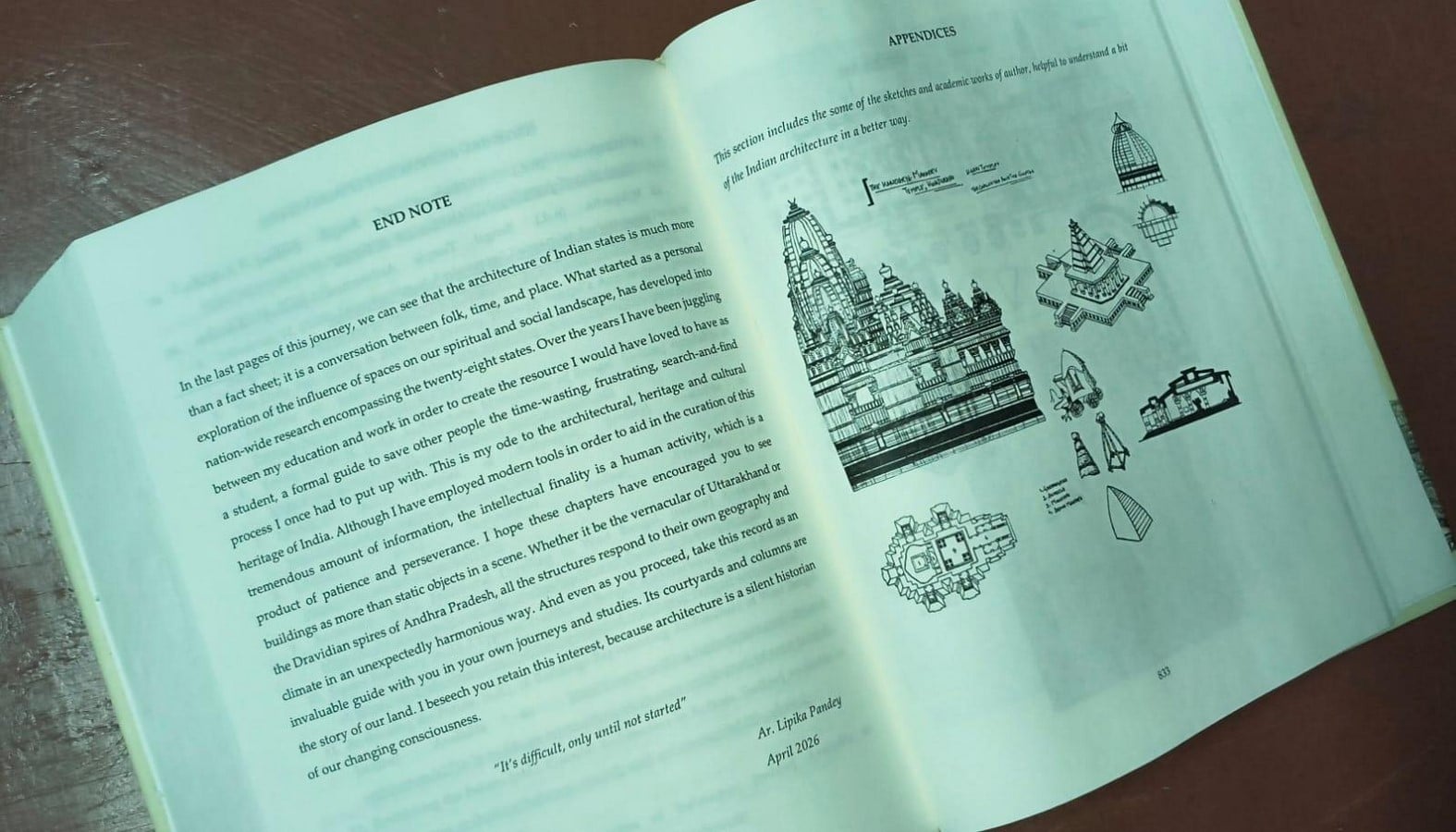
There are books that inform, and then there are books that fill a void. ARCHINDIA: Architecture of Indian States by Ar. Lipika Pandey belongs unmistakably to the second category. At 847 pages spanning all 28 states of India, this is not merely a book it is a reckoning. It is the exhaustive, cohesive, deeply personal reference that every architecture student in India has quietly wished existed but never quite found on any bookshelf.
Lipika is an architect and writer, committed to exploring the relationship between design, human experience, and culture. Her passion for architecture and quest to understand how spaces affect the social, artistic, and spiritual fabric of India has driven her to complete her graduation in architecture as a gold medalist, begin her professional journey, and then pursue a master’s in planning. With time, she has blended architectural practice with research, writing, and documentation, holding firm to the conviction that architecture is not limited to form or function alone. It is a living dialogue between folk, time, and place.
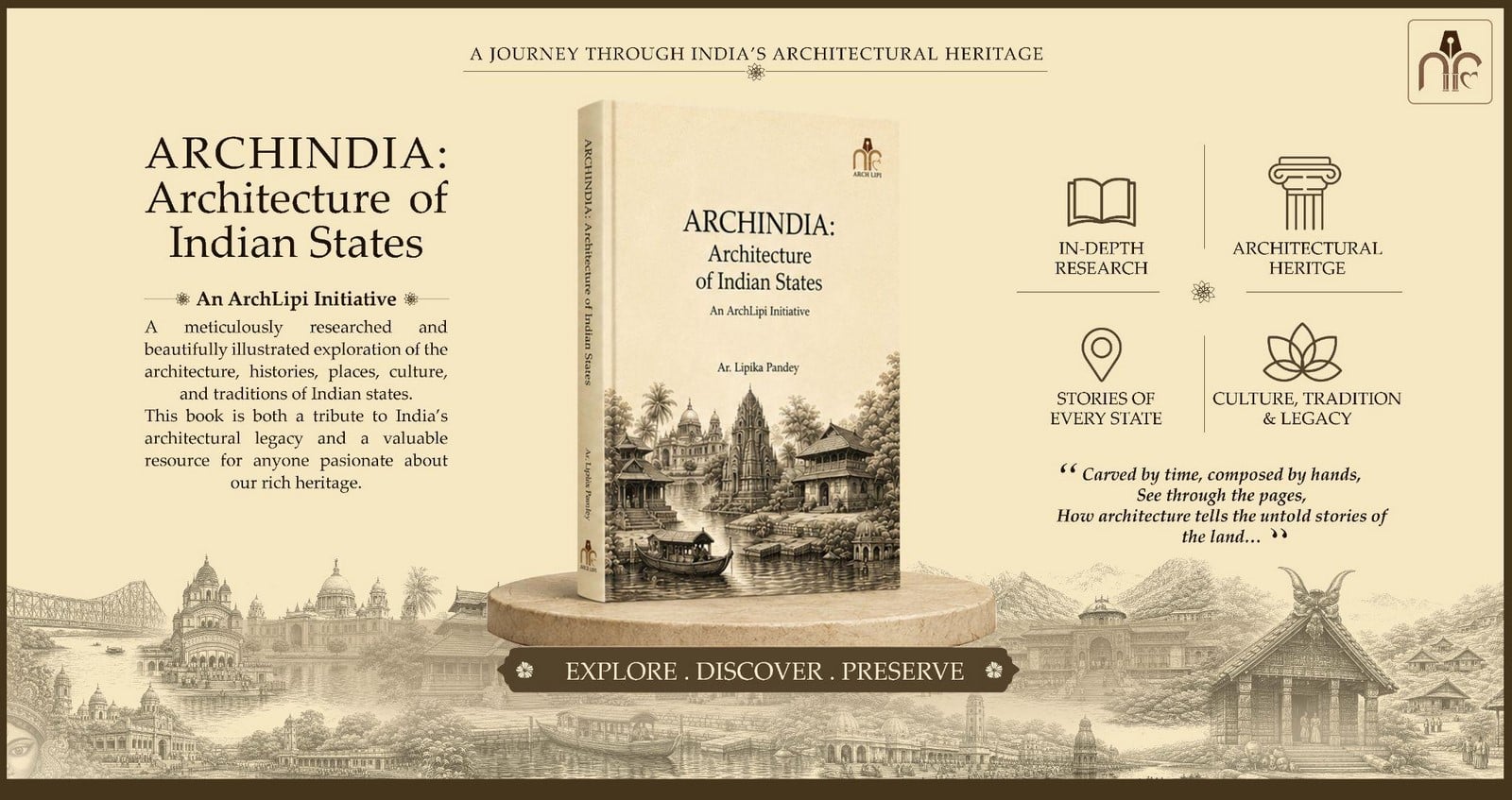
Her initial blogging website, Echoes of Edifice and then ArchLipi, began as a personal project to explore the works of various architects and the regional architecture of India. It gradually transformed into a nationwide study, resulting in the series The Architecture of Indian States. It took more than three years, juggling study and work simultaneously, to complete articles covering the architecture of all 28 states. Along with in-depth research, her writing weaves together travel experiences and personal reflections, combining professional pursuit with cultural connection and serving as a guide for anyone interested in architecture and travel.
From the first page, ARCHINDIA reads not as the work of a distant academic, but as a labour of love by someone who has stood where students stand, frustrated, under-resourced, and hungry for a single authoritative guide that could map the full landscape of India’s built heritage.
“You have made an immense contribution to the documentation of architecture of India, by authoring this book. It is commendable that you pulled it off alongside your academic programme”. – Ar. R.D. Padmakumar from COSTFORD, Kerala.
The Gap This Book Fills
Let us begin with the honest problem Lipika identifies in her own preface. For years, architecture students across India have cobbled together knowledge of regional traditions from scattered blogs, incomplete textbooks, and unreliable online sources. The architecture of Arunachal Pradesh and Manipur has rarely received the same depth of treatment as Rajasthan’s havelis or Tamil Nadu’s Dravidian temples. This imbalance has quietly distorted how a generation of architects understands their own country.
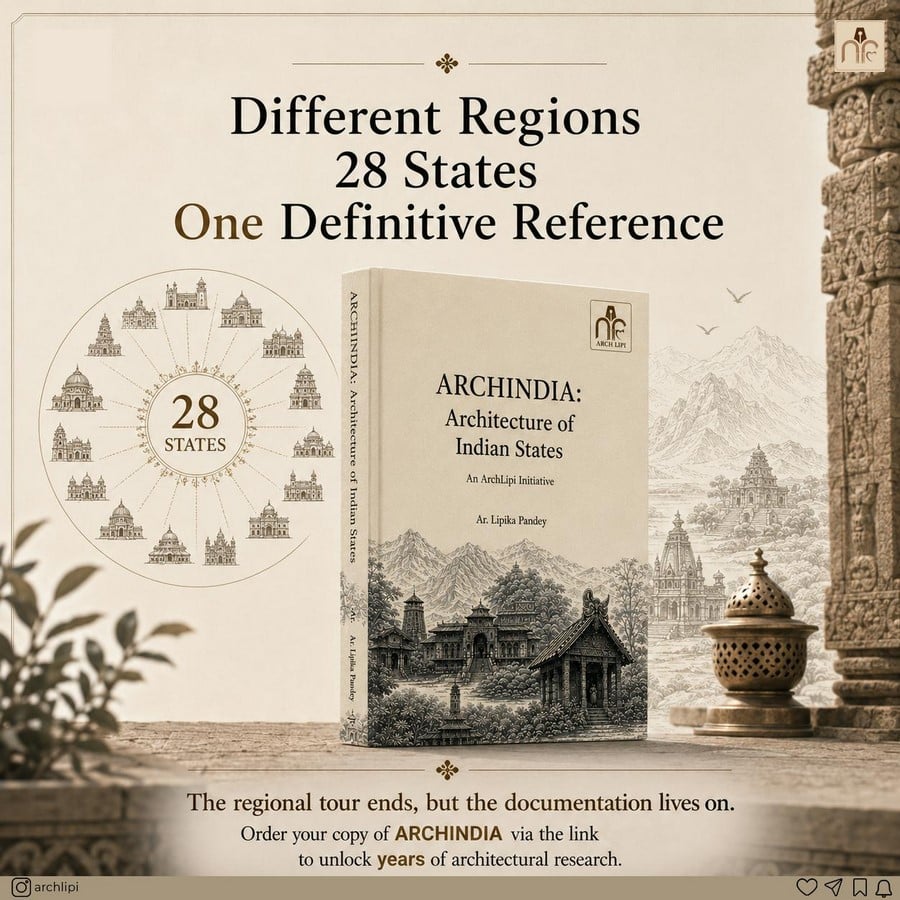
ARCHINDIA corrects that imbalance with quiet authority. Over 4.5 years of research, writing, and revision juggled alongside her studies and professional practice The author has assembled a 28-chapter compendium that gives each Indian state its due. From the Chalukyan and Vijayanagara influences of Andhra Pradesh to the colonial-tropical layering of Goa, from the Buddhist monasteries of Sikkim to the tribal dwellings of Nagaland, each chapter follows a consistent and intelligent framework: vernacular housing, temple or sacred architecture, climate-responsive design logic, city-specific studies, and places of architectural significance.
As her professor, Dr. Ajay Kumar (ITPI, Bihar Chapter), observes in the foreword, Lipika’s work is “a rare attempt to bridge fragmented studies into a cohesive narrative,” one that “provides a formal benchmark for the next generation, reminding us that our built heritage is a living dialogue between geography, climate, and culture.” He is right. This book does not just document; it contextualises.
The Vernacular Logic at Its Best
The chapters on Himachal Pradesh and Meghalaya alone are worth the price of the book. Lipika’s treatment of Kath Kuni the traditional timber and stone interlocking construction system of Himachal, whose very name derives from the Sanskrit kashth (wood) and kona (corner) is among the finest available in accessible literature. She demonstrates with precision how this centuries-old technique produces structures that are not only climatically intelligent but seismically resilient, a fact that should give every contemporary architect pause.
Similarly, her exploration of the Living Root Bridges of Meghalaya transcends the merely descriptive. These are not curiosities for tourist brochures; they are sophisticated, living infrastructure engineered across generations using the roots of the Ficus elastica tree that embody principles of organic growth, community maintenance, and bio-integration that modern sustainable design is only beginning to articulate. Internationally acclaimed architect Kengo Kuma, who reviewed the manuscript, describes ARCHINDIA as “the essential guide that the next generation of architects has long been waiting for.” Reading these chapters, one understands exactly why.
For students of sustainable design, climate-responsive architecture, or vernacular studies, these sections alone make the book an indispensable academic resource.
A Personal Voice That Elevates the Work
What distinguishes ARCHINDIA from a standard reference manual is its voice. Tucked within these pages is a travelogue, a deliberate, personal gift to the reader in which the author moves from observer to experiencer, reminding us that architecture is not a static object to be catalogued but a living encounter between a body, a space, and a culture. This is a brave editorial choice, and it pays off. The travelogue section gives the book emotional texture and reminds both students and professionals that their discipline is ultimately a human one.
The author writes in her preface: “Each chapter has its own story, born with patience, spending hours of research online.” That patience is palpable on every page. The writing is neither dry nor overwrought; it sits in the rare register of the knowledgeable guide who genuinely wants you to understand and, more importantly, to feel what they have discovered.
Why Every Architect and Designer Must Own This Book
For students of architecture and design, ARCHINDIA is the all-in-one companion that the curriculum has long failed to provide. Whether preparing for thesis research, GATE examinations, or simply trying to understand India’s regional diversity before beginning a project brief, this book is the single authoritative starting point. No more patchwork of internet searches. No more relying on sources of uncertain provenance.
For working professionals, the book serves as both a reminder and a resource. In an era where architectural practice is increasingly globalised and aesthetics are becoming dangerously homogeneous, ARCHINDIA grounds the reader in the intelligence of local material cultures. It is a call to look inward at our own soils, climates, and communities before reaching outward for borrowed solutions.
For educators and researchers, it represents a benchmark of documented knowledge against which future studies can be measured and from which new investigations can depart.
A Final Word
ARCHINDIA is not a perfect book no first edition of this scale ever is. But its ambition is extraordinary, its research is diligent, and its intent is irreproachable. Ar. Lipika Pandey has given Indian architecture something it has long deserved: a comprehensive, accessible, and deeply felt record of its own magnificent diversity.
Buy it. Mark its pages. Return to it often.
The published book can be found here: https://store.pothi.com/search/?q=Lipika%20Pandey