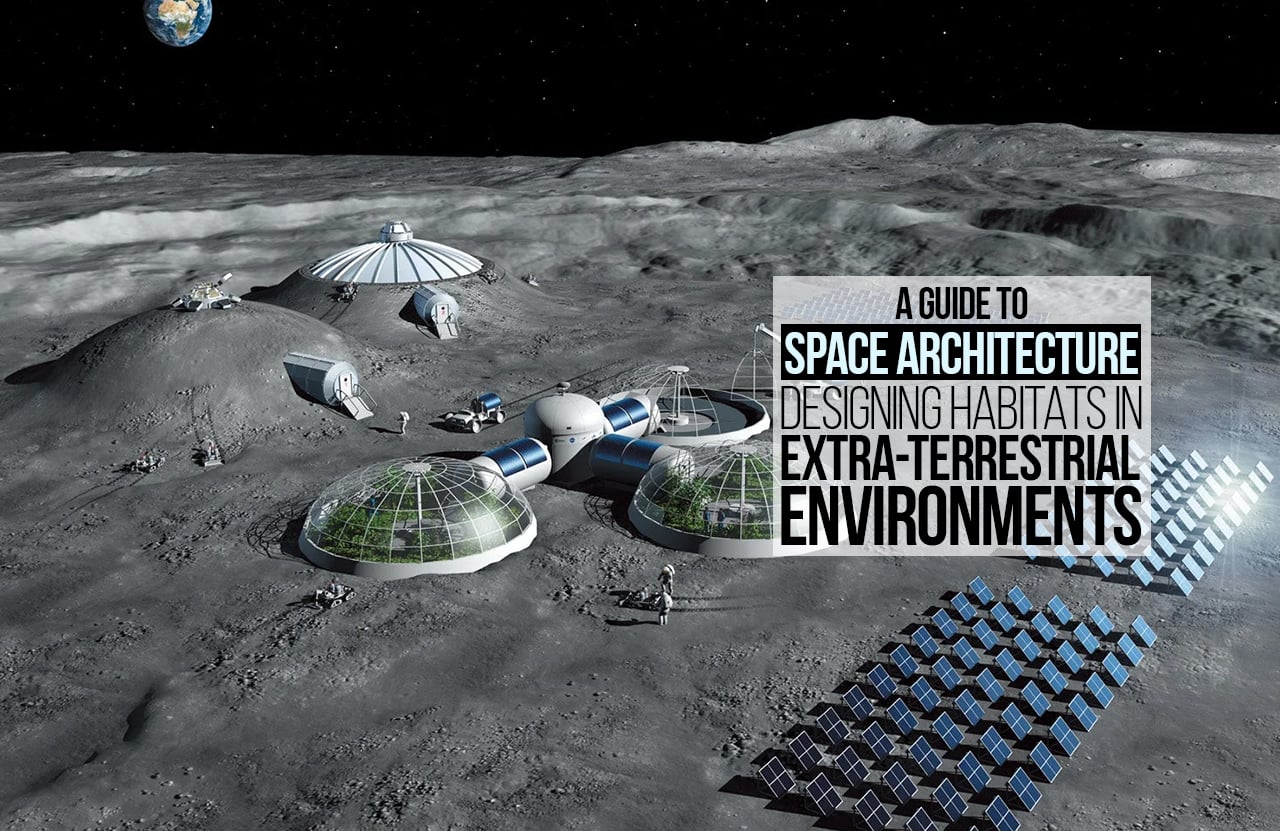
Space architecture is defined as the design and construction of habitable environments in outer space or based on other celestial bodies. Unlike architecture on Earth, it corresponds to extreme conditions, life-support systems, human factors and materials and technologies. Space habitation exploration has never been a new concept for humanity, even before Apollo’s landing on Moon. Literature has seen multiple examples of this speculative approach in books such as “De la Terre à la Lune” by Jules Verne or even the famous space opera, Star Wars. Post-1960s this interest in space exploration has only increased in reaching the parts of space that are temporally accessible for humans.
From Moon to Mars, the stays in space only become longer, as we move to gradual planetary exploration. This exploration is novel in nature as we would be “implementing unprecedented innovations in unforeseen scenarios.” (Netti & Bannova, 2021). Space architecture is a method to investigate how our everyday architecture on Earth is changed and shaped when placed in foreign environments with existential constraints far different than what are experienced here.
To tackle a discipline that is so integrated with other sciences, it is imperative that a framework is utilized to impart considerations and build a criterion. Space architecture is goal-oriented and specifically depends on the individual mission requirements and type.

Why Has Space Architecture Become So Popular?
Ever since the Moon’s landing in 1969, the idea of constructing human habitat in outer space has only gained more traction as the thought of humans in extra-terrestrial environments has been becoming a ground reality. Space organizations and enterprises have been looking towards these exponential leaps in exploration and human technological development as opportunities. As we stand at the threshold of broadening these horizons, the question of how humans will survive and more than that, thrive in these conditions becomes increasingly relevant. This brings in the new perceived field in architecture looking into conjectural methods that bring in the practical possibility of tomorrow. Space architecture becomes more than an answer to the query of how humans will build in space, it brings into discussion the adaptability and resource utilization, information that can further be implemented back on Earth.
Categories of Space Architecture:
How space architecture will be rationalized depends on which category it is catering to. “To design for space, we need to start with defining the goal of our travel because a short explorative trip or a self-sustainable surface colony requires very different design approaches.” (Netti & Bannova, 2021) Since the settlement is being made for humans, whose natural habitat is Earth, what is a most relevant and important consideration is how far away from Earth are they being taken because that has the equal opportunity of influencing the settlement. These categories are identified depending on either what kind of gravity they are responding to (the control group for this is Earth; the standard) or what kind of built human response will be seen. So, for instance, categories for gravity could be:
- Orbital infrastructures (microgravity)
- Interplanetary spacecrafts (zero or microgravity)
- Planetary architecture (partial gravity)
(Netti & Bannova, 2021)
Orbital Infrastructures
Since November 2, 2000, there have always been humans in space because of the continuous presence of crews at the International Space Station (ISS). A product of collaboration between 15 countries, ISS is the largest structure to be put into space. Designed in a modular fashion, it is host to human habitation and laboratories for scientific experiments. In the microgravity situation, ISS utilizes a fascinating three-dimensional circulation, a unique feature one would not find on Earth as all things are mobility-wise limited by gravity. A constraint that is not quite so absolute is allowing one to float to doors on the roof, fundamentally changing how architectural zoning is done as well.
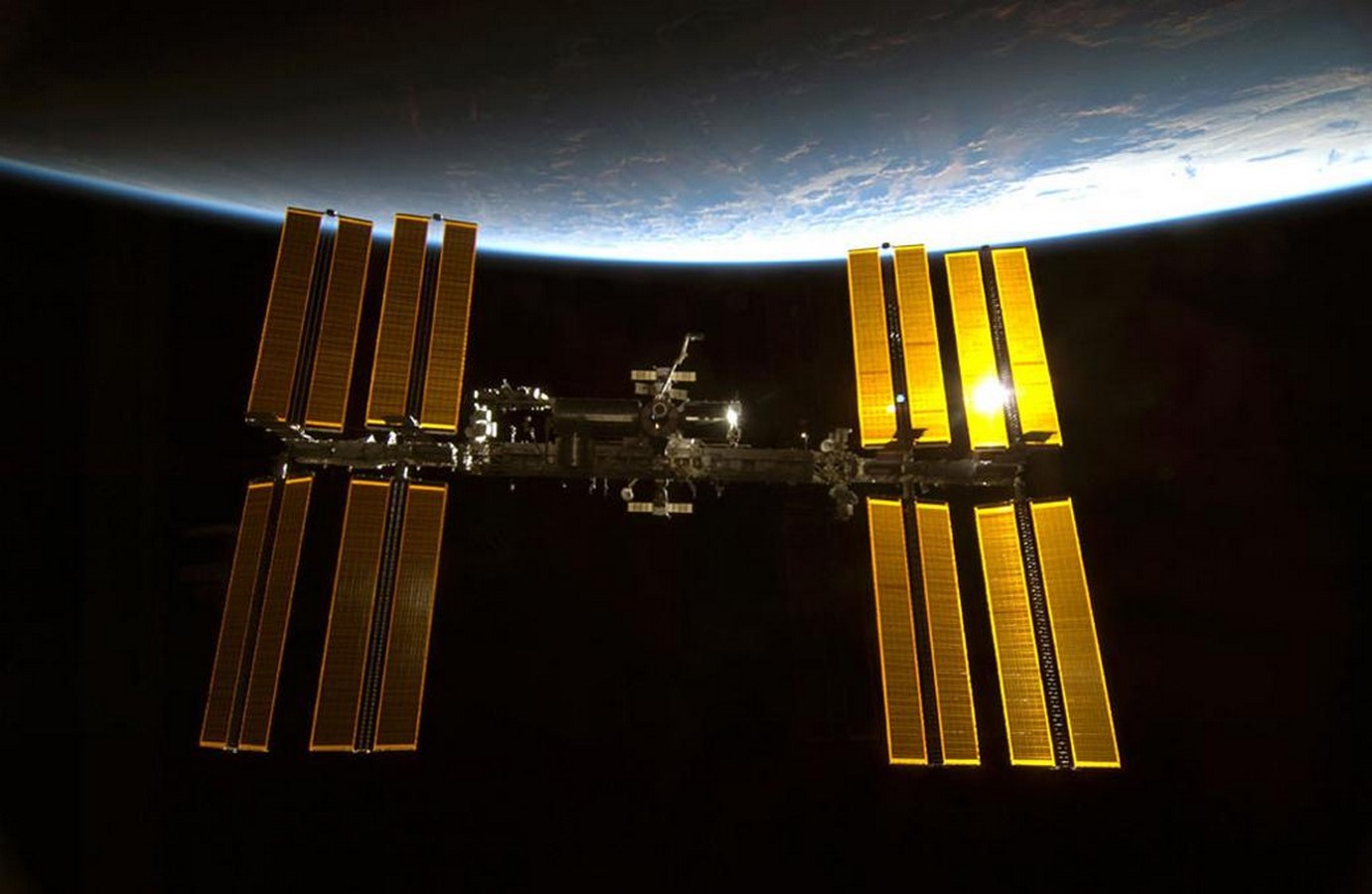
https://www.space.com/24208-international-space-station-extension-2024.html
The second category of interplanetary structures follows shuttles, spaceships and rockets that serve as interim habitats for humans as they are covering a journey with a definite amount of time to reach the destination.
Planetary Architecture:
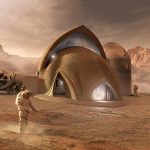
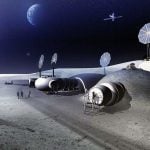
This category explores on-surface architecture and is being hypothetically explored. Human outposts on the Moon and Mars have been vigorously imagined under this umbrella. Unlike the previous two, this category of space architecture comes with a different set of variables that shift our sense of environment as it is known on Earth. This will be further explored below.
The other category for the type of space architecture is its buildability and material sources used to achieve it. “Class I is pre-integrated – entirely manufactured, integrated, and ready to operate when delivered to space. Class II is prefabricated and is space or surface deployed with some assembly or setup required. Class III is an in-situ-derived structure manufactured using local resources available on the Moon or Mars’.” (Netti & Bannova, 2021)
In-situ-derived habitats, while of most interest, are still a figment of imagination for humans. Hypothetically, there might be a use for regolith, the planetary dust, to create structures but no absolute outer-space structure has come out of it yet. These habitats are still a concept; however, they hold immense potential in themselves.

Mission Architecture:
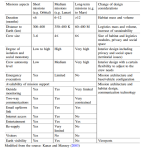
To understand the complexity of the discipline, an approach of mission architecture is taken under which all the required constraints are identified and then specified according to that particular project. These constraints range from distance to time to the nature of the mission, crew size etc. Referring back to the goal-oriented factor in space architecture, each celestial body comes with its own set of possibilities and constraints, and these requirements and criteria essentially hold the key to the design of human habitation. “Each asset brings new constraints and new capabilities or can cause new technological developments.” (Netti & Bannova, 2021). For example, on the Moon the planetary rotation is 14 days, which means that there is negligible natural light and artificial lighting sources are needed. But, for Mars it is 24.6 hours which is quite relatable to Earth’s. The mission duration and requirements decide the design responses as well. Following table refers to mission specifications:
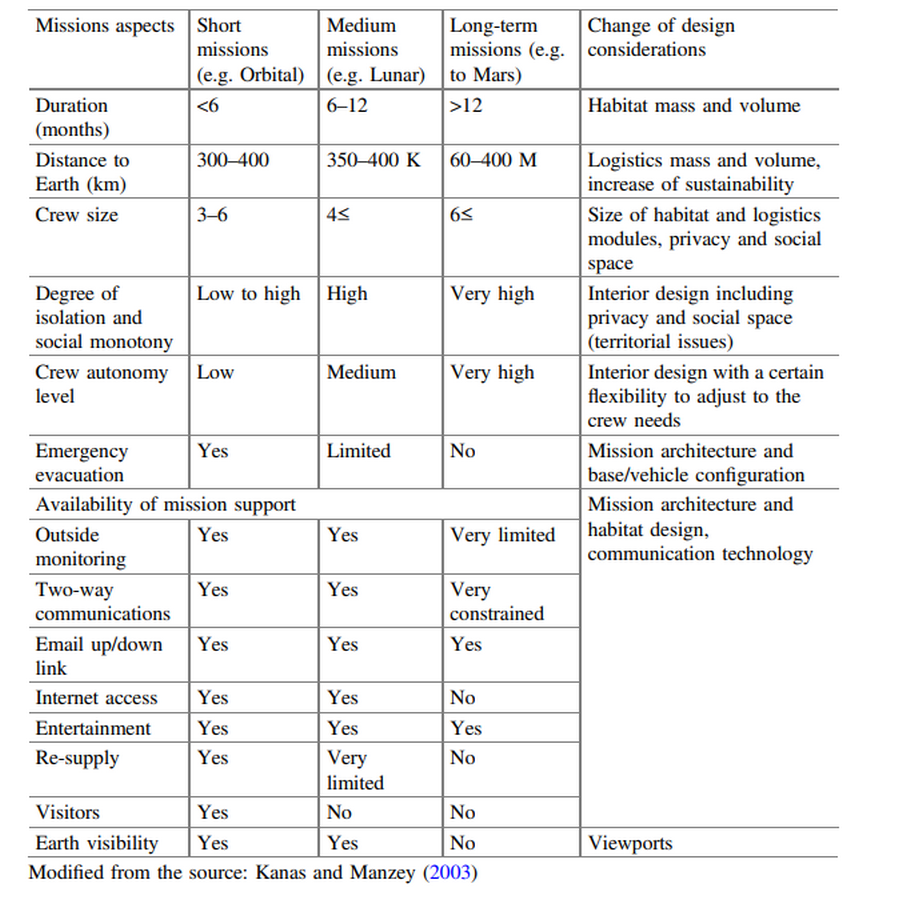
Aspects of Environs:
Nothing derives the speculative habitation quite like the environs consideration; these include tangible and intangible factors that govern the planet or outer space. From atmosphere, to gravity, to radiation, to materiality and so on these factors will influence and challenge the basis of humanistic design. The gravity on Mars being 38% of Earth’s means that the tread of a person no longer remains the same. The standard 6” tread of a staircase is no longer the standard. Similarly, the Moon’s gravity is 1/6th of Earth’s, meaning that the standards of human mobility have shifted as well.
By investigating the evolving parameters and constraints of design in low-gravity contexts, the socio-cultural implications of isolation, effect of these conditions on human psychology and the use of local planetary resources and materials, it becomes evident that the architecture of outer space is not merely a technical endeavour, but a deeply human one of exploration. Space architecture, hence, is not just a tool to visualize the present but instead an opportunity to conceive the future and look beyond.
Reference List:
Häuplik-Meusburger, S. and Bannova, O. (2016) ‘Space Architecture Education for engineers and architects’, Space and Society [Preprint]. doi:10.1007/978-3-319-19279-6.
Netti, V. and Bannova, O. (2021) ‘Space architecture: Designing Beyond the Sky’, Moby Dick: avventure e scoperte | Adventures and Discoveries, pp. 180–194. doi:10.2307/j.ctv2z0vts7.19.
Leach, N. (2014a) Space architecture: The New Frontier for Design Research . Available at: https://www.researchgate.net/publication/268283546_Space_Architecture_The_New_Frontier_for_Design_Research
Donovan, J. (2024) Space architects will help us live and work among the stars, HowStuffWorks Science. Available at: https://science.howstuffworks.com/space-architecture-news.htm