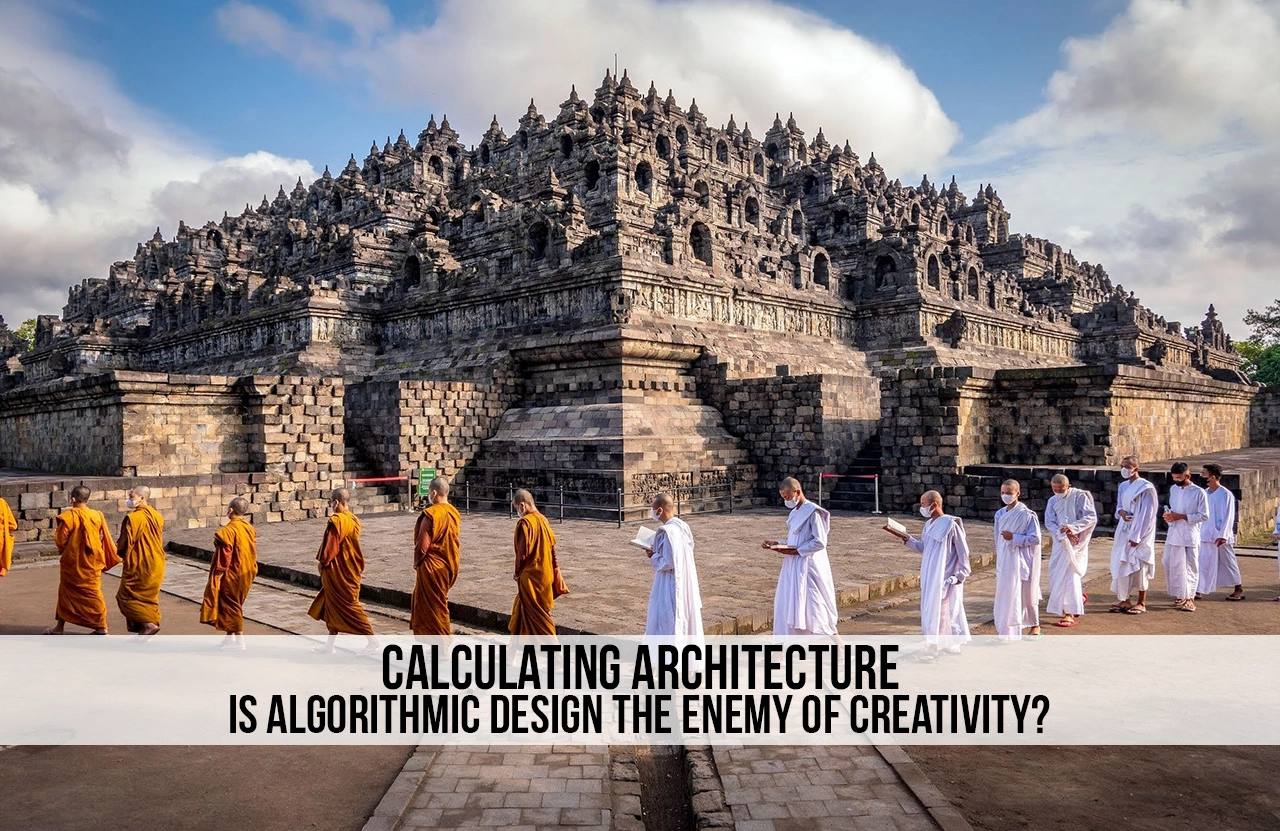
Algorithmic design is often caricatured as the enemy of creativity, indistinguishable from the computerisation of architectural design. Whilst algorithmic design describes the creation of design solutions – problem-solving using systematic, mathematical or logical methods – computerisation describes ‘entities or processes, already conceptualised, simply entered, presented, or stored on a computer system’ (Terzidis, 2004).
Evidence of algorithmic design principles predate parametricism, a term coined in 2008 by Patrik Schumacher to describe the use of computer algorithms, digital animation, and parametric software to create fluid, highly complex, and interconnected organic components of architecture (Crook, 2026). A key example of this is Borobudur Temple – the largest Buddhist Temple in the world. Borobudur Temple was erected during the eighth century as a guide to the Noble Path of the Buddha (Dokras, 2024). Located in Central Java, Indonesia, Borobudur was believed to embody Buddhist scriptures and stories pertaining to the gods, human life and animals (Sulistiawati et al., 2022).
In the absence of standardised metric units, ancient Javanese architects relied upon an anthropometric metric system called the Tala, using human ratios, proportions and dimensions such as the 4:6:9 ratio between the foot, the body and the head. In a paper titled ‘Borobudur was Built Algorithmically’, Indonesian researcher and scientist Hokky Situngkir identified the absolute dimensions of the temple’s stupa as adhering strictly to a 4:6:9 proportional ratio (Situngkir, 2015). Using the mathematical cube-counting method, he also determined that the temple featured an exact fractal dimension of 2.325; mathematically proving a ‘self-similarity’ whereby a single architectural component – in this case the iconic bell-shaped stupa – reflected the geometry of the entire architectural body (Situngkir, 2015).

To coordinate thousands of workers, each using their own individual measurements, a recursive mathematical rule was likely used at every layer, allowing workers to flawlessly scale up a micro-design – such as a single, small stupa – into the massive, yet cohesive, temple seen today. Subsequent ethnomathematical studies have modelled Borobudur’s layout using Cellular Automata (CA) theory, allowing researchers to successfully replicate the design using 1-dimensional and 2-dimensional computational CA systems (Sulistiawati et al., 2022). A key finding was that the structural patterns align with Rule 92 and Rule 254 on cellular automata generators such as Wolfram Alpha (Sulistiawati et al., 2022). Algorithmic design, therefore, in its earliest form, was not a computer programme, nor an enemy of creativity; it was a tool for construction and a language through which monumental architecture could be expressed. Though it could be argued that with the rise of computerisation and parametricism the role of algorithmic design would also change, at its core it would continue to remain a problem-solving tool.
Fabrication and Representation
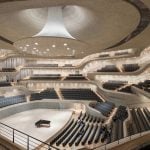
‘Architecture, like many other art forms, frequently mirrors the technological advancements of its time’ (Ferreira, 2022). Though algorithmic design would also become computerised, it continued to serve as a tool, or ‘conceptual framework for the exploration of forms, structures, and processes of architectural design’ (Terzidis, 2004). A key example of this was the Elbphilharmonie in Hamburg, Germany. Nicknamed the ‘Elphi’, the famous concert hall featured a central auditorium: a gleaming ivory cave built from 10,000 unique acoustic panels lining the ceiling, walls and balustrades (Stinson, 2017). Much like the interlocking pieces of a giant, undulating puzzle, each one of the 10,000 gypsum fibre panels was designed to shape sound within the auditorium. As Koren explains (Stinson, 2017), ‘when sound waves hit a panel, the uneven surface either absorbs or scatters them.
Working with famed acoustician Yasuhisa Toyota and Slovenian architect Benjamin Koren (founder of computational design and digital fabrication firm One to One Studio), ‘no two panels absorb or scatter sound waves alike, but together they create a balanced reverberation across the entire auditorium’ (Stinson, 2017). Toyota understood that certain panels, such as those lining the back wall of the auditorium, would need deeper, bigger grooves to absorb echoes, while others, such as those on the ceiling surfaces behind the reflector and the top parts of the balustrades, would require shallower cells.
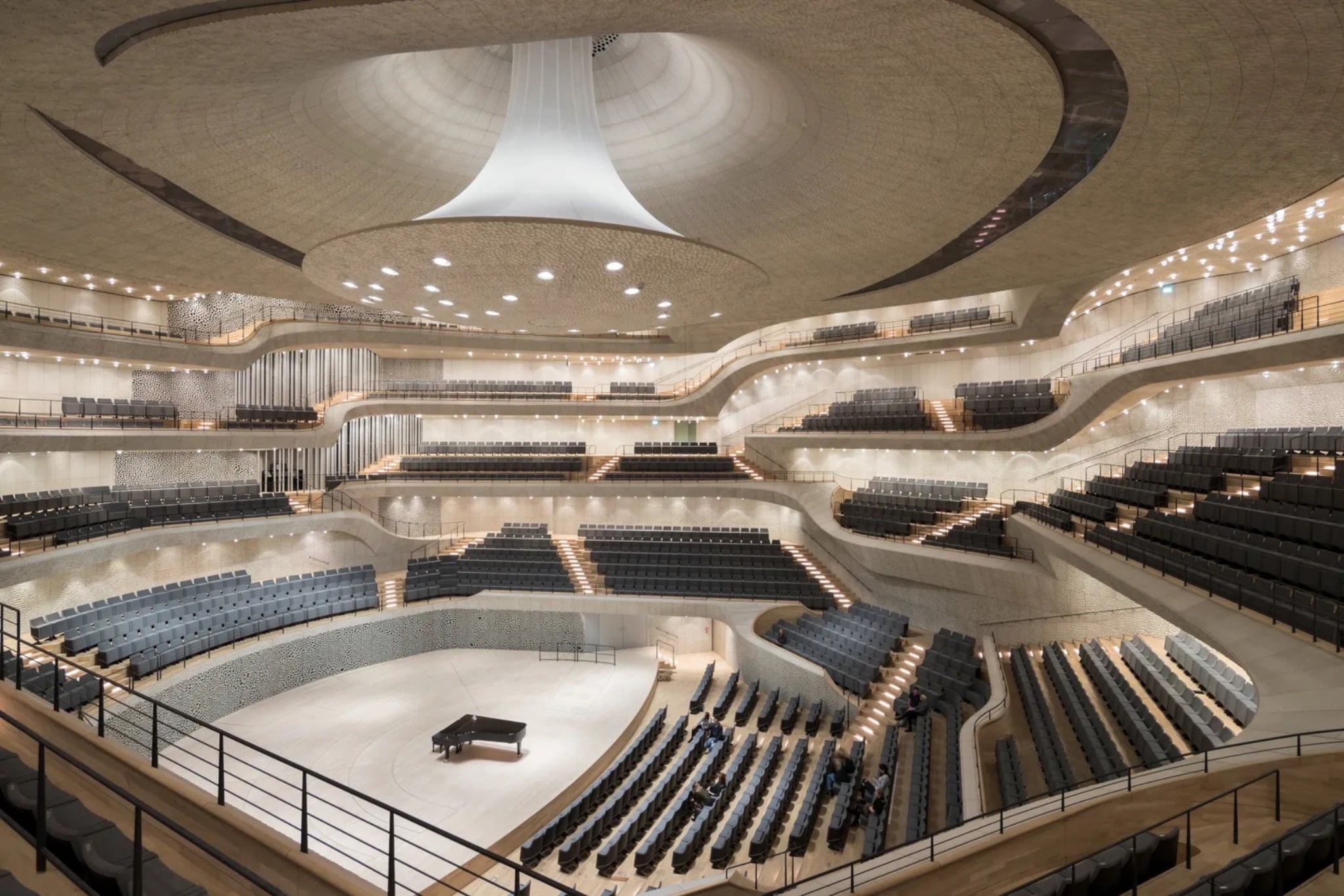
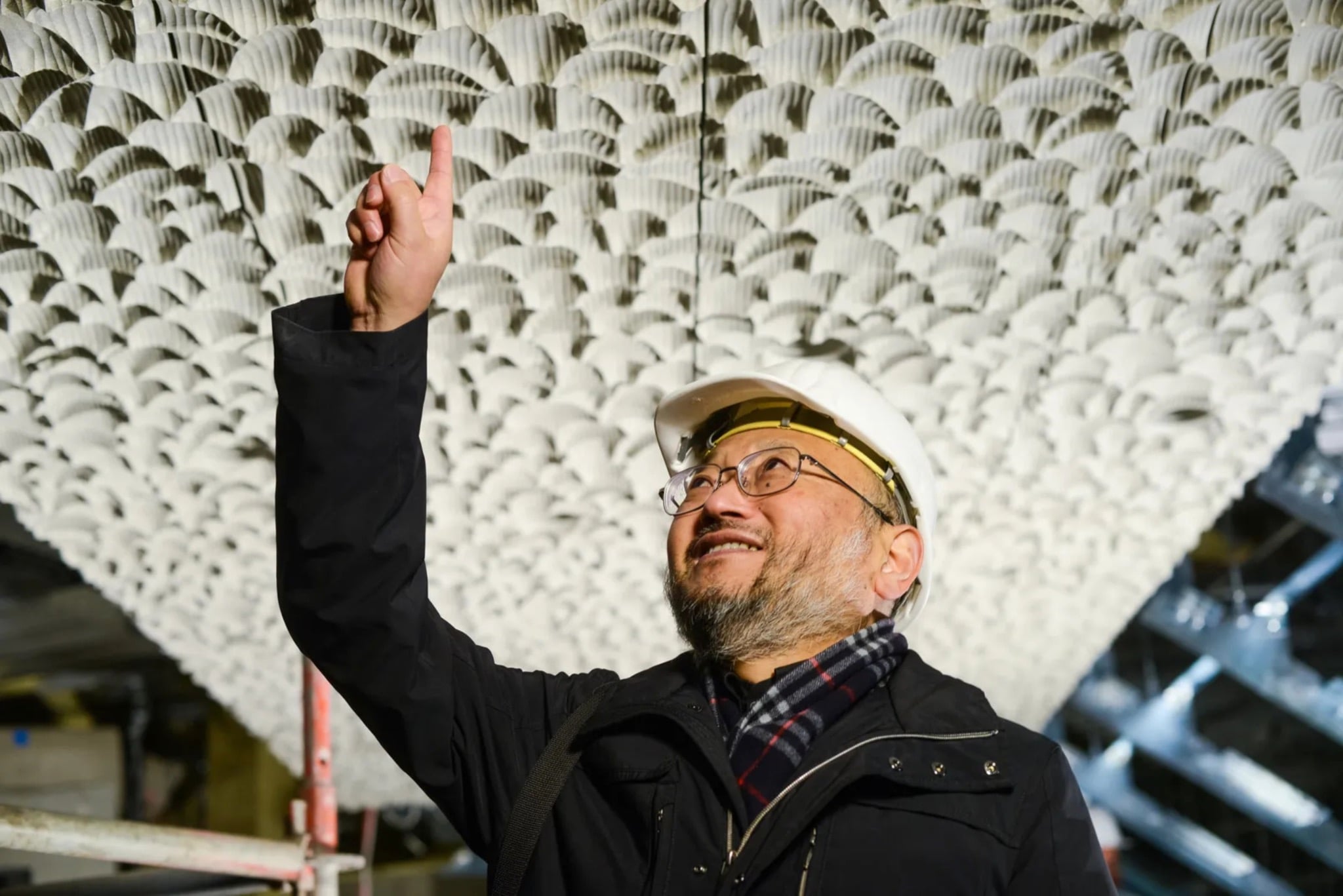
This idea and technique of using undulating acoustic panels was not new and, in fact, had been used for centuries; a key example being Vienna’s ‘Musikverein’ – built between 1867 and 1870 – whose ornate, neoclassical detailing created the same diffusion effect. Based on the room’s geometry, Toyota would then go on to create an optimal sound map for the auditorium, allowing Koren to develop an algorithm that produced 10,000 panels, each with a unique shape and pattern, mapped to clear aesthetic and acoustic specifications (Stinson, 2017). The use of algorithmic design here allowed Benjamin Koren to not only optimise but also refine the process. Speaking to Wired magazine, Koren noted that ‘it would be insane to do this by hand’ (Stinson, 2017).
Advancing Architectural Research
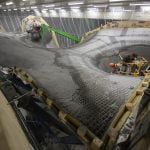
Beyond architectural representation, algorithmic design has also been used to advance architectural research, working, again, as a tool alongside human creativity. This was exemplified by a team from Zürich’s University of Science and Technology (ETH Zürich), who, working alongside industry partners, developed a lightweight, flexible concrete formwork using algorithms. Inspired by the thin shell structures made famous by Spanish architect Félix Candela, the ultra-thin, self-supporting, ‘double-curved concrete roof’, consisted of an inner concrete layer, covered by heating and cooling coils and insulation, and an outer layer of concrete covered by thin-film photovoltaics. The inner layer of the shell was formed by spray-applying concrete to a stretched cable net with an underlying polymer textile layer functioning as the formwork for the concrete (Cousins, 2018; Eidgenössische Technische Hochschule Zürich, 2017).
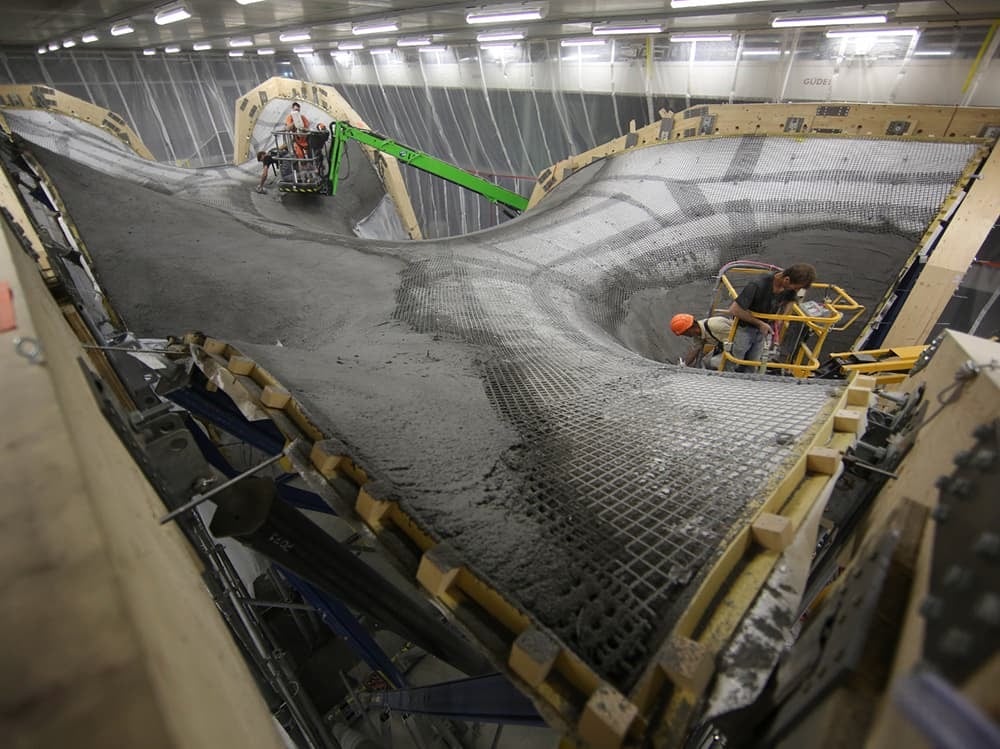
Designed to take on the desired shape under the weight of the wet concrete, the cable net was a calculation method developed by the Block Researcher Group and their collaborators in the Swiss National Centre of Competence (NCCR) in Digital Fabrication (Cousins, 2018; Eidgenössische Technische Hochschule Zürich, 2017). An initial algorithm worked out the non-uniform pre-stresses that had to be applied to the net to cause it to settle in a specific way. A second set of ‘automated optimisation algorithms’ calculated the additional stresses required on different cables to adapt the net to real-world conditions involving inaccurate construction tolerances or movement in timber edge beams to which the cables were fixed. Professor Philippe Block from the Institute of Technology in Architecture at ETH Zürich told RIBAJ that ‘the second set of algorithms sorted through about 90 trillion options to tell us precisely how to correct the net by tightening or loosening the turnbuckles on the edges to redirect the cables to hit the correct geometry and ensure we don’t overstress members’ (Cousins, 2018). The algorithms here clearly ensured that the forces were distributed correctly between the individual steel cables and that the roof assumed the intended shape precisely (Eidgenössische Technische Hochschule Zürich, 2017).
Despite the construction of the roof being ‘inconceivable without state-of-the-art computation and fabrication techniques’, the project itself still heavily relied upon the expertise and experience of several craftspeople according to Eidgenössische Technische Hochschule Zürich (2017). Eventually, thanks to the technology and an adaptive solar façade, the residential unit is expected to generate more energy than it consumes, making complex, curving, geometric forms much cheaper and faster to build (Eidgenössische Technische Hochschule Zürich, 2017; Cousins, 2018).
In its earliest form, algorithmic design could be interpreted as both an architectural tool and a language through which human creativity could be expressed. It was used not only to translate ideas from the conceptual through to the physical, but also to coordinate construction using systematic rules and logic. With the computerisation of algorithmic design, this continued; however, instead of simply providing an input and receiving an output, algorithmic design could now also be easily iterated to explore and refine multiple solutions. Though algorithmic design may not serve as an enemy of creativity, its capabilities have certainly evolved over time. Moving forward, perhaps the argument is less about solely discussing the potential of the tool itself, but rather the autonomy negotiated between the architect and the algorithm.
Reference list:
Cousins, S. (2018). Flexible formwork: Free-flowing rooftops on the horizon. [online] RIBAJ. Available at: https://www.ribaj.com/spec/flexible-formwork-extreme-spec-pip-stephen-cousins-switzerland/ [Accessed 7 Aug. 2026].
Crook, L. (2026). A Simple Guide to Parametricism. [online] Dezeen. Available at: https://www.dezeen.com/2026/05/06/parametricism-simple-guide/ [Accessed 11 Aug. 2026].
Dokras, U. (2024). Mathematics at Borobudur. [online] Scribd. Available at: https://www.scribd.com/document/502403853/Mathematics-at-Borobudur [Accessed 8 Aug. 2026].
Eidgenössische Technische Hochschule Zürich (2017). Construction Prototype for Ultra-Thin Concrete Roof. [online] Ethz.ch. Available at: https://ethz.ch/en/news-and-events/eth-news/news/2017/10/innovative-construction.html [Accessed 4 Aug. 2026].
Ferreira, P. (2022). Picture a Building: Algorithmic Design in Architectural Representation. [online] INESC-ID. Available at: https://www.inesc-id.pt/picture-a-building-algorithmic-design-in-architectural-representation/ [Accessed 1 Aug. 2026].
Situngkir, H. (2015). Borobudur Was Built Algorithmically. [online] arXiv.org. Available at: https://arxiv.org/abs/1508.03649 [Accessed 6 Aug. 2026].
Stinson, L. (2017). What Happens When Algorithms Design a Concert Hall? The Stunning Elbphilharmonie. [online] Wired. Available at: https://www.wired.com/2017/01/happens-algorithms-design-concert-hall-stunning-elbphilharmonie/?mbid=social_fb&utm_medium=website&utm_source=archdaily.com [Accessed 4 Aug. 2026].
Sulistiawati, Turmudi, Arifin, S. and Indra Bayu, M. (2022). Ethnomathematics in Borobudur Temple Based on Cellular Automata Perspective. AIP Conference Proceedings, [online] 2468(1). doi:10.1063/5.0102457.
Terzidis, K. (2004). Algorithmic Design: A Paradigm Shift in Architecture? eCAADe proceedings, pp.201–207. doi:10.52842/conf.ecaade.2004.201.