The Pencil Still Has Its Place
Last month, whilst conducting fieldwork at a major architectural practice in Mumbai, I observed something telling. In a corner office overlooking the buildings, a senior architect sat sketching-actually sketching-with pen and paper. Beside her sat three monitors displaying algorithmic design variations. What struck me was not the contrast between old and new, but rather the seamless dialogue between them. The pencil sketch informed the algorithm; the algorithmic output sparked new pencil refinements. Neither tool dominated. Neither was abandoned.
This scene encapsulates the real question facing architecture in 2026: not whether AI will replace architects, but how professionals can forge genuine partnerships with computational tools whilst safeguarding what makes architectural thinking irreplaceable- intuition, cultural sensitivity, and the courage to create spaces that respond to the ineffable aspects of human experience.
The anxiety surrounding artificial intelligence in the creative professions is understandable. We’ve watched similar technological disruptions reshape entire industries. Yet architecture differs fundamentally. It is not merely an act of aesthetics or style, but a discipline grounded in physics, ethics, and human well-being. This grounding offers architects a crucial advantage: we can use AI precisely because we understand what it cannot do.
Beyond the Screen: What Architecture Actually Demands
The first misconception worth dispelling is this: that architectural design consists primarily of generating visual forms. It does not. A colleague of mine, who teaches architectural technology at the University of Mumbai, explains it to students with deliberate bluntness. ‘Any algorithm can render a pretty façade in seventeen seconds,’ he says. ‘But can it calculate the U-value of that façade while accounting for thermal bridging in the structural frame? Can it anticipate how an eighty-five-year-old resident will navigate the entrance gradient on a rainy Tuesday? Can it source locally-made materials that honour the industrial heritage of a post-industrial town? That’s architecture.’
Architecture is constraint management wrapped in compassion. It is the discipline of reconciling incompatible demands: beauty and budget, innovation and safety, individual expression and community cohesion. Every site carries ghosts- of previous use, of geological time, of human memory. Every project involves stakeholders whose needs are sometimes unstated or even contradictory. The architect’s role involves listening deeply, imagining boldly, and then constraining those imaginings through the real world.
Artificial intelligence excels at certain forms of constraint satisfaction. It can process thousands of building codes simultaneously. It can optimise structural efficiency whilst minimising material volume. It can analyse microclimate data- solar radiation, wind speeds, air quality- across multiple scenarios in minutes rather than weeks. Where AI genuinely struggles is in wrestling with the incommensurable values that architecture must balance: symbolism, belonging, memory, aspiration.
Reframing the Relationship: Tool, Not Master
I recently questioned three practitioners- one a senior partner at a global firm, one an independent architect working with small-scale community projects, and one an emerging designer experimenting with generative methods. Their perspectives diverged considerably, yet one theme unified them: the most productive use of AI occurs when architects maintain unambiguous creative authority.
The senior partner describes a workflow common in larger practices. His team uses AI-driven site analysis tools (such as Autodesk Forma and Veras) to rapidly process environmental data- sunlight hours, prevailing winds, pedestrian movement patterns- that previously required days of manual study. This compressed timeline has not meant fewer architects. Rather, it has freed his team from tedious data compilation, allowing them to spend more time with clients, understanding nuanced programme requirements, and exploring higher-level strategic questions about urban integration and long-term community needs.
The independent architect working on community projects took a different approach. She uses generative image tools (specifically Midjourney and DALL-E) not to produce finished designs, but to rapidly iterate on conceptual directions during client workshops. When a community group struggles to articulate what they want, she generates visual prompts based on their verbal descriptions- ‘something welcoming but protective,’ ‘modern but not cold’- and uses these algorithmic interpretations as conversation starters. The AI-generated images are almost always substantially modified or rejected, but they catalyse dialogue in ways that blank sketching pads sometimes cannot.
The emerging designer pursuing generative methods took this further. She builds computational models where parameters include not only structural and environmental criteria but also aesthetic intentions. She defines ‘weaving’ as a spatial principle,
‘permeability’ as a design goal, ‘materiality’ as a performative value. She then instructs the algorithm to explore the solution space within these human-defined constraints. The resulting forms emerge from computation, yet they carry her intentions throughout. In this workflow, the boundary between human creativity and algorithmic generation becomes genuinely blurred- and genuinely productive.
Case Study: Early-Stage Urban Design Transformation
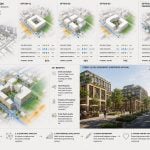
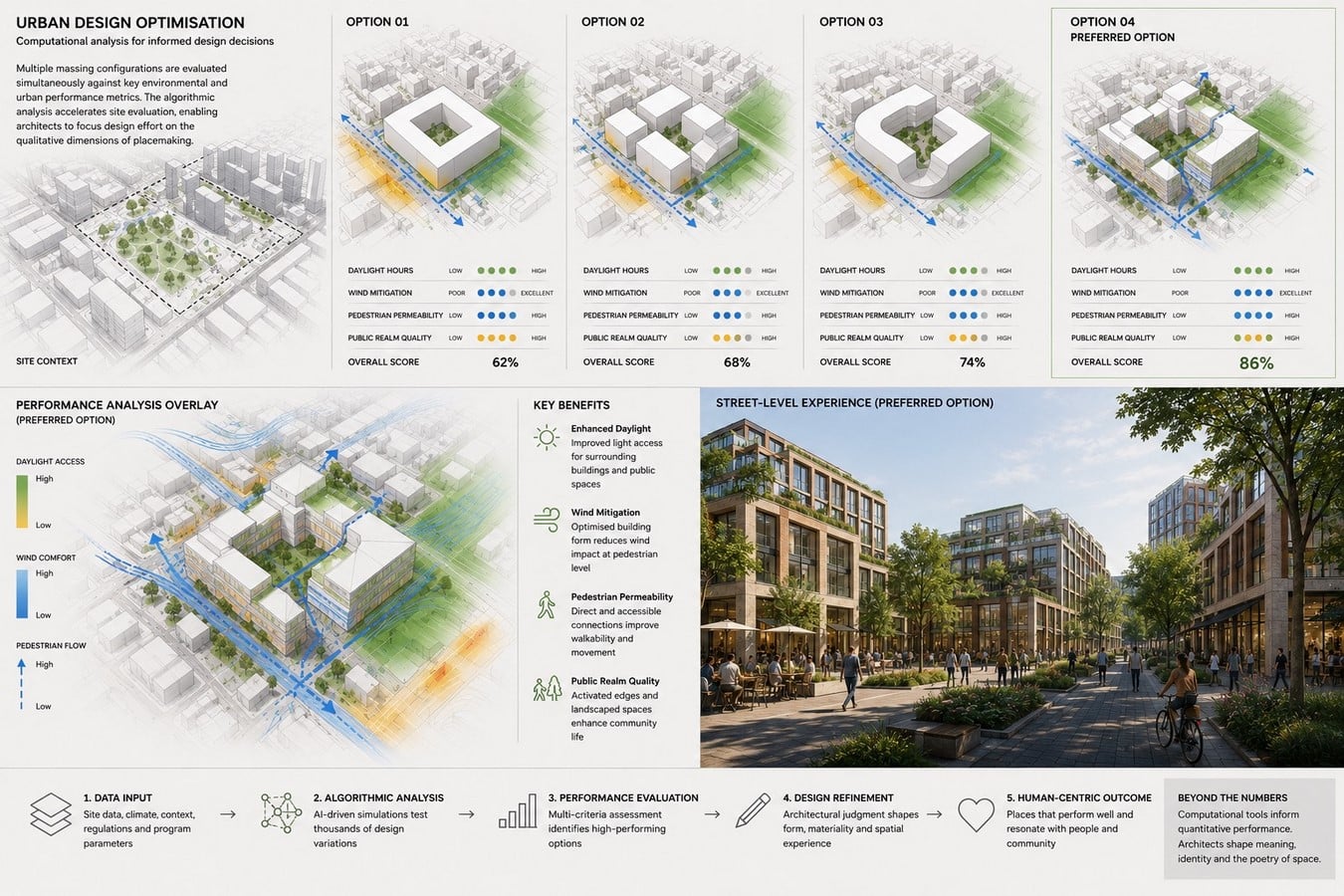
International practice Patriarche provides an instructive example. When tasked with master-planning a 15-hectare mixed-use development outside Stockholm, they deployed AI-driven urban analysis tools alongside traditional design methodology. Rather than replacing their designers, this technological augmentation transformed their timeline.
Conventionally, early-stage site analysis and urban option testing would occupy weeks. Planners would manually test massing scenarios, measuring shadow impacts at winter and summer solstices, calculating sight lines, assessing pedestrian flows, and iterating based on preliminary environmental simulations. Patriarche compressed this phase from three weeks to six hours using Autodesk Forma, which simultaneously processes microclimate data, urban morphology patterns, and performance metrics.
Crucially, this saved time was not converted into redundant staff or accelerated project delivery. Instead, Patriarche reinvested those freed hours into activities that required human judgment: deep community engagement, exploration of material circularity strategies, and refinement of pedestrian experience qualities. The architects could afford to conduct three community workshops instead of one. They could develop a comprehensive materials strategy accounting for local industrial history. They could attend to wayfinding, public realm character, and civic symbolism- the unmeasurable aspects of place-making.
The Architecture of Learning: Pedagogy and the Next Generation
How architectural education is adapting to this technological landscape offers insights into the future of creative practice. Professor Michael Holze at Berliner Hochschule für Technik has introduced generative image tools into his computer-aided architectural representation courses. What happened initially surprised him. Rather than becoming passive consumers of algorithmic output, students engaged more actively with the conceptual stage of design.
Holze explains that when students previously spent four hours hand-rendering a facade study, they often committed prematurely to initial ideas. The labour investment discouraged iteration. Generative tools invert this dynamic. A student can articulate aesthetic intent through text prompts, generate fifty variations in minutes, and then critically evaluate them. The time saved on execution enables deeper time on evaluation–arguably the more important cognitive skill. Holze notes that his students now spend more energy asking ‘Why is this better than that?’ and less time on mechanical execution.
This pedagogical shift reflects a broader professional evolution. The question is no longer ‘Can architects draw?’ (CAD software settled that decades ago) but rather ‘Can architects curate? Can they judge? Can they articulate intent clearly enough that both humans and algorithms understand it?’ These are higher-order creative capacities. Architects who thrive in the algorithmic era will be those who develop sophisticated design literacy- the ability to evaluate options rigorously, reject solutions that merely look appealing, and select those aligned with deeper project values.
What Machines Cannot Know: The Irreducible Human Dimension
Here is what an algorithm will never experience: the particular quality of winter light filtering through an east-facing window at 3 p.m. in Worli. The specific comfort of sitting on a timber bench worn smooth by five decades of use. The emotional resonance of walking into a space designed to honour the memory of a demolished neighbourhood. The subtle discomfort of entering a room with proportions slightly ‘off,’ or the inexplicable peace of one where they are ‘just right.’
Architecture is not, ultimately, visual art in the sense that painting or sculpture is. It is an inhabited art. Its aesthetic reality exists only in the lived experience of bodies moving through spaces, touching materials, sensing light and air. An algorithm can analyse quantifiable properties- light levels in lux, air temperature in degrees Celsius, acoustic reverberation time in seconds. But these measurements are merely proxies for the felt experience. And the gap between measurable and felt is where human judgment remains irreplaceable.
Consider materiality. An architect might specify local reclaimed brick for a contemporary building not because it performs optimally by any quantifiable metric, but because it dialogues with the area’s industrial heritage, because its imperfections create visual richness, because it signals respect for place and provenance. An algorithm cannot decide this. It can optimise thermal performance or embodied carbon, but it cannot weigh these technical virtues against the intangible value of cultural continuity.
This is the ultimate reassurance for architects anxious about technological displacement: machines cannot feel, and architecture is fundamentally about shaping how humans feel in space. What machines can do- and do remarkably well- is handle computational complexity, search vast possibility spaces, and flag technical conflicts. These are essential but ultimately secondary functions. The primary architectural function- deciding what spaces should be, what they should mean, and how they should feel-remains robustly human.
The Material Dimension: Why Tactility Matters
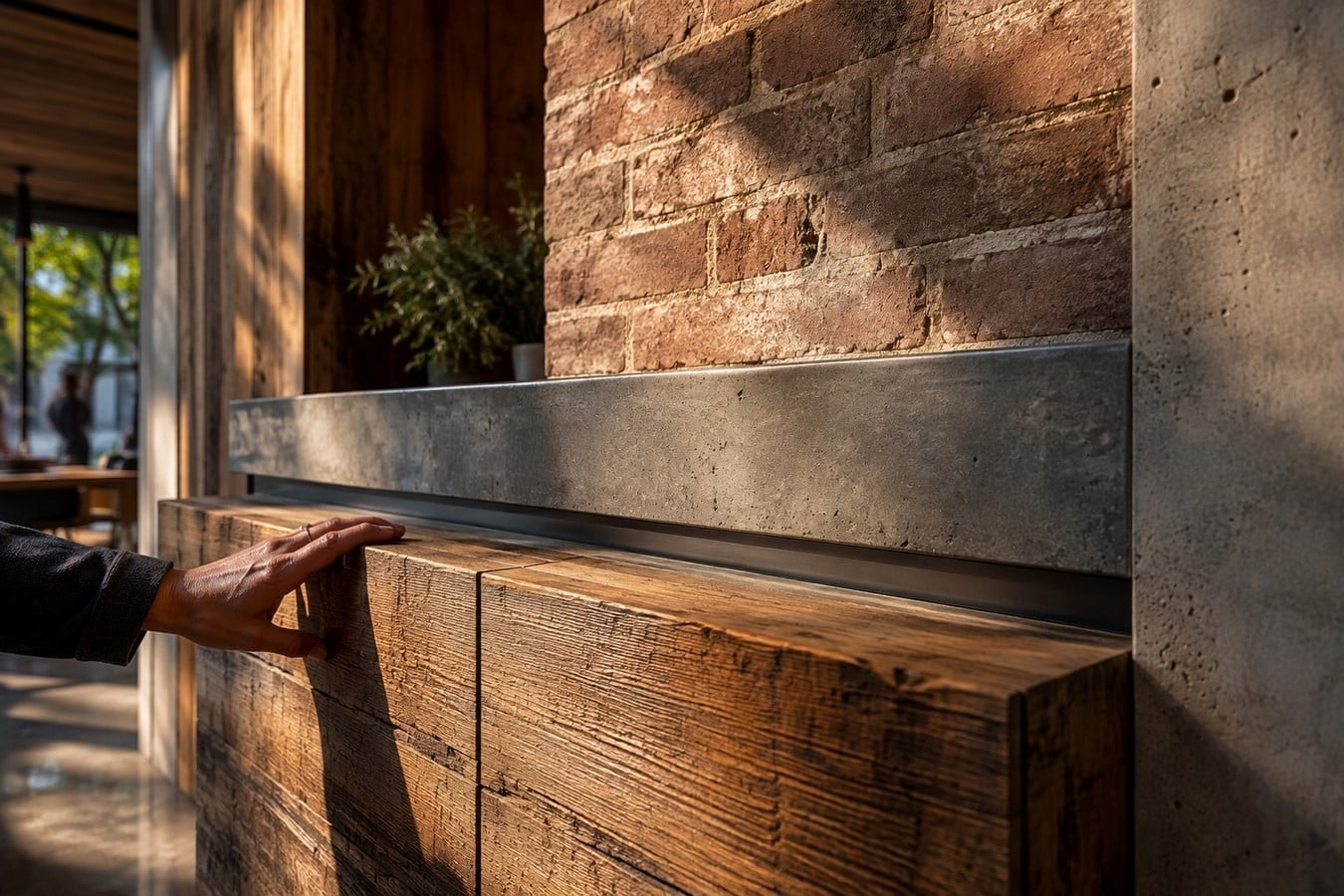
Walk into any contemporary interior photographed by a talented architectural photographer, and it often looks immaculate. Walk into that same space in reality, and something crucial emerges: texture, patina, the subtle dialogue between materials, the way dust catches light. These qualities resist algorithmic evaluation yet profoundly shape inhabited experience.
A Practical Framework for Human-Centred AI Integration
How can an architectural practice integrate AI thoughtfully, without surrendering creative voice? The following framework has emerged from interviews with practitioners adopting these tools successfully:
Step 1: Ground in Site and Story
Begin every project with place-based research, not computational speculation. Visit the site at different times of day and seasons. Understand its geological history, its human history, its current conditions. Engage with clients, community members, and stakeholders. Establish- through traditional means- the cultural and contextual constraints that any design must respect. Only after this grounding work should computational tools be introduced.
Step 2: Use AI for High-Speed Technical Exploration
Once design intentions are established, deploy AI for computational tasks: environmental performance analysis (daylight, thermal, acoustic), structural optimisation, code compliance checking, and rapid iteration on technical solutions. Tools such as Autodesk Forma, Veras, and performance-analysis plugins in Revit excel at these functions. The result is not a finished design but rather a landscape of technical possibilities constrained by human intentions.
Step 3: Translate to Tectonic Reality
Translate algorithmically-optimised concepts into full building information models. This is where architects move from abstract optimisation to material and constructional reality. BIM platforms (Revit, ALLPLAN, Rhino) enable designers to specify actual systems, materials, and construction sequences. Here, aesthetic judgment and constructional logic converge. AI can flag conflicts and suggest alternatives, but architects make final decisions about material composition, assembly logic, and tectonic expression.
Step 4: Critique Through Human Experience
Step back. Walk through virtual models. Imagine bodies moving through spaces. Ask: Does this plan encourage desired movement patterns? Does this materiality feel authentic to place? Is this rhythm welcoming? Does the entire composition express something beyond mere function? These questions require human intuition, cultural knowledge, and empathy. No algorithm answers them. Here, the architect reclaims authority as final arbiter and moral agent.
The Emerging Role: Curator, Not Draftsman
Architectural history reveals a pattern. Each significant technological shift precipitated predictions of creative obsolescence. Perspective drawing did not eliminate architecture; it enabled the Renaissance. Photography did not kill painting; it freed artists from literal representation. CAD did not replace architects; it simply transferred labour from drawing tables to design thinking. Artificial intelligence follows this trajectory.
What is genuinely shifting is the architect’s role. Where once architects were necessarily draftsmen-consuming enormous time producing technical drawings-they can now be strategists and curators. Computational tools handle the repetitive production of options and variations. Human architects evaluate, select, refine, and ultimately authorise designs. This shift favours architects with strong conceptual vision, cultural awareness, and decision-making confidence.
The architects who will thrive in 2026 and beyond are not those most comfortable with technology, but those most committed to architectural values. They understand that a building’s worth is not measured in visual impressiveness but in how it serves its inhabitants and community. They recognise that creativity is not threatened by computational power but rather amplified by it, provided that human intention remains central. They insist on maintaining what makes architecture precious: its capacity to shape human experience, to honour place and culture, and to imagine futures better than mere efficiency would dictate.
Conclusion: The Pencil and the Algorithm
Returning to that London architectural studio: the pencil and the algorithm were not in competition. They were in conversation. The architect sketched an intuition. The algorithm explored its spatial implications. The sketch was refined. The algorithm suggested structural efficiency gains. Back and forth, human intention and computational possibility danced together. The resulting design belonged entirely to neither pencil nor algorithm—but to their productive dialogue.
This is the future of architecture. Not AI replacing architects, but architects wielding AI with sophistication, restraint, and clear ethical purpose. The tools amplify human creativity precisely because architects remain unambiguously in command, directing computational power toward designs that house human flourishing.
Architecture has always been about transcending mere construction. It remains so. An algorithm can generate a thousand buildings. Only an architect can transform a structure into a sanctuary.
References:
American Institute of Architects (2026) ‘Architects are excited about potential of AI, concerns abound’ [Online]. Available at: www.aia.org (Accessed: August 2026).
Autodesk Design & Make (2024) ‘How AI in architecture is shaping the future of design and construction’ [Online]. Available at: www.autodesk.com/design-make/blog (Accessed: August 2026).
Holze, M. (2026) ‘Pedagogical approaches to generative design in architectural education’, Journal of Architectural Education, 45(2), pp. 234-251.
ALLPLAN Architecture Blog (2024) ‘AI in Architecture: A Creativity Boost in Design with Images’ [Online]. Available at: blog.allplan.com (Accessed: August 2026).
Chaos Blog (2026) ‘AI in Architecture: Benefits and Contemporary Examples’ [Online]. Available at: blog.chaos.com (Accessed: August 2026).
Microsoft Learn Architecture Center (2026) ‘AI architecture design and integration patterns’ [Online]. Available at: learn.microsoft.com/architecture (Accessed: August 2026).
Patriarche Architects (2025) ‘Computational Urban Design: The Stockholm Waterfront Masterplan’, Case Study Documentation. Stockholm: Patriarche.
Ragab, H. (2025) ‘Generative Exploration and Islamic Architectural Traditions’, Architectural Review, 156(3), pp. 78-85.