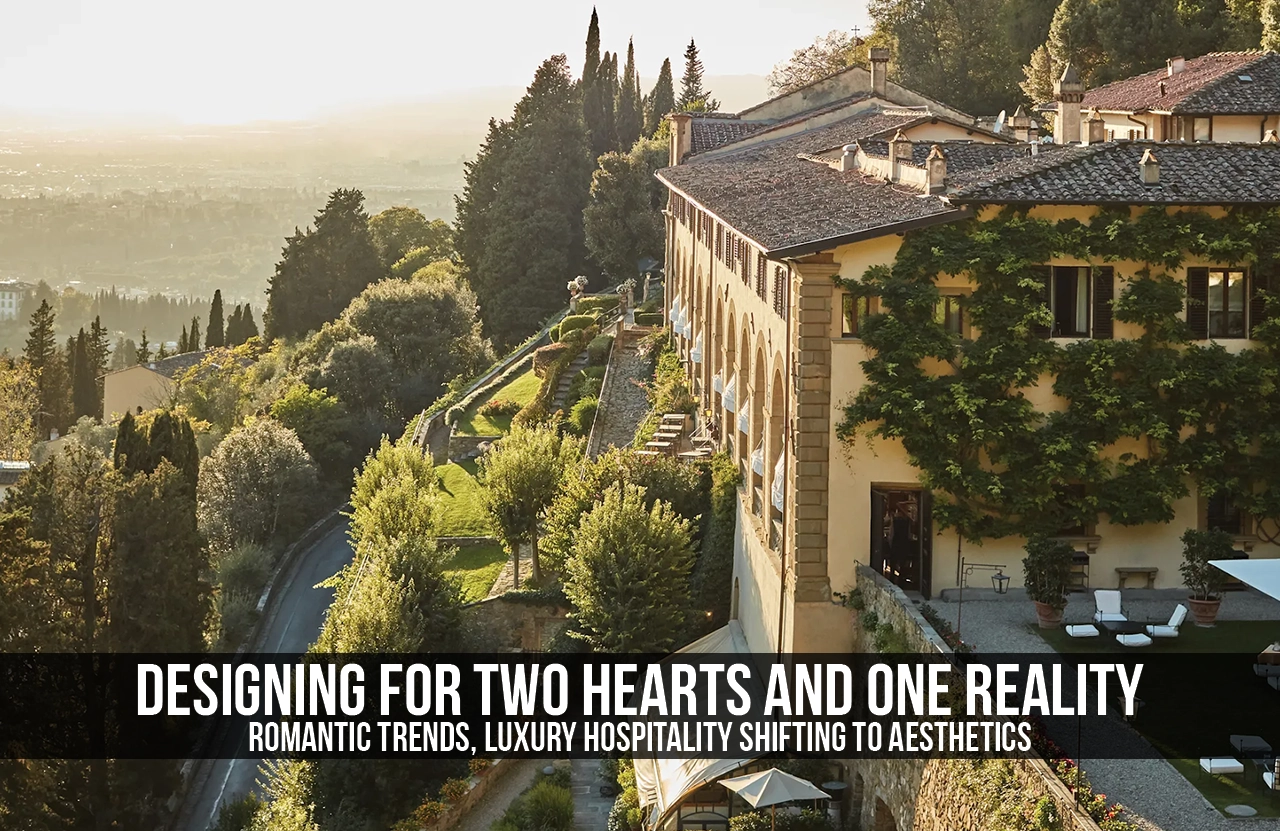
Luxury hospitality is no more selling rooms – it scripts emotional weather. The decisive shift is from static beauty to shared sensation – the hush before sunset, the charged pause at a threshold, the pleasure of reaching a place that feels briefly stolen from the world. Emotion, sensory coherence, and personalised sequencing are now the currency of high-end romantic travel, with materiality, lighting, scent, and spatial planning all used to shape memory. The question is – how to make this shaping-memory-process happen.

Guest Journey in Luxury Hospitality
Designers discuss the guest journey as a continuous emotional script – arrival, check-in, circulation, room layout, and sensory coherence all orchestrated to produce calm, anticipation, or release (HKS, 2026; Independent Hotel Show, 2025). Luxury hospitality no longer begins at the suite door. It begins at the kerb, in the transfer, in the first shadowed corridor, and in the conviction that nothing awkward will interrupt the shared mood.
Room aesthetics directly affect booking intention, particularly when innovation is balanced with familiarity and visual presentation reduces uncertainty (Lin et al., 2025; Marder et al., 2019). But a romantic environment cannot rely on surface prettiness alone. It needs tactile intelligence, flattering light, privacy, and enough composure to make sensuality feel self-generated rather than imposed. Luxury hospitality works when a space makes guests feel perceptive, comfortable, and desired by their surroundings – not merely surrounded by expensive objects.
What Industry Signals
Mandarin Oriental, Costa Navarino, Greece
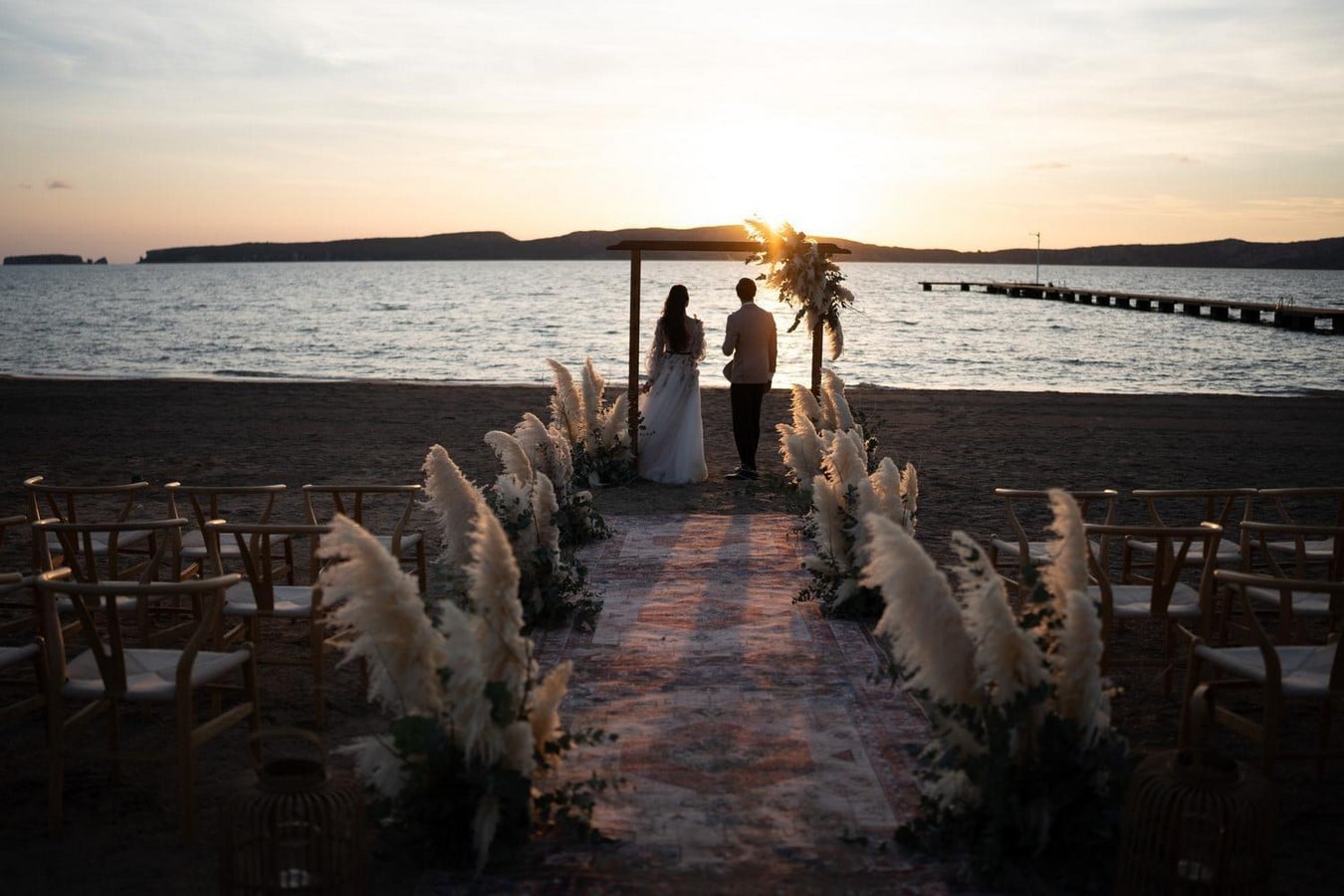
Designed by K-Studio and Alexandros N. Tombazis and Associates Architects, Mandarin Oriental, Costa Navarino sits above the Bay of Navarino in the Peloponnese. The masterplan draws from the ancient local stone shelters known as mandria – low, curved structures following natural topography – distributing 99 earth-sheltered pool villas in clusters that cascade toward the sea (K-Studio, 2024; LIV Awards, 2026). Green roofs, local stone, olive trees, and lavender integrate the architecture into landscape so seamlessly that the resort appears to have grown from the hillside rather than been placed upon it.
Every suite arranges its private pool terrace and framed bay view as the emotional centrepiece – not the room itself. Two guests receive an uninterrupted Mediterranean horizon as their exclusive possession (Mandarin Oriental, 2024; Coopers Hill, 2025). The resort’s victory at the LIV Hospitality Design Awards 2025 – Architectural Design of the Year – confirms its standing as a benchmark for luxury hospitality that resolves the tension between ecological intelligence and genuinely affecting atmosphere.
Six Senses London, United Kingdom
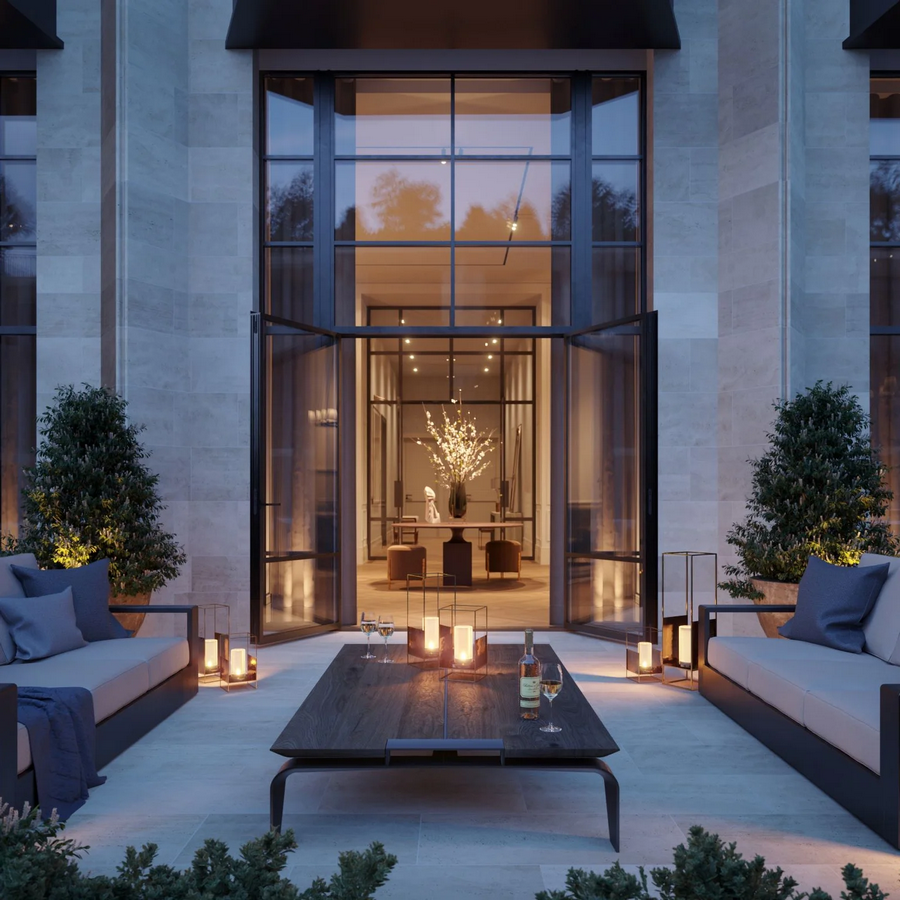
Six Senses London, opened in March 2026, poses the question: can luxury hospitality achieve the same emotional depth within dense urban fabric? Located in the restored Art Deco Whiteley building in Bayswater and conceived by AvroKO alongside EPR Architects, the 109-room hotel occupies a former department store and turns the logic of commerce inside out (International Traveller, 2026). Where Whiteley’s once staged spectacle for public consumption, AvroKO now stages immersion for private retreat.
The design language draws from the Great Exhibition era’s black-and-white contrast, reframed through nature – deep greens in lobby marble, Art Deco curves softened by warm woods and inky blues across the guestrooms and suites (International Traveller, 2026). The signature Whiteley Suite commands a 125-square-metre roof terrace above Hyde Park, reintroducing the private horizon into the heart of a world city. For couples navigating the tension between cosmopolitan energy and the desire for stillness, Six Senses London delivers luxury hospitality as calibrated mediation – the city is visible, but the guest is insulated from its friction.
The Female Gaze Issue
There is a persistent misreading of who the target audience for romantic Luxury Hospitality actually is. The popular assumption – that the paying guest is male and that his aesthetic preferences should govern design – produces interiors that are technically impressive but emotionally neutral. The evidence points firmly in the opposite direction. Women make 82% of all travel decisions, from choosing the destination through to the moment of booking, and are projected to control 75% of global discretionary spending by 2028 (Skift Research, 2024; Much Better Adventures, 2025). The economic reality is therefore that men may frequently pay, but women almost always decide.
Women do not book extraordinary stays because they wish to be surrounded by conventionally ‘soft’ objects. They book because they wish to feel – and more precisely, they wish to feel sensual, composed, and valued by the space itself. Research on hotel aesthetics confirms that room presentation affects booking intent most powerfully when it reduces uncertainty and produces a sense of emotional familiarity without sacrificing originality (Lin et al., 2025).
The dynamic between the female decision-maker and the male payer deserves a structural reading rather than a commercial one. When women dominate travel decisions, they are exercising a form of aesthetic authority that is rarely discussed as such. They are selecting, on behalf of the couple, the emotional register of a shared experience: the degree of quietness, the palette of the landscape, the texture of the available light. The design community serves this well when it builds for full sensory coherence – when the entrance zone, the corridor, the bathroom, and the view all speak the same spatial language – and serves it poorly when it defaults to masculine legibility: hard surfaces, loud brand statements, and visual complexity that signals power rather than pleasure (Independent Hotel Show, 2025; HKS, 2026).
Luxury Hospitality at its most commercially and emotionally intelligent is not designed for women in any reductive sense. It is designed with the understanding that the person who will feel this space most acutely, and decide whether to return, is almost certainly a woman.
References:
Coopers Hill (2025) Mandarin Oriental Costa Navarino. Available at: https://coopershill.design/project/mandarin-oriental-costa-navarino/
HKS (2026) ’10 Ways Hotel Design Can Forge Emotional Connections and Engage the Senses.’ Available at: https://www.hksinc.com/our-news/articles/10-ways-hotel-design-can-forge-emotional-connections-and-engage-the-senses/
Independent Hotel Show (2025) ‘Sensory Design: When Luxury Becomes a Feeling.’ Available at: https://www.independenthotelshow.co.uk/news-hub/sensory-design-luxury-becomes-feeling
International Traveller (2026) ‘Six Senses London opens within a former Art Deco department store,’ 12 March. Available at: https://www.internationaltraveller.com/europe/uk/england/london/six-senses-london/
K-Studio (2024) ‘MO Costa Navarino: Inspired by tradition, in harmony with nature.’ Available at: https://k-studio.gr/mo-costa-navarino-inspired-by-tradition-in-harmony-with-nature/
Lin, et al. (2025) ‘Transforming Spaces, Shaping Choices: The Impact of Room Aesthetics on Guest Booking Preferences.’ International Journal of Hospitality Management. Available at: https://www.sciencedirect.com/science/article/abs/pii/S0278431925000234
LIV Hospitality Design Awards (2026) ‘Mandarin Oriental, Costa Navarino – Architectural Design of the Year.’ Available at: https://livawards.com/winner/special/2025/2033/0/
Mandarin Oriental (2024) ‘Press Kit – Mandarin Oriental, Costa Navarino.’ Available at: https://press.mandarinoriental.com/wp-content/uploads/2024/10/3f8766b3ea3f61de952f68b205b291a0.pdf
Marder, et al. (2019) ‘The Role of Photograph Aesthetics’. Journal of Travel Research. Available at: https://www.pure.ed.ac.uk/ws/portalfiles/portal/120559224/MarderEtalJTR2019TheRoleOfPhotographAesthetics.pdf
Much Better Adventures (2025) ‘82% of Travel Decisions Are Made by Women.’ Available at: https://www.muchbetteradventures.com/magazine/women-make-travel-decisions/
Skift Research (2024) ‘The Woman Traveler – Key Data and Insights.’ Available at: https://skift.com/2024/10/14/the-woman-traveler-key-data-and-insights-skift-research/