“It is both strong and tough, which is a combination not usually found in nature,” said Teng Li, the co-leader of the team at the University of Maryland, when referring to the miracle material superwood. “It is as strong as steel, but six times lighter. It takes 10 times as much energy to fracture as natural wood. It can even be bent and moulded at the beginning of the process.”

In 2018, a team of researchers, after years of research, converted the wood from genetically modified poplar trees. The timber from such species is generally considered soft (Janka rating 480) and used mostly for crates, drawers, cabinets, toys, etc. However, they were able to develop a method to produce from it a timber sample stronger than anything we have ever seen from a natural resource.
To understand how this is possible, one can imagine the internal structural makeup of natural wood similar to that of an RCC structure. Natural wood is made up of air gaps and several other components, mainly cellulose and lignin, along with other components like hemicellulose, resins, oils, and trace minerals.
The Process of Forming Superwood From Natural Wood
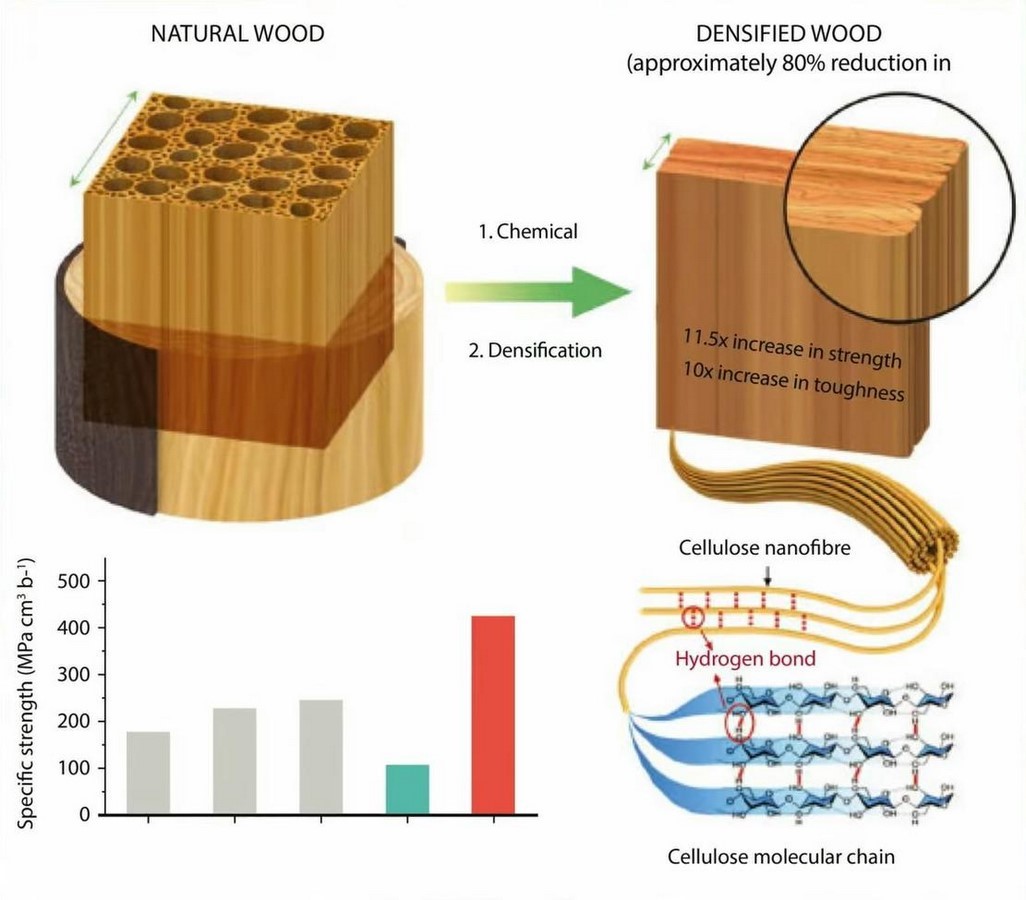
Lignin is the binding element, akin to a brittle cement matrix, and cellulose is the strong fibrous chains within this matrix, functioning similarly to how steel reinforcement bars would. In this natural composition, the wood is lightweight and full of air gaps and weak zones, which makes its mechanical performance (strength and toughness) unsatisfactory for many advanced engineering structures and applications. Even though several methods exist to simply enhance this performance, the resulting wood still retains air gaps and lacks dimensional stability, particularly in response to humid environments, and wood treated in these ways can expand and weaken. This pushes engineers to resort to other, less sustainable options in the market, like concrete and steel, even though wood is more cost-effective.
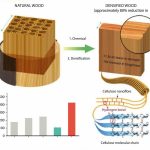
A high-strength engineered wood sample is created by partially removing the lignin or ‘compression’ component using a couple of mild chemicals (chemical delignification). The missing compression is compensated for by the next process, where this softwood is densified at around 65 degrees Celsius, which helps align the cellulose fibres and re-bond with the residual lignin (hot compression).
In this process, the wood not only loses 80% of its original volume but also turns into dense, strong, and remarkably lightweight timber with tensile strength up to 50% greater, and a strength‑to‑weight ratio approximately 10 times higher than structural steel!
Superwood as a More Sustainable Construction Material
This enables superwood to be a potential contender as a go-to material for usages ranging from interiors and facades to structural infrastructure. It retains the same aesthetic benefits of natural wood, like its grain design and ability to take custom finishes using stains.

Currently, demand for strong woods is satisfied by natural wood species that require long growth periods, which is highly unsustainable. For example, if species like teak, mahogany, oak, deodar, and more are harvested faster than they grow, depletion occurs, soil erodes, carbon is released, and the forest’s ecosystem takes a hit.
Superwood, on the other hand, only requires any species from the large range of fast-growing species like poplar, neem, bamboo, rubberwood, and eucalyptus to produce wood that would satisfy the same requirements. This helps absorb and lock in more carbon from the atmosphere (carbon sequestration) and thus aligns with sustainability goals.
Though yet to be compliant with building codes worldwide, superwood shows great promise to develop into being fire‑rated, moisture‑ and pest‑resistant, which is ideal for varied climates, harsher conditions, and exterior exposure. It would not only serve the field of architecture, but also furniture design, automotive interiors and parts for a more lightweight design, and aerospace parts.
The total embodied energy for superwood is estimated at 13,424MJ/m³, whereas steel boasts an embodied energy of 235,500 MJ/m³. Structural steel has significantly higher embodied energy than Superwood: roughly 15 to 18 times greater per cubic meter. Considering sequestrated carbon, Superwood has -0.86 ton CO₂/m³, meaning each cubic metre removes about 860 kg of CO₂ from the atmosphere and keeps it locked inside the building material as opposed to a positive emission value, which releases carbon into the atmosphere (Swann, 2023).
Challenges & Optimistic Prospects
However, the pros come with their own set of cons. At present, superwood is produced on a limited scale, making its cost-effectiveness a potential forecast only if production expands to a larger scale, similar to steel manufacturing today. Due to its robust mechanical properties, ways to work with it are yet to be explored. How might an average Joe utilize this material in their projects? Which common tools would be suitable for working with superwood? What tools would be necessary for its installation?
Moreover, while the primary resource itself turns out to be more sustainable, the impact of the energy used and the disposal of chemical wastes from sodium hydroxide and sulfite used at the delignification stage raises questions on the same issue. Superwood may be well-backed by lab tests, which are conducted in controlled environments, but still lack credibility for its performance in real-world scenarios like effects from UV radiation, seismic environments, cyclic loads, etc.
As of now, there aren’t any completed buildings made entirely of “Superwood” as the material is still relatively new and scaling up for structural applications will take time, testing and certification before it’s used at full structural scale in buildings. Production is only currently taken up by InventWood, a startup based in the same university where Superwood was patented. As funds roll in from those who can support the advent of a sustainable future, it would only be a matter of time until we start spotting superwood in places more than just informative articles and fancy interiors.
REFERENCES LIST:
Superwood is Here! This Amazing New Material Could Change The World! (2025) YouTube. Available at: https://www.youtube.com/watch?v=n4-v3ntYZAs (Accessed: 16 February 2026).
Song, J. et al. (2018). Processing bulk natural wood into a high-performance structural material, Nature News. Available at: https://www.nature.com/articles/nature25476 (Accessed: 16 February 2026).
Cutlip, K. (2024). Study: New ‘super wood’ uses less energy, cuts…, Maryland Today. Available at: https://today.umd.edu/study-new-super-wood-uses-less-energy-cuts-pollution (Accessed: 16 February 2026).
Super Wood could replace Steel (2018) Super Wood Could Replace Steel | Maryland Energy Innovation Institute. Available at: https://energy.umd.edu/news/story/super-wood-could-replace-steel (Accessed: 16 February 2026).
Pangea (2025). What is superwood? – Pangea biotecture, What is superwood? Available at: https://pangeabuild.com/what-is-superwood/ (Accessed: 16 February 2026).
Swann, S. (2023) Final Scientific/Technical Report [Project Name: Superstrong, Low-Cost Wood for Lightweight Vehicles], Office of Scientific and Technical Information. Available at: https://www.osti.gov/servlets/purl/2547033 (Accessed: 16 February 2026).
Superwood Explained: The Miracle Material That Could Reshape Everything (2025) YouTube. Available at: https://www.youtube.com/watch?v=fB60TiL2jFk (Accessed: 18 February 2026).