Urbanism in India is often influenced by population growth, economic changes, and cultural elements. India, one of the most rapidly urbanizing countries in the world, is witnessing massive migration shifts, resulting in the demand for increased housing and infrastructure opportunities. This demand, in turn, has begun to blur the line between formal and informal spaces in a city, with unplanned developments, leading to a phenomenon called “Seeping Urbanism.” While paving the way for several opportunities for urbanism in India, this blending of spaces is continuously posing challenges for India to rethink its urban fabric. This article dives deep into the details of urban seepage in India, exploring the merge of urban and rural spaces.

An Overview of Seeping Urbanism in India
The evolution of urbanism in India is a story that spans thousands of years. This evolution of the country, from ancient cities to modern towns, echoes the city’s rich culture, economy, population, and various factors. The expansion of urban spaces reflects a complex, fluid, and often unregulated character of urban growth where the formal can merge seamlessly with the informal. As cities throughout the country expanded to accommodate a rising population—due to natural increase and mass rural-urban migration—formal and informal spaces became increasingly blurred.
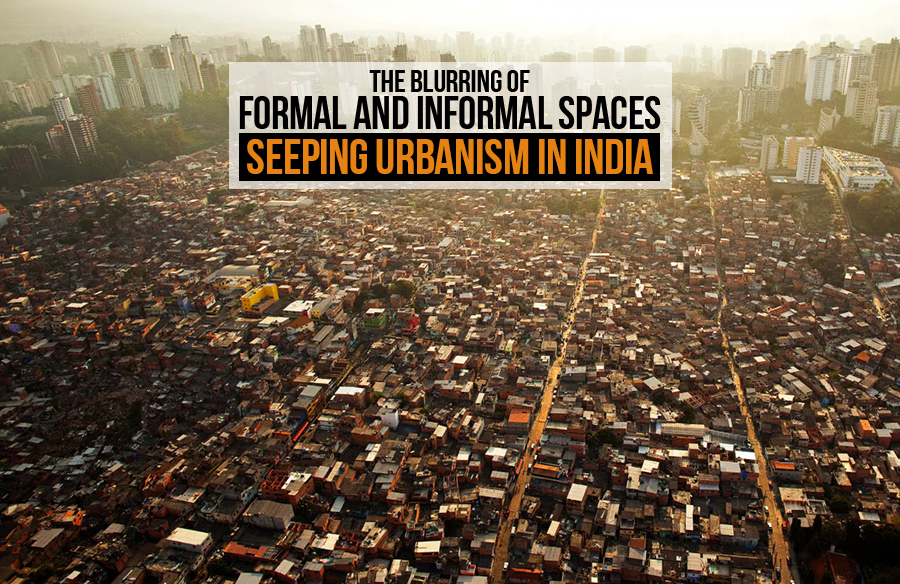
Slums, also known as informal housing settlements, are a growing example of this; although they provide shelter to millions of people, they are rapidly encroaching on urban areas. Moreover, informal activities like street vending, waste recycling, small-scale manufacturing, etc., have become a part of the urban fabric, by fulfilling and satisfying the basic needs and comfort of the users in a formal setting. The growth of these informal spaces is a testimony to the flexibility and resilience of urban communities. Understanding seeping urbanism in India is vital to developing policies and frameworks that cater to informal spaces while valuing their resilience, adaptability, and contributions to the urban economy.

The Thin Line Between Formal and Informal Spaces
Formal and informal spaces, especially in the context of urbanism in India, are deeply interconnected yet contrasting. These communities are shaped by the history, culture, and environment of the city in which they are located. Formal urban spaces are planned, regulated, and politically sanctioned by one or other official means and are usually formed within a structured frame of urban development. Examples of formal urban spaces found in India include gated communities, planned townships, commercial business districts, and government-authorized housing developments.
Informal urban spaces have developed outside the context of any formal rule, generally arising from various reasons including the formal urban sector’s inability to provide housing and employment to an ever-growing urban population. Slum settlements, unauthorised colonies, areas with street vendors, and unlicensed transportation networks are a few instances of informal urbanism in India. This gap between the two settings is beginning to diminish, which in a way, is positive, considering the development of the informal setting. However, the formal spaces lose their uniqueness and privacy. Therefore, establishing a seamless connection between the formal and informal spaces is crucial to balance the seeping urbanism in India.

A Shift in Urban Planning Perspectives
A rapid growth of urban spaces and a revolution in its planning and development can be witnessed as urbanism in India continues to trend. Conventional urban planning in India prioritized orderly growth and structural developments, emphasizing the creation of distinct zones for residential, commercial, and industrial purposes. However, the reality of rapid urbanization, combined with a growing informal setting, is a challenge to these rigid frameworks. Urban planners have developed an increasingly clear understanding that informal settlements and informal economies are not temporary phenomena but integral parts of the urban landscape that fulfill essential housing and employment functions.
This new approach seeks to develop a more inclusive and adaptive society that accepts the dynamic and resilient nature of these informal areas. For example, policies are oriented toward providing basic amenities such as sanitation, drinking water, electricity, and enhanced security, facilitating stability and investment opportunities in such settlements. Urban planning, however, accepts mixed-use spaces that accommodate both formal and informal activities by recognising the economic interdependence of the two sectors. Innovative planning models like participatory planning and community-driven development are the other positives of this shift. This fresh perspective toward seepage urbanism in India moves away from conventional ideologies, and standard urban designs. It represents a transition toward a more equitable, ecologically sustainable, and socially inclusive city.

Urbanism in India: Efficient Integration of Formal-Informal Settlements
A successful model that now synthesizes the process of upgrading slum settlements in Ahmedabad’s Slum Networking Programme (SNP), which was initiated in the 1990s. It aimed to enhance infrastructure and services to slum localities while recognizing the rights of the slum dwellers to occupy. The programme, funded by the Ahmedabad Municipal Corporation and NGOs, provided basic services like clean drinking water, sewage line connection, and paving of roads. With this compromise of securing the land tenure of residents, the residents were able to invest in their homes, which led to sustainable improvement in living standards without any displacement. SNP focuses specifically on the need for municipal involvement and collaboration with NGOs. Hence acknowledging informal spaces as indispensable to urban life offers opportunities for developing urbanism in India and creating more inclusive planning strategies in which formal and informal spaces coexist harmoniously. Cities following such an integrated approach create the space for resilience and adaptability while promoting urban growth.

Future of Seeping Urbanism in India
Cities are beginning to realize the value that informal settlements hold for the urban economy and society rather than a hurdle for modern urbanism in India. The shift includes mixed-use zoning plans that revolve around land for residential, retail, and industries in close proximity to one another. Adaptive policies also promote in-situ development—upgrading informal settlements on-site instead of relocating residents, enabling communities to keep their social and economic networks intact. Formalisation of land rights and tenure security for informal settlements is emerging to become a central pillar of urban policy. This will motivate residents to invest in and improve their neighborhoods and gradually upgrade both infrastructure and housing quality. Increasingly, the sustainable form of urban policy emphasizes providing basic services—water, sanitation, electricity, and transportation—in some of the most deprived informal areas, prioritizing equitability. Smart and inclusive technology is integrating solutions to urbanism in India in both formal and informal spaces, embedding technology to make tech-enabled opportunities more accessible to all citizens.
Thus, in India, seeping urbanism has become a growing trend where formal and informal urban spaces intersect. Informal settlements have become critical for urbanism in India, providing affordable housing and supporting livelihoods. Challenges like lack of infrastructure and security against settlement pose particular challenges. This concept of seeping urbanism has the potential to develop more inclusive, sustainable, and resilient cities. By embracing seeping urbanism, cities can harness the potential of all residents, cultivating environments where economic opportunity, environmental sustainability, and social equity are accessible to all. Therefore, the future of urbanism in India lies in recognizing the importance of both formal and informal spaces and fostering urban policies that integrate and support them.
References:
- futurearchitectureplatform.org. (n.d.). Connecting the Formal and Informal. [online] Available at: https://futurearchitectureplatform.org/projects/0c33961c-5116-40e8-937a-7144cd0fbf08/.
- Anon, (2023). Exploring Indian Urbanism: The Growth Of Indian Cities. [online] Available at: https://urbandesignlab.in/exploring-indian-urbanism/.
- Wikipedia. (2022). Urbanization in India. [online] Available at: https://en.wikipedia.org/wiki/Urbanization_in_India.
- Rajesh, J.A. (2021). In Situ Redevelopment_Ramapir No Tekro, Ahmedabad. [online] Cept.ac.in. Available at: https://portfolio.cept.ac.in/2021/m/fp/housing-project-studio-uh4001-monsoon-2021/in-situ-redevelopment-ramapir-no-tekro-ahmedabad-monsoon-2021-puh20023 [Accessed 3 Nov. 2024].
- Uni.xyz. (2024). UNI | Journal. [online] Available at: https://uni.xyz/journal/harnessing-urban-informal-spaces-a-deep- [Accessed 3 Nov. 2024].
- Yakubu, P. (2024). How Do You Design for Informality? [online] ArchDaily. Available at: https://www.archdaily.com/1012095/how-do-you-design-for-informality [Accessed 3 Nov. 2024].
Images:
- Indian Liberals. (2024). Whithering Indian Urbanisation? – FP Antia – Indian Liberals. [online] Available at: https://indianliberals.in/content/whithering-indian-urbanisation-fp-antia/ [Accessed 3 Nov. 2024].
- International Institute for Environment and Development. (2019). Climate resilience and informal settlements: the urgent need to focus on how power and knowledge interact. [online] Available at: https://www.iied.org/climate-resilience-informal-settlements-urgent-need-focus-how-power-knowledge-interact [Accessed 3 Nov. 2024].
- TheCityFix. (2023). 5 Ways India Can Use Innovation to Meet Its Urbanization Challenges |. [online] Available at: https://thecityfix.com/blog/5-ways-india-can-use-innovation-to-meet-its-urbanization-challenges/.
- Desai, D. (2022). The Sabarmati story: A river is more than a usable resource – Question of Cities. [online] questionofcities.org. Available at: https://questionofcities.org/the-sabarmati-story-a-river-is-more-than-a-usable-resource/.
- GAUTHAM SELVARAJAN (2021). KATHIPARA URBAN SQUARE INAUGURATED. [online] Magzter.com. Available at: https://www.magzter.com/ja/stories/Newspaper/The-New-Indian-Express/KATHIPARA-URBAN-SQUARE-INAUGURATED [Accessed 3 Nov. 2024].