The modern Asian city, as experienced by automobiles or light rail, is an everyday experience for city dwellers. Will the experience of walking, pausing, and “seeing” unlock a different beauty of Asian urbanism? Third-world aesthetics are often overlooked or neglected. The project’ Bangkok Bastards’ by Bangkok-based CHAT Architects, founded by Chatpong Chuenrudeemol, uncovers this aesthetics and showcases the incredible innovation and adaptability of informal spaces when they are ‘bastardised.’ This project resonates with the messiness, the unregulated, the unauthorised, and the informal spaces of the city, presenting them in a new light.
Asian Urbanism
Bastards:/ˈbastərd/
- Someone or something illegitimate in birth.
- An unpleasant or despicable person or thing.
Self-funded and self-motivated, Bangkok Bastards is a ‘homegrown’ celebration of the everyday life of city inhabitants in Bangkok and many other Asian cities. The modifications and adaptations they make to the everyday spaces and objects, such as the chumchon (slum), a local street vendor cart, a bastardised shophouse, or a make-shift sidewalk bench, are a testament to their creativity and resilience. Chatpong Chuenrudeemol states, ‘Bangkokians walk past Bastards every day, but would never consider it as serious design or Architecture’. ‘We record, document, and celebrate Bangkok Bastards because we feel that they are examples of authentic, direct, and solutions in architecture that can be the foundation of an authentic, locally rooted architecture in Thailand.’
The notion of the “Bastard” recalls verbs synonymous with terms like hack, hybrid, adapt, and mutate.
Everyday Asian life adapts the everyday urban environments into innovative functional spaces characterised by temporariness and messiness. This depiction forms the aesthetics of Asian urbanism. Such aesthetics of Asian urbanism, whilst illegitimate, as Chat labels it, Bangkok Bastards has been awarded the 2020 Silpathorn Award laureate in architecture from Thailand’s Ministry of Culture – the country’s most prestigious award for contemporary artists.
An obsession with details
While scrolling through the Bangkok Bastards website, the background music of “Studio Lam Plearn” by The Paradise Bangkok Molam International Band brings to life the spirit of everyday Bangkok.
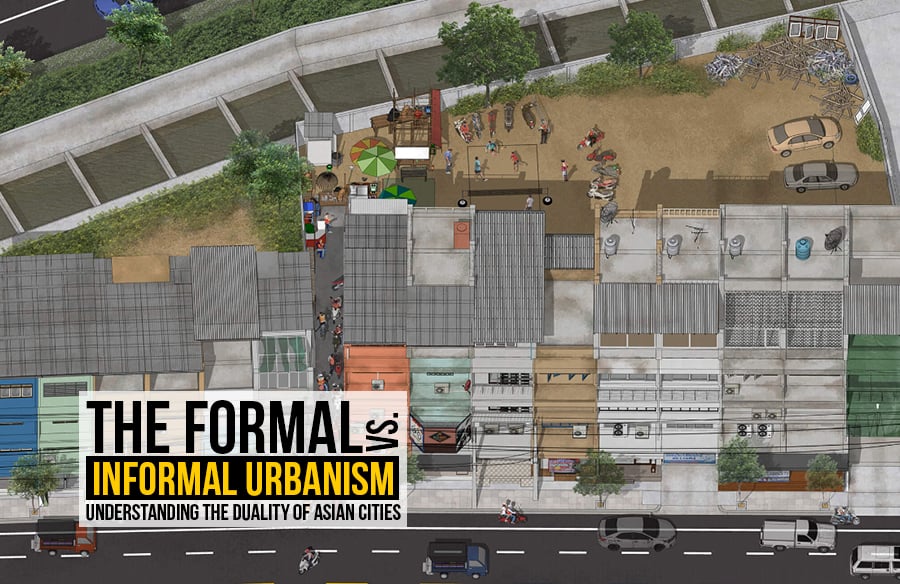
Contrary to the formal discipline and theories of architecture and urbanism, Bangkok Bastard is an antithesis of that. Bangkok Bastard offers an alternative microscopic perspective of Asian urbanism – it captures every little detail of the built environment, every single object like a towel, a toothbrush, a plate, and a shoe; it captures life! Categorised into typologies of urbanism, architecture, ecology, and objects, urban life is evidenced in each illustration and represented in the most basic form of architectural drawing: the axonometric, plan, section, and elevation.
The alley, the street, the road and the urban void


Let’s take a look at a few typologies of “bastards”. The food alley is a typical hack of Asian streets. The documentation of the food alley called “Food Plus” illustrates every detail, such as the food kiosks, the tables, chairs, pathways, the air con compressors, and the signages, including the movement of the everyday users illustrating the life brought about by the organised chaos of an informal alley. Whilst these may be seen as unstructured, the adaptations of the linear narrow space by the food vendors illustrated more than thirty food vendors and two customers “long tables” are squeezed into an 85-meter long, 4-meter wide, narrow gap between a bank and retail shophouses in Bangkok’s popular Siam Square.


The Bed-Sheet Restaurant illustrates how a hard edge of a main vehicular thoroughfare adjacent to a water reservoir is hacked into a soft edge delineated by dining spaces defined by temporary elements such as rope, construction tarp, beach umbrellas, plastic mats, and twin-size bedsheets. These elements bring colours to the muted landscape, and through the spatial intervention, the edge now becomes a place of life. The spatial hacks used minimal intervention to create space. Each outdoor “eating “room” contains a large umbrella with a concrete-filled tyre stand for overhead sun protection, a local woven plastic mat as a dining surface (local Thais prefer eating on the ground), and lively cartoon bedsheets as privacy screens that create privacy from speeding cars just a few centimetres away.


Asian cities are also filled with a network of canals (known in Thai as Klong), which are fast disappearing. The mapping and dissection of the Klong through the lens of Bangkok Bastards reveals the life of the Klongs. Located in the affluent Thonglor district, the Klong Peng Canal Shantytown. The unique concrete canal crossbeams retrofitted into the canal have been repurposed by locals as narrow footbridges. These spatial extensions form alternative convenient and innovative pathways connecting opposite spaces.


Motorcycles are popular transportation in Asian cities. In Bangkok, these motorbikes are used as moto-taxis and organised into win-stations throughout the city. These stations are injected into the narrow alleys at busy intersections, where riders queue up to await potential passengers. The alley also leads to an empty lot in the rear, which has been taken over as a mini ‘win’ station with various accommodations: a covered outdoor lounge, motorcycle service station, motorcycle parking, outdoor kitchen, and even a chicken coop (for cockfighting-enthusiast drivers).
Drawing from everyday urban life, Bangkok Bastards reveals the unique and often overlooked aesthetics of Asian urbanism. Its obsession with details, through the simplest form of representation, depicts alternative realities of the Asian city—one that is unregulated, unstructured, unique, authentic, and local. These spaces illustrate urban alternatives that are often missed by urban dwellers and exude a unique informal quality of the Asian city, inviting a closer look and deeper appreciation.
References:
Chat Architects (2024). Bangkok Bastards. [online]. Available at: https://www.bangkokbastard.com [Accessed 10 August 2024]