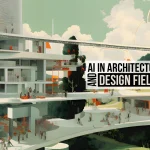
Architecture and design have long been the byproducts of lived human experiences, imagination and indicators of creativity for years to come. This process has always required more than just pure technical abilities but a significant amount of emotional intelligence, cultural awareness, and the ability to interpret human needs and desires. However today we stand at the interjection of utilizing AI over thinking independently, which is rising at a fast pace posing a challenge to the creative industry including architecture.
AI is capable of producing results in seconds from a plethora of conceptual sketches, analyzing climatic geo spatial data, modelling plugins, basic energy calculations to even producing photorealistic visualizations and walkthroughs. It is quick, analytical and unbiased. So will architecture and design continue to remain AI-free, or does an AI-powered future become inevitable?
To answer this, we must first remind ourselves that architecture is at once a product and a process: it results in drawings, models, and buildings-but what makes architecture meaningful is the process through which ideas are developed. The greatest architectural achievements were never just technical outputs; they were responses to context, culture, climate, economics, politics, emotion, and identity. AI is extraordinarily capable at processing information, but information alone does not equal meaning. Architecture deals not just with “what works,” but with why something should exist in a specific place, for specific people, at a specific moment in time. That dimension is still deeply human.
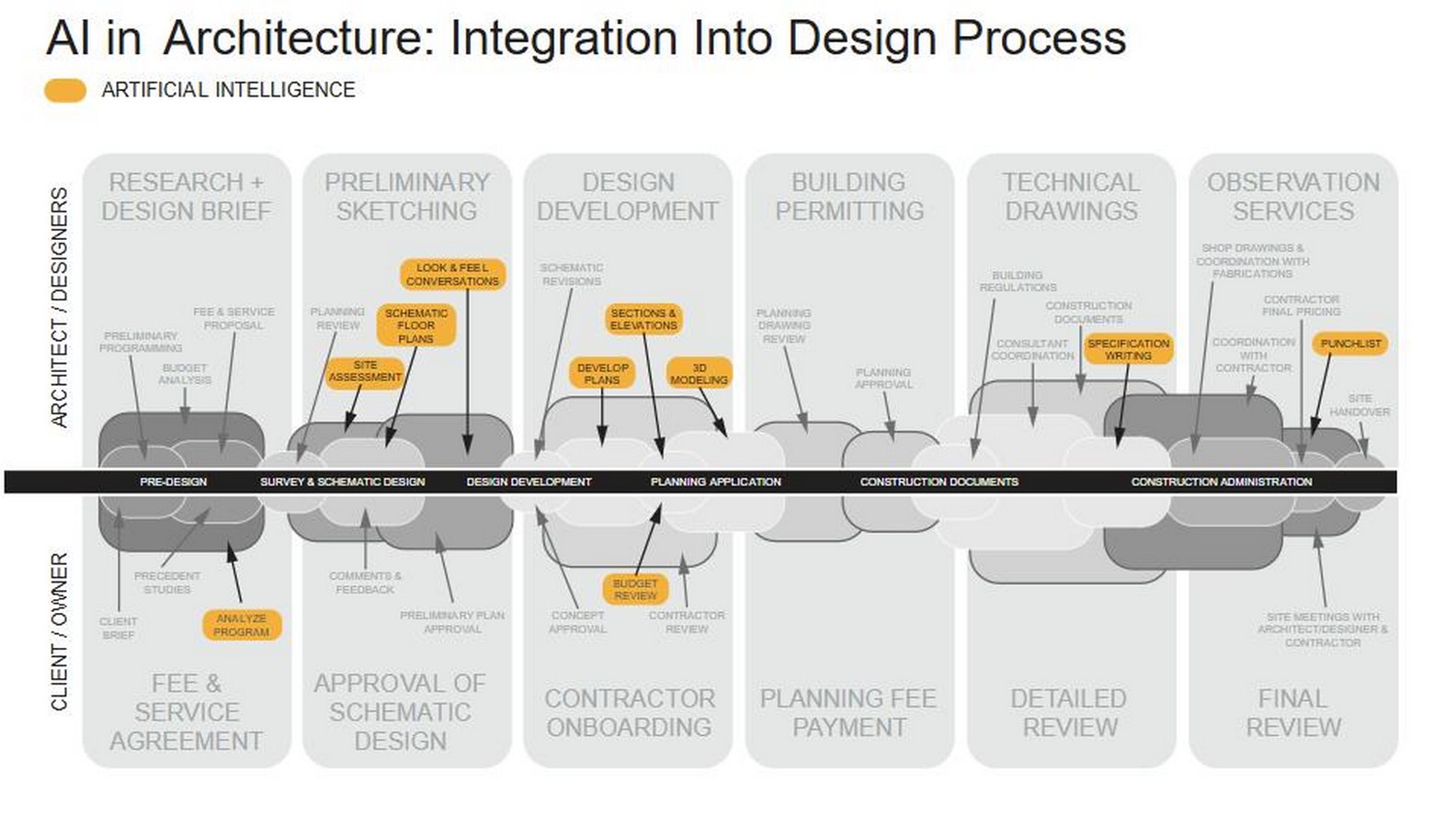
However, AI is no longer sitting outside the profession—it is already inside. Parametric tools, machine learning optimization, automated space planning, and algorithmic material mapping are already assisting firms worldwide. AI is changing architectural workflows in three major ways:
AI as a Tool – helping designers work faster
AI as a Collaborator – suggesting solutions humans may not think of
AI as a Generator – producing entire design concepts independently
The first is widely used and is common, the second is emerging. The third is where ethical and professional boundaries begin to blur the lines. An important question arises wherein if AI is used to design a fuly functional building concept in seconds where does the role of an architect or designer come in? Yet the reality is more nuanced. Ai can generate various ideas for the form of a building but cannot yet understand spatial experiences, emotion and culture. It can simulate daylight, but not emotion. It can optimize circulation, but not community.
Architecture is not just the organization of space—it is the organization of human experience. And human experience is shaped by memory, history, belief, aspiration, trauma, ethics, and values, none of which can be fully quantified by algorithms.

But dismissing AI entirely would be naïve considering the fact that the architecture profession is changing with the challenges faced in the built environment changing as well. Cities face an immense amount of complex issues: heat stress, housing shortages, biodiversity loss, social inequality, accessibility, deforestation, waste management, pollution, and the need for sustainable material practice. The brains and effort of one person or even a team may not be sufficient to process every detail. Ai can do this effortlessly with thousands of data sets at lightning speed and reveal results that humans might miss. This could imply that AI could become the next drafting revolution, just as CAD and BIM once were. When digital drafting software and digital tools arrived people feared the death of hand drawing, but instead it opened newer doors to enhance architectural potential. AI may do the same, if framed as tools we utilize to help us rather than an absolute replacement to creativity.
Still, one question remains: will clients eventually accept AI-designed structures without human involvement? It may happen with certain building types, warehouses, parking structures, industrial shells, and repetitive housing blocks where efficiency matters more than creating emotional experiences having a link to culture and context. But for cultural institutions, public plazas, memorials, schools, religious buildings, museums, and homes, people still want authorship, accountability, empathy, and vision. They want someone they can look in the eye and ask:
“Why did you design it this way?”
It is impossible for any AI engine to answer that question in a way that is an immediate reflection of the complexity in terms of people’s lived human experiences.
There also arises the hurdle of legal responsibility. If a building designed by AI collapses because of a plethora of reasons including fire related issues, weak structural systems or data complexities, who is to be held responsible….. The software, the engineer, the architect, or the company that trained the model? Laws in most countries still assume that design responsibility belongs to a licensed professional who has ethical obligations. Until legal frameworks change, fully AI-generated buildings may remain rare.
It is essential to remember that architecture is not only about solving problems but also expressing identity. Buildings are cultural icons; cities house collective memories. People resort to travelling not to discover the most optimized structure but to see the ones with soul. The Great Pyramid, the Forbidden City, the churches of Goa, the Sydney Opera House, the mud mosques of Mali are not algorithmic. They are stories in built form narrating tales of past decades.
So will architecture remain AI-free? No. AI is already here, and it will continue to reshape how we design, document, and build. But will architecture become AI-dominated? Not entirely because architecture is a subject having innumerable facets to the human experience. The future can rather be perceived as not AI or architects, it is AI with architects. The strongest ideas will not be born out of completely rejecting AI, nor from being overly dependent on it, but the ones who use it thoughtfully, ethically, and creatively, while remembering that the purpose of building is not to serve software, but community.
Citations:
Henning, J., 2023. How To Use AI In Architecture: 6 Phases Of The Design Process. Available at: https://rascoh.com [Accessed 23 November 2025].