If you are to ever walk across open fields or trek across sunny paths, at some point you’d be sure to find yourself looking for a space that provides respite from the heat and light from the sun, however tiny that space is– perhaps a niche into a cave, a spot formed by a dark cloud passing by, a dark area under a tree. The presence of shade becomes an element that defines the quality of a space; it allows an open ground to gain a characteristic of refuge. Architecturally speaking, it acquires a ‘sense of place.’ From this point onwards, the place starts to attract a diverse range of users, and shade attracts almost everyone, from humans to animals and even low-light plants.
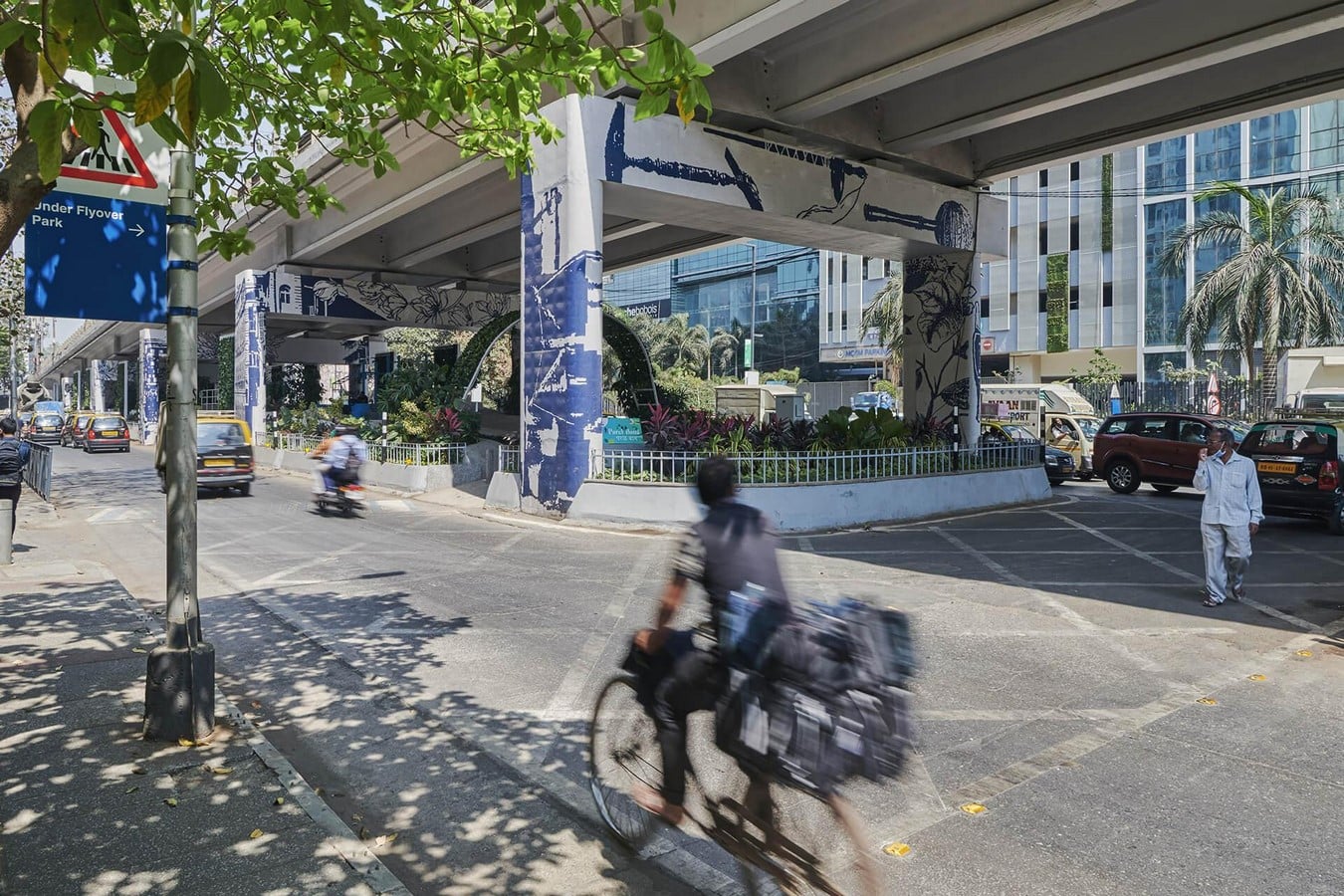
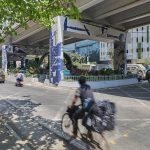
When a source of shade begins to exist next to any major urban road, it wouldn’t be wrong to expect all kinds of people to gather collectively in and around that space to wait for their rides, stand and chat, relax, or, for those without homes, catch up on some sleep. In this fashion, much like a growing organism, the groundwork for a public space is created. It is observed that this is exactly the phenomenon that drives the unregulated ‘chaos’ that ensues underneath numerous flyovers that are hastily built solely for the purpose of redirecting a percentage of incoming traffic.
The primary aim of flyovers is to take up less land than solutions like the cloverleaf junction. However, it is often overlooked that the vast areas of shade, invisible on aerial Google Maps views, have inadvertently converted previously sunlit and unusable spaces to cool, comforting ones.
Renowned Brazilian urban planner Jaime Lerner’s theoretical idea still hangs low in the air here: “A city grows like an organism.” An organism responds to stimuli to maintain homeostasis. So it is safe to expect that the shaded space generates use without instruction, transforming the ground area the authorities wished to leverage into a living space. Flyovers all across the world create some of the largest unbroken and continuous shaded environments in the urban fabric. Despite every urbanite passing through such unregulated spaces frequently, they manage to just fall out of the scope of the hands that have the power to improve these conditions.
Under The Belly of Modern Flyovers
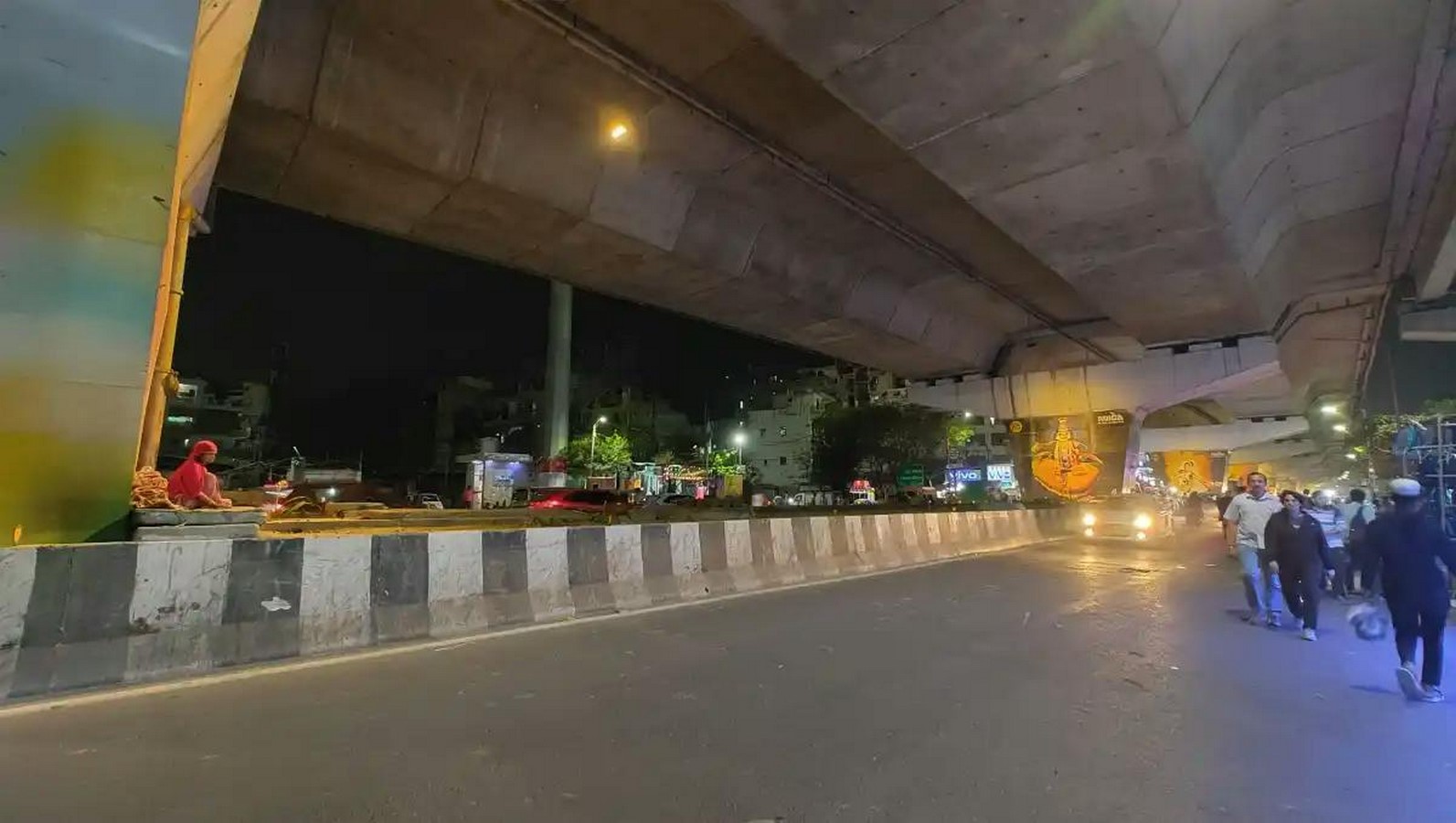
Though this ground area acts as a new umbrella during the intense summers and the windy monsoons, a coin comes with two sides. On the alarming side of matters, shade brings with it not just shelter, but also darkness.
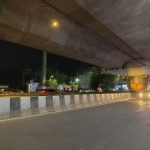
A darkness that tends to breed within it secrets, activities, and behaviors that would not comfortably occur in daylight. Large monumental pillars of the bridges block sightlines, and spaces slip beyond the eyes of the passersby on the street. The public areas that people depend on for respite during the summer and monsoon gradually start to make casual users think twice before approaching such a risky area.
This way, the land goes back to being selectively unusable, in a social sense, and now poses a risk of causing more harm than good. It’s interesting to observe that significant public funds, ranging anywhere from 60 to 100 crores (Anbuselvan, 2025), are allocated to construct these projects which ultimately serve a comparatively small portion of the total users in that area.
As reported by the government, over a few years, these flyovers accumulate a net economic profit due to the man-hours and fuel saved, while also reducing the carbon footprint at a level equivalent to the absorption rate of several lakhs of trees. Although these impact numbers seem huge, it is critical to analyze whether these profits benefit the majority of people affected by this infrastructure or just a select few who reap the benefits of the said profits.
This emergent public space is another example of how the lack of responsibility, design intent and regulation, considering the perspective of all kinds of users can turn a potential third space into a risk factor for the community, gradually moving the space into social exclusion and a local hub for small-time crime.
This condition can be addressed in mainly two ways: replacement and redesign.
Replacing Existing Flyover Conditions
The first approach would be to study and locate existing flyovers that currently fail to solve the issues targeted during their construction. Over the past year, many professionals have noted that flyovers just move traffic from one place to another, not fix congestion (Jairath, 2025). Simply elevating a junction does not solve the problem. Metropolitan citizens may also notice that the initial days after a flyover is opened welcome better flowing traffic. But sooner or later, more cars appear, and this turns into a cycle.
Why can such structures not be demolished? The land could then be reclaimed as restorative public space instead of being left as permanent concrete scars.
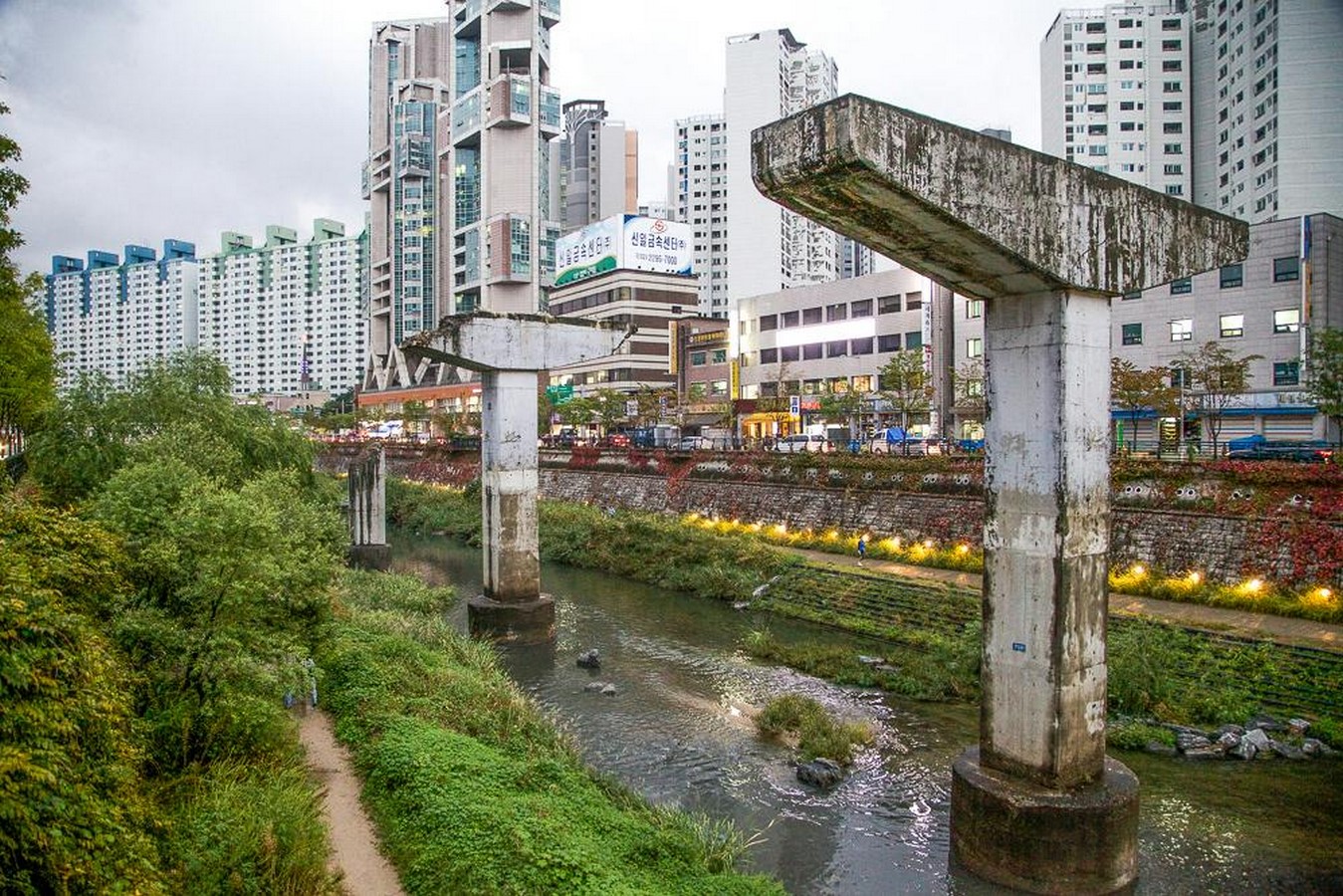
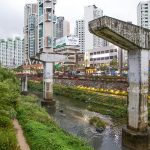
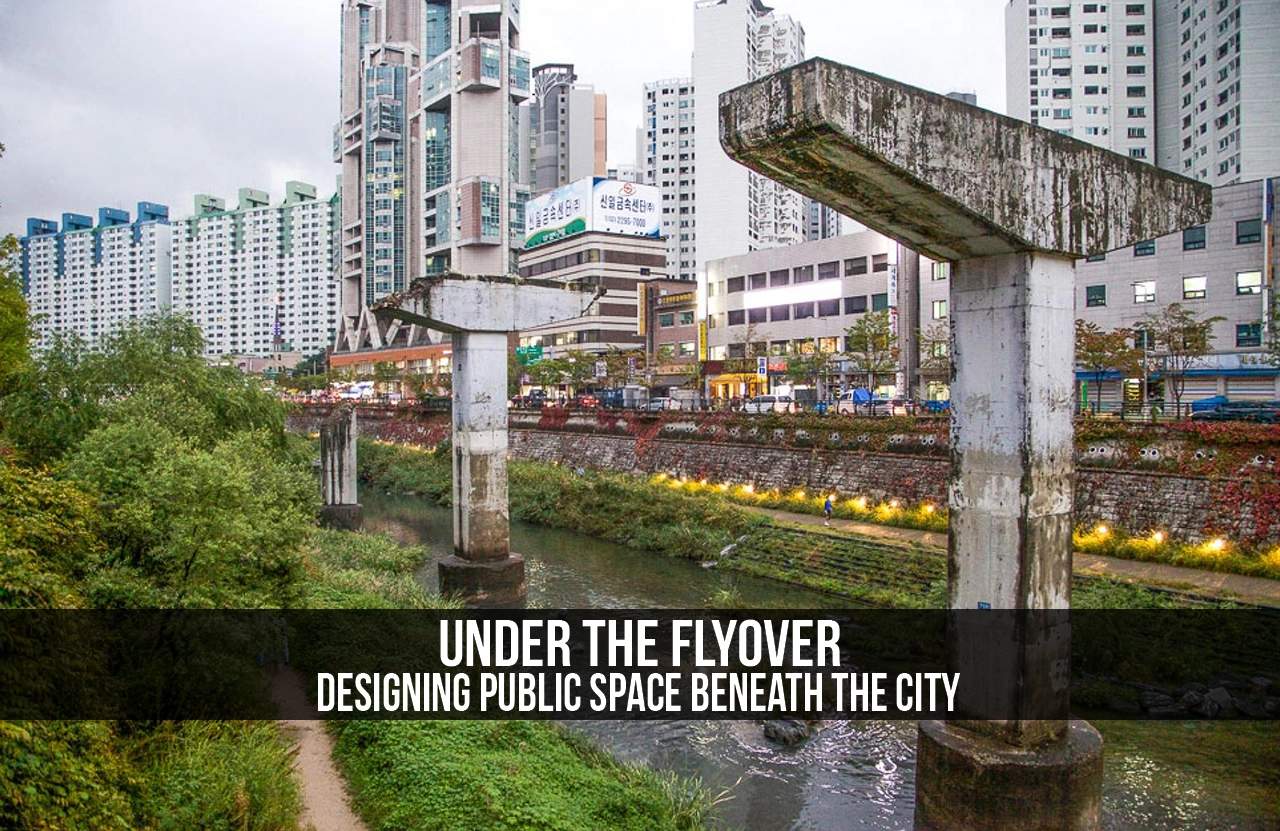
An example that everyone looks up to under this replacement strategy would be Seoul’s Cheonggyecheon River Linear Park that resulted from the demolition of an elevated highway in 2003. It is currently a well-maintained greenway spanning a length of 6-kilometers that brings in about 60,000 pedestrian visitors every day. The impact numbers here show an increase in biodiversity, an increase in the value of nearby land, enhancement of local air quality, flood protection, and an increase in public transport ridership (Robinson, 2024).
Similar strategies implemented in other cities, such as San Francisco and Toronto, also go to show that a flyover may not be necessary, as improving walkability and pedestrian experience encourages more people to use public transportation, taking out wheeled vehicles from the equation entirely.
Redesigning The Public Spaces Underneath
The deteriorating quality of public spaces under flyovers is shaped by social, visual, and physical factors that deter people from occupying them. There is a concept called “Eyes On The Street,” as described by popular urban design theorist Jane Jacobs in her book The Death and Life of Great American Cities (Jacobs & Fuller, 2016), which discusses vast topics on how cities have their own sense of life. Continuous visibility and natural surveillance of strangers that gather under the space is key to activating public spaces and making it harder for an anti-social atmosphere to take shape. Currently, massive and opaque concrete columns turn into visual barriers by completely obstructing sightlines. Instead of feeling safe and part of a community, users feel uncertain about who’s watching them and whether the intentions surrounding them are cruel or not.
Hence, a sense of danger is naturally triggered by inadequate lighting in the underbelly of these structures, concealment (large physical barriers), and a lack of natural surveillance.
Possible Integrated Solutions
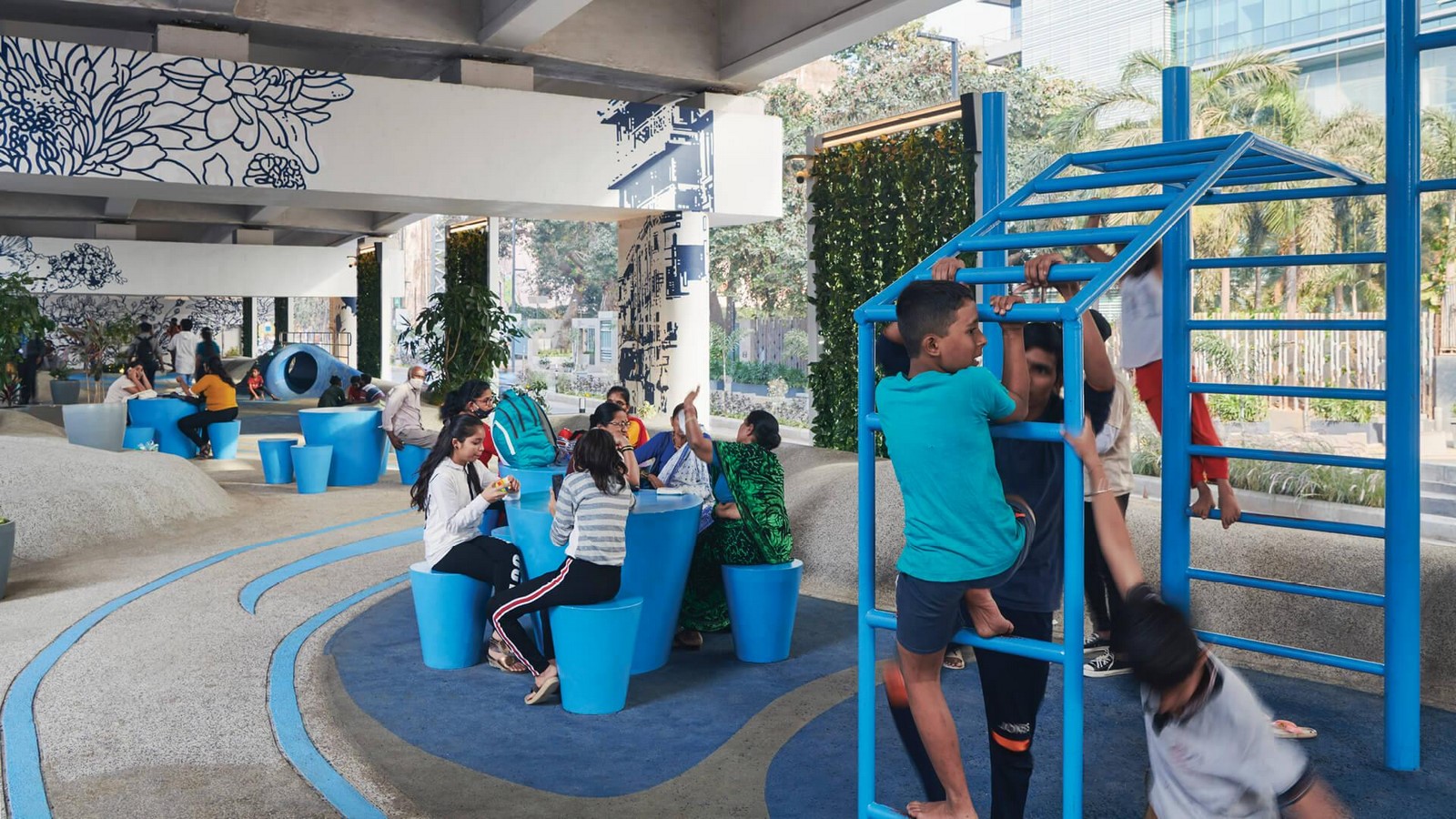
There are a number of ways to turn these “leftover voids” into “active public spaces.” At the very least, providing lighting can eliminate dark areas and enhance surveillance even after the sun sets. With the current technology, it is possible to rethink flyover engineering in order to create clear sightlines through space. Is it possible to design the columns to be more see-through? How can blue-green infrastructure be incorporated? The levels of pollution, heat, and noise can be brought down by such solutions. Increased cooperation between transportation authorities and urban planners in order to account for the mobility of human lives, rather than sweeping those matters under the rug.
They might loosen traffic bottlenecks for a while, but they are also seen to suffocate the city’s ability to breathe as a living being. Spaces beneath flyovers have the potential to be the lungs of a city that enhance urban life rather than serve as a symbol of neglect.
In order to ensure that public space is given the same priority in planning decisions as vehicle movement, modern cities must balance infrastructure for mobility with infrastructure for people.
REFERENCES LIST:
Bharadwaj, K.V.A. and Gowhar, I. (2014) Spaces under flyovers prone to crime in Karnataka, The Hindu. Available at: https://www.thehindu.com/news/national/karnataka/spaces-under-flyovers-prone-to-crime-in-karnataka/article6337899.ece (Accessed: 11 January 2026).
Dubash, K. (2025) Are flyovers the problem or the solution to traffic woes in Indian cities?, ITDP India. Available at: https://itdp.in/are-flyovers-the-problem-or-the-solution-to-traffic-woes-in-indian-cities/ (Accessed: 11 January 2026).
Jacobs, J. and Fuller, M. (2016) The Death and Life of Great American Cities. London: Macat International Limited.
Directorate of Information & Publicity Government of NCT of Delhi (2016) Directorate of Information & Publicity. Available at: https://publicity.delhi.gov.in/publicity/six-lane-mukundpur-chowk-flyover-inaugurated-rs-12-crore-saved-25th-november-2016 (Accessed: 16 January 2026).
Anbuselvan, B. (2025) Teynampet-Saidapet flyover is TN’s costliest at Rs 195 crore per km, The New Indian Express. Available at: https://www.newindianexpress.com/states/tamil-nadu/2025/Aug/18/teynampet-saidapet-flyover-is-tns-costliest-at-rs-195-crore-per-km (Accessed: 16 January 2026).
Robinson, A. and Myvonwynn Hopton (2011) Cheonggyecheon Stream Restoration Project, Landscape Performance Series. Available at: https://doi.org/10.31353/cs0140 (Accessed: 16 January 2026).
Jairath, I. (2025) Why building bridges may do more harm than good: Delhi news, The Times of India. Available at: https://timesofindia.indiatimes.com/city/delhi/why-building-bridges-may-do-more-harm-than-good/articleshow/124296053.cms (Accessed: 16 January 2026).