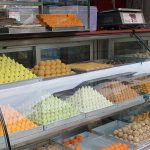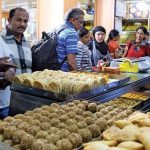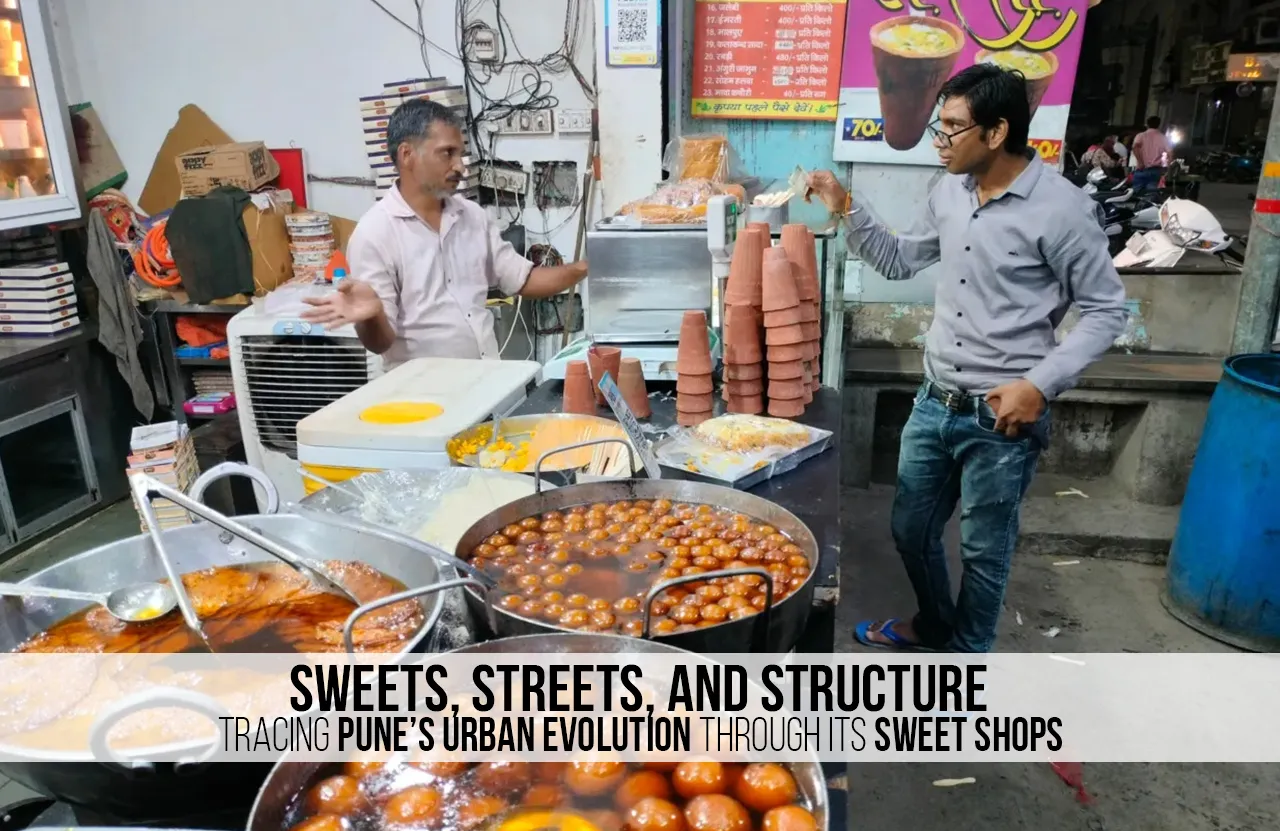
Every festive season in Pune, queues spill out of sweet shops: people balancing boxes of sweets and savouries, negotiating tiny counters, calling out orders over the din of frying ghee and the whir of ceiling fans. The air smells of sugar, cardamom, and anticipation. These scenes repeat across the city, from the narrow lanes in Budhwar Peth to the arterial stretches of Bajirao Road, each shop a small stage in the larger theatre of the city’s life.
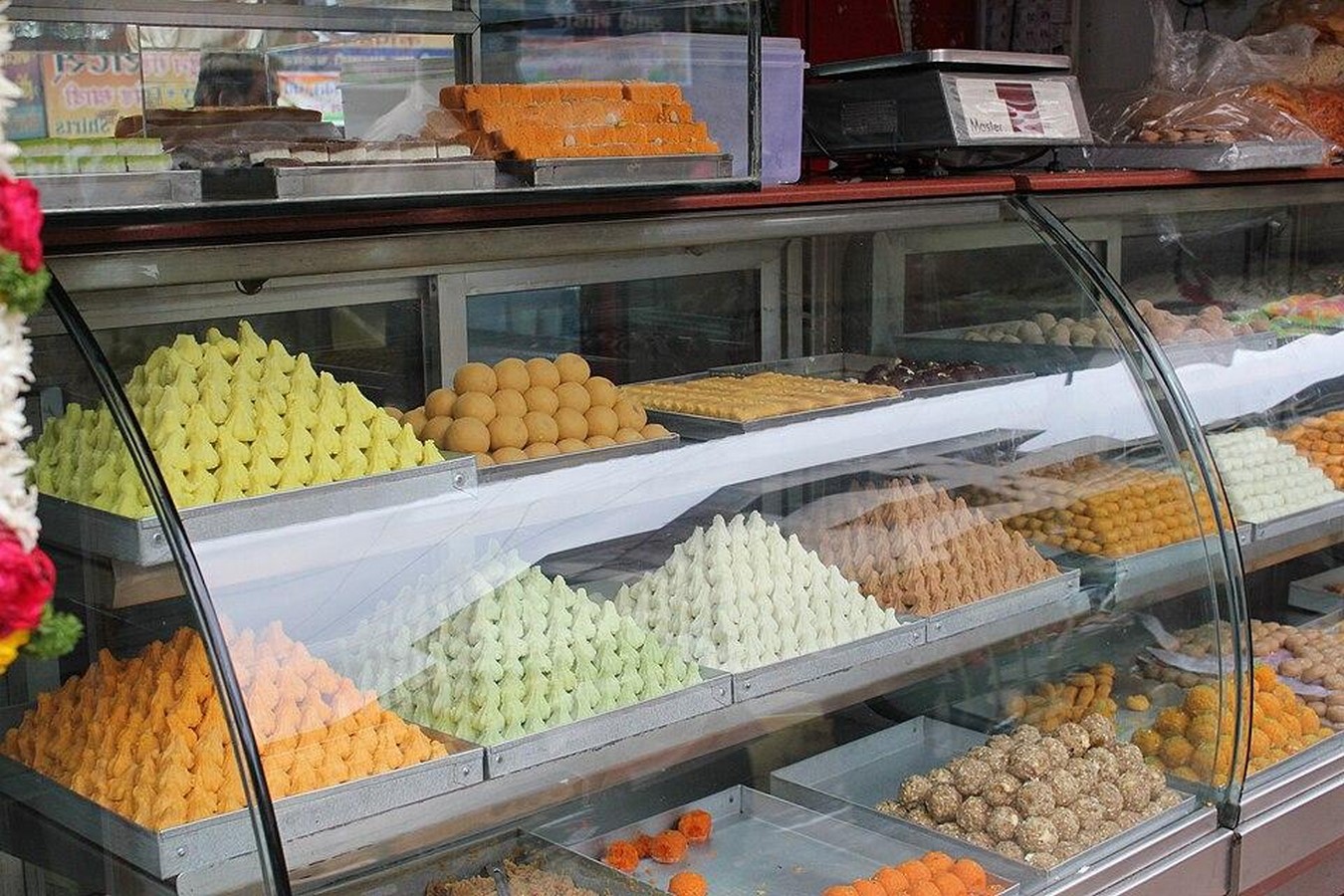
Sweet shops in Pune are more than destinations for confections; they are embedded in the city’s cultural identity and collective memory. They witness the changing pace of mornings and the festive surge of evenings, quietly narrating stories of continuity and transformation. Their interiors, façades, and circulation patterns mirror evolving social habits, consumer expectations, and the broader urban pulse. While they vary in scale and expression, these shops together capture the everyday architecture and sociocultural demeanour of the city in a microcosm.
This case study focuses on Chitale Bandhu Mithaiwale, a contemporary icon of the city’s sweet shop culture, situated within a continuum that includes older establishments like Dagdusheth Halwai and other mid-century and contemporary names. Together, they reveal how even the most ordinary commercial spaces can articulate urban histories, design sensibilities, and social insight, thus offering a tangible, human lens through which to understand Pune’s urban evolution.
Design and Urban Context
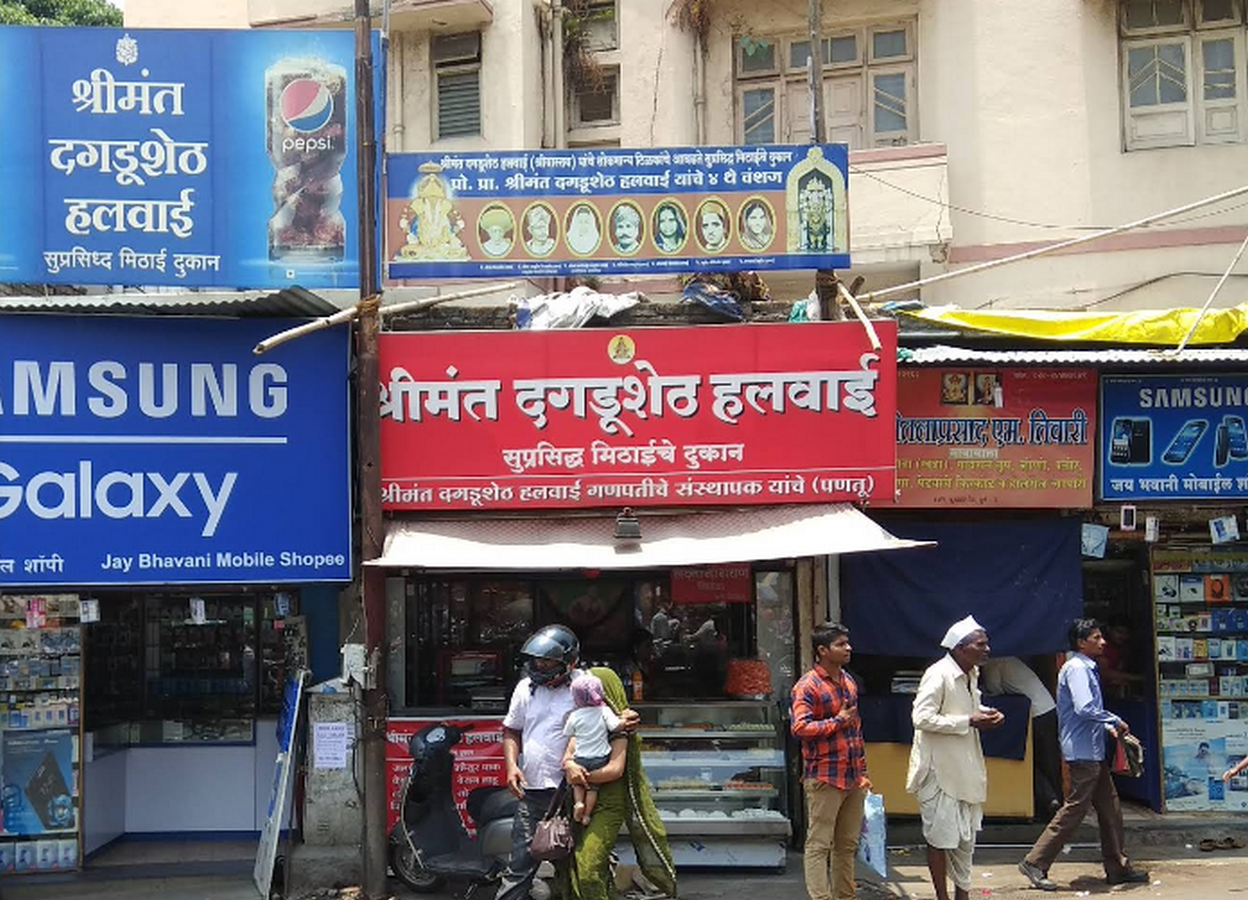
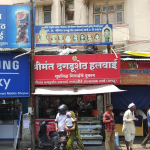
One of Pune’s most beloved deities, the Dagdusheth Halwai Ganpati, traces its origins to the very same halwai whose modest sweet shop still stands in Budhwar Peth. Established over a century ago, Dagdusheth Halwai remains quietly a part of the dense historic fabric of the old city. Its compact design, consisting of a single display wall, a functional counter, and a plain red shutter, reflects the pragmatic sensibility of its time. The shop’s architecture is not one of spectacle but of endurance: small in scale, deeply integrated with the narrow streets and flanked by the wadas around it. The frontage opens directly to a busy thoroughfare and a widened plaza beyond, blurring boundaries between the sacred, the commercial, and the civic. Here, architecture serves continuity, not innovation, and preserves a spatial memory that has evolved through necessity.
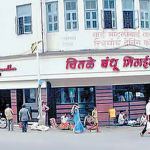
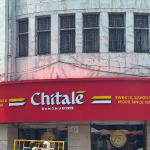
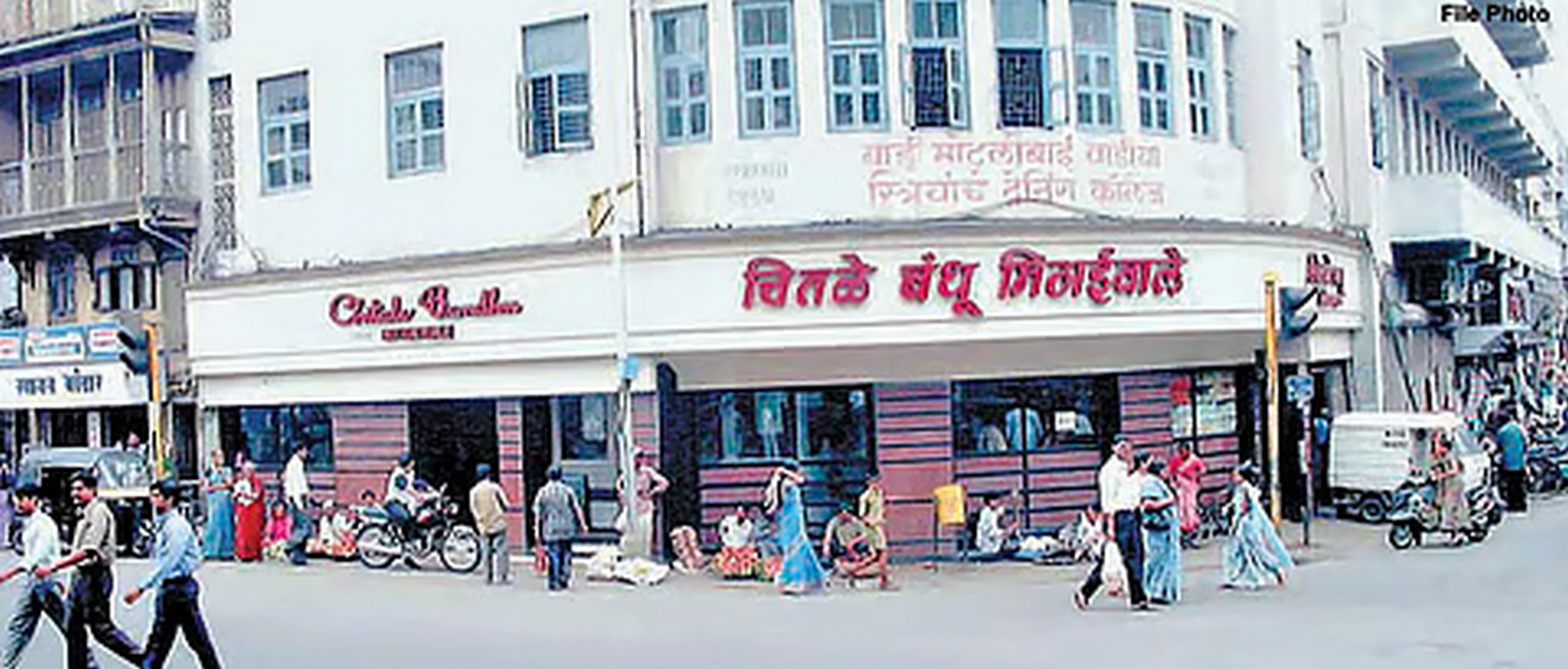
No discourse on Pune’s sweet shops is complete without one name: Chitale Bandhu Mithaiwale, a true cultural icon. Established in the 1950s, the first store of this popular sweets and snacks enterprise still stands proudly on Bajirao Road, even as the brand has expanded to over seventy-five franchises. With its rooted yet transforming identity, it offers a contrasting yet complementary narrative. Housed on the curved corner of an Art Deco building, the shop negotiates both its presence as a neighbourhood fixture and as a city-wide symbol of identity. Originally, the façade featured dark polished stone and a simple wooden signboard reflecting the familiar simplicity cultivated by the old guard. Today, vibrant red signage and marketing elements, including images of cricket legend Sachin Tendulkar, signal a renewed emphasis on visibility and engagement, driven by the younger generation of the brand. Architectural elements, from the curved corner and street connectivity to the modulation of interior spaces, depict a relation to urban circulation, pedestrian interaction, and the city’s evolving patterns. Chitale is more than a sweet shop; it is a lens through which the story of Pune’s modern urban evolution can be read, blending tradition, community memory, and contemporary urban sensibilities.
Materials, Construction, and Evolution
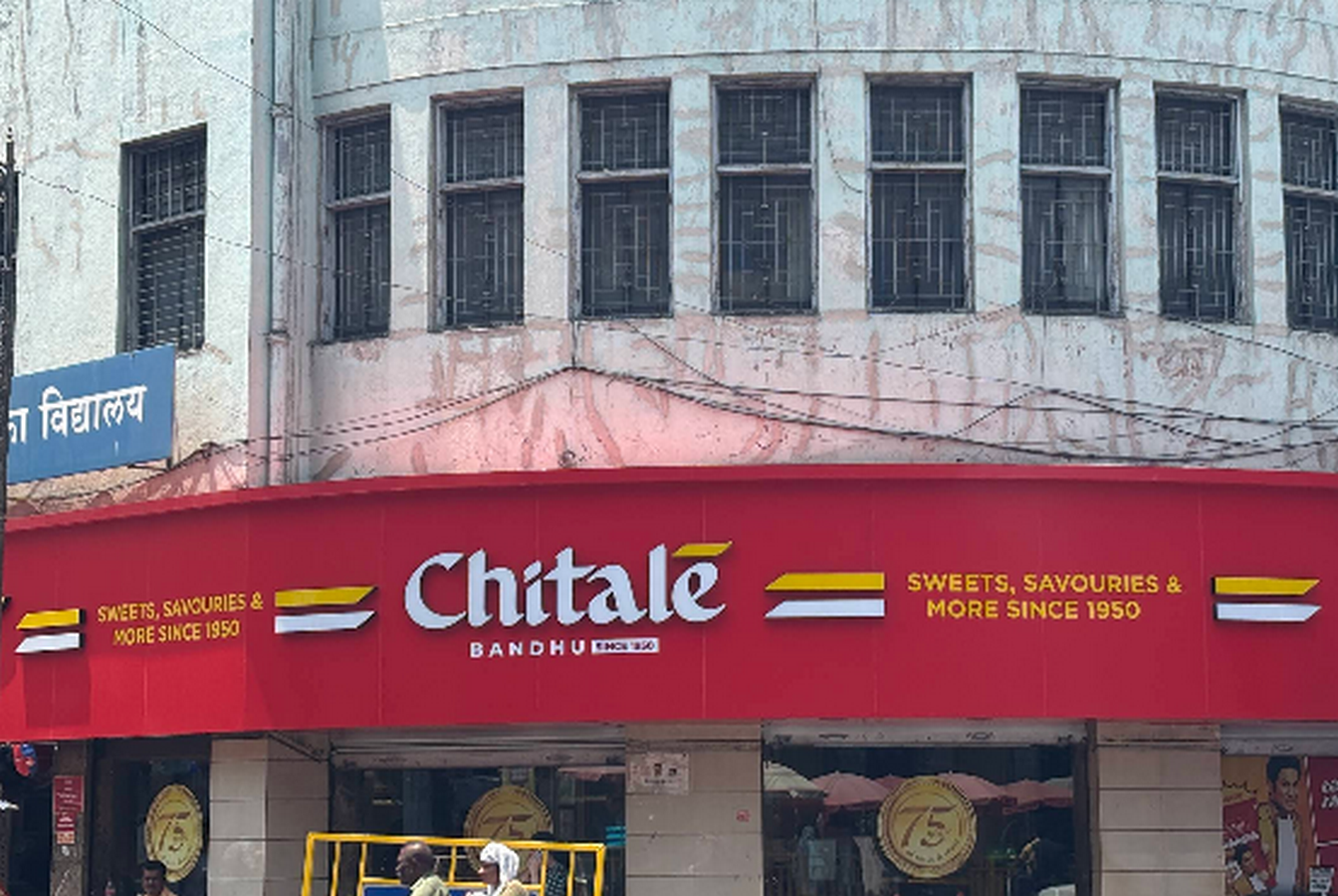
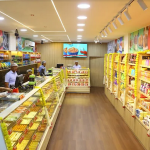
Though modest in scale, the materiality and spatial strategies of these shops reveal a story of adaptation. Chitale’s original outlet employed traditional finishes, compact circulation, and functional counters. As the brand expanded into over seventy-five franchises, the architecture evolved incrementally. In different stores, setbacks from footpaths accommodate pedestrian movement and deliveries, while raised plinths, where present, ensure visibility without overt monumentality. Newer stores introduce glass façades, air-conditioned interiors, and more open circulation paths, balancing contemporary retail design with the city’s enduring textures.
The evolution is not merely architectural; it is operational. Earlier, Chitale outlets infamously closed mid-afternoon for a siesta, a common practice in the easy-going city at the time. This mid-day pause from 1 to 4 pm reflected the city’s slower pace and prioritised owner well-being. Today, the stores operate throughout the day, signalling engagement with a faster urban tempo and a growing cosmopolitan population. Interior layouts have shifted from rows of counters to more efficient, doubly loaded circulation and display strategies, demonstrating increased awareness of shopper experience and operational efficiency. Yet, despite modernization, the human scale remains intact through the warmth of interaction, the aroma of sweets, and the intimacy of the space.
Spatial and Cultural Dynamics
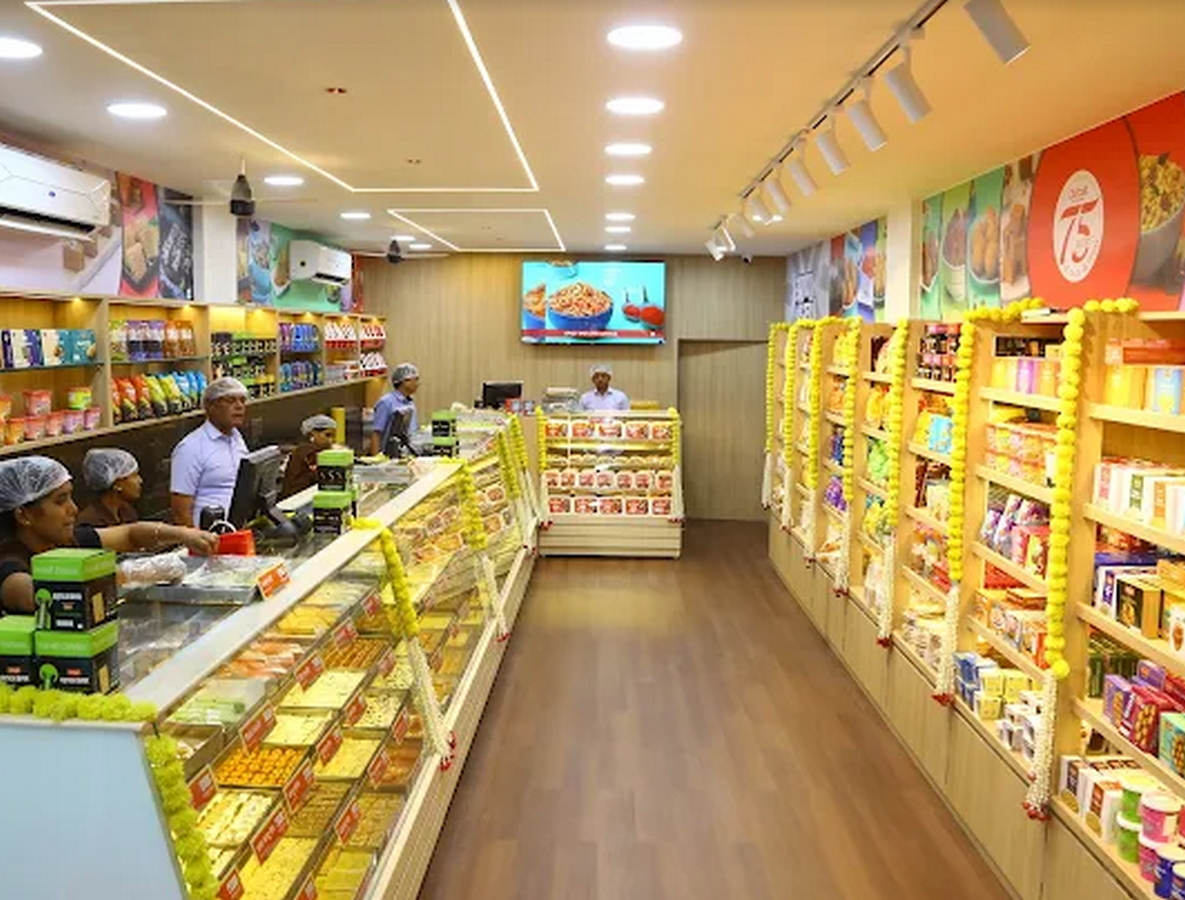
Sweet shops operate as small urban nodes and cultural timestamps. The interplay between interior and street, front-of-house and service areas, and old-guard practices versus contemporary strategies illustrates a dynamic relationship between architecture, culture, and urban life. Older stores, with solid stone walls and modest interiors, contained activity, creating an intimate space for customers. Modern stores, with transparent façades and visible operations, invite the street in, softening boundaries between public and private and fostering a subtle humanisation of labour.
Chitale’s outlets reflect both brand evolution and the city’s changing culture. They exemplify this dual narrative of continuity and change. Details like a façade colour, a set-back, a curved corner communicate values and qualities, while traces of history, such as faded signage, worn plaster, and familiar smells, preserve continuity. These elements collectively place the shop within Pune’s memoryscape, making it not merely a functional retail environment but a living archive of the city’s evolving socio-cultural scene, architectural sensibilities, and everyday life.
Conclusion: An Everyday Case Study
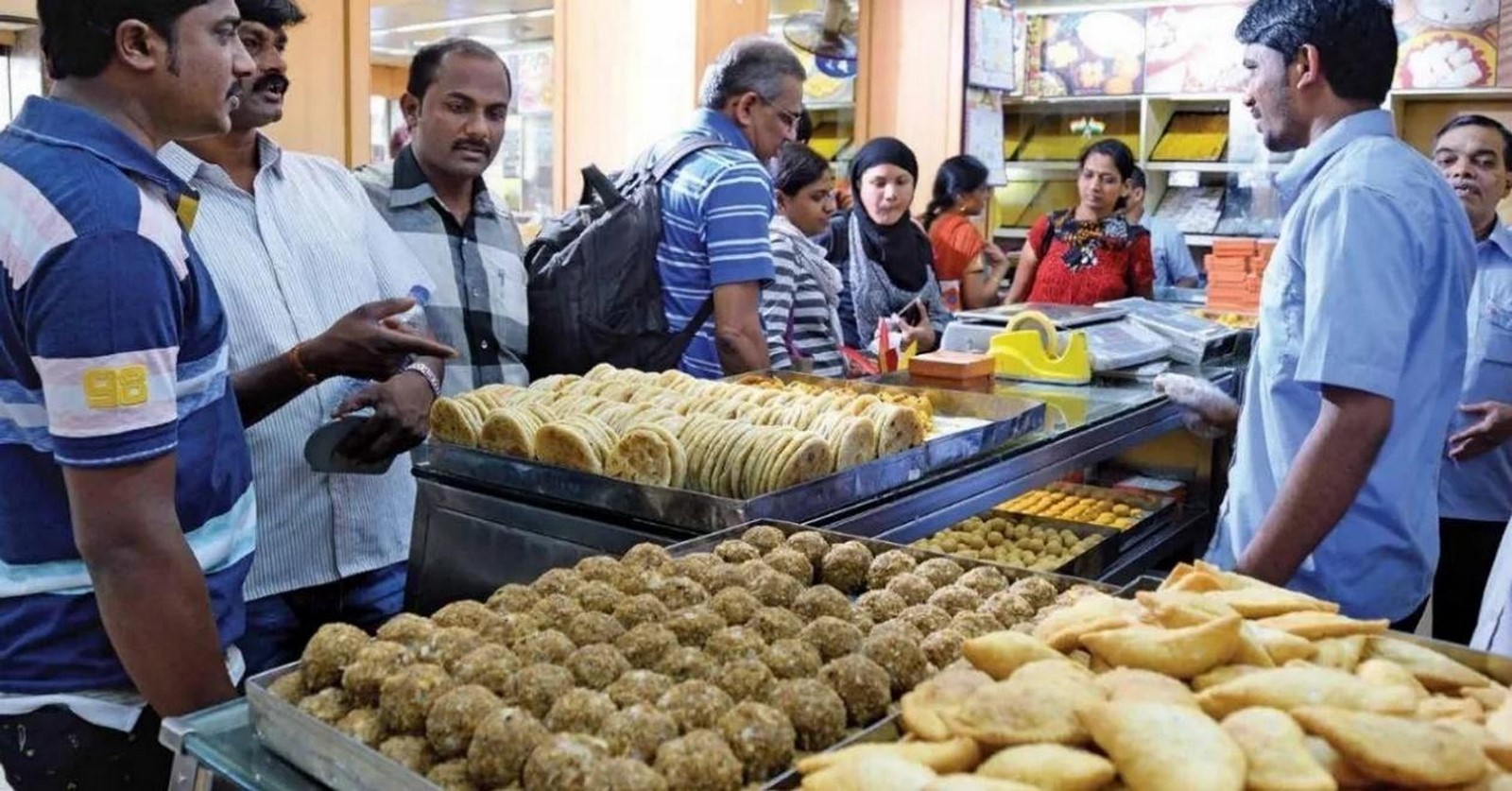
Through the lens of sweet shops, Pune’s streets emerge as living architecture, where even modest commercial spaces tell layered stories of the city’s evolution. Traditional establishments like Dagdusheth Halwai embody continuity and embeddedness, preserving familiar forms, materials, and ways of operating that connect generations. Chitale Bandhu Mithaiwale, the focus of this case study, reflects adaptation, growth, and engagement with a changing urban environment. It stands as a single example of a broader phenomenon. The city’s sweet shop landscape is otherwise diverse, encompassing corner shops, family-owned establishments, mid-century modernisers, and contemporary outlets that balance commerce, architecture, and cultural symbolism.
Together, these shops demonstrate how even ordinary structures articulate the city’s architectural, social, and cultural narratives. Sweet shops act as timestamps: they record the passage of time, preserve tradition, and mirror the city’s evolving rhythms, from leisurely mornings to festival-driven chaos. Observing them reveals how design choices, like façade treatments, spatial layouts, and circulation patterns, respond to both operational needs and urban context. Studying this spectrum of sweet shops offers insight into the subtle interplay of space, culture, and architecture, showing how a city negotiates memory and modernity, continuity and change, in the everyday patterns of urban life.
Citations:
(n.d.). Shrimant Dagdusheth Halwai Ganpati Temple. Shrimant Dagdusheth Halwai Ganpati Temple Official Website. https://www.dagdushethganpati.com/
Biswas, P. (2023) ‘Postcards from the Past: Shrikrishna Chitale on building a sweets empire back when Pune relied on tangas’, The Indian Express, 24 September. Available at: https://indianexpress.com/article/cities/pune/postcards-past-shrikrishna-chitale-building-sweets-empire-pune-relied-tangas-8953658/
Dey, P. (2025) ‘Down the Ages: From Bhakarwadi to Walmart, How Chitale Bandhu Mithaiwale’s Sweet Legacy is Going Global’, Outlook Business, 31 May. Available at: https://www.outlookbusiness.com/magazine/down-the-ages-from-bhakarwadi-to-walmart-how-chitale-bandhu-mithaiwalas-sweet-legacy-is-going-global