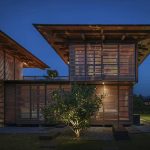
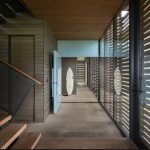
This Hawaiian cultural innovation is imagined and brought to life by Seattle-based architect Olson Kundig. He has built a new image for architecture that seamlessly transitions indoors and outdoors, embraces raw finishes, and adapts to place kinetic details and vernacular references in a single entity, a method of adopting innovation while not letting go of its roots. From rugged cabins in the Pacific Northwest to luxurious retreats in Hawai‘i, their work consistently spins design around nature as a central element of living and experiencing it in its original form as possible.
Hale Napo‘o, a family retreat on Kaua‘i’s north shore, continues this lineage by responding to the island’s unique geographical context. Let’s dive deep into the article to find out how this Hawaiian retreat is not just for living but for experiencing nature at its best.
Contextual Planning
Kaua‘i is the oldest of the Hawaiian islands. Its unusual landform originated from ancient volcanoes and was further moulded by heavy rains that carved its way into turning rocks into valleys. The north shore, where Hale Napo‘o sits above Hanalei Bay, offers some of the island’s most phenomenal scenery, which is pristine to watch. The mountains rising behind and the Pacific Ocean stretching out in front are nothing less than a visual treat to watch. The soil here is rich in water-holding capacity and minerals, but often unstable from erosion and moisture, so coastal homes rely on solid, elevated foundations to deal with both drainage and occasional flooding.
The climate is warm and tropical, with temperatures usually between 69 and 85°F, maintaining moderate change throughout the year. Constant trade winds, moving at 5–15 mph, cool the coast and make natural ventilation practical and effective. Rain is frequent but often short-term, which adds to the greenery of the island.

Life on this part of the island feels secluded and away from the main hustle as the connecting paths are narrow and mostly of bridges. Hence, it is a much preferred choice for a peaceful vacation stay. Hanalei is a small town that is connected to the rest of Kaua‘i by a two-lane highway that winds across narrow bridges, which might be fragile at times. The nearest airport is almost an hour away in Līhu‘e, explaining its remoteness. This secluded location is part of the beauty — a retreat for meets and greets, yet away from the urban hustle.
The site of Hale Napo‘o sits just above Hanalei Bay. It is one of Kaua‘i’s most iconic beaches, which acts as the foreground for the emerald ridges of Hihimanu, Namolokama, and Mamalahoa. The nearby attractions are the Na Pali Coast trails and taro fields of Hanalei Valley. These places encourage the surf culture that is a prominent trait of the north shore. This is not just a residential neighbourhood, but one of Hawai‘i’s most scenic landscapes where the land, sea, and sky meet in different landforms at the same point as mountains, valleys, beaches, and cliffs. Hence the building might have deeper pile foundations to support the structure and erosion of cliffs.

Planning
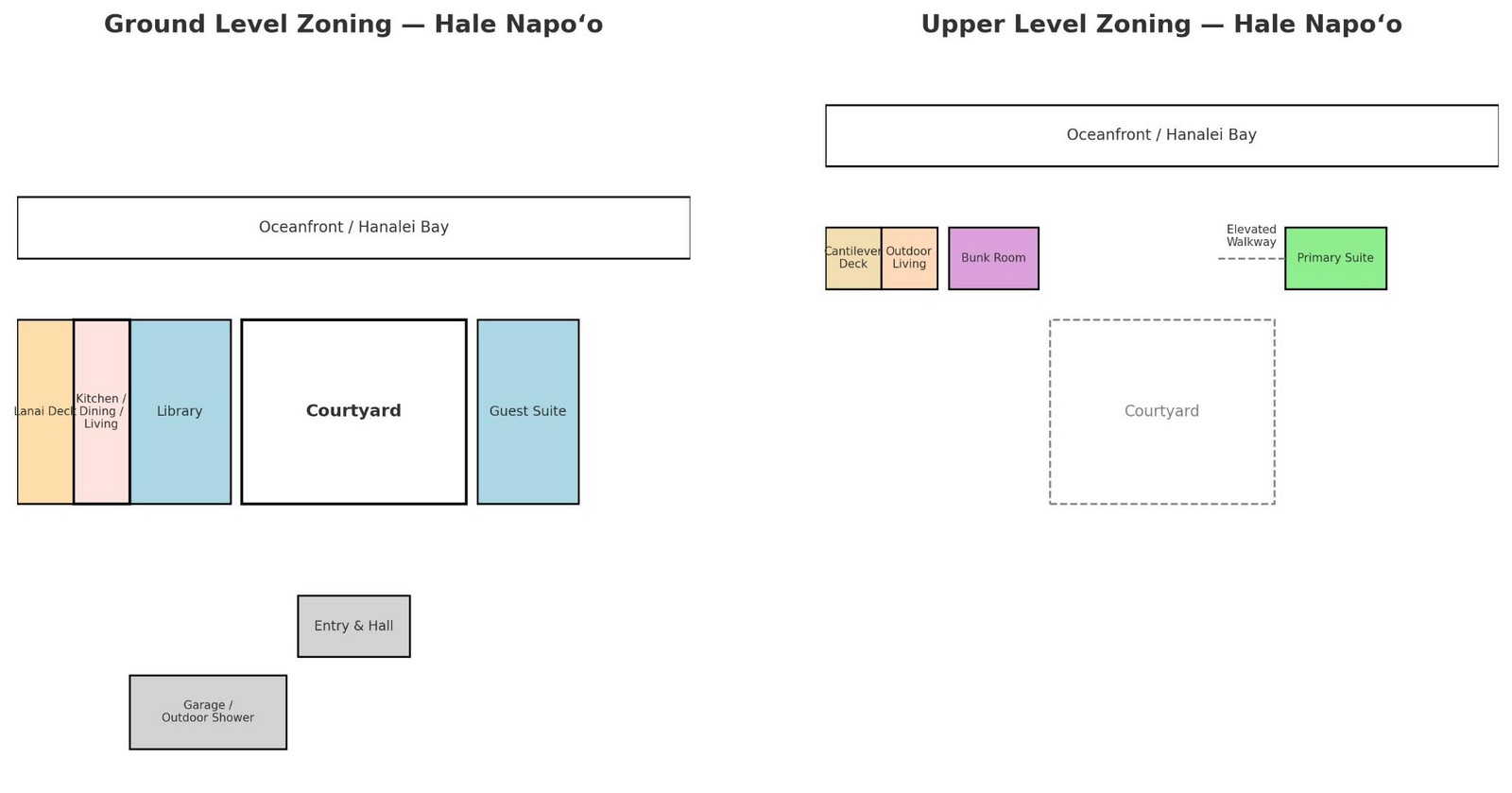
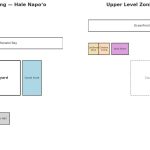
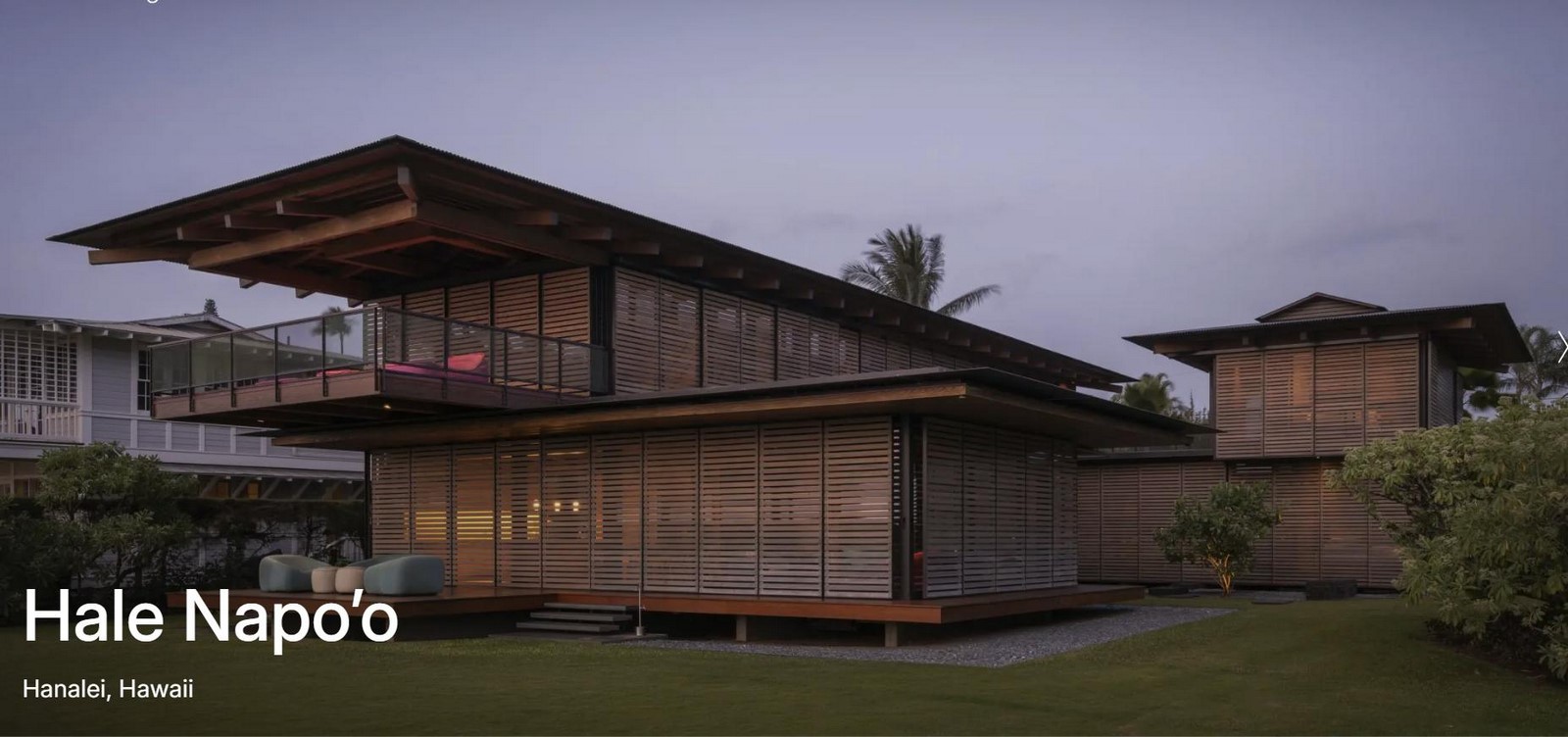
The planning of Hale Napo‘o follows a strict hierarchy of public, semi-public, and private spaces. The western bar, which gathers the most communal functions—kitchen, dining, and living. The bar spills outward to a raft-like lanai, which frames Hanalei Bay, nothing less than that of a picturesque photograph.
Semi-public areas, such as the upper outdoor living deck and children’s bunk room, transition between the openness of the social zones and the privacy of the retreat spaces. The primary suite, which is reached by an elevated walkway, remains the most secluded and uppermost in the hierarchy of privacy. By this positioning, it draws an unsaid line of privacy apart from the bustle of family and guests. This also provides an extended viewing area of view from all three sides.
In Hawai‘i, the place where open-air gatherings and celebrations are an integral part of the cultural rhythm, the house is designed to be perfectly balanced both social and private life. Its plan supports large-scale entertainment without disturbing the family’s retreat.
This separation of functions is clearly visible even on the ground floor, where the garage and toy room, paired with an outdoor shower, are offset from the central living bar, which draws a silent boundary between communal use and more composed domestic life.
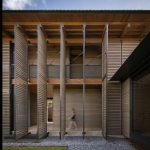
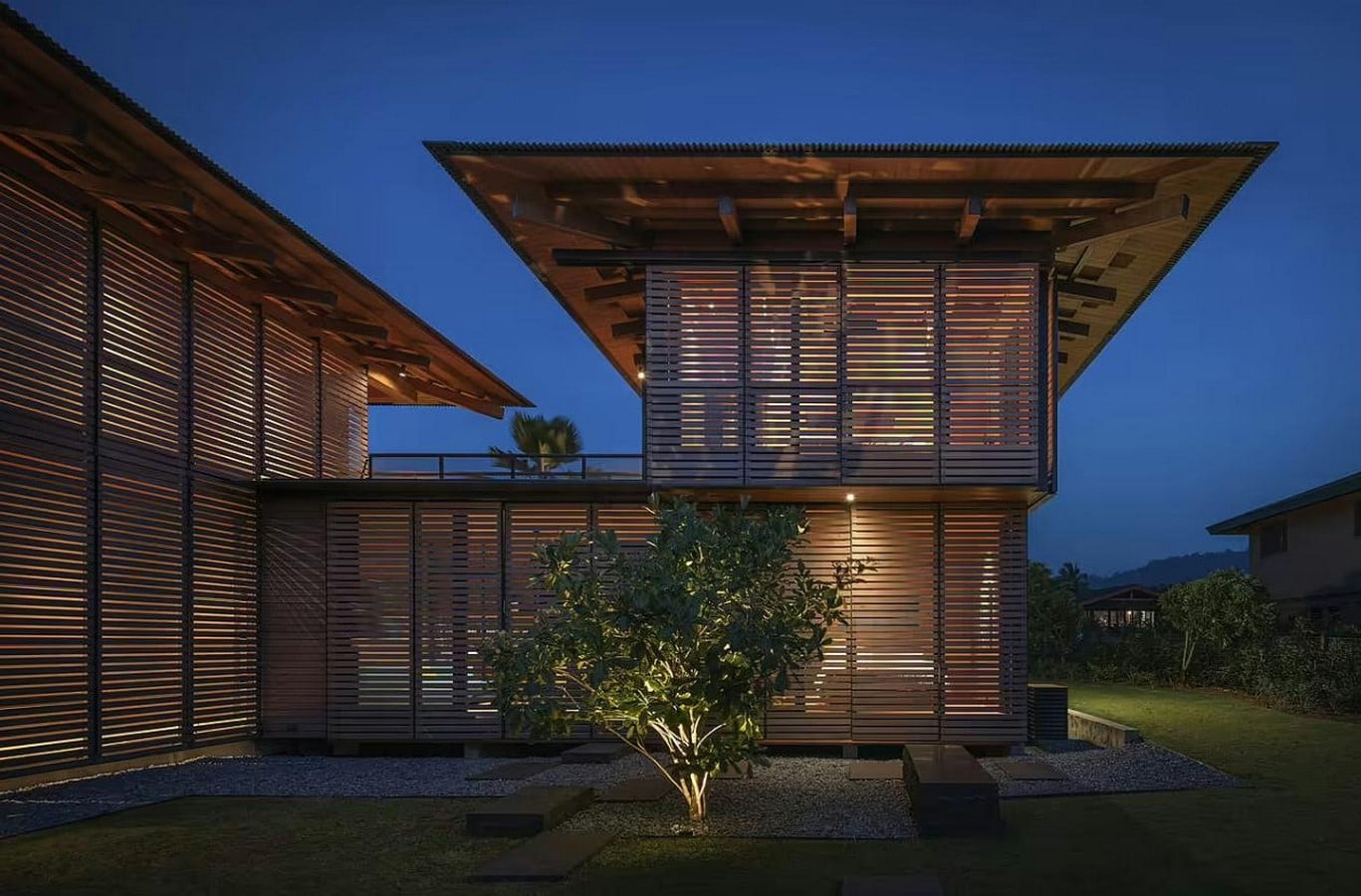
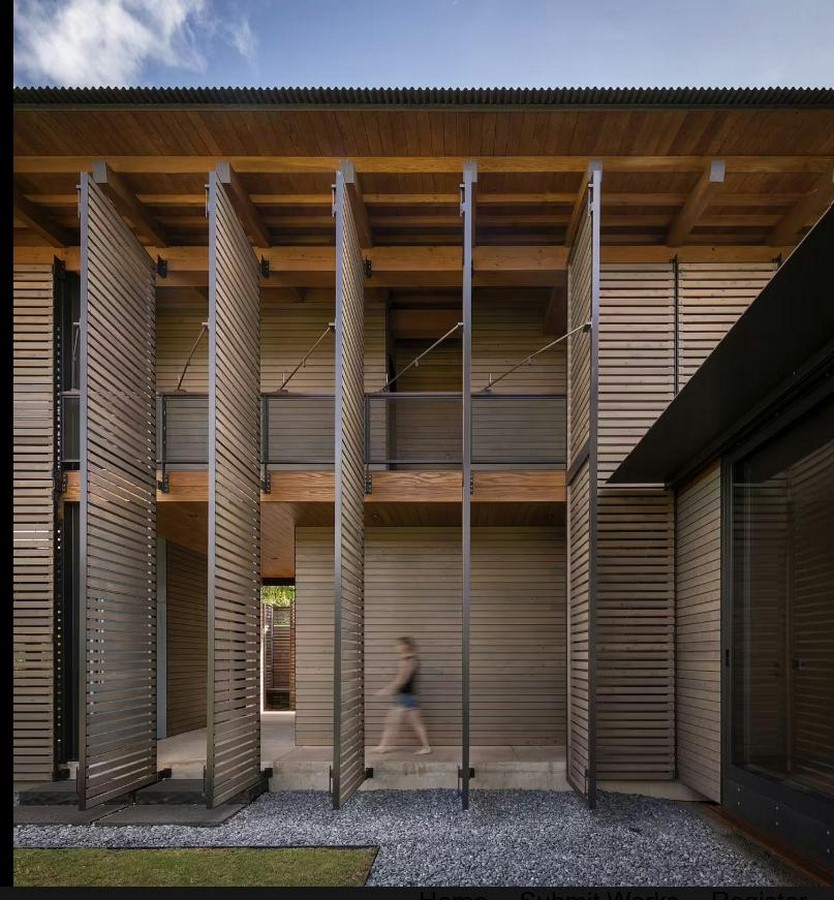
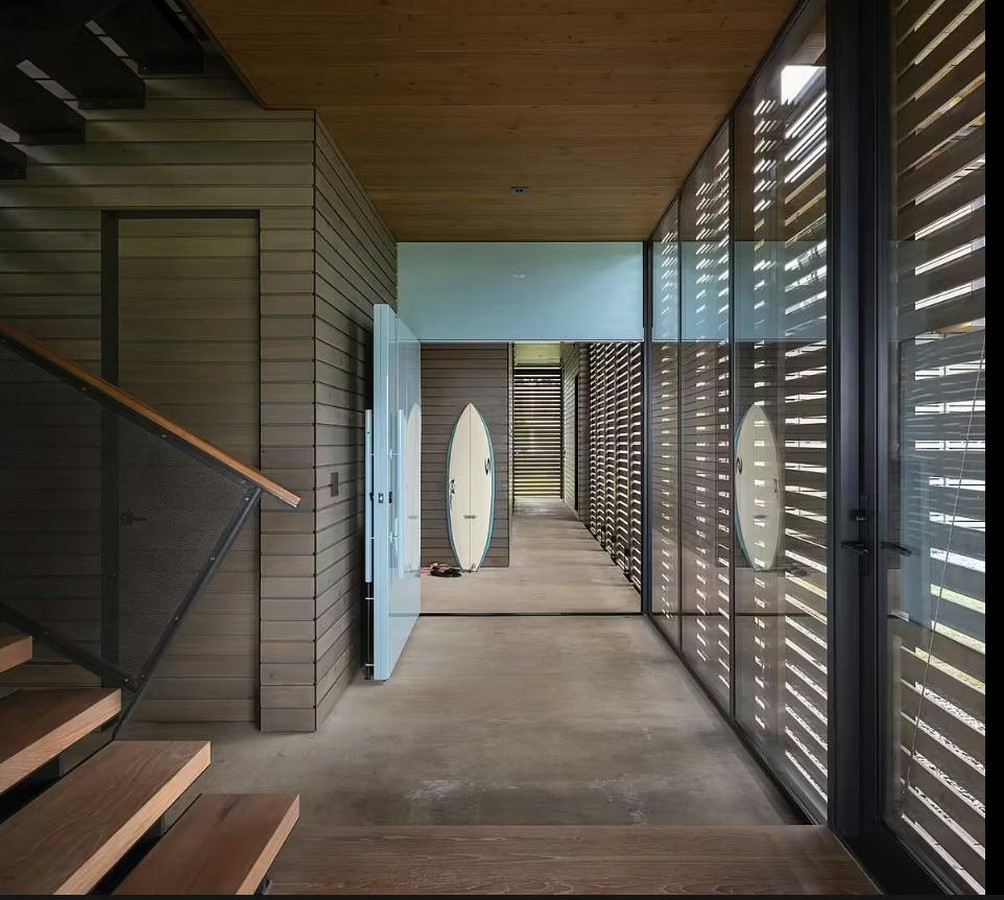
Olson Kundig further emphasises this balance with operable boundaries—pivoting louvers, flip-up shutters, and sliding panels—that allow the home to dissolve into its setting or enclose itself at will. When opened, the mountains, the ocean, and the courtyard merge into a single continuous landscape as if the boundaries never existed between man and nature. When closed, the house withdraws into private enclosures, returning as a shelter. In this way, the architecture offers freedom of lifestyle: to embrace openness or retreat into seclusion, to host a celebration or preserve solitude.
Materials used
Olson Kundig carefully selects the materials to balance durability, local resonance, and natural harmony, which is his way of expressing modernism through vernacular principles. The similar approach of verandahs and open pavilions is also observed in Hale Lana to balance openness and a tropical setting:
Copper Dickey Roof
- The roof takes its origin from the traditional Hawaiian Dickey style, characterised with a steep upper pitch to send heavy rain sliding off quickly and wide, flared eaves to shield the lanais below. These also have vented ridges, which help in regulating the airflow and temperature.
- By using copper, the architects ensured it could stand up to corrosion from salty coastal air and gradually develop a protective patina. It’s both practical and symbolic representation — resilient against the elements yet rooted in local tradition
Cedar-and-Steel Shutters
- These pivoting and sliding shutters aren’t just a design flourish; they’re the home’s lungs. Cedar naturally resists moisture and insects, while the louvers let in the trade winds and frame views.
- When a storm rolls in or the family wants privacy, they close down. The steel frame makes sure they stay strong against the coastal winds.
Japanese Birch Interior Paneling
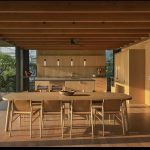
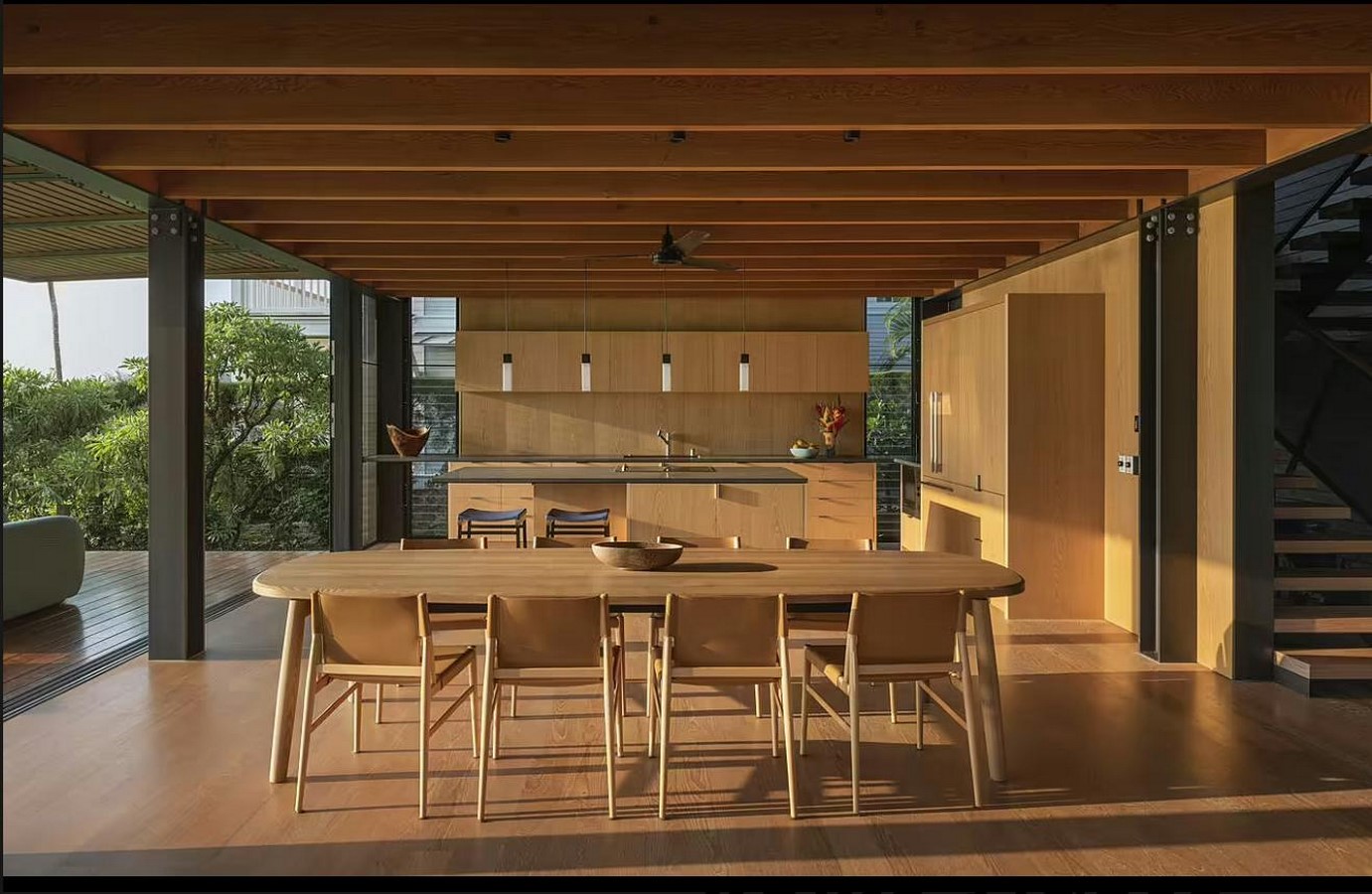
- Interiors are adorned by birch — its appearance is pale, smooth, and calming. In a climate that can feel heavy with humidity, light wood surfaces brighten the interiors and make them feel airy while retaining the tropical theme.
- Birch is dimensionally stable when treated, which makes it less likely to warp in moisture. The moisture resistance is the most important quality required in this context, as the site is surrounded by sea and mountains. By this brilliant choice, it carries both warmth and practicality.
Wooden Floors
- Timber floors flow seamlessly from the living areas out onto the lanais, which gives a feel of seamless transition between indoors and outdoors, providing a feeling as a sense of a single entity.
- They stay cool underfoot in the heat, which makes them a comfortable choice, along with being aesthetically pleasing.
A retreat is not just a place to live, it is a place to experience. Like Frank Gehry said, “Architecture should speak of its time and place, but yearn for timelessness.” This holiday retreat is not just another vacation home. It is a signature of Olson Kudig with an impactful message of retaining the culture while inculcating modernism. This vacation home is not just a stay, it’s an experience of nature with freedom.
REFERENCES:
Archilovers. Hale Napo’o / Olson Kundig. 2023. Available at: https://www.archilovers.com/projects/317209/hale-napo-o.html (Accessed: 31 August 2025).
HomeAdore. Hale Napo‘o: Hawaii’s Premier Beachfront Retreat by Olson Kundig. 2023. Available at: https://homeadore.com/2023/09/15/hale-napoo-hawaiis-premier-beachfront-retreat-by-olson-kundig/ (Accessed: 31 August 2025).
Olson Kundig. Hale Napo‘o. Available at: https://olsonkundig.com/projects/hale-napoo/ (Accessed: 31 August 2025).
Wikipedia. Kauaʻi. Available at: https://en.wikipedia.org/wiki/Kaua%CA%BBi (Accessed: 31 August 2025).
Kauai.com. Kauai Geography. Available at: https://www.kauai.com/kauai-geography (Accessed: 31 August 2025).
Kauai.com. Kauai Weather. Available at: https://www.kauai.com/kauai-weather (Accessed: 31 August 2025).
ArchDaily. Hale Lana House / Olson Kundig. 2020. Available at: https://www.archdaily.com/941941/hale-lana-house-olson-kundig (Accessed: 31 August 2025).