The Roman Empire was built on political prowess. It was founded on a complex system of governance starting with the Roman Republic and climaxing into the Roman Empire. Its political structure was characterized by a combination of autocracy, aristocracy, and bureaucracy which was directly reflected in its architecture.
The Roman Empire || Power & Religion
Roman buildings merged elements of Roman power and engineering with influences from Greek classical architecture that was the epitome of mythological symbolism. Mythological narratives were central to Roman belief systems and cultural identity, and they found expression in various aspects of architectural design.
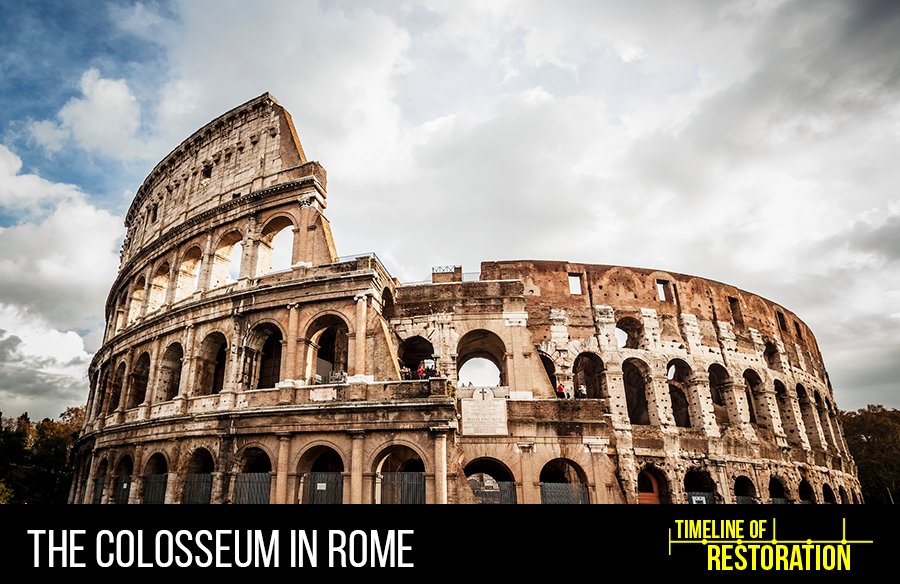
As a testament to Roman might and prestige, one of the most iconic structures of ancient Rome, the Colosseum, primarily served as an arena for public spectacles and entertainment, its architectural elements reflect the broader mythological and cultural context of ancient Rome. It is the largest amphitheater in the world and in the enduring efforts to preserve it, it has undergone numerous phases of restoration and conservation.

The Colosseum Architecture
The Colosseum, previously known as the Flavian Amphitheatre, is a remarkable elliptical amphitheater, measuring approximately 189 meters in length, 156 meters in width, and standing over 48 meters tall. It was built in the Ancient Roman architectural style. It’s estimated 100,000 cubic meters of travertine stone, plus a similar measure of Roman cement, bricks, and tuff blocks. It’s a demonstration of the Romans’ mastery of concrete construction, arches, and vaulting.

Social Hierarchy in Design
The functional design is optimized for hosting gladiatorial contests, animal hunts, and other public spectacles. It was designed to reinforce Roman social order with hierarchical seating where the designed layout is composed of three main levels of seating that can accommodate 50,000 spectators. It is divided based on social class, from bottom to top, the podium, gradatio, and the porticus, with the most privileged spectators seated closest to the arena floor. It is composed of four entrances for the political and religious leaders and 76 for the ordinary citizens as well as complete separation between social groups through the corridors. The arena had two entrances, the northwestern Porta Triumphalis, used for triumphal processions by gladiators entering the arena, and the southeastern Porta Libitinaria, named for the Roman goddess of funerals and burial Libitina, used to remove bodies from the blood sports entertainment.


The Colosseum’s Underground
Beneath the arena floor lies the hypogeum distributed on two levels, an intricate network of tunnels, chambers, and trapdoors used to house gladiators, animals, and stage sets. 80 vertical shafts connected the underground hypogeum with the arena.

Roman Adoption of Greek Architecture
As a continuation of Greek architecture and its cultural identity, the Colosseum’s exterior facade adopted the three orders of columns; Doric, Ionic, and Corinthian arranged in three tiers. The ground floor features Doric columns, the second-floor Ionic columns, and the third-floor Corinthian columns. The columns went from lesser to greater stylistic complexity from bottom to top.

Timeline
AD 71-72
Start of construction.
AD 80-81
Excavation of the hypogea.
2nd century
First reconstruction.
217 BC
The building was destroyed by a fire that left only the outer skeleton; it took more than 30 years to rebuild the structure.
410 BC
The amphitheater was abandoned, and its surroundings became a burial site.
Timeline of Restoration
Medieval Period (12th-13th Century):
During the medieval period, the monumental Colosseum was neglected and fell into disrepair, preservation efforts were menial, and the structure went as far as being a source of building materials for other buildings in Rome. Unused or damaged parts of the building were dismantled and reused recycling the materials of the damaged amphitheater.
Renaissance and Baroque Periods (15th-17th Century):
Influenced by the inspiration drawn from the Colosseum as a symbol of ancient grandeur by artists and architects, including Michelangelo and Gian Lorenzo Bernini, in their work, the Colosseum gained renewed interest. It underwent repairs of the exterior and stabilization of the structure.
18th-19th Century:
Restoration efforts intensified in the 18th and 19th centuries, spurred by growing interest in ancient Roman monuments and archaeological preservation. Pope Benedict XIV initiated significant restoration work in the 18th century, including reinforcing the outer walls and stabilizing the structure with tie rods installed to secure the facade. Later, in the 19th century, Pope Pius IX financed further restoration efforts, focusing on repairing damage caused by earthquakes and erosion.
20th Century:
The 20th century saw continued efforts to preserve and restore the Colosseum, particularly in response to damage inflicted during World War II. Following the war, extensive restoration work was carried out to repair bomb damage and stabilize the structure to address structural issues.
21st Century:
In recent decades, conservation efforts have focused on addressing ongoing structural challenges, including the effects of pollution, weathering, and tourist foot traffic. Advanced technologies, such as laser scanning and 3D modeling, have been employed to assess the condition of the monument and guide restoration efforts.
From 2013-2021, the Colosseum underwent a two-phase $30 million restoration project. The restoration of the external façade was completed in 2016, and the second phase was initiated in 2018 and focused on the Colosseum’s hypogea – the underground passages, cages, and rooms where prisoners, animals, and gladiators waited, or were kept before they entered the arena above. Collaborative initiatives involving archaeologists, architects, engineers, and conservation experts worked on renovating the 15,000-square-metre space and established a new 160-metre passageway that opens the hypogea up to visitors.
The restoration project was prompted by Italy’s massive tourist attraction. The government aimed to rebuild its most visited monument as a tourist destination which welcomed 7.6 million visitors in 2019. In a separate initiative, the Italian government decided to provide the ancient Roman landmark with new hi-tech flooring.

Monumentality and Permanence
Despite the challenges posed by time, natural disasters, and human activity, the Colosseum stands as a symbol of resilience and enduring cultural significance. It stands as a symbol of Roman power and grandeur; the Colosseum conveys a sense of monumentality and permanence. Its massive scale, imposing facade, and strategic location in the heart of Rome reflect the Romans’ desire to assert their dominance.

References
Timeline of the Valley of the Colosseum. The Colosseumnet The resourceful site on the Colosseum. (n.d.). https://the-colosseum.net/wp/en/chronology/
Denman, S. (2021, June 21). Rome’s Colosseum reopens after extensive restoration – in pictures. The National. https://www.thenationalnews.com/lifestyle/travel/rome-s-colosseum-reopens-after-extensive-restoration-in-pictures-1.1248760
A&E Television Networks. (2022, July 15). How the Colosseum was built-and why it was an architectural marvel. History.com. https://www.history.com/news/how-roman-colosseum-built
Architecture of the Colosseum. The Colosseum. (2018, April 18). https://www.thecolosseum.org/architecture/
Colosseum Architecture: Design Plan & Highlights. rome.com. (n.d.). https://www.tickets-rome.com/colosseum/architecture/
Roman Colosseum history: 72 AD to Today. rome.com. (n.d.-b). https://www.tickets-rome.com/colosseum/history/?_gl=1%2Awl7jyp%2A_ga%2AMTkzMTA3NjI3Ny4xNzE0OTA4MDA3%2A_ga_Y45PC9R73C%2AMTcxNDkyNDY3OS4zLjEuMTcxNDkyNzMwNi4zMC4wLjA.
Colosseum Architecture: How Colosseum was built: Colosseum Building. Rome Colosseum. (2024, April 2). https://romecolosseumtickets.tours/colosseum-arhitecture-rome/