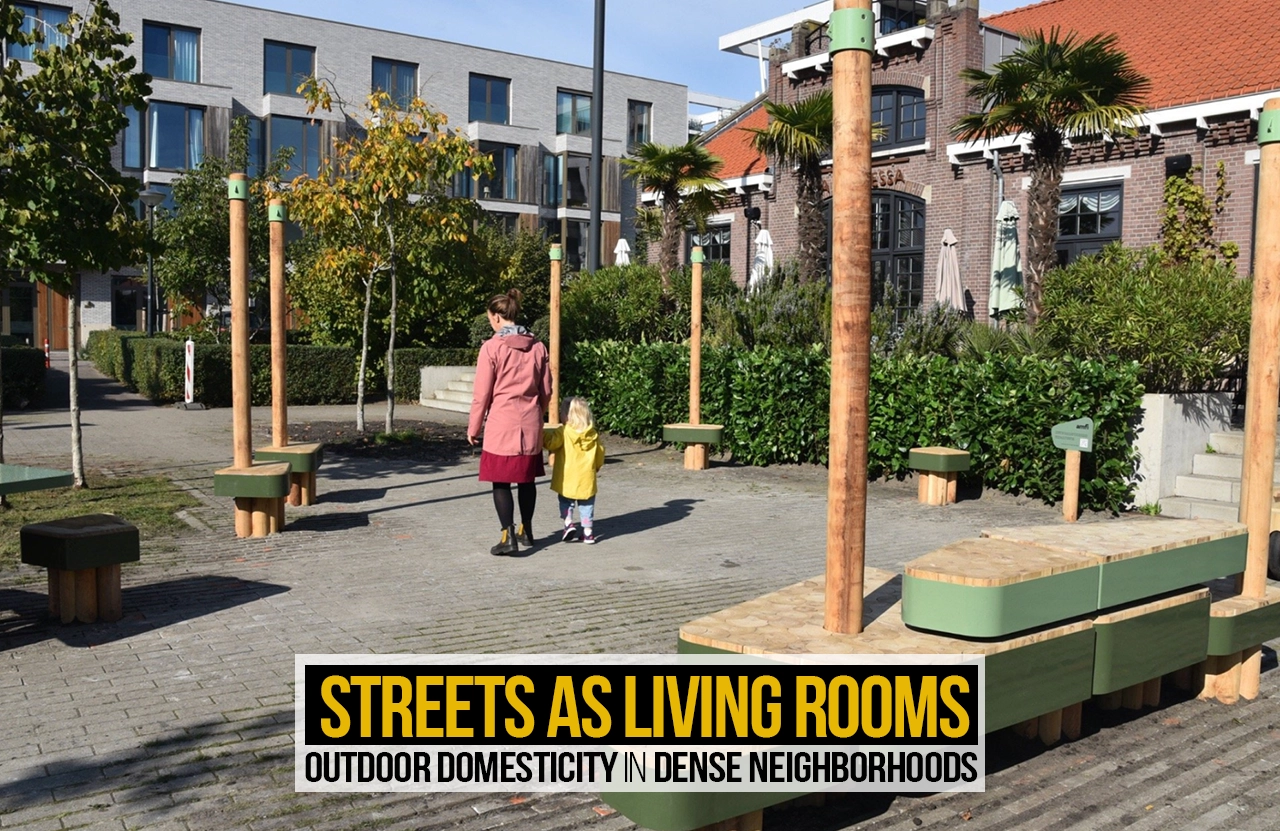
When streets become living spaces
Streets don’t just transform into private property; they become a shared semi-domestic environment through increased utilisation and familiarity. Common elements such as verandas and porches act as extensions of homes into streets, emphasising public-private relationships.
The most important element is the threshold – the space between the door and the street. A doorstep, veranda, shaded sitting ledge, or recessed entrance enables residents to occupy the threshold without exposing themselves to the street. When the house is small, hot, crowded, or otherwise inadequate, domestic activities spill over into the street. Residents may sit outside in the evenings, wash and mend things nearby, watch children, chat with neighbours, shop, hold festivals, or gather for meetings.
Occupants of a street become familiar with one another, and the street takes on a character that can be recognised. People know where to stand or sit so as not to interfere with others and where children may congregate. Streets develop their own informal social order, with a rough hierarchy and an understanding of what is permissible and what is not. An article about Istanbul notes how inhabitants “temporarily transform the street to meet specific sociocultural needs” in a process that “creates an indoor-outdoor domesticity”. Windows, balconies, doors, awnings, railings, and low walls act as intermediaries between the domestic and public realms. A featureless façade presents no opportunity for interaction, while a more porous one enables a degree of surveillance and social interaction. The porosity does not have to be great – what matters is that the domestic domain is not entirely enclosed, invisible, and inaccessible.
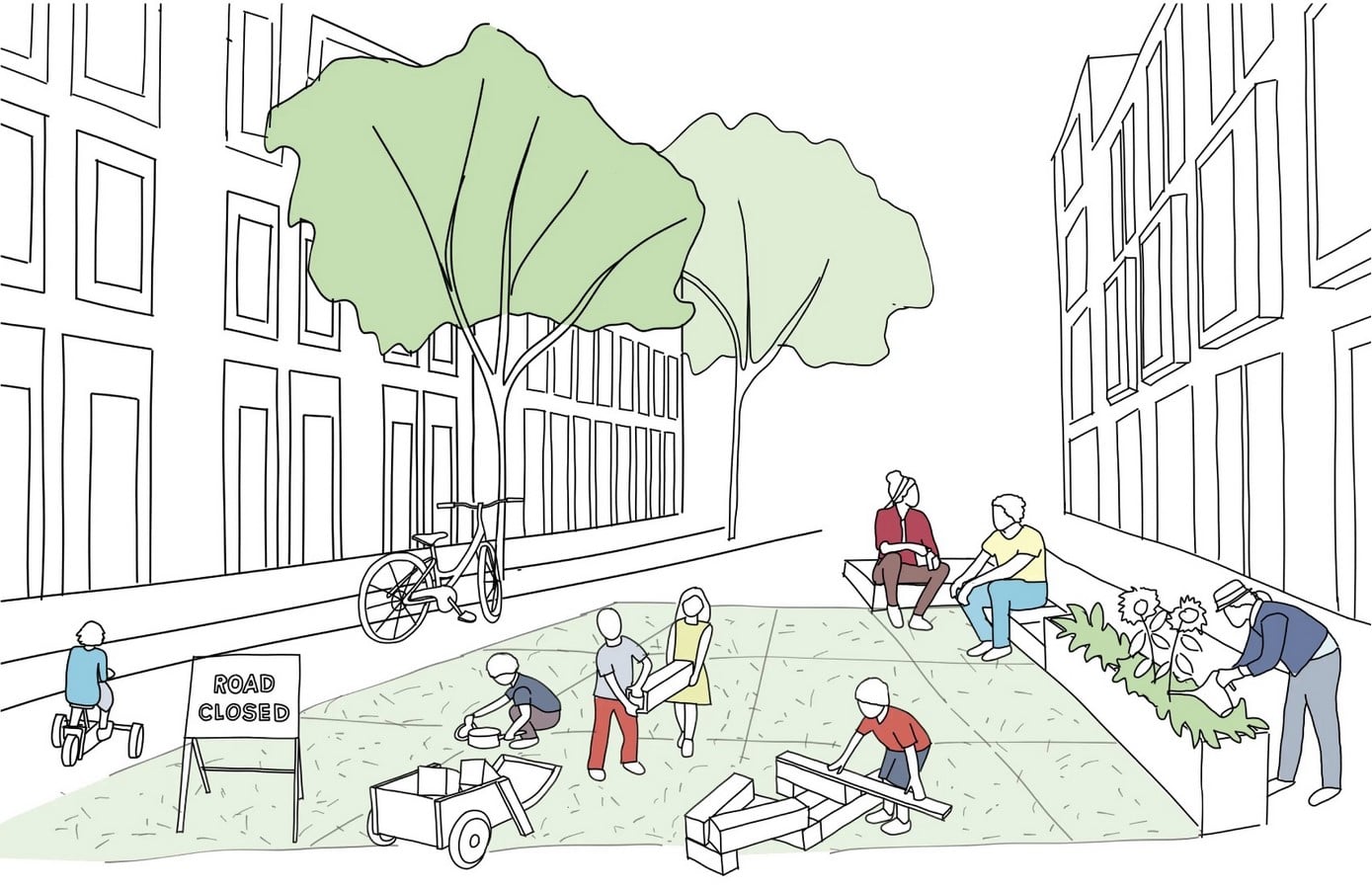
Individuals should be able to personalise their frontages while also respecting the needs of their neighbours. Trees, porous surfaces, and other elements can be incorporated into the street to make it more comfortable and responsive to the local climate. Designers should think about the street as a space that functions at different times of day. The street is a place for walking and sitting at all times of day, but it serves different purposes at different hours. It is a route to be traversed in the morning, a workplace during the day, and a place to sit and chat in the evenings. Most importantly, the street is an intermediary space between the home and the larger world. The domestic and public realms are not mutually exclusive.
The everyday elements of a living street
Ordinary elements which create enough warmth and comfort for people to interact and observe are the simple meaning and goal of a living street. Small changes and movements can completely alter a street from crowded chaos to a calm neighbourhood corner which allows people to expand their social circle and go outside their comfort zone. Additionally, seating and gathering in a place can be formal or informal. Formal seating includes benches and chairs while informal seating consists of steps, low walls and ledges. Though seating is present in most public spaces, for it to be effective, it needs to follow the following criteria:
- It should be located near the activity rather than away from it.
- It should be available to seat a single person, families, groups, and couples.
- It should protect people from rain and sun.
- It should be accessible for all.
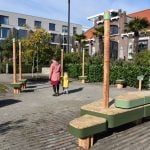
Outdoor life revolves around thermal and climatic comfort. Shade makes it possible to stay outside for longer. Trees, covered walkways, verandas, tensile canopies, arcades, and shaded shopfronts can create a range of comfortable microclimates. Trees can serve multiple purposes: providing shade, generating a sense of enclosure, adding a sense of place, providing contrast to hard surfaces, offering informal seating and gathering, and being a calming influence on the senses. Street trees are most effective when combined with seating. A tree without seating offers shade but does little to encourage people to linger; seating without shade may be uncomfortable. Trees and seating provide a sheltered outdoor room, and urban design guides often suggest trees, seating, and children’s play areas as part of a thriving streetscape.
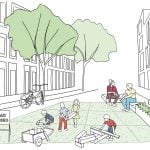
Similarly, weather protection measures need to take into account the likelihood of rain and wind. In Chennai, for example, a living street would need to provide both solar protection and monsoon protection. Continuous awnings, deep eaves, covered drains, verandas, and slip-resistant surfaces can all contribute to making a street more comfortable in a range of weather conditions. Children bring an unmistakable vibrancy to a street, and play is an essential part of childhood. But play does not always take place in playgrounds – it can be integrated into the street landscape in a number of ways. Making space for children can take many different forms, such as paved or smoothed road surfaces, playgrounds, traffic-calmed or car-free streets, painted games, inset walls, irregular surfaces, mounds, stepping stones, lawns, or planting pockets, loose materials inviting children to build, and bicycle paths with places for seating where parents are within sight.
From passageways to social spaces
Street design can facilitate interaction by creating conditions for lingering. Slower traffic, wide sidewalks, seating, shops along sidewalks, visibility from and to entrances, and clusters are ways for a street to generate opportunities for meetings. Steps, verandas, low facades, trees, and food stalls can all contribute to incidental encounters, where people need not always have planned to meet. A lively street can accommodate walking, waiting, playing, shopping, and sitting down in the same place. By virtue of being able to see each other, people feel closer to each other. Thus, streets can promote interaction by generating opportunity and choice.
Between the privacy of the home and the public street there is a buffer zone that offers a measure of security by being neither. Various features such as verandas, entrances, front lawns, balconies, recessed doorways, arcades, and side streets permit people to be at the street and yet not in it. They act as enclaves offering limited exposure to the outside and control over what happens within. From a veranda, one can observe one’s children without having to invite the street in. The buffer is especially valuable in cities where housing is compact and domestic and neighbourhood life have to be squeezed together.
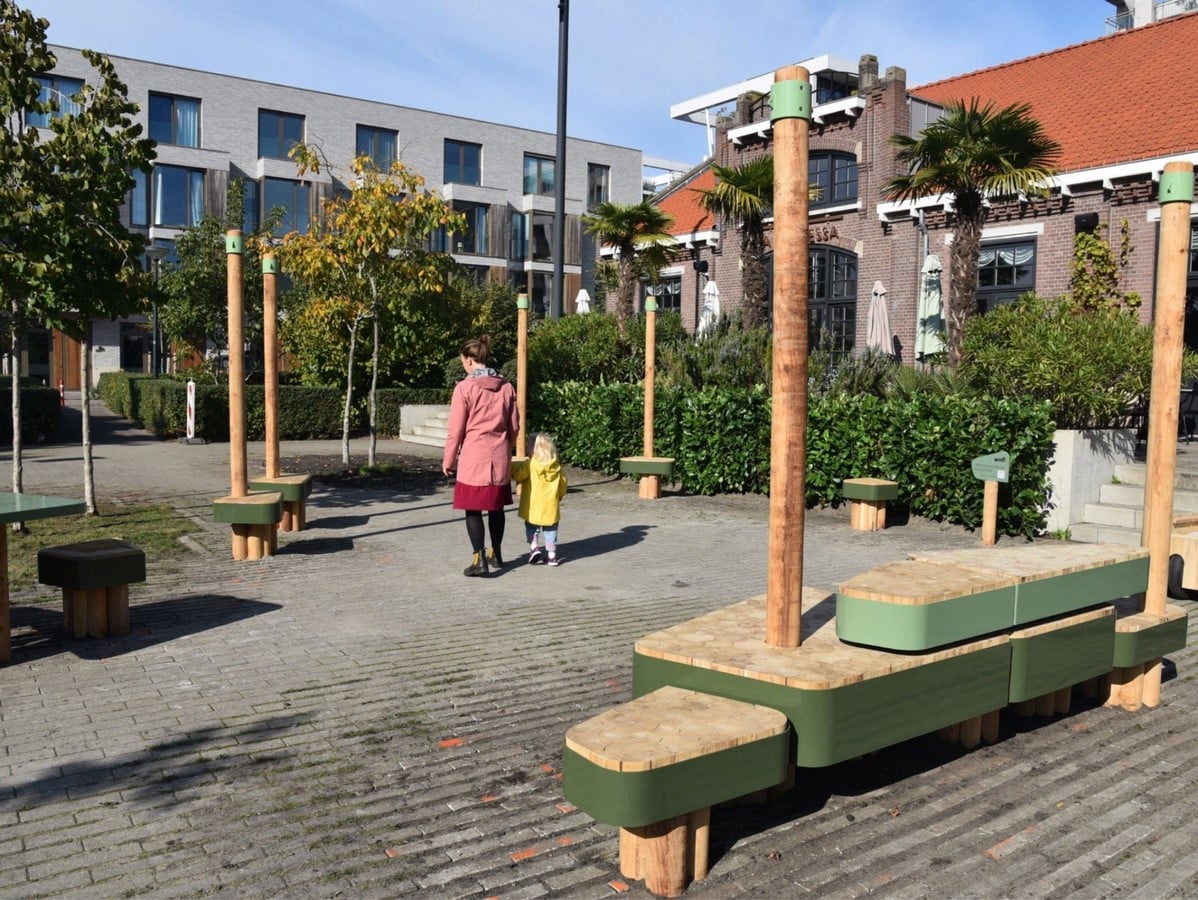
Well-designed community streets can take many forms: residential lanes, pedestrian streets, markets, or play streets are all variations. Their success depends on both design and culture. In different places, streets can acquire different vernacular uses based on climate or habits acquired over hundreds of years. Streets can be the place for chatting, sitting, home service, festivals, street food, and games. Where the climate allows, shady verandas and enclosed seating can add to the attraction of a street. A designer needs to understand such issues before beginning to act on a street. Designers can learn to intervene only when they understand the living patterns of the people and how much choice there is in the matter.
Designing streets for people
The best streets are multifunctional and serve as platforms for sitting, walking, shopping, playing, waiting for buses, and chatting rather than as a transportation artery. It is essential to study the patterns of the informal use of thresholds, shop fronts, shady corners, and other available seating places and think about how the existing good practices can be systematised. Planners should consider the unique characteristics of the local climate, as well as ordinary and diverse social behaviours, to allow streets to fulfil their role as the centre of free communication.
While designing streets, it is critical to balance the needs of various groups of street users, considering their specific requirements. Pedestrian-friendly centres should offer a shady place to sit, separate and safe lanes for pedestrians, cyclists, and motorists, and the ability for local businesses to provide their goods and services. At the same time, car-free streets need to be safe for vulnerable road users, offer street lighting, be barrier-free, have a comfortable surface, have good suction, and be strategically located. The security of the sidewalks and plazas can be enhanced by using roadsides, seating, trees, organised parking, and other urban furniture.
The design of everyday street life can contribute to the enhanced quality of life of the city’s residents with high population density. It is explained by the fact that the densification of the city with compact developments offers its inhabitants more opportunities and space for socialisation, sport, and recreation. For example, if a street is shady, has seating, places to play games for children, trees, food, and a favourable environment for communication, it can alleviate the load on the residents’ private houses. At the same time, it should be remembered that the quality of street life depends not only on the design but also on management, and processes need to be established for maintaining and managing streets.
Reference list:
[1] Compendium of WHO and other UN guidance on health and environment 2024 update. (n.d.). [online] Available at: https://cdn.who.int/media/docs/default-source/who-compendium-on-health-and-environment/who_compendium_chapter9.pdf [Accessed 20 Aug. 2026].
[2] Global street design guide. (2015). [online] National Association of City Transportation Officials. Available at: https://nacto.org/publication/global-street-design-guide/ [Accessed 20 Aug. 2026].
[3] Mehta, V. (2006). Digital repository at the University of Maryland (DRUM). [online] Umd.edu. Available at: https://drum.lib.umd.edu/items/f0e9886a-fdc1-4244-8075-455c2d141b00 [Accessed 20 Aug. 2026].
[4] Terraced houses and the public realm. (n.d.). [online] www.designingbuildings.co.uk. Available at: https://www.designingbuildings.co.uk/wiki/Terraced_houses_and_the_public_realm [Accessed 20 Aug. 2026].
[5] Warakanyaka, A.A.A.S. and Atmodiwirjo, P. (2017). Live beyond buildings: The street as the everyday living space in Istanbul, Turkey. Environment-Behaviour Proceedings Journal, [online] 2(6), p.303. doi:10.21834/e-bpj.v2i6.995.
[6] citiespeoplelove.co. (n.d.). Cities for play: Designing streets that prioritise children over cars | cities people love. [online] Available at: https://citiespeoplelove.co/article/cities-for-play-designing-streets-that-prioritise-children-over-cars [Accessed 21 Aug. 2026].
[7] Rok Grča (2025). Street furniture as a social element. [online] Landscape Architecture Platform | Landezine. Available at: https://landezine.com/grijsen-recommendation-street-furniture-as-a-social-element/ [Accessed 21 Aug. 2026].