Most people step into a café, a bookstore, or a library with very different intentions. A café is often about pace : a quick coffee, a casual chat, or sometimes a laptop opened for hours of remote work. The architecture of cafés usually mirrors this: open layouts, ambient buzz, and a design that encourages constant movement of people.
A bookstore, on the other hand, is transactional at its core. Visitors browse shelves, discover titles, and leave with a purchase. Its design is about clarity and accessibility, making books visible, arranging them to invite discovery, but rarely asking people to linger for long.
A library shifts the purpose entirely. It is a civic institution of silence, structure, and focus. People come to borrow knowledge, to study, or to find solitude in the collective stillness of others doing the same. The architecture reflects order: rows, symmetry, discipline.
What makes Champaca Bookhouse compelling is that it refuses to fit neatly into any of these categories yet borrows from all three. It has the informality of a café, the curiosity-driven discovery of a bookstore, and the reflective quiet of a library. But more importantly, the adaptive reuse of an old villa allows it to transcend typology. It is not just a space for coffee, books, or study, but a hybrid where architecture itself sets the rhythm for how people interact, pause, and belong.
Adaptive Reuse
One of the most compelling aspects of Champaca is its adaptive reuse. Instead of demolishing and rebuilding, the project embraces the life of the existing villa, allowing its walls, rooms, and verandas to take on a new identity. This is not just a matter of sustainability, though that is significant; adaptive reuse conserves material, energy, and memory. More importantly, it gives architecture a second life without erasing its first.
In Champaca, this manifests through the way domestic spaces are reprogrammed. What was once a living room now holds shelves of books; verandas that may have framed family gatherings are now stages for collective reading; bedrooms have been reimagined as quiet nooks for browsing. The proportions of these rooms remain unchanged, so the intimacy of their original use lingers, lending warmth and familiarity to the new functions.
The adaptive reuse also highlights the layering of time. Architectural traces of the villa’s past ,from its flooring textures to its openings remain visible, reminding visitors that they are inhabiting a space with history. Instead of being polished into anonymity, the building wears its age with dignity, creating a setting where past and present coexist.
This approach stands in stark contrast to commercial bookstores or cafés built from scratch, which often rely on formulaic design templates. Champaca’s strength lies in how it embraces imperfection, asymmetry, and memory. The villa was not designed to be a bookstore or a café, and yet its reuse allows precisely those qualities of informality, coziness, and porosity to enrich the experience in ways a new building could never replicate. By choosing reuse over replacement, Champaca demonstrates that architecture can be transformative without being destructive. It shows how a structure deeply tied to private life can be opened to public use, and how cultural spaces can emerge not by overwriting the city’s fabric, but by carefully reinterpreting it.
Architectural Uniqueness
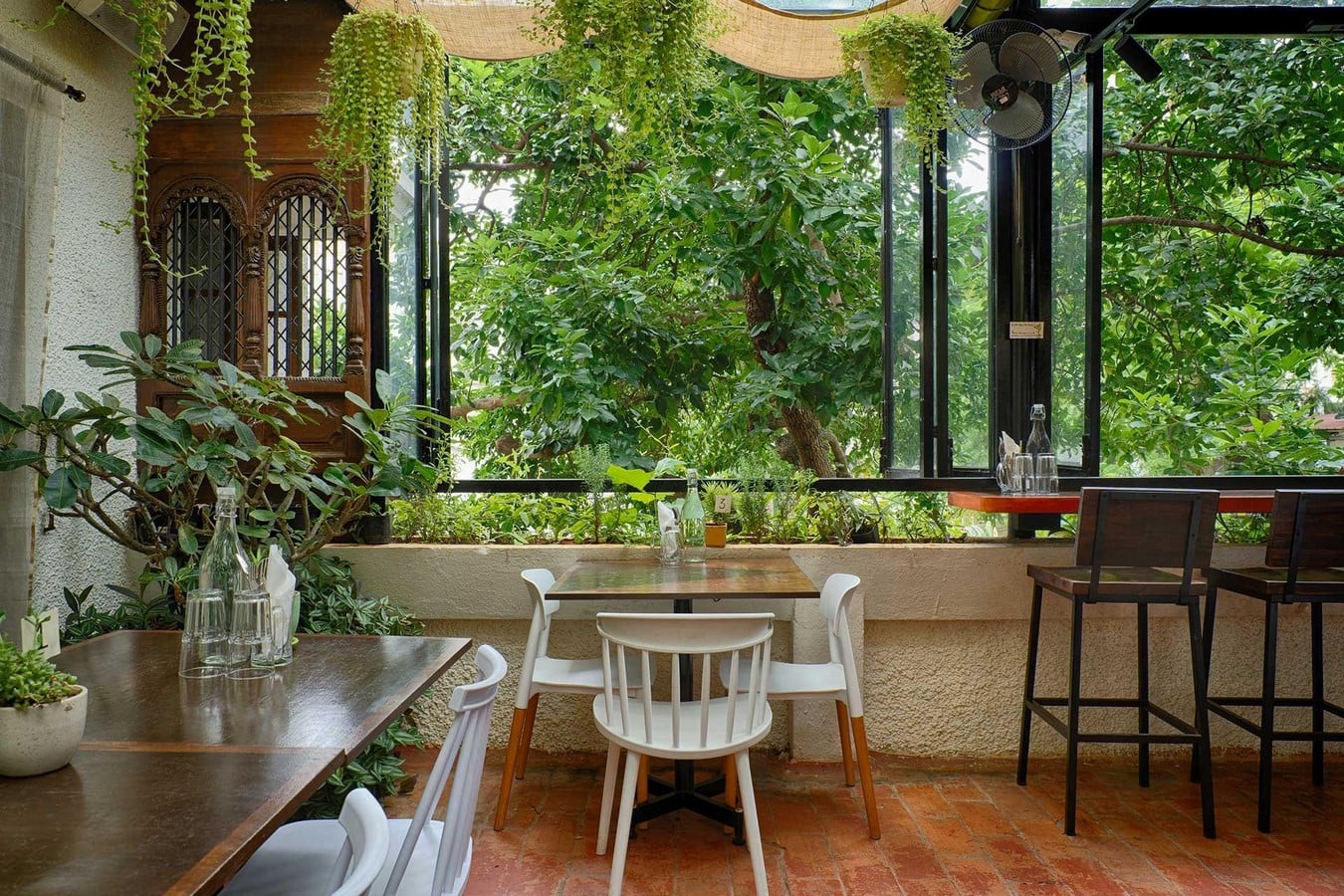
The difference lies not only in Champaca’s program but in its architecture. Where cafés are designed as fluid, open spaces for efficiency, Champaca’s adaptive reuse of a villa offers a sequence of smaller, intimate rooms. Each room carries the proportions of its domestic past, and this scale transforms browsing into something deeply personal almost as if one is reading within a home rather than a commercial outlet.
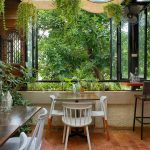
Unlike a typical bookstore, where bookshelves dominate and dictate movement, here the architecture frames the act of reading through its thresholds and transitions. The shift from the shaded garden into the veranda, and further into the cool interior rooms, feels like a journey inward. The villa’s verandas, deep windows, and porous edges allow nature to be part of the reading experience. Instead of isolating books from their context, the design situates them within a living, breathing environment.
In contrast to the rigid order of libraries, Champaca’s architecture is layered and porous. The adaptive reuse retains the asymmetry of a lived-in house: rooms open into each other, shelves tuck into niches, and verandas spill into the café. This looseness fosters a sense of belonging rather than discipline, creating a rhythm of pause and discovery.
Arrival & Spatial Layout
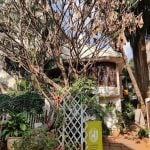
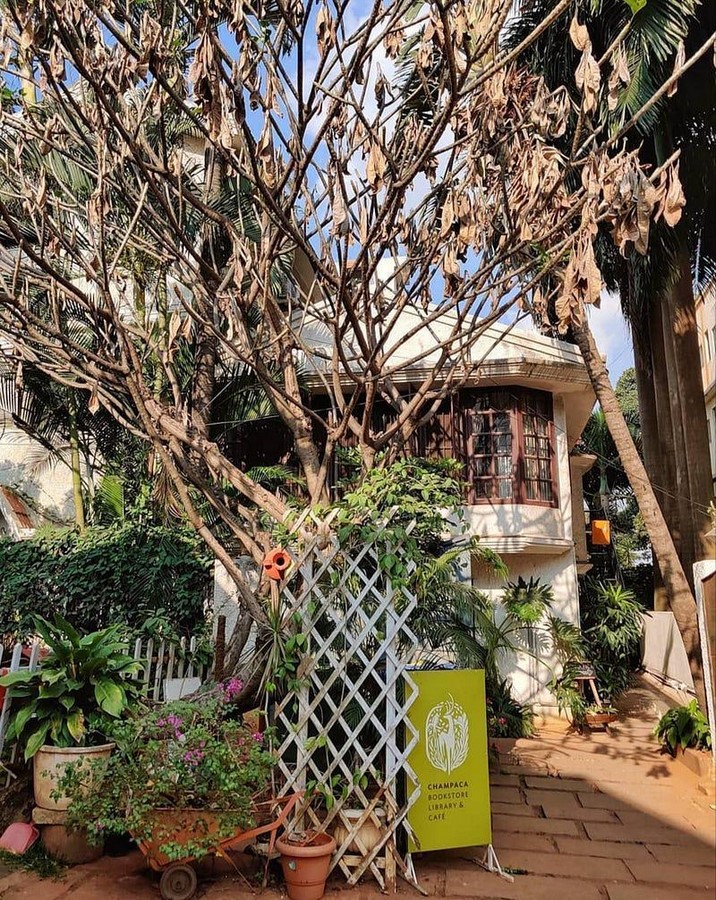
The entrance to Champaca is telling in itself. Unlike cafés and stores that rely on bold signage and conspicuous façades, Champaca hides behind a modest gate. You walk past greenery and ascend a narrow metal staircase draped in creepers, a threshold that feels more like entering a home than stepping into a commercial outlet. The sense of arrival is intimate, almost secretive, setting the tone for the experience inside.
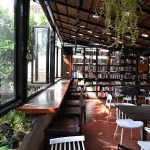
The interior layout continues this simplicity. The main space is both bookstore and dining area, where bookshelves line the walls on all sides, framing conversations and meals with the presence of literature. A small kitchen fronts the café counter, scaled like a domestic kitchen rather than a commercial one reinforcing the sense that you are in someone’s home. Tucked discreetly into one corner is a compact back-office, where book stocks and supplies are stored. Nothing about the plan is grand or performative; it is efficient, modest, and deeply human in scale.
Context, Materiality & Atmosphere
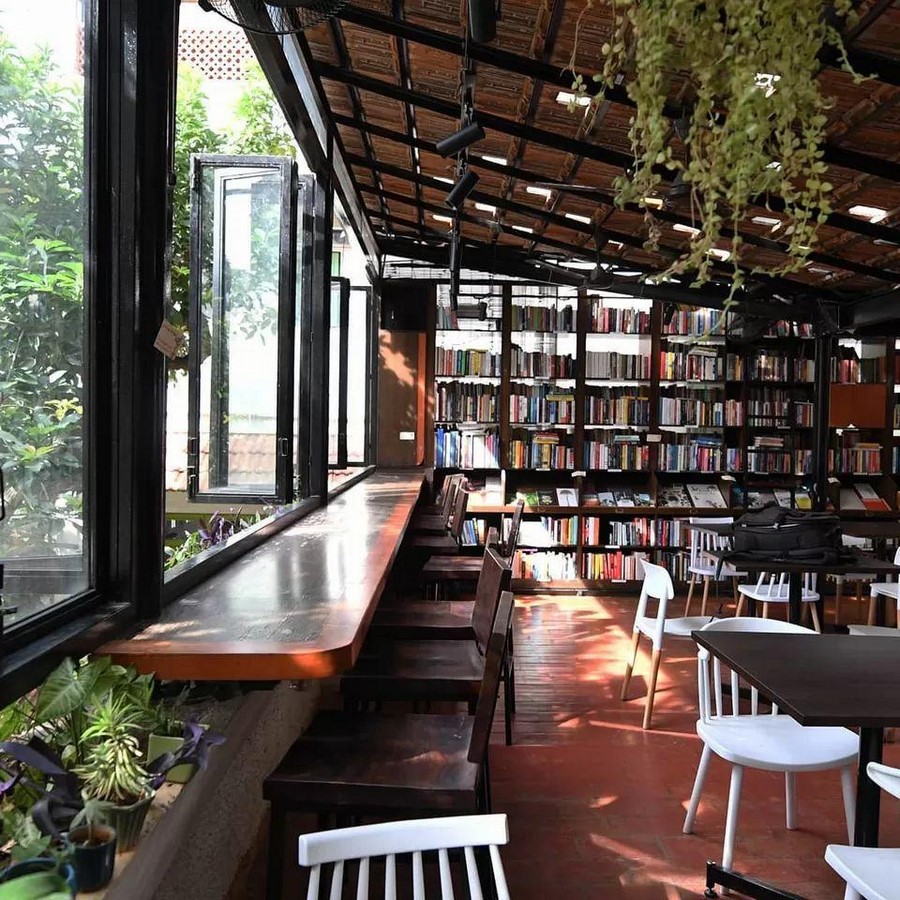
What elevates Champaca beyond its simple plan is its contextual setting. Sitting at the hardwood ledge high table by a wide window, you are framed against a magnificent magnolia tree, the tree that lends the bookstore its name. The view extends into the adjoining residential property and a small kindergarten. At times, the air is filled with children’s laughter and shrieks of play, layered with the faint hum of city traffic that you only notice when you pause to listen. This constant exchange between the interior and its surroundings ties the bookstore to its neighborhood in a way few urban cafés or bookshops manage.
The materiality of the store reinforces its rootedness. Locally sourced and sustainable materials dominate, grounding the adaptive reuse in both environmental responsibility and contextual sensitivity. The flooring, made of natural material, remains cool underfoot and blends seamlessly with the rest of the palette. The ceiling is perhaps the most remarkable feature: made of Mangalore tiles, it slopes inward, terminating at a central gutter. Certain tiles are punctured and covered with translucent material, transforming them into skylights that filter daylight into the interior. The effect is an interplay of light and shadow that keeps the space naturally bright while reducing reliance on artificial lighting.
The furniture is intentionally unassuming: basic dining tables and chairs, a few casual benches, and a cozy floor-seating zone with cushions. This understated approach avoids spectacle and instead foregrounds comfort and familiarity. The result is a space that feels at once designed and organic, curated yet unpretentious.
Final notes
Champaca is not merely a bookshop in a restored villa, it is an argument for how cities can nurture culture without erasing memory. The adaptive reuse preserves the intimacy of a home while opening it to the public, allowing readers to inhabit rooms where life once unfolded privately. Its verandas, shaded by trees, blur the threshold between garden and interior, turning the act of reading into a communal, almost ritualistic pause in the city’s pace. What makes Champaca remarkable is not just the books it houses, but the way its architecture scripts slowness, intimacy, and belonging in a metropolis defined by speed.