The history – AI’s birth
The phrase Artificial Intelligence (AI) was first used as a name for a summer workshop by John McCarthy in 1956, held at Dartmouth, with the aim of encoding human language into a machine and enabling it to solve problems. But the concept of AI had been making its rounds before this. In the year 1950, Alan Turing, a scholar, pondered whether machines would think for themselves. He studied this through an experimental setup, which was centered around a Victorian game. This game involved cross-examination of a man and a woman, but for the purpose of this study, one of them was replaced by a computer program. If the examiner failed to identify the computer, it would conclude that the machine could think. Some of the names used for this concept were – thinking machine, cybernetics, and automata.

Current status
Now, in the present, a ‘thinking machine’ is not a concept but a reality. AI doesn’t just think for itself; it can now assist us and, at times, even make decisions for us. It can solve problems in milliseconds and spot errors or inconsistencies in data in seconds to minutes. In the past few years, the study on AI has propagated to such an extent that it is integrated everywhere, in mobile phones as search engines, in home appliances as cleaning robots, in self-driving cars, and in home security.

But, the most important and sensitive integration of it is in the professional services. The widely used form of it is GenAI or generative AI; the commonly used ChatGPT comes under this category. The reason for its need, as mentioned before, is its ability to automate repetitive processes, consolidate and review data quickly, like creating graphs and charts, and thereby offering more time for us humans to focus on complex and creative affairs. With the benefits, AI carries its drawbacks too.
Inherent constraints
Since AI uses an amalgamation of the information available on the internet to resolve issues, a question of authenticity comes into play, which could lead to an ethical collapse, followed by its capability to emphasize and validate conventional ideas, shrinking the possibilities of a whole new approach or perspective. Another concern is its over-dependence, which could result in weakened critical judgment and proficiency among the users. The most significant of them all is the confusion or blur regarding the real author, the human, that is, the user, or AI, that generated the results. The ownership of AI-generated work cannot be pointed to one as it depends on the circumstances of its use and the governing framework surrounding it.

Ownership and accountability
There could be a few ways to untangle this dilemma, one being that the rights to the generated designs be bestowed upon the creators of the AI software, because it’s a tool licensed by them, without which the said designs wouldn’t exist. On the other hand, authorship could be entrusted in the hands of the users who trained the AI with their information and inputs, based on which the AI developed the results. The third being, since AI’s work is mostly a spin-off of existing works, the copyright should reside with the architects of that original work. With all this, the question of accountability arises: who is responsible for AI’s outcomes?
Let’s say, in the event of an architectural design failure, the liability cannot lie with the AI. Here, the licensed architect, due to their experience and judgment, has the capacity to determine whether the proposals from the AI need to be accepted or not.
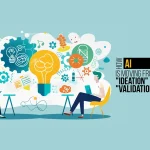
The program perceives what is fed to it and nothing beyond; it cannot account for a definitive context in terms of the site and its contours, nor can it perceive the abstract sentiments of the clients and transform those into livable spaces. These can only be comprehended by a human – an architect. So, the ideation formed by an AI is just a tool, providing vague glimpses of designs that could be or not.
Licensure
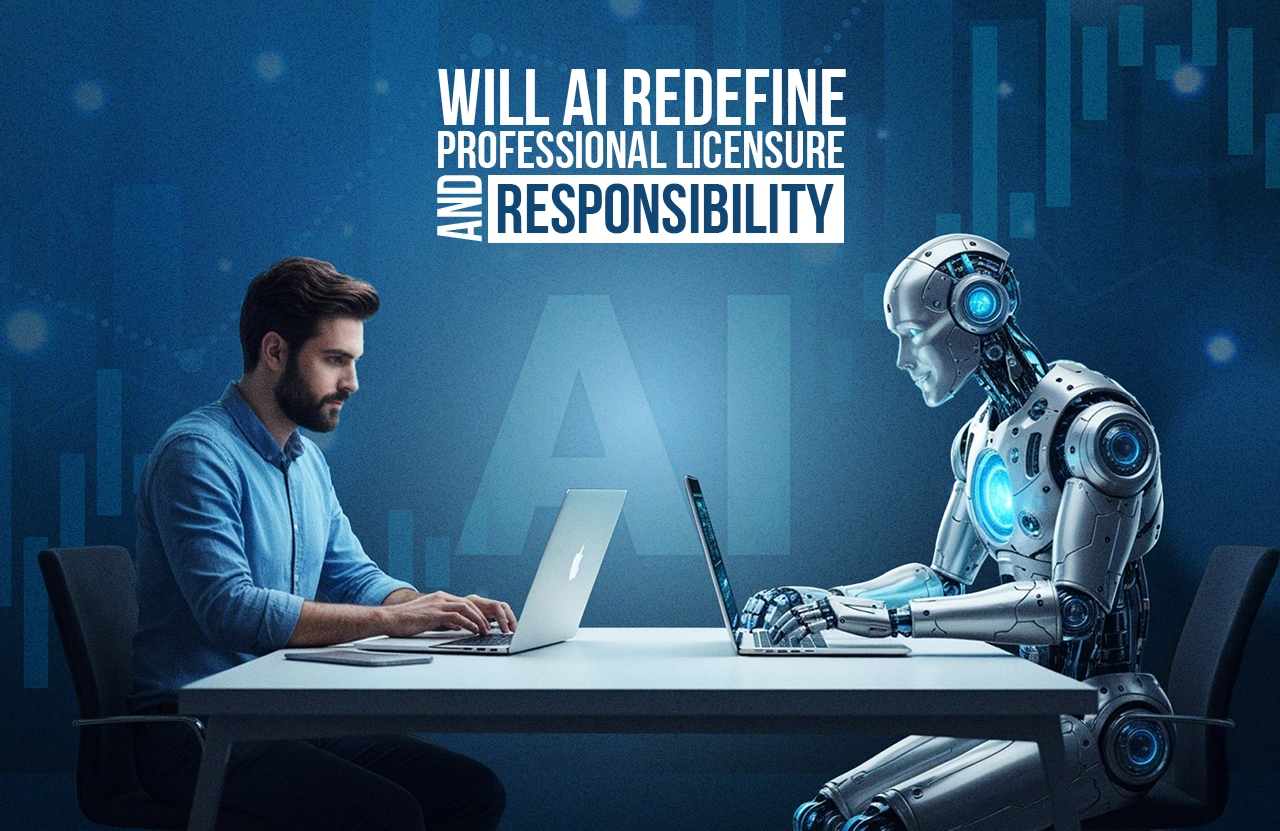
Beyond design, the use of AI in the medical field to evaluate patient data and form diagnoses, and in legal and finance to provide quick and affordable advice, makes it an obligation that AI and AI agents undergo a licensing and certification process in the form of rigorous testing and moral compliance to meet the required standards. This certification process needs to continuously evolve with research and advancements, and must recur at stipulated intervals to maintain compliance with the mandatory guidelines.
On a deeper note, AI, as its name suggests, is artificial; it cannot replace humans. It cannot be human, though it can slightly mimic a few characteristics. It cannot substitute the essence of a being. It is an instrument, like a violin, that can produce notes only when played by a human, and can produce different melodies when controlled by a brain. AI is a mere instrument!

References:
- Lawrence Livermore National laboratory (2026). The birth of Artificial Intelligence (AI) research. [online]. (Last updated 2026). Available at: https://st.llnl.gov/news/look-back/birth-artificial-intelligence-ai-research [Accessed 22 April 2026].
- Sedna (2025). How is AI Being Used in Professional Services? [online]. (Last updated 2025). Available at: https://www.sednacg.com/post/how-is-ai-being-used-in-professional-services [Accessed 22 April 2026].
- Pearson (2025). How will AI influence the future of professional skills? [online]. (Last updated 2025). Available at: https://www.talentlens.com/blogs/ai-future-professional-skills.html [Accessed 22 April 2026].
- Applitux (2024). The Impact of Artificial Intelligence on the Professional World [online]. (Last updated 2025). Available at: https://apptilux.com/blog/the-impact-of-artificial-intelligence-on-the-professional-world/162 [Accessed 22 April 2026].
- LinkedIn (2025). Why Licensing Matters More in the AI Era [online]. (Last updated 2025). Available at: https://www.linkedin.com/pulse/why-licensing-matters-more-ai-era-thearpl-ojace/[Accessed 22 April 2026].
- Ali Al Mokdad (2025). Licensing AI: If We Trust It with Lives, We Should Certify It Like Professionals [online]. (Last updated 2025). Available at: https://medium.com/@almokdadali1/licensing-ai-if-we-trust-it-with-lives-we-should-certify-it-like-professionals-d54cca8b7409 [Accessed 22 April 2026].
- David Mallon, Julie Duda, Stefano Besana, Maya Bodan (2026). AI and the future of human decision-making [online]. (Last updated 2026). Available at https://www.deloitte.com/us/en/insights/topics/talent/human-capital-trends/2026/decision-making-with-ai.html [Accessed 22 April 2026].
- Shivanku Misra (2024). Licensing AI Agents — How to Ensure Accountability in High-Stakes Professions [online]. (Last updated 2024). Available at: https://www.cdomagazine.tech/opinion-analysis/licensing-ai-agents-how-to-ensure-accountability-in-high-stakes-professions [Accessed 22 April 2026].
- AIA Contract Documents (2024). The Ownership Dilemma: Who Owns Building Design in the Age of AI? [online]. (Last updated 2024). Available at: https://learn.aiacontracts.com/articles/the-ownership-dilemma-who-owns-building-design-in-the-age-of-ai/ [Accessed 22 April 2026].