On a hot day, a glass office tower can offer a curious contradiction: the world outside shimmers in the heat, while the interior remains precisely cool.
Behind this comfort lies a shift in how buildings negotiate with their surroundings.
Modern architecture had long explored sunlight, ventilation, shading and orientation before air conditioning became widespread.
AC did not invent modern architecture, but it changed what buildings were expected to do, allowing mechanical systems to assume responsibilities once addressed substantially through architectural form. What drove this shift, how did it reshape buildings across climates, and what has this dependence on controlled comfort come to cost?
Comfort, Composed by Design
Before air conditioning became widespread, modern architecture was already tackling the challenge of creating comfortable interiors. Climate was not simply an obstacle to technological progress; it was a condition architects sought to negotiate through design.
Le Corbusier explored solar orientation, projecting terraces and deep façades to mediate sunlight, while Walter Gropius’s studies of light and air considered how building spacing, height and arrangement affected environmental conditions.
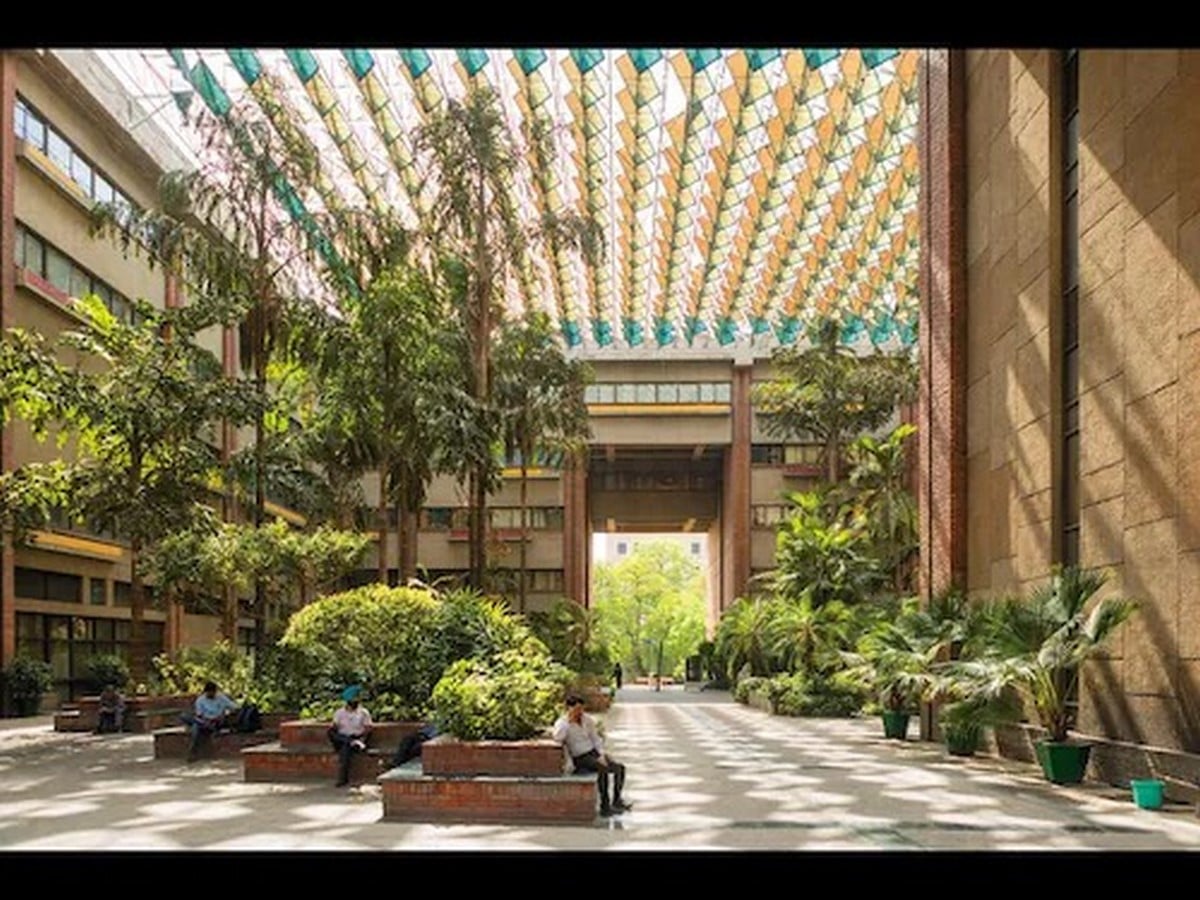
Early commercial buildings similarly used operable windows, light wells and internal courts to admit daylight and encourage airflow. Yet these strategies were neither universally effective nor sufficient in every climate.
As Daniel A. Barber argues in Modern Architecture and Climate: Design Before Air Conditioning (2020), modernism’s relationship with climate deserves closer attention. The ambition was not simply to escape the outdoors, but to shape indoor conditions through architectural form.
Air conditioning would extend this ambition while changing its terms: where orientation, shading and ventilation worked by negotiating with the climate outside, mechanical cooling made it increasingly possible to maintain indoor conditions despite it.
In doing so, it began to shift part of the responsibility for comfort from the building’s form to the systems operating within it.
The Business of Being Comfortable
If architecture had once relied on form to negotiate with the climate, air conditioning offered modern architecture a different proposition: indoor conditions could be controlled with greater precision, even when the weather outside could not.
Its appeal first extended beyond human comfort to practical problems of production.
In printing, for instance, fluctuations in humidity could affect paper and manufacturing processes, making environmental control an industrial concern before it became a familiar feature of everyday buildings.
The New York Stock Exchange explored cooling and humidity control as early as 1902, reflecting the growing interest in managing the heat and moisture that complicated indoor environments.
Later, cinemas turned cool interiors into an attraction in themselves, making relief from summer heat part of the public experience.
Across these settings, controlled air became associated with cleanliness, health, and productivity, while engineers increasingly treated temperature, humidity, and air circulation as conditions they could measure and regulate.
These promises were influential, although cooling alone did not guarantee healthy air or better working conditions.
What made the technology particularly compelling was its promise of predictability: interiors could maintain relatively stable conditions despite fluctuations outdoors.
This suited modern architecture’s growing faith in rational systems and technological control, helping extend the mechanically conditioned interior from specialised industrial settings into public buildings, workplaces and, eventually, a wider range of climates.

The Weather Divide
Few elements expose the changing priorities of modern architecture as clearly as the window.
Balancing daylight, views, ventilation, solar heat and weather protection has always made its design a balancing act between the building and its climate.
Air conditioning altered that relationship: once ventilation could be assigned to machinery, the window no longer had to perform all these roles together.
At the Hershey Chocolate Corporation’s windowless office building in the 1930s, even awareness of the weather was mediated by a “Mechanical Weather Man” – a panel of coloured lights translating outdoor conditions into signals for employees.
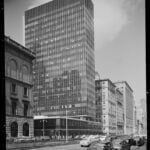
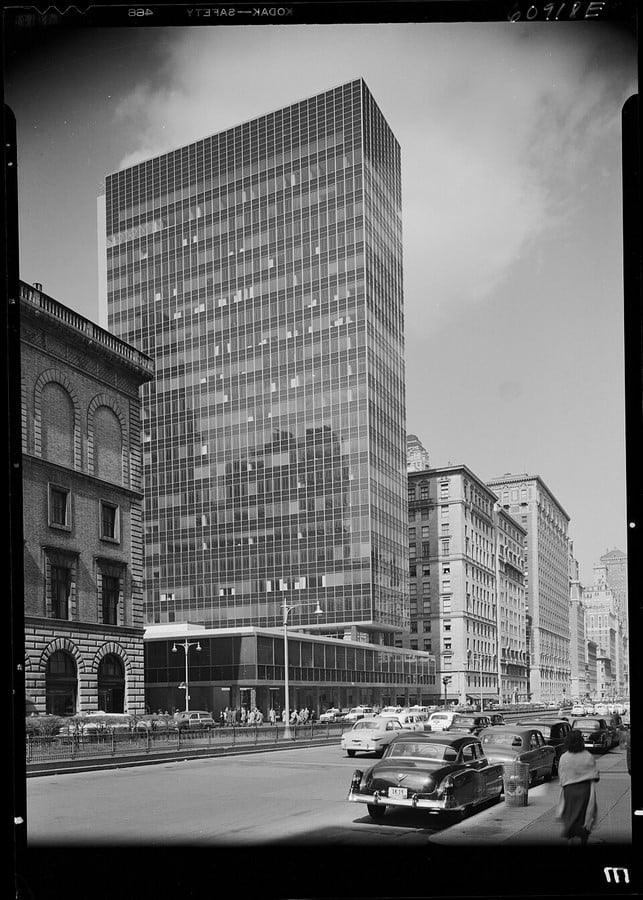
By 1952, New York’s Lever House presented a more elegant version of the same separation: its largely fixed glass façade preserved views while mechanical systems managed the interior climate. The façade no longer had to do as much to keep the indoor environment comfortable.
Air conditioning made certain architectural choices more practicable and weakened the incentive to resolve every aspect of comfort through form.
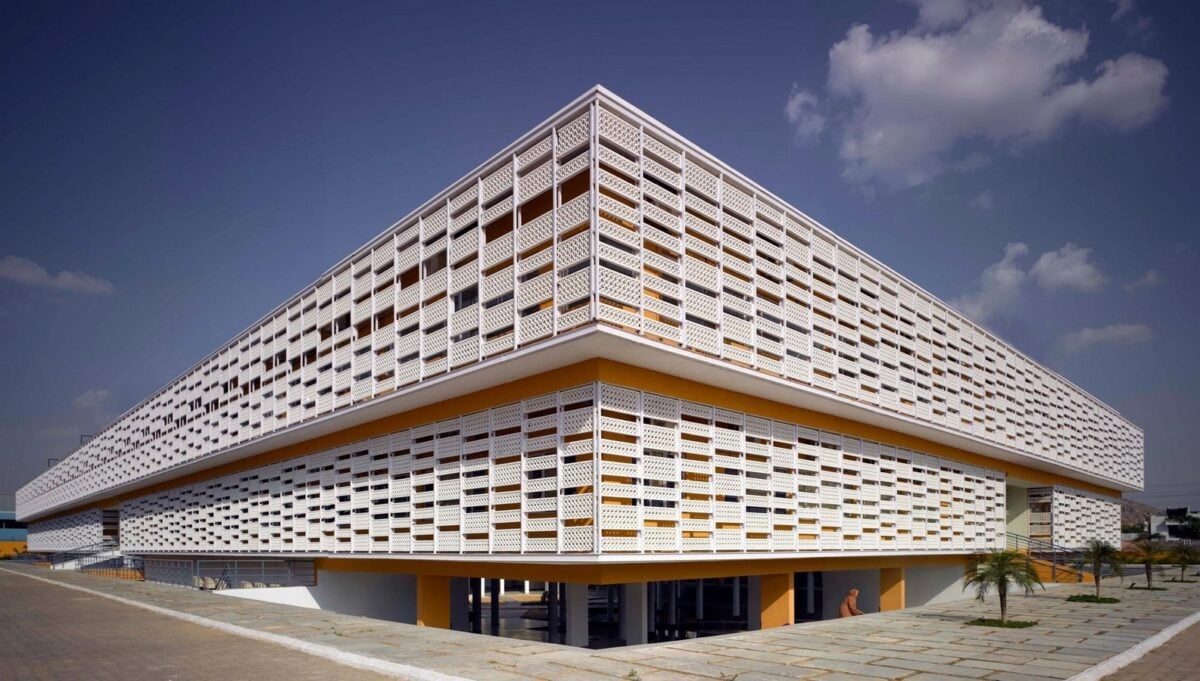
As cooling systems assumed more responsibility for comfort, screens, deep shading, climate-specific materials and spatial devices such as courtyards began to lose ground to designs that prioritised a controlled interior.
This was not the disappearance of climate-responsive architecture, but a shift in what design was expected to solve – and what machinery could be asked to compensate for.
Library of Congress/ Wikipedia
Still Under Construction
The legacy of modern architecture in the age of air conditioning is neither wholly liberating nor entirely damaging.
Mechanical cooling has made buildings usable in extreme heat and enabled functions that natural ventilation alone cannot always support.
Yet dependence on electricity, equipment and refrigerants raises a difficult question: how resilient are buildings when the systems sustaining their comfort become unreliable or environmentally costly?
The answer lies not in abandoning air conditioning, but in reconsidering what architecture can do before it becomes necessary.
Orientation, shading, glazing, courtyards and thermal mass can help limit heat gain and improve indoor conditions, allowing mechanical systems to address what design alone cannot adequately resolve.
Such an approach does not pit traditional climate-responsive strategies against modern technology; it asks how the two can work together.
This brings us back to the window: should it be merely a view onto the weather, or part of how a building responds to it?
The future of modern architecture may depend on restoring that connection, making comfort not simply something machinery delivers, but something architecture helps sustain.
References:
Chang, J.-H. and Winter, T. (2015). Thermal modernity and architecture. The Journal of Architecture, 20(1), pp.92–121. doi:10.1080/13602365.2015.1010095.
Architecture of the well-tempered environment. (n.d.). [online] press.uchicago.edu. Available at: https://press.uchicago.edu/ucp/books/book/chicago/A/bo5956755.html [Accessed 12 Oct. 2026].
Chandler, M. (2022). Review: Air-conditioning in modern American architecture, 1890–1970. Journal of the Society of Architectural Historians, [online] 81(4), pp.523–525. doi:10.1525/jsah.2022.81.4.523.
Calder, B. and Bremner, G.A. (2021). Buildings and energy: Architectural history in the climate emergency. The Journal of Architecture, 26(2), pp.79–115. doi:10.1080/13602365.2021.1891950.
ArchDaily. (2017). How air conditioning helped shape architectural history (for better or worse). [online] Available at: https://www.archdaily.com/871410/how-air-conditioning-helped-shape-architectural-history-for-better-or-worse [Accessed 12 Oct. 2026].
Siry, J.M. (2021). Air-conditioning in modern American architecture, 1890–1970. [online] Penn State Press. Available at: https://books.google.com/books?id=PzQPEAAAQBAJ [Accessed 12 Oct. 2026].
Carrier.com. (2018). Invention of Air Conditioning. [online] Available at: https://www.carrier.com/us/en/history/invention-of-air-conditioning.html [Accessed 12 Oct. 2026].
Chang, J.-H. and Winter, T. (2015). Thermal modernity and architecture. The Journal of Architecture, [online] 20(1), pp.92–121. doi:10.1080/13602365.2015.1010095.
Barber, D.A. (2020). Modern architecture and climate design before air conditioning. Princeton Princeton University Press.
Siry, J.M. (2021). Air conditioning in modern American architecture, 1890-1970. Buildings, Landscapes, and Societies.
Robbins, S. (2003). Keeping things cool: Air-conditioning in the modern world. OAH Magazine of History, [online] 18(1), pp.42–46. doi:10.1093/maghis/18.1.42.
AE Air (2024). How HVAC technology is changing modern architecture. [online] AE Air. Available at: https://ae-air.com/how-hvac-technology-is-changing-modern-architecture/ [Accessed 12 Oct. 2026].
Daikin Internet. (n.d.). A history of air conditioning from ancient Egypt to today. [online] Available at: https://www.daikin-ce.com/en_us/daikin-blog/the-history-of-air-conditioning.html [Accessed 12 Oct. 2026].
David (2019). How air conditioning shaped modern architecture. [online] E-architect.com. Available at: https://www.e-architect.com/articles/how-air-conditioning-helped-shape-modern-architecture [Accessed 12 Oct. 2026].
Elif Ayşe Fidancı (2025). Exploring the evolution of air conditioning in architectural design: From past to future trends. [online] Learn Architecture Online. Available at: https://learnarchitecture.online/blogs/architecture-design/exploring-the-evolution-of-air-conditioning-in-architectural-design-from-past-to-future-trends [Accessed 12 Oct. 2026].
Newsletters Newsletter # 102 The PTC 3 min read and on, P. (2025). How air conditioning impacted global design | insights | the PTC. [online] Theproptechconnection.com. Available at: https://www.theproptechconnection.com/article/how-air-conditioning-impacted-global-design [Accessed 12 Oct. 2026].
Nridigital.com. (2024). Climate change: Design lessons from the past – design & build review | issue 59 | december 2020. [online] Available at: https://designbuild.nridigital.com/design_build_review_dec20/climate_change_design [Accessed 12 Oct. 2026].