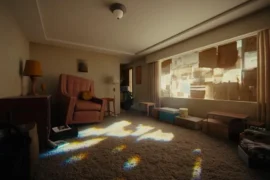
Bethlehem Kudumba Unit (2026) is a Malayalam rom-com film directed by Girish A.D, featuring Nivin Pauly and Mamitha Baiju, in the lead roles. The film offers a world that is memorable and relatable, transforming an ordinary neighbourhood into the setting for a story about love, humour, and the small encounters that shape everyday life.
The film, produced by Bhavana Studios, Fahadh Faasil, Dileesh Pothan and Syam Pushkaran is currently the highest- grossing Malayalam film of all time .

The plot follows Justin, an unmarried man approaching middle age, whose life takes an unexpected turn when Ashley moves in next door. Ashley is a college student from Mundakkayam, who moves in with her family to Angamaly due to financial difficulties. A gentle romance unfolds between them surrounded by humour filled incidents of daily life. The film finds much of its appeal in its characters, the environment they inhabit and is anchored around the love story. The movie opens with Ashley returning to Kerala after spending one and a half years studying in Ireland. Her return is overshadowed by an emotional memory, reminding her of Justin, the man she had fallen in love with before leaving the country. The narrative then moves two years back to recount the events that led to their relationship.
Bethlehem Kudumba Unit offers an interesting opportunity to examine how ordinary residential settings become meaningful through human interaction and relationships. Visual composition, colour, and atmosphere of everyday spaces are controlled to give the audience an immersive personal connection with the story.
The setting
The neighbourhood itself, like the name suggests, is set as a family unit, where proximity creates opportunities for encounters. The relationship between Justin’s house and Ashley’s neighbouring home is particularly important in the neighbourhood. The spatial layout of either house can be noticed leading to the situations in favor of the love between the protagonists.

https://www.instagram.com/reel/DcisE37T_J5/
In an interview with Manorama Online, cinematographer Ajmal Sabu explained that the team deliberately introduced the film’s surroundings early so that viewers could quickly become familiar with its world. The cinematography prioritised the story and its emotional moments, avoiding an overly colourful or artificial visual treatment.
The Home
The team searched extensively for a suitable location before choosing a house near Puthenchira, close to Chalakudy. The visual character of the houses is aimed at a natural, middle-class range that supports the emotional tone of the story. The cinematography takes the audience through every nook and corner of the house that matters to the story.
The shots where they exchange glances and small talk through windows that face each other stir soulful emotions in the audience.
The bougainvillaea in front of the house plays an unappreciated significant role in the movie. What may appear incidental becomes the identity of the space and also a threshold between either houses, creating a strong sense of character. More importantly, the presence of another smaller house nearby suited the story requirements.
Rain, Colour, and Atmosphere.
The opening and closing sequences are framed by rainfall, which is a timeless element that sends love in the air. Rain changes how the neighbourhood is perceived. It transforms the atmosphere to softer and more intimate, supporting the film’s romantic tone.

The film also demonstrates the importance of colour gradation. Wet surfaces reflect light and overcast sky makes colours acquire greater depth. Instead of saturating every frame, the visual designers selected colours carefully to maintain a consistent mood. The cinematography develops what Sabu described as a “wet mood”, coordinating the appearance of the surroundings, lighting, and costumes of the artists.
Production Design
The team experimented with lenses and lighting variations to prevent repeated views of the location from becoming visually monotonous. A scene worth applause is the sequence involving a jeep travelling alongside a train. The crew combined shots across four locations and used visual effects to create the final scene rather than filming the entire action as it appears on screen.
Cars, houses, and windows are recurring elements in most frames of the film. And to avoid monotonous repetition that this could cause, the team explored every possible camera angle inside the car—leaving none unused. They filmed inside the vehicle under various conditions: be it stationary or, through the use of VFX, made to appear as if it were in motion. Similarly, for scenes set near windows, they utilised different times of day to introduce variation.

Architectural takeaway
Bethlehem Kudumba Unit is not a film showcasing architectural brilliance, nor does it have an architectural lens in the conventional sense. Its architectural value lies in the attention to the ordinary spaces in which people live, interact, and form relationships.
A social framework is established in the neighbourhood and cinematography transforms ordinary surroundings to leave a lasting impact on the audience. Together, these elements demonstrate how architecture participates in storytelling through subtle details like the view through a window or a flowering plant at the entrance. The most meaningful architecture is not always the architecture that demands attention; sometimes, it is the architecture that quietly makes life possible.
The film offers a perspective that the success of a space cannot be measured by appearance alone. It must be understood through the experiences from the people it caters to, and the memories it helps create.
References:
- Wikipedia contributors. (2026, October 25). Bethlehem kudumba unit. Wikipedia. https://en.wikipedia.org/wiki/Bethlehem_Kudumba_Unit
- Mohan.A (2026, August 28). Interview with Bethlehem Kudumba Unit cinematographer Ajmal Sabu. Manorama Online. https://www.manoramaonline.com/movies/interview/2026/08/27/bethlehem-kudumba-unit-movie-cinematographer-ajmal-sabu-interview.amp.html
- Ajith.S.P (2026, August 21). Bethlehem Kudumba Unit review: Nivin Pauly and co. deliver a fun Onam entertainer. Onmanorama. https://www.onmanorama.com/entertainment/movie-reviews/2026/08/21/nivin-pauly-mamitha-baiju-bethlehem-kudumba-unit-movie-review-onam-entertainer.html
- Das, S. (2026, September 14). Bethlehem Kudumba Unit emerges as highest-grossing Malayalam film of all time, beats Lokah, Thudarum, L2 Empuraan | Hindustan Times. https://www.hindustantimes.com/entertainment/others/bethlehem-kudumba-unit-emerges-as-highest-grossing-malayalam-film-of-all-time-beats-lokah-thudarum-l2-empuraan-101789394271853.html