This article endeavours to discuss whether the emergence of Brutalism, in a contemporary context, would be suitable. The origins of the term Brutalism, is said to have evolved in 1950, from Swedish architect, Hans Asplund, when he used the term ‘nybrutalism’ (meaning ‘new brutalism’) to describe a brick building (Irpino, 2023). When describing the post-war construction that occurred in the UK, the term became more well known, when it was used by Reyner Banham in an article for the Architectural Review, titled ‘The New Brutalism’ in 1955.
Brutalism in The Late 20th Century:
The term Brutalism also originates from the French phrase ‘béton brut’, meaning raw concrete (Irpino, 2023), thus referring to its fundamental physical characteristic, with its focus on functionality and rejection of prioritising aesthetic appeal. Aggregates of ‘concrete jungles’ became increasingly prevalent from 1955 to 1979 (Gira Magazine Editorial Team, 2023), an example of this being Unité D’habitation, designed by Le Corbusier and constructed in 1952.

The Unité D’habitation, however, contrasted the usual characteristics of Brutalism, such that, the use of the concrete paired with the coloured walls created a juxtaposition that fed into the Modernist movement, as the colour palette attempts to ‘humanize the imposing concrete façade’ (Zhao, n.d). Some may propose the argument that Brutalism, in terms of materiality, does not offer that much to the narrative of the space, which is where the form of the building may come into play. An example of this is The National Theatre, located in London, designed by Denys Lasdun and completed in 1976 (Mull, 2014).

What the materiality is unable to offer, is done by the form and circulation of the scheme, such that, the varying heights and levels of the pathways that merge with the walkways of the South Bank create a sense of interconnectivity that becomes ‘hard to define where the National Theatre begins and ends’ (Mull, 2014). This characteristic is reflective of general Brutalist features, that involve creating a community atmosphere through connecting these varying heights through pathways, emulating ‘streets in the sky’ (Irpino, 2023). Creating community atmospheres through form and circulation, especially in residential or public Brutalism schemes, are pertinent, since the choice of materiality is quite unappealing and uninviting.
The Development of Brutalist Structures In Contemporary Times:
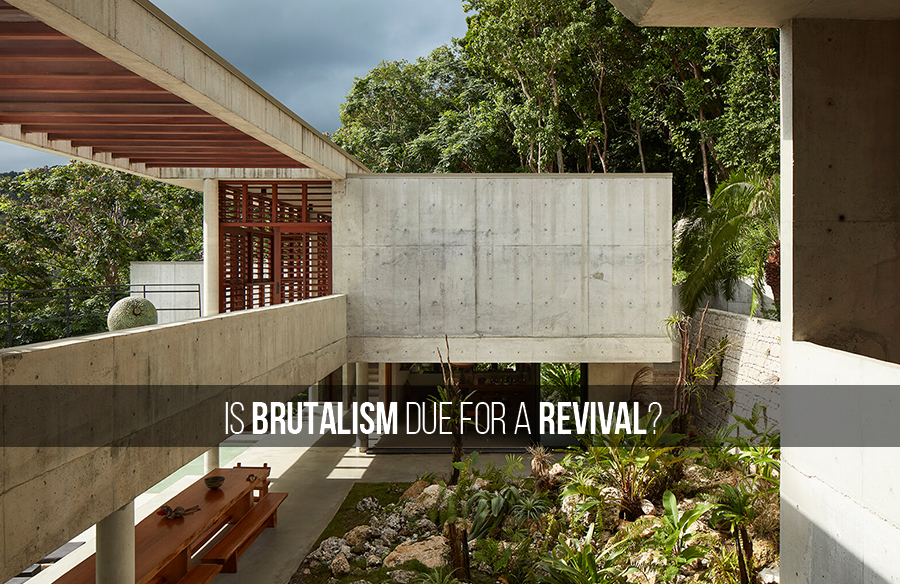
A movement that appears to be increasingly popular amongst this particular niche in architecture is Tropical Brutalism, which allows countries in hotter climates to adapt this post-war style of architecture into more vernacular landscapes. The amalgamation of the utilitarian aesthetics of Brutalism, displayed by the raw materiality paired with the simple geometric forms, and the natural elements displayed by the tropical regions these buildings are situated in, allow for comfort-optimising designs (Clausen, 2024). An example of Tropical Brutalism is Pompey, designed for Diplo, a DJ and music producer (Clausen, 2024).

Another example of how Brutalism has developed to cater to the wider public is the V&A Dundee Museum, located in Scotland. Kengo Kuma Architects attempted to make Brutalist pieces of architecture more inviting and appealing to the public, and this is clearly shown through the angular approach taken in the form of the design. Although the building is designed with concrete, the decreasing levels of support in the building’s structure are said to ‘mimic the rugged cliffs of Scotland’s coast’ (Goyal, 2024).

From assessing the examples presented in the article, perhaps one can assume that Brutalism relies heavily on relating to the context of the location, more so than other styles of architecture. This may be due to the fact that the raw and rough nature of the materiality used, as well as the simplicity of the standard Brutalist forms, proposes constraints for designers from the start of the design process. Thus, relying more on the context of the surrounding location to inform their design, creates a more thorough and refined scheme, as done by Kengo Kuma with the V&A Museum. Perhaps, the style of Brutalism, itself, is a constraint that allows designers to think outside of the (concrete) box.
In summary, the question that the article attempts to discuss: ‘Is Brutalism Due For A Revival?’ seems quite rudimentary, as the examples of contemporary brutalism, such as the Tropical Brutalism that Diplo’s Pompey is built from, or the V&A Museum by Kengo Kuma architects, are all projects that show us that this style is evolving, rather than being revived. The negative connotations towards Brutalism during the early stages of its creation resulted in an exhibition ‘SOS Brutalism – Save the Concrete Monsters’, held in Frankfurt, then other European cities after. One of the targets of the exhibition was to address the history of the style, in an unbiased manner, and to communicate the style’s main attribute: rejecting the ornate and ornamental embellishments of design for ‘stark authenticity’ (Gira Magazine Editorial Team, 2023). Since the exhibition, the projects under the Brutalism bracket, seen on an international level, have confirmed that what Brutalism requires more than a revival, is an evolution.
References:
- Clausen, M. (2024) Concrete Jungle: Tropical Brutalism is Having a Moment [online] Available at: https://adorno.design/editorial/concrete-jungle-tropical-brutalism-is-having-a-moment/?srsltid=AfmBOoq6ck6e0lJn2qOhic5u6qNblZ5FCby9BcV8KgnQRrnPKHoVyXv4 [Accessed 27th November 2024]
- Gira Magazine Editorial Team. (2023). Architecture in the raw: Brutalism [online] Available at: https://www.gira.com/uk/en/g-pulse-magazine/architecture/brutalism# [Accessed 27th November 2024]
- Goyal, J. (2024) Contemporary Brutalism: Reviving A Controversial Architectural Style [online] Available at: https://smartinitiative.in/contemporary-brutalism-reviving-a-controversial-architectural-style/ [Accessed 29th November 2024]
- Irpino, L. (2023.) What is Brutalism? [online] Available at: https://artrkl.com/blogs/news/what-is-brutalism [Accessed 27th November 2024]
- Mull, O. (2014). Brutalist buildings: National Theatre, London by Denys Lasdun [online] Available at: https://www.dezeen.com/2014/10/06/brutalist-buildings-national-theatre-london-denys-lasdun/ [Accessed 27th November 2024]
- Zhao, W. (n.d) Unité D’habitation [online] Available at: https://museemagazine.com/features/2023/7/5/unit-dhabitation [Accessed 27th November 2024].
Image URLs:
- https://museemagazine.com/features/2023/7/5/unit-dhabitation
- https://theatre.reviews/insider-guide-to-london-theatres/national-theatre/
- https://www.pompeyjamaica.com/
- https://smartinitiative.in/contemporary-brutalism-reviving-a-controversial-architectural-style/