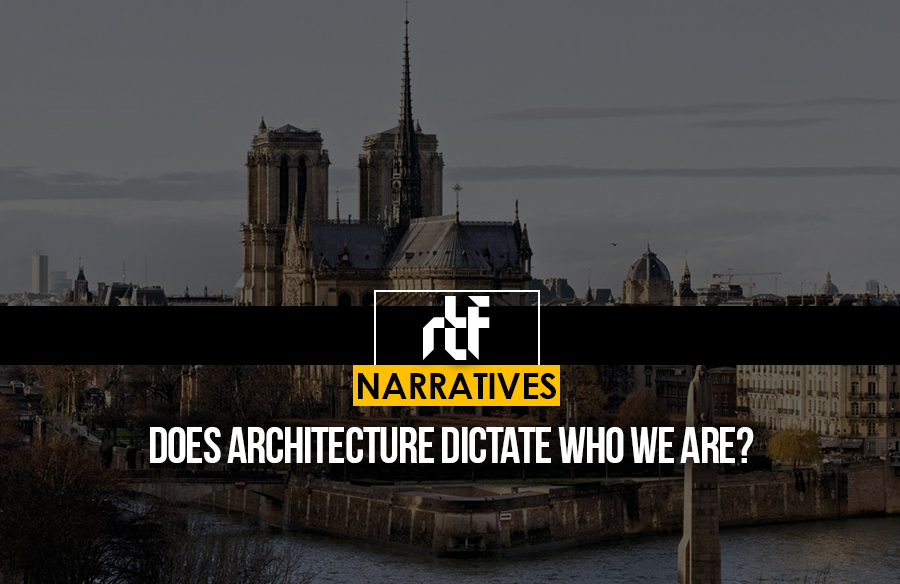
“Belief in the significance of architecture is premised on the notion that we are, for better or for worse, different people in different places – and on the conviction that it is architecture’s task to render vivid to us who we might ideally be.” – The Architecture of Happiness, Alain De Botton.
What is architecture? A concept; an idea? An impact on the lives of people, place, a moment in time? Do they shape it or does architecture shape them? Will we ever fully comprehend the exquisite nature of this intricate nexus that holds our tangible world together? Or are these statements simply a romanticised credence of the world through the lens of a designer?
Architecture as a Thought and Emotion-Provoking Agent
When one looks at a building, strong associations are immediately conjured up in the mind to make sense of one’s surroundings. These associations may be a belief, an aspiration, a brutal reminder, or even a celebration. It could be a visual cue into the past, present, or future. All in all, a collective spirit and aesthetic is projected by the architecture onto its users. It is the storyteller, and we, its listeners.
Architecture as a Visual Narrative of History
If a person with prior knowledge, to whatever extent, of Indian history were to picture an exquisite white marble dome with an inlay of precious stones. Minarets frame the central structure and lavishly spawn Charbaghs. Immediately, a regal Mughal Emperor clothed in a Jama and ornaments of gold come to mind. The Islamic rule is then briefly re-lived by the viewer.
Alternatively, one sees a grand basalt fort, atop which rests a palace embellished with jharokhas and chhatris. They are then reminded, as they walk through havelis with intricate wooden carvings of the walls adorned with murals and paintings of the tales of the brave Rajput rulers.

On a stroll through a once-anglicised city, one may be presented with stained glass, church spires, exposed dark basalt stone, and on occasion a clock tower. So how can they forget the colonial rule in India? How can they forget the stories narrated by their ancestors and the material reminders that never cease to exist in the surroundings they still inhabit?
Architecture as a Reflection of Society
From ancient structures to modern skyscrapers, from stone to steel, architecture has captured the essence and evolution of materials, technology, culture, and economic advancements. It is a marker of our progress as a society. A reflection of who we are, what we have achieved, and how we function as a collective. In the tapestry of cities, it marks the changing priorities, ambitions, and struggles of society. For example, the Gothic cathedrals of medieval Europe define a moment in time when the spiritual devotion and centralised power of the church rose to prominence much like the verticality of the buildings and the upward pointed arches and ribbed vaults. A connection to God so significant, the church structures continue to reflect a society deeply rooted in faith.

On the other hand, the Bauhaus movement emerged post World War I as a response to industrialisation and societal upheaval. Its focus on functionality, clean lines, and use of steel and glass symbolised the society’s shift towards efficiency, a break from tradition, aspirations of simplicity, and egalitarianism. Furthermore, it displayed the material and technological advancements being made at the time.
Similarly, in a contemporary context, in a city like Mumbai, where skyscrapers mark the city’s skyline tower above the sprawling slums of Dharavi. Symbols of luxury, modernity, and wealth as opposed to the makeshift homes, and narrow alleys representing the lack thereof. The high-rise buildings represent India’s growing economic power, while the slums expose systemic inequalities, lack of affordable housing, and socio-political challenges. Thus, the cityscape is a direct reflection of the paradox of the city’s inherent character.

Architecture as a Screenshot of the Present
A photograph captures a moment, it freezes and thus memorializes an occurrence, holding within it an essence that may or may not be replicated. Architecture is the same. It embodies the zeitgeist of its era to thrive in its creation and offers a history for future generations.
The Burj Khalifa in Dubai is amongst the flag bearers for the 21st century’s spirit of globalisation, technological innovation, and economic ambition. Its sleek structure and unparalleled height are symbolic of our pursuit of progress and ambition. Also, eco-friendly structures such as Singapore’s Gardens by the Bay reflect today’s emphasis on sustainability and the urgent need to harmonize urban development with environmental conservation.

During the COVID-19 pandemic, architecture adapted to prioritise health with designs incorporating flexible spaces, outdoor access, and better ventilation. It became the primary and defining attribute that governed how those years of people’s lives were spent. Architecture is thus a screenshot of human innovation, expression, and a record of all existence.
Architecture as an Indicator of the Future
In serving as a blueprint for the future, revealing aspirations, innovations, and evolving priorities, the designs created today indicate the kind of world that is envisioned. A world that addresses challenges such as climate change, urbanization, and social equity.
Sustainable architecture is a prime example. Structures like the Bosco Verticale in Milan, a vertical forest integrating greenery into urban living, suggest a future where cities coexist harmoniously with nature. Similarly, net-zero buildings, such as the Bullitt Center in Seattle, point toward energy-efficient design as a standard for combating environmental degradation.
Smart cities and adaptive designs further highlight the trajectory of architecture. Projects like Masdar City in Abu Dhabi envisioned as a hub for renewable energy and technology, show a commitment to innovation and resilience. Modular housing systems, designed for rapid assembly and flexibility, reflect a future addressing housing shortages and disaster relief needs.

Architecture thus anticipates societal shifts. It offers a glimpse of a future that prioritises adaptability, connectivity, and human-centric design. It evokes a sensitivity in the users, and assurance of a world built to thrive in the face of change.
List of References –
- (n.d.). Bullitt Center. Retrieved December 2, 2024, from https://bullittcenter.org/
- De Botton, A. (2008). The Architecture of Happiness. Knopf Doubleday Publishing Group.
- Sen, A. (2023, July 5). Architecture as a Reflection of Society. illustrarch. Retrieved December 2, 2024, from https://illustrarch.com/articles/16709-architecture-as-a-reflection-of-society.html
- Vertical Forest | Milan. (n.d.). Stefano Boeri Architetti. Retrieved December 2, 2024, from https://www.stefanoboeriarchitetti.net/en/project/vertical-forest/