Throughout the ages, art has carved a niche that facilitates the exploration of human spirituality and individuality, yet making it accessible to a world full of strangers. All forms of creative arts go beyond the physical world and allow a greater appreciation of one’s self and the environment. It is an interactive form of medium that invokes several emotions, metaphysical subjects, and even philosophies within their creators and patrons that would otherwise remain dormant. The art and spirituality connection levels are complex; there is art because there are things, ideas, and even feelings to express in an intelligible yet intangible manner through images and sights.
Art encourages the development of individuality because it is an activity that helps to express oneself uniquely. The artist’s internal world is expressed in every movement of the brush and every sculptural detail. At the same time, each viewer is allowed to understand how this work resonates with him or her and anything he or she has gone through.
Therefore, it is not enough to say that art represents the world; it alters it, instead. Within these two frames, the visible art and the invisible art, art becomes an instrument of change, creates new meanings, builds understanding, and empathy, and restores grooves of interest within and connection without.
N.K.P. Muthukoya: An Eccentric Artistic Visionary Shaping Perspectives

Boundaries did not impede N.K.P. Muthukoya — he led an extensive life embellished with philosophy and cultural presence. In the process of creative self-exploration, Muthukoya, in tandem with themes of the linear history of art in his works, employed history to speak to the past and modernity. His discourse shaped art trends in the world – and it was impossible to look at man, nature, and the world the same way after experiencing the paintings, drawings, and sculptures that he created. The article presents a study of N.K.P. Muthukoya’s life as well as his achievements as an artist. It especially sheds light on his works and beliefs, and their acceptance centuries later in the wider art society.

Vision and Connection:
N.K.P. Muthukoya came into this world of beauty, traditions, and cultures. Born and raised in a family of artists in Kerala, India, Muthukoya enjoyed Mother Nature and human connection from a young age. As a state with a rich artistic background, particularly related to performing arts like Kathakali and folk art like traditional murals, Kerala significantly contributed to his early appreciation of art. Muthukoya was not just interested in art for its visual representation but also in the stories that accompanied it.
Enthralled by art education both within this nation and abroad, Muthukoya underwent proper training that combined Indian classical practices with Western modernism. This mix of colonial and contemporary views would later define the style of his works, where the old and the new coexisted harmoniously. He was a great advocate for art as a global concept and would frequently declare, ‘Art has no time, has no culture, has no place; it is only a voice of one’s inner self to everything external.’
When Muthukoya became a professional, his artistic character had already formed, attracting critics and lovers of art almost immediately. His images possessed spirituality and contemplation, echoing nature and reflecting both the man’s beliefs and the earth to which he belonged.
Philosophy:
Muthukoya’s artistic vision was intrinsically linked to the world he grew up in. He asserted that art served as an essential means of conveying one’s thoughts to the public. His art, most of the time, could be regarded as visual religion, largely due to Indian metaphysical thinking—particularly the philosophy of Advaita Vedanta, which holds that everything in existence is one, and opposites such as life and death, light and dark, are but two sides of the same entity.
This idea of universality was pertinent to Muthukoya’s process of creation. He dealt with issues of being, self, and the placement of man in the environment, often sculpting human figures interacting with other elements like trees, water bodies, and the sky. His works were not mere reflections of the outer world, but rather an investigation of the outer limits of the human psyche. To a large extent, it can be said that Muthukoya’s art is about meditating on the life lived.

Essence and Pigment:
The artistic approach of N.K.P. Muthukoya can be described as precise, detailed, and full of symbolic representations. He managed to put down his imagination on various platforms ranging from oil paints, and watercolours, to charcoal and mixed media, and many others. Each of these mediums had its reason for being present in Muthukoya’s works. He delved into oils for the textures and tones, and watercolours for their beauty and delicacy. His charcoal work, which consisted of a lot of clean sketches before adding colour to them, revealed the core of that thinking process—often crude and perilous.

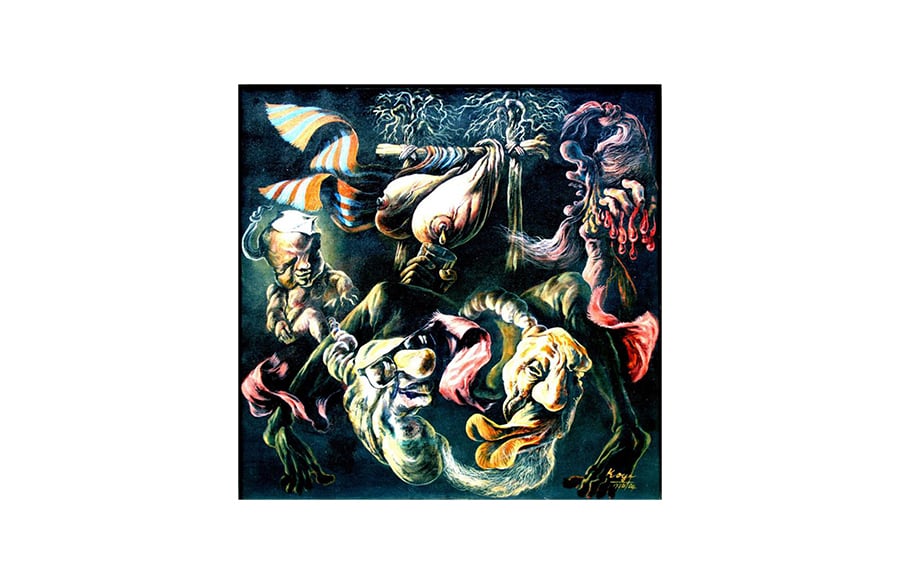
The artist’s style borrowed quite a lot from the canon of Indian art, most specifically mural art, yet it was imbued with modernist constructs. He painted with striking warm tones – reds, ochres, and greens – that were typical of the regions of Kerala but employed clumsy abstraction with contorted lines that gave the illusion of movement. His works regularly presented pictures of people concerning flora, for instance, trees emerging from the torso or fish flying around heads, all denoting the oneness of the living.
Many of Muthukoya’s well-conceived works tended to deal with the topic of ‘form without form’. The artist was intrigued by the contradiction of the existing body and the inner self, which he illustrated with images of persons who were both solid and contained a ghost. In this way, his pieces functioned in several ways: for entertainment, as a story of human life, and for probing the essence of the world. His, for instance, became well known due to the pictures of a silhouette of a person merging with that of a tree bringing out their unity in the human-nature continuum.

Medium and Experimentation:
Muthukoya’s main focus and commitment was to painting but equally, he was a great experimenter with art. He attempted a lot more than the usual techniques that most artists would find comfort in. Mixed media caught his attention and he used paint alongside other materials including leaves, twigs, and sand to give the surface a feel. Such attempts were borne of his aim to bridge gaps that existed, not only between nature and art but also between art as a picture and art as existence.
His devotion to the sculpting art although not as abundant was very gratifying. He fashioned clay and wood, materials with which he was idiosyncratic and which he believed had a tangible interaction with the land into mini sculptures. His sculptures unnervingly paralleled, if not overshadowed, the narratives of his works in paintings, which are of human forms and are either rising out or getting logged deep into the earth or the sky respectively, supporting his theory of life in its utmost cycle.
In Remembrance of N.K.P. Muthukoya: An Artist Who Painted Interconnectedness
N.K.P. Muthukoya has made substantial historical contributions to art but the focus of his appreciation would not fall on him during his lifetime. Muthukoya passed away in 1986 and following some years, his work was appreciated by more people, especially in the academic and artistic sects which enjoyed his theories on art. He was rather a simple man but this simplicity only worked to create a charant where the women and men of the words later become fanatical students and devotees of his thoughts.
In the recent past, exhibitions focusing on his works started coming up in very reputable art institutions in places like India, Europe, and The United States of America. Biographical accounts on his life and the works explored the extent of his philosophical quest and the originality demonstrated in the use of both the form and the medium. Art critics then appreciated the position of his works in the entire Indian twentieth-century art history and placed him among the modern artists who defied the traditions and fused modern contemporary ideas with the artistic aesthetics of the country.
His works have since been included in numerous galleries and institutions, libraries, and even universities all over the world already analysing his philosophy and his role in the development of contemporary art. Nowadays, young artists admire his paintings and sculptures and strive to reach the same ecological premise in their art as he did.
Even more so, in this changing world, where climate change and environmental destructiveness are major threats, his worldview on the interconnectedness of all beings makes even more sense. Muthukoya’s work, in its subtle and contemplative modalities, urges us to remember the sacred relationship we have with nature, one that, if cultivated, can engender a peaceful and restorative paradigm of existence.
Transcending boundaries; Connecting Places
N.K.P. Muthukoya was a visionary artist who felt it necessary to conquer the medium as ‘art’ began to build its realm. He was influenced by and developed aesthetics that included the regional Indian vernacular art style and global philosophical thinking. As a result, his works remain alive, provocative, and creative. His works were consciously designed to educate and promote diversity appreciation in the country, where he perfectly understood both mankind and the surroundings. It is impossible not to remember how the profession illustrates diversity, beauty, and the unifying force of differences.
In an often divisive and disintegrated world, Muthukoya’s art is complete—it is an assurance that a greater reality exists beyond the individuals. His work beckons us to look and embrace consciousness that makes one revel in the different faces of beauty that life comes with.