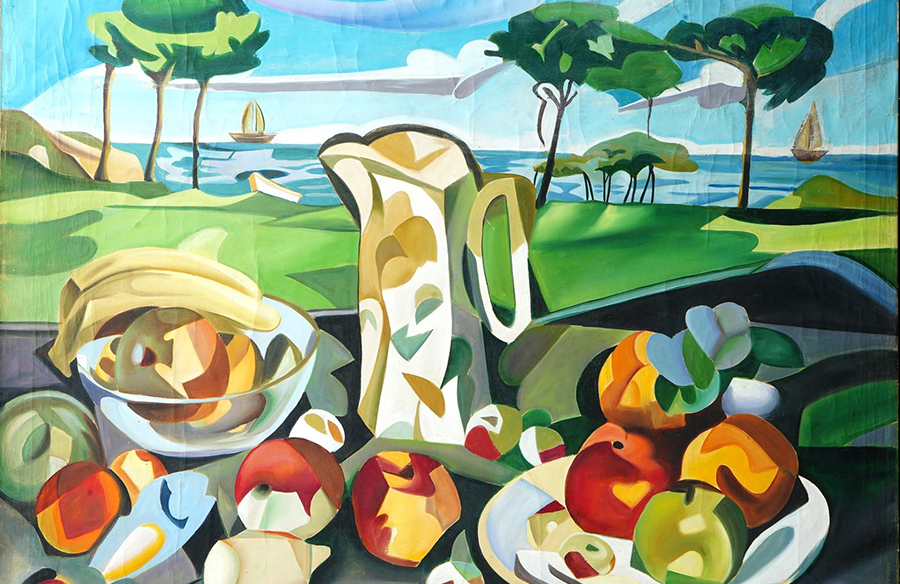
Jehangir Sabavala, known for his Dali-esque moustache, silk cravat, and well-tailored suits, impacted Indian modern art through his lyricism and serenity. His distinctive blend of Cubism and Impressionism, shaped by European training, made a unique impact. With muted, geometric landscapes and seascapes, his intellectual and philosophical depth is reflected well in his work. Inspiring poets and filmmakers, Sabvala exhibited internationally and left behind a significant legacy in Indian art.

Overview of the Artist
Jehangir Sabavala was a prominent painter born into Mumbai’s prosperous Parsi family in 1922. He blended modernist techniques like Impressionism and Cubism to produce his unique style of art. Pursuing his formal training at different prestigious institutions in Mumbai, London, and Paris, his foundation laid for a distinctive visual expression. After completing his studies at the Sir JJ School of Art in Mumbai in 1994, Sabaval moved to London, where he received further training at the Heartherley School of Art from 1945 to 1947. Between 1948 and 1951, he honed his craft in Paris, under the apprenticeship of famous cubist painter Andre Lhote. This experience significantly influenced his art form.

After returning to the newly independent India in 1951, Jehangir Sabavala stepped into his celebrated painting career, exhibiting his work at Mumbai’s Taj Mahal Hotel. Sabavala’s work stood out thanks to his subtle expressionist landscapes, which contrasted with the vibrant, bold compositions of his peers, for instance, MF Husain and SH Raza. One of the first Indian artists to study extensively in Europe, Sabavala’s techniques and aesthetics left a lasting impact on Indian art.
Philosophy and Career
The solo exhibition at the Taj Mahal Hotel in Mumbai in the year 1951, marked the beginning of Jehangir Savala’s career. His academic grounding in Europe made him stand out, yet categorisation was something he wasn’t too focused on, as he considered it as only one facet of his wide body of work. Over sixty years of his career, Sabavala’s artistic journey consisted of more than 30 solo exhibitions and participation in 150 group exhibitions globally. His works have been exhibited in prominent museums and galleries, such as the Jehangir Art Gallery and the Smithsonian Institution. Adding more to this list, his works are held in collections like the National Gallery of South Australia and the Birla Academy of Fine Arts.

Over the decades, Sabavala’s artistic style evolved. Early inspiration from Lyonel Feininger, a cubist painter, Sabavala developed his unique blend of Impressionism and Cubism. From the 1960s, a shift in Sabavala’s work was noticed, as his works became softer and more focused on muted colours, light and shadow. He consistently explored themes of mysticism and the human journey through life. Abstract, nature and poetry featured significantly in his artworks. Sabavala was an intellectual with curiosity and philosophical leanings, which often reflected in his art. For instance, his painting, The Purdah Series, addressed social issues concerning the oppression faced by women. Jehangir Sabavala was able to leave a legacy behind with his exploration of colour, space and form, complimented by his deep contemplation towards life.
Style and Medium
Jehangir Sabavala’s work was primarily Cubist, where angular and geometric patterns defined the subjects within his paintings. Even though he was infamous as a westernized painter, he held a deep understanding of the Indian landscapes, which were frequently visible in his depiction of trees, rocks, ravines and waterfalls. His artworks like On the World’s After Light, Green Thoughts and The Lost Tribe, reflect his mastery in the use of shades of green and other subdued tones. While many of his fellows were quick to follow the popular trends, Sabavala pursued his uniqueness.

Jehangir Sabaval worked primarily with oils. His ability to manipulate light, texture and colour became a significant characteristic of his works, which was reflected in using geometric shapes to create a sense of depth. Despite being perceived as Westernized, his works received appreciation from poets like Ranjit Hoskote. For Sabavala, his work not only involved mere landscape but mirrored the introspective journeys into the human life and their soul, aligning with Chetovistatra, the expansion of consciousness. With delicate use of light and form, he combined the presence of solitary human figures, which provided a contemplative depth to his artworks.
Recognition and Legacy After Death
The last two decades of Jehangir Sabavala’s career saw an evolution of his works. His art became more vibrant in colour and maintained a melancholic quality. His works shifted by blending his signature Cubist style with a focus on the human figure, which was demonstrated in his work such as The Casuarina Line II (2002) and the Mantle Trilogy (2006). These works consisted of women in red, blue and green and were presented at his noteworthy show “Ricorso” (2008-2009). Sabavala balanced his studio time which lasted rigorously for eight hours alongside his social life. Accompanying his wife, he attended exhibitions and hosted dinner parties, which helped him establish companionship with young artists and intellectuals. Sabavala’s works have been displayed in many prestigious venues globally, from Mumbai, and New Delhi to Edinburg, London and New York.

Jehangir Sabavala received numerous awards in recognition of his unique art. In 1977, he was honoured with the Padma Shri and the Kala Ratan in 2001. The legacy that he left behind was not only in the art field, but he significantly contributed to literature and cinema alike. His works inspired many others including poets like Jerry Pinto and Ranjit Hoskote. His life was mirrored in the award-winning film Colours of Absence by Arun Khopkar. Following a battle with lung cancer, Sabavala passed away in 2011 at the age of 89. Sabavala painted daily, even in his final days, leaving behind an unforgettable legacy and inspiration behind him.
References:
Academy, M. (2023) Jehangir sabavala, MAP Academy. Available at: https://mapacademy.io/article/jehangir-sabavala/ (Accessed: 05 October 2024).
Artiana (no date) Jehangir Sabavala – artist Biography, paintings, artworks, Auction Records, Jehangir Sabavala – Artist Biography, Paintings, Artworks, Auction Records. Available at: http://www.jehangir-sabavala.com/ (Accessed: 05 October 2024).
Chand, K. (2015) ‘A STUDY OF INDIAN ARTISTS IN THE VIEW OF STYLE OF ART’, GLOBUS Journal of Progressive Education, 5(1), pp. 1–3.
Editorial, A. (2018) Jehangir Sabavala: A master’s lasting impression on Indian modern art, Artisera. Available at: https://www.artisera.com/blogs/expressions/jehangir-sabavala-a-master-s-lasting-impression-on-indian-modern-art?srsltid=AfmBOooDp9nIgLj46xveeo9p3y7g_l08UUhgKDoAHijsswElZX4T7lcR (Accessed: 03 October 2024).
Vora, S. (2021) Jehangir Sabavala (1922-2011): A painter’s pilgrimage, Swapna Vora: Jehangir Sabavala (1922-2011): A painter’s pilgrimage. Available at: https://www.asianart.com/articles/vora/jehangir/index.html (Accessed: 03 October 2024).
Zhang, K. (2011) Jehangir Sabavala (1922-2011), Artasiapacific. Available at: https://artasiapacific.com/news/jehangir-sabavala-1922-2011 (Accessed: 04 October 2024).