Architecture, as a field, can be considered an ever-growing discipline due to various fluctuations around the world. Specifically, nuanced factors such as culture, travel, and cuisine have culminated in a paradigm shift in the way people perceive architecture, but also evoke the emotion possibly intended by the architect. It can be argued that architecture is no longer just a standing structure but a soulful embodiment of values and ethical beliefs. Consequently, it can lead to a peculiar identity representation for an architectural era. Through the years, it can be endeavoured that culture, travel, and cuisine have also influenced the way users interact with the space – tasting the rich, flavourful cuisines of the city, echoing cultural history through the walls, and experiencing the stories across streetscapes. Therefore, this article delves into the different spectrums that are engraved onto concrete and bricks that sculpt the cities across the world.
Cuisine: Slicing the Layers

It can be claimed that culinary practice came to fruition through the discovery of fire, which transformed the social organisation of human assemblage. Billions of years ago, fire was used in the context of providing warmth and protection from the harsh weather. However, it came as an effective source in providing comfort food and eating habits to the community. Thus, huge banquet gatherings were initiated and appreciated within social groups. Food preparations, however, were gradually marginalised. Cultural communities such as Egyptians, Phoenicians, Greeks, and Romans shared a common trait of hosting large banquets. For instance, in ancient Greece, the cultural phenomenon of aristocratic strata steered towards meals being a social experience symbolised as art (ArchDaily, 2022). The quintessential spatial arrangement during this period included kitchens attached to the houses and in patios that were left uncovered (ArchDaily, 2022). During the Roman period, cuisine was served in a more opulent way for the richest. There were no specific kitchen arrangements in the Roman households; instead, collective kitchens were installed in the center of cities to prepare meals (ArchDaily, 2022). However, the culinary preparation process digressed from its main purpose. Hence, the development of a solitary space was curated by the architects to exert a socio-cultural statement of segregation, the kitchen. Through the preceding case studies, it can be argued that cuisine and culture, intertwined, can influence the social-political dynamics. Moreso, it can formulate perceptions within the community that will be carried forward for generations to come.
Exchange Across Borders – Testament to Cultural Heritage?

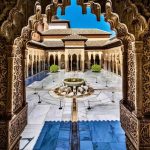
Cultural aspects like the famous music, flamenco, were influenced by the musical forms derived from Islamic North Africans. It has been perpetuated further to date that some flamenco lyrics are in Spanish and Arabic. Subsequently, ‘kamanjeh’ (Moroccan violin) is ubiquitous alongside the guitar. Zooming into architecture, one of the iconic structures, the Alhambra Palace, can be claimed as a visual testament of Islamic’s 700-year-long conquest in Spain. There have been various imprints such as tilework, courtyard gardens, and geometric motifs inspired by Arabic architecture. In Andalusia, Islamic art bifurcated into various terms with a unique meaning. ‘Moorish Art’ is a popular name for Mudéjar, which translates into architecture created for Christian patrons by Muslim craftsmen (FANN, 2023). The word ‘Moor’ originated from Latin, where it translates to Berbers and inhabitants of North Africa (FANN, 2023). Later, the meaning fluctuated to describe the Muslims of Spain after King Philip III of Spain commanded their expulsion. Moorish art is predominantly identified by its geometry, floral motifs, and the well-use of light and shadow within its buildings, especially in the Alhambra Palace. This can be endeavoured as the repercussions of culture correlated with user experience, playing an important part in the interaction of a space in the city.
On the whole, it can be concluded that culture plays an important role in seamlessly weaving both cuisine and travel as they are important aspects of urban fabric functioning. Culture acts as an important visual statement being exerted through architecture, while cuisine exhibits the social dynamics of various communities. Travel, on the other hand, showcases socio-political scenarios overlapped over the years. Moreso, the repercussions of these colonisations in the past continue to pivot in the present. Therefore, through the preceding case studies, it can be inferred that the evolution of architectural styles and the overlap of cultural beliefs occurred primarily due to these factors.
References:
- ArchDaily. (2022). The History of Kitchens: From the Great Banquets to the Built-in Furniture_© https://www.archdaily.com/978388/the-history-of-kitchens-from-the-great-banquets-to-the-built-in-furniture.)
- FANN, B.A. (2023). Islamic Art & Architecture in Spain. [online] Bayt Al Fann_© https://www.baytalfann.com/post/islamic-art-architecture-in-spain.
- Panford, L. (2022). Exploring the Islamic influence on Spanish culture and language Permission to Speak_© https://www.pearson.com/content/dam/one-dot-com/one-dot-com/uk/documents/subjects/modern-languages/C0218-Islam-inf-spain.pdf.