Quality of Life (QoL)
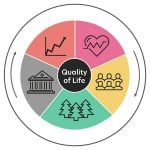
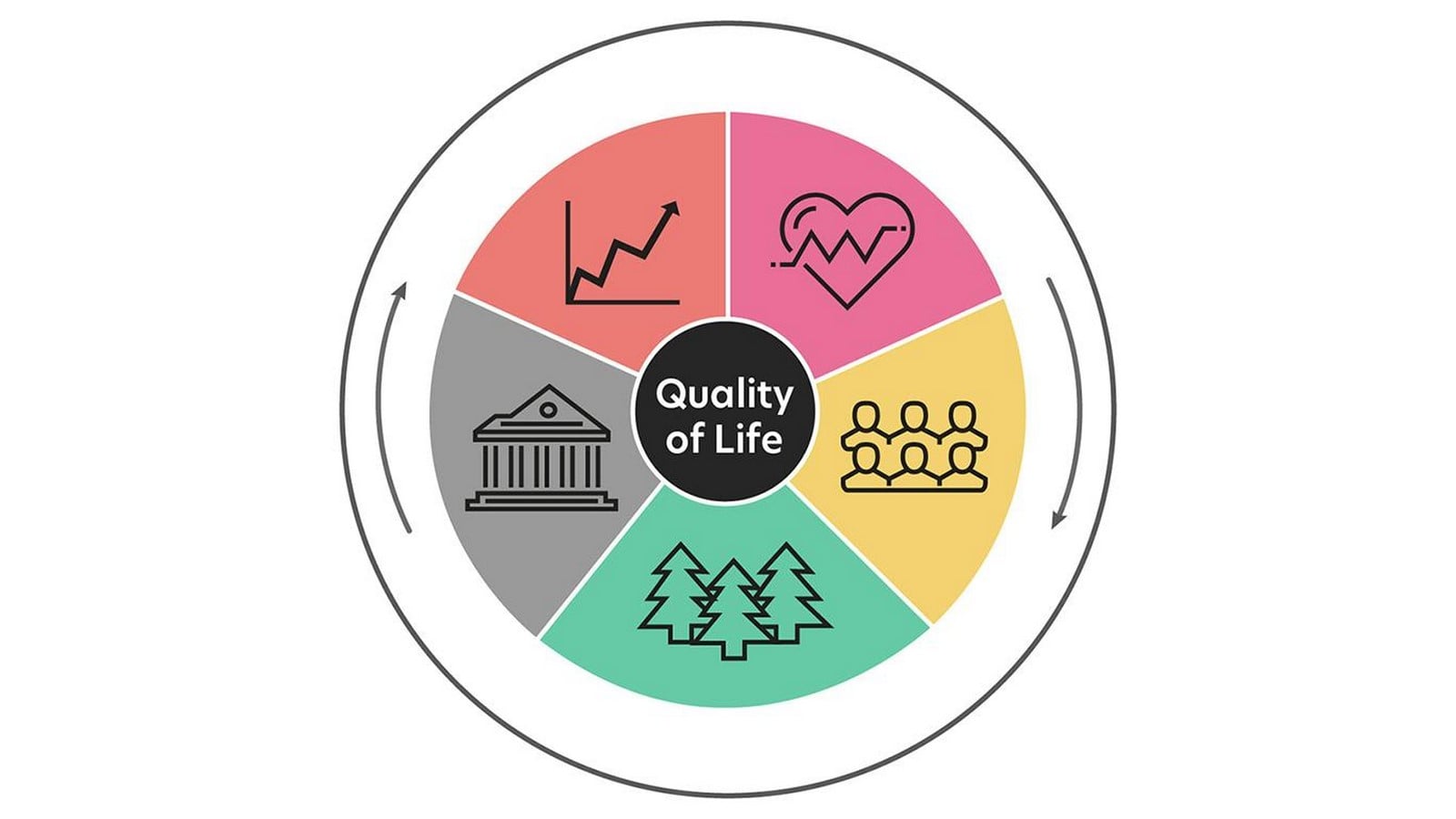
The U.S. National Institute of Health (NIH) has defined quality of life (QoL) as a concept that includes the welfare of individuals or groups at a specific moment in time. This concept of QoL goes beyond physical well-being and encompasses various other aspects, such as mental, social, and environmental aspects of health. Since it portrays the dimension of how individuals live their lives day by day, QoL has become the core theme to look at in fields from healthcare and politics to global development and urban planning.
So far, there is no uniformly accepted method of measuring the QoL, but multiple methods and indicators. Various institutions and organizations use various models and parameters, each focusing on certain dimensions of human life to quantify QoL. The most widely utilized indicator across the globe is Gross Domestic Product (GDP), a term that refers to the aggregate monetary value of goods and services produced within the borders of a nation during a particular period of time. Although GDP is a measure that is very useful in monitoring economic activity and growth, it can give only a very narrow representation of people’s well-being. To truly understand the broad spectrum of quality of life, various other indicators must be considered.
Moving Beyond GDP
GDP reflects the market production but does not capture how people live, feel, and thrive. To address this gap, several organizations have developed alternative frameworks for measuring QoL. These approaches emphasize social, psychological, and environmental well-being alongside economic prosperity.
1 Eurostat
Eurostat is the European Union’s statistical office, and it offers one of the richest frameworks in evaluating QoL in member states. Its indicators go beyond money to encompass a variety of life dimensions.
Indicators that encompass are:
Income and living conditions, Housing and living conditions, Jobs and labour market security, Health and healthcare access, Education and learning, Personal relationships and social connections, Personal and material well-being, Environmental health, Governance and trust in government, Well-being
By reconciling material conditions with subjective well-being, Eurostat provides a more integrated view of Quality of Life in Europe.
2 OECD and the Better Life Index
The Organization for Economic Co-operation and Development (OECD) engages QoL by its Better Life Index that enables nations to compare themselves across different dimensions of well-being.
Indicators included are:
Housing, Income and jobs, Education and skills, Health and life expectancy, Community and social networks, Environment, Civic engagement and governance, Safety and personal security, Work-life balance, Overall life satisfaction
The OECD model emphasizes that Quality of Life is determined not just by income but also by social connection, environmental quality, and time for personal life.
3 UNDP and the Human Development Index (HDI)
The United Nations Development Programme (UNDP) brought in the Human Development Index (HDI) to quantify development in terms of human well-being and not just economic production.
Indicators that are included are:
Life expectancy, Mean years of schooling. Expected years of schooling, Gross National Income (GNI) per capita
Even less complex than other models, the HDI does represent critical elements of human development and is still one of the world’s most powerful indicators of quality of life (QoL).
4 WHO and the WHOQOL Framework
The World Health Organization (WHO) understands that health is not the absence of disease, but also a state of total well-being. The WHOQOL model assesses various aspects of Quality of Life.
Factors that are included are:
Physical health and energy, Psychological well-being and mental resistance, Independence in daily living, Social relationships and support, Environment, including resources and safety, Spirituality, religion, and personal beliefs
This approach recognizes cultural diversity and stresses the subjective and individual aspects of Quality of Life.
Urban Design and Quality of Life

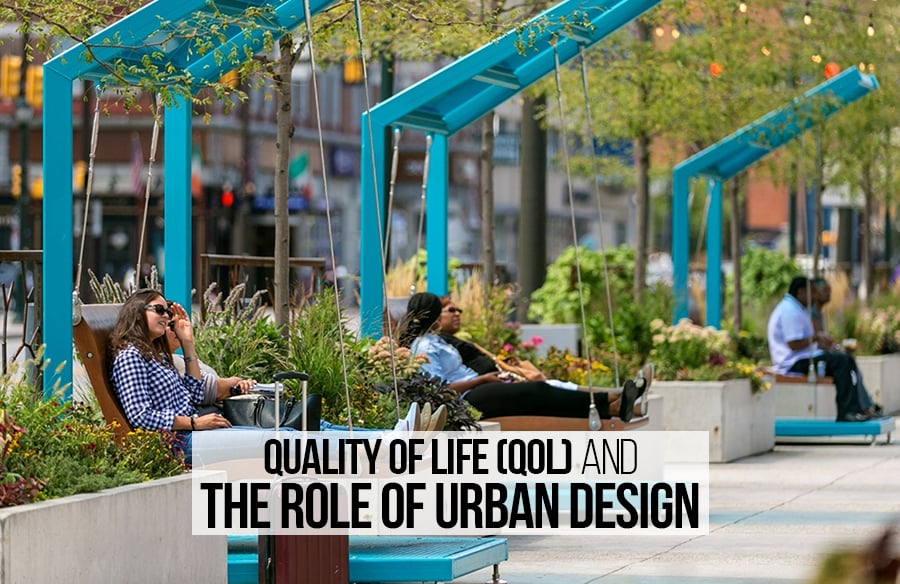
Most individuals experience the daily conditions of dwelling, work, health, and community life in cities. Public space can contribute to increasing or decreasing the quality of life. Urban design addresses the planning of the streets, squares, parks, and all the public areas where people’s daily activities take place. Urban design covers all scales of human activity, from large-scale strategic levels such as national and regional planning down to the very details of street furniture and materiality. A planned and designed city can enhance last-mile connectivity, provide access to parks and green spaces, and make everyone feel the same, whether old or disabled. These decisions can impact health, social relationships, and even happiness in the city directly.
Good city design allows cities to expand in an effective, sustainable manner by mixing housing, workplaces, and transport to keep people in their communities more of the time. At the smallest level, even such details as shaded walkways, benches, street lighting, and pavement texture can determine public spaces and build a friendly place for people to walk.
In essence, urban design can be a powerful instrument capable of not only shaping the look of a city but also influencing how its citizens feel and engage in the city and its streetscapes. By putting urban design at the forefront of public spaces, Quality of Life measures such as safety, comfort, community, and environment can be tackled.
References:
Eurostat (n.d.). Quality of life indicators – measuring quality of life. [online] ec.europa.eu. Available at: https://ec.europa.eu/eurostat/statistics-explained/index.php?title=Quality_of_life_indicators_-_measuring_quality_of_life. [Accessed: 15 August 2025].
OECD (2025). OECD Better Life Index. [online] OECD. Available at: https://www.oecd.org/en/data/tools/oecd-better-life-index.html. [Accessed: 15 August 2025].
United Nations (2024). Human Development Index. [online] United Nations Development Programme. Available at: https://hdr.undp.org/data-center/human-development-index#/indicies/HDI. [Accessed: 15 August 2025].
World Health Organization (2012). WHOQOL – Measuring Quality of Life. [online] World Health Organization. Available at: https://www.who.int/tools/whoqol [Accessed: 15 August 2025].