Aesthetics is a branch of philosophy that deals with the Nature and Expression of Beauty. Architecture, a field where the trinity of structural integrity, beauty, and space are combined to create spaces and buildings. These buildings and structures have to be designed driven by the premise of utility a space can offer and aesthetics is an aim for some projects and a by-product for others. Architects have a set of principles while designing an aesthetically pleasing place, such as Mass and Void, Balance, Symmetry, Contrast in colours and textures to add a certain depth and character. Yet is every building then pleasing to every eye?
Aesthetics in architecture is as subjective as one’s personal choice in clothes. Yet we can critique or surmise a few basic principles based on which we can conclude a building to be aesthetically pleasing. Architecture is also not just a creative field as it caters essentially to the social and basic needs of man, and it cannot exist out of context. As Ar. Moshe Safdie elucidates in a poem:
‘He who seeks shall find beauty
He who seeks beauty shall find vanity
He who seeks order shall find gratification
He who seeks gratification shall be disappointed
He who considers himself a servant of his fellow beings shall find the joy of self expression
He who seeks self expression shall fall into the pit of arrogance
Arrogance is incompatible with nature
Through nature the nature of universe and the nature of man we shall seek truth
If we seek truth we shall find beauty’
Moshe Safdie
Vernacular Aesthetic in Architecture

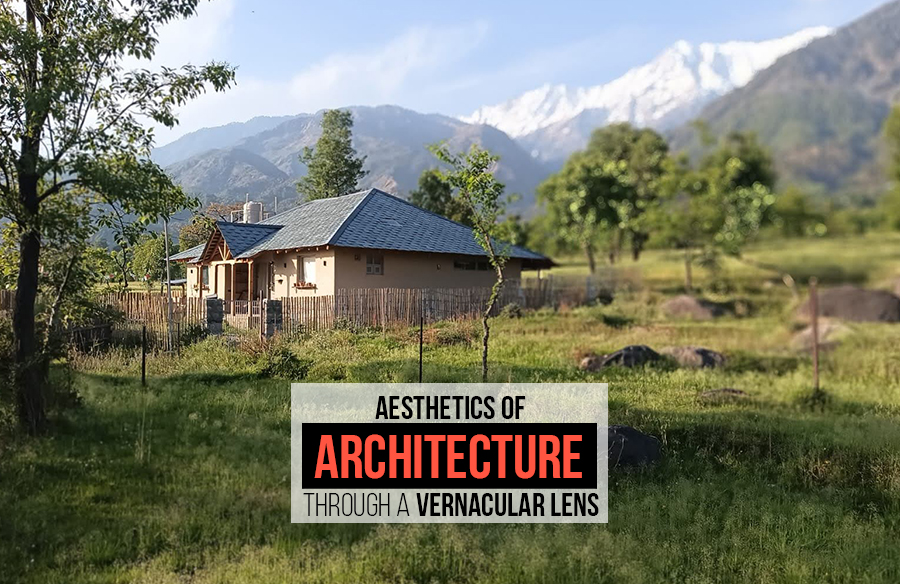
As one travels through European countryside and even Himalayan countryside one views houses so well ingrained in their landscape that it is hard to differentiate between the landscape and the built environment. They merge together organically and one can seldom imagine one without the other. Then as we shift our gaze to cities we see Commercial and Public Buildings which are so similarly designed the world over now, that one could easily place them anywhere in the world. This similarity of modern structures renders them anonymous unless they deliberately cross certain benchmarks of Height, Amenities or we can also conclude that this universality lends them the power of versatility which is the ability to be replicated anywhere, a boon for some in today’s capitalistic times. These buildings seem to exist in harmony in their surroundings-the man-made infrastructure of a city, yet they are evidently competing with each other and the environment.


Vernacular Architecture– In Harmony with Nature
The buildings one often sees in the countryside is ‘Vernacular Architecture’ of that place which is also the local or indigenous architecture that is not only location and climate-specific but is also built from local materials and using local skilled labour. Surmising sustainability in its very own unique and specific way. “Vernacular exists and adapts with the environment and thus it exists in harmony with nature whereas modern city buildings appear to be in an evident conflict with nature.” Didi Contractor.

Aesthetics and Vernacular Architecture
What makes architecture aesthetic? It is a subjective topic that has no right or wrong answer. We can judge a building based on what we feel when we see it, that is one way to conclude. Then we can judge it based on the basic principles of form, regularity, and complimenting colours which are used by architects while designing.
Vernacular Architecture is so deep rooted in our psyche and context and has stood the test of time since centuries. Thus it has a strong and unique cultural connotation as what is vernacular for one region is quite different from another, stone is used in Jaisalmer as it is abundant there whereas in Bengal Bamboo and Bricks are used. Timber is used in the Himalayas and Mud mixed with straw , clay, and bricks in Gangetic Plains. Vernacular is the basic premise of sustainability, and it exemplifies what the normal population builds or lives in. With time, and money the richer people in a bid to segregate themselves socially have started embellishing houses with materials sourced from faraway lands. This trend has only increased with an increase in capitalism, and led to ‘Wealthy Architecture’.
Now it is embellishment that is considered luxury and the basic old cultural traditions and materials used in building are getting lost. Among the few Architects who practised Vernacular Architecture is Didi Contractor who passed away in 2021. Didi, a self-taught architect, created Adobe structures in Sidhbari, Dharamshala. Her buildings emerge from the earth and appear to be a part of the landscape for centuries. She believed and practised that a building could exist as a plant in the landscape and also grow.

Reviving Vernacular Aesthetic

Materials used in Vernacular Construction like Lime plaster, Lime finishes, Adobe bricks, and Slated or thatched roofs are limited in their variety and need a high level of skill and much more time to be executed. They are much healthier alternatives to paints and concrete but in today’s fast-paced world, very few people have the knowledge and respect for these traditional materials. These practices are dying slowly and very few architects have been able to lend them the much-needed Modern Appeal. In India many architects like Laurie Baker, Didi Contractor to name a few and now many emerging practices are exploring the possibilities of making vernacular practices accessible and modern. M-lime by Malvika Mehta offers ready-to-use Lime Plasters and Natural Pigments, Live North by Rahul Bhushan is a practice based in Manali that is focussed on the revival of local Kath Kuni Architecture. Auroville has its own ecosystem where architects practise and train in various vernacular construction techniques.
We can agree to disagree in terms of aesthetics but there is no comparison of the warmth that is felt within a mud house and thatched roof in comparison to a concrete structure in the Himalayas. It could be this warmth and comfort that these materials offer that makes these vernacular structures not only aesthetic but also lend a power to this aesthetic which is not dependent on high monetary expense.
The way light is used in the structure, the . Is it as different as beauty is to the eyes of the beholder. There are very strong opinions but they do converge at the vernacular. It is because it is history and what we have grown up with.
How materials used in context and earlier stood the test of time and lent an air of warmth and belongingness to a house or building. (Here can show recent examples of vernacular materials and traditions being used in current projects).
A deep perusal of Didi’s architecture reveals that her buildings seem to grow from earth and are in perfect harmony with nature. This is quite contrary to the present day modern buildings which look to be in conflict with nature. A perfect yang-and-yin relationship between her buildings and landscape is thus an important salient feature of her architecture. Didi herself explains, “I am very interested in using landscape as a visual and emotional bridge between the built and the natural. Look at the old buildings, they are beautiful in the landscape, and the new ones are at war with it - they say something. So, we are in conflict with nature, and nature will be in conflict with us. I imagine a building as growing, like a plant, within a landscape. Landscaping is really a key to this thing of marrying the earth to the building.”
Describing the relevance, impact and beauty of the old buildings which are being replicated till date and which somehow have much better aesthetics than the Trendy Modern Architecture. (Showcase a few examples of vernacular architecture examples -old )
Respect for surroundings
In urban sense also the vernacular always adapted and showed respect for its surroundings
And fit well in the urban or rural landscape it was built in. The art of merging has now been replaced by demand for new materials and designs. The focus is on iconic buildings not realising every building differing is creating a chaotic urban landscape. (Here can show few images of existing vernacular inspired latest constructions )
How to imbibe and continue Vernacular aesthetic
How in today’s times we can incorporate and continue the traditions and values of vernacular architecture and then in synchronicity of building and respecting nature develop aesthetically pleasing buildings. (Images of Modern houses built with this contect in mind.)
References:
(https://worldarchitecture.org/article-links/ehegh/didi_contractor_a_selftaught_architect_who_builds_in_mud_bamboo_stone.html?fbclid=IwAR28MYso5WGrrFb7eSbuW2O9R7-xf-YR4kKGXB9TTozH6rfMT-oTo3a1YYk#google_vignette)
https://vernacular-architecture.in/essays/vernacular-form-design-spaces-and-relevance/