Among all the objects architecture could be connected to, watches were the least thought of by me. It’s only recently, influenced by my husband, that I began to observe the world of watches and realize what a miraculous feat of engineering and craftsmanship those little wearable clocks are. While ‘time-telling’ is considered the fundamental function of watches, it isn’t the sole reason for their existence, especially considering that devices like mobile phones and computers provide accurate timekeeping today. A watch is a device of greater appreciation for mechanical science, art and culture, and a status symbol- a wearable object that tells something about its wearer. They are also incredibly social objects- curiously expensive for their size, attention drawers, the topic of heated debates, passion-driven auctions, collectible treasures, historical artifacts, and much more. Like great architecture, a great watch is an inherently functional object that, through considered design, becomes an object of timeless beauty.

Much like architecture, watchmaking is a multilayered discipline that involves a complex fusion of art, design, and engineering. A science that really is an art. The age-old craft of watchmaking, a part of the broad science of horology, has evolved significantly over centuries. This article explores the history and intricacies of watchmaking, along with the connection of the watchmaking world with that of architecture, and explores a few architect-designed watches. (Yes, architects have designed watches too!)
A Brief History of Watchmaking
Although there is no record of the first appearance of the mechanical clock in history, the earliest accounts date back to 8th century China, with water-driven clocks using an escapement mechanism. The 14th century saw great developments like Giovanni de Dondi’s Astrarium, a complex astronomical clock that took over 16 years to complete and was one of the most intricate timekeeping devices of its era, and the earliest literary reference to a mechanical watch in Dante’s Divina Commedia. Around late 14th and 15th century Europe, mechanical clocks appeared on towers, royal palaces, churches, and governmental buildings, primarily weight-driven.
It wasn’t until the early 1500s that the concept of portable clocks came into being, thanks to the German clockmaker Peter Henlein. These were small ornamental timepieces worn as pendants, encased in rings, hanging from belts, or kept in pockets. They soon turned into a status symbol in 16th and 17th century Europe, worn by the elites and royals.

Key innovations, such as Jost Burgi’s addition of the ‘seconds’ unit, and Galileo’s pendulum later refined by Christian Huygens, significantly improved timekeeping accuracy. Huygen’s invention of the balance spring in 1675 revolutionized horology, leading to the development of the modern clock face- with concentric hour and minute hands in one dial- by the English clockmaker Daniel Quare in the late 17th century.
John Harrison’s invention of the H4 chronometer in 1761 was a significant contribution before the course-changing Industrial Revolution, which transformed human society to one where work was regulated by accurate timekeeping instead of seasons, the sun, and the moon. The revolution spurred the mass production of clocks and watches first in the U.S., which initially outpaced Europe in quality and cost. By the late 19th century, European manufacturers raised their competitiveness by adopting American industrial techniques.
‘Quartz revolution’ was the next big thing. With Seiko’s launch of the Astron 35SQ in 1969, the world’s first quartz wristwatch, watches were 100 times more accurate and cheaper than mechanical watches.

The increased popularity of Quartz watches plunged the Swiss watch industry into crisis. In response, Swiss brands like Patek Philippe, Rolex, and Audemars Piguet shifted their focus to technical creativity and luxury, transforming mechanical watches into high-end status symbols prized for their craftsmanship and design.
Craftsmanship and Mechanics
The history outlined above illustrates how watchmaking has been a long-standing art, evolving gradually from astronomical clocks to modern wristwatches.
Watchmaking and architecture, as mentioned before, are multifaceted fields where art, design, and engineering come together. Both are artistic practices preoccupied with how their products interact with the human form. Both are function-driven- a watchmaker makes an object to tell the time, while an architect creates a structure to inhabit- yet both practices often go beyond their utilitarian purpose serving as excellent mediums for personal style and status.

A watchmaker’s role is to understand the culture and needs of a person wearing a watch, much like an architect who has to understand the site context and the people for whom they design.
The key steps in watch design- Concept and design, movement creation (manual or automatic), assembly, and finishing- are also similar to that in architecture with the main and striking difference of scale. Architects are primarily excited by the challenge of working on such a small scale when asked to design watches. Several watch collections have also been inspired by architecture.
Explaining the Swiss brand Mido’s tagline “Inspired by Architecture”, the CEO Franz Linder says, “Good architecture is innovation, functionality, and aesthetics. And when we design watches, those are exactly the ambitions we have, so we wanted to reflect these shared values.”


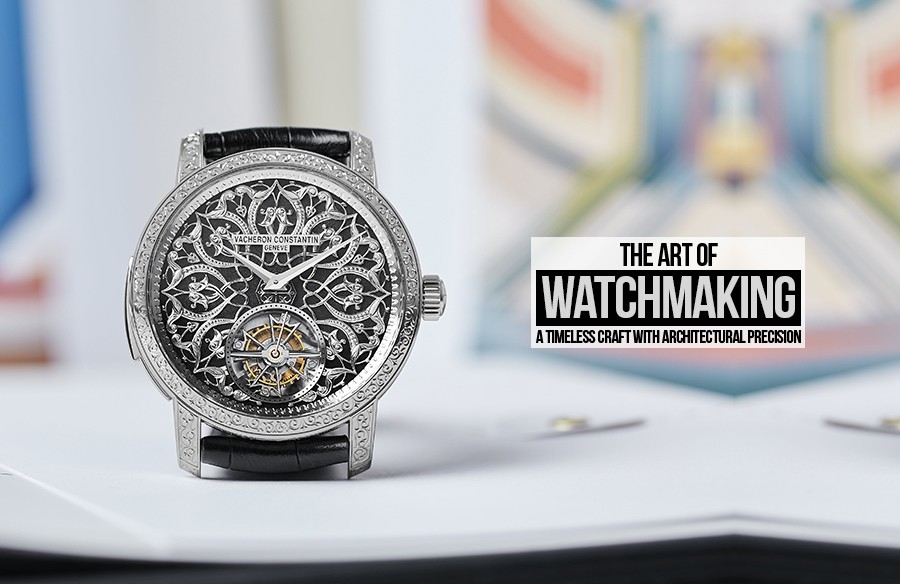
The most complicated watch, the Vacheron Constantin Les Cabinotiers – The Berkley Grand Complication, contains nearly 3,000 parts and features over 60 complications, including the ability to measure the Gregorian, Hebrew, astronomical, lunar, and Chinese perpetual calendars—all in a device that fits in the palm of your hand. Released in April 2024, it surpassed the record already held by Vacheron Constantin’s Reference 57260, presented in 2015.

“Mechanical watches are among the most efficient machines ever created,” says English watchmaker and historian Rebecca Struthers in her book Hands of Time: A Watchmaker’s History. She notes that some watches she has worked on have stopped only once since being serviced in the 1980s! No wonder since the first chronometer discovery, watches have accompanied humans everywhere from Mt. Everest’s summit, the depths of the Mariana Trench, both the Poles and even to the moon.

Architect-designed Watches
Despite the drastic scale difference, the similarities between watchmaking and architecture have encouraged many architects to explore watch design, highlighting the common bond between watchmakers and architects. Hence, it’s unsurprising (though it took me by surprise when I found out!) that many renowned architects, from Frank Gehry to Zaha Hadid, have experimented with watch design, some creating notable pieces along the way. Recently brands have been enlisting Pritzker Prize winners to design their watches. Here are a few of my favorite watch designs by architects.
Frank Gehry for Louis Vuitton
In March 2024 the French luxury fashion house Louis Vuitton launched their ‘Tambour Moon Flying Tourbillon Poinçon De Genève Sapphire Frank Gehry’. Inspired by the Louis Vuitton Maison Seoul store’s glass facade and the sail-like form of the Fondation Louis Vuitton in Paris, the iconic creation’s dial had an engraved rippling form. The watch’s case and dial were cut from a single 200 kg sapphire crystal block. The paper-thin dial alone took 250 hours of machine and hand work to craft.

The design was described by Mr. Gehry as “very simple, but the way the light plays on the shapes makes the watch ever-changing”, much like his buildings. To determine the powerful yet airy waves on the watch face, Gehry crumpled up a printout of the 2022 Tambour Moon Saphir, creating the new model’s dial.

Tadao Ando for Bulgari
In April 2024 Bulgari added a new watch collection to their Serpenti line, designed by the Japanese Pritzker laureate Tadao Ando. Ando collaborated with the brand back in 2019, designing a limited edition for their Octo Finissimo automatic collection.
Adding to the much-celebrated Serpenti jewelry range, each piece of the Serpenti Tuboga x Tadao Ando takes the form of a stylized serpent with head and tail. The watches embody nature’s transient character, symbolising time and transformation as the serpent sheds its skin. Much like the architect’s striking, nature-inspired buildings.

Each watch represents a season: Summer features a green aventurine (a form of quartzite) face with a yellow gold and steel strap, Autumn has a tiger’s eye watch face, while Winter’s is made with white mother of pearl, and Spring evokes cherry blossom trees with a pink mother of pearl face. All the watches include a bezel set with 38 diamonds and come in a box designed and signed by Ando, with his signature engraved on the back.

Renzo Piano for Swatch
In 1999, Swiss watchmakers Swatch collaborated with 1998 Pritzker Prize winner Renzo Piano for their Swatch Art series.
Inspired by his inside-out architecture of Centre Pompidou, Piano created the ‘Jelly Piano’. Built inside out, the watch showcases the pure beauty of colored watch work machinery through its cool and composed transparent design.

Marc Berthier for Hermès
Launched in 2010 and updated in 2018, the Hermès Carré H watch, designed by French architect-designer Marc Berthier, is a distinctive timepiece known for its modern, geometric aesthetic. The square timepiece with lightly softened edges added a visual balance and also helped it sit close to the wrist. Rounded corners are so common today that it almost seems like industry standard. But in 2010, during the launch of Berthier’s first Carré H, the soft-rounded square felt sharply contemporary and was quite ahead of the curve.

Edouardo Souto de Moura for LeBond watches
Founded by an architect, the Barcelona-based Lebond watches is an exclusive brand for watch and architecture enthusiasts. Founder architect Asier Mateo coordinates prestigious architects and Swiss watchmakers, bringing forth intriguing pieces. A perfect fusion of Swiss watchmaking and architecture.
The brand unveils one design annually, collaborating with a new Pritzker Prize architect each time. So far, they have launched two watches, designed by Portuguese architects Alvaro Siza (1992 Pritzker laureate) and Eduardo Souto de Moura (2011 Pritzker laureate) respectively.

The ‘Lebond Souto Moura’ was launched in March 2024. A slim watch with a titanium case and no lugs, inspired by his principle ‘minimum material for maximum function’, Souto de Moura also kept the dial as pure as possible. The whole watch is tilted 30 degrees clockwise so that 11 is at the top to have a quick and easy read of time whether writing, drawing, or driving, de Moura says.
Other Pritzker laureates who have designed watched include Zaha Hadid (ACME Studio and Puls), Oscar Niemeyer (Hublot), Jean Nouvel (Maurice Lacroix), Rafael Moneo (Cauny) and Kazuyo Sejima (Bulgari).
Watches are a world unto themselves. With time now measured so accurately, it’s easy to forget that this was not always the case. Our ability to do business, structure our day, and access life-saving developments in science and medicine all are in fact, made possible by access to accurate time, and all the horological developments we read about play a crucial role in this achievement.
When watchmakers seek inspiration from great architecture, perhaps the quality they most yearn to replicate is the timelessness of a great building- the enduring legacy. With the explosion in demand for second-hand watches, such timelessness is now more important than ever. The pursuit to create long-lasting timepieces reveals the irony at the heart of modern watchmaking: although the basic purpose of a wristwatch is to tell the time, the ultimate goal is to achieve a design that remains timeless.
References:
Benedictus, L. (2022, July 28). The Common Bond of Watchmakers and Architects. Retrieved July 28, 2024, from The New York Times Style Magazine: Australia: https://taustralia.com.au/the-common-bond-of-watchmakers-and-architects/
Berthiers, M. (2018, October 01). Marc Berthier Has “Never Belonged” in the Design World. (S. Watson, Interviewer) Retrieved July 29, 2024
Davin, A. M. (2024, May 21). When Watchmakers Team Up With Pritzker Prize Winners. Retrieved July 27, 2024, from The New York Times: https://www.nytimes.com/2024/05/21/fashion/watches-pritzker-prize-winners.html
Galanti, S. (2023, December 26). A brief history of watchmaking, from the 14th century to the present day. Retrieved July 28, 2024, from Medium: https://medium.com/watchdossier/a-brief-history-of-watchmaking-from-the-14th-century-to-the-present-day-28907f13681f
Ravenscroft, T. (2024, April 10). Tadao Ando unveils serpent-informed watch for Bulgari. Retrieved July 29, 2024, from Dezeen: https://www.dezeen.com/2024/04/10/tadao-ando-serpent-watch-bvlgari/
Struthers, R. (2023). On the Beauty and Art of Making a Watch. In R. Struthers, Hands of Time: A Watchmaker’s History. Harper. Retrieved July 28, 2024
Thompson, M. (2022, December 30). The Humanity of Watchmaking. Retrieved July 29, 2024, from Linkedin: https://www.linkedin.com/pulse/humanity-watchmaking-mitchel-thompson/
Images:
1_World’s most expensive wristwatch, the Patek Philippe Grandmaster Chime Ref. 6300A-010, which was sold for $31 million at the Only Watch charity auction in 2019_ © Ruud de Jong
2_A portable watch from the late 17th century, called ‘Onion’ because of its shape_© Musée International d’Horlogerie, La Chaux-de-Fonds, Switzerland
3_The Seiko Quartz Astron 35SQ _© seikowatches.com
4_sketches of the ‘Inspired by Architecture’ Limited Edition watch by Mido inspired by the Solomon R. Guggenheim Museum in New York by F.L Wright_© MIDO watches
5_The Guggenheim watch- the inspiration and the inspired_© MIDO watches
6_The Audemars Piguet [RE]Master02 is the latest launch by the Maison as a tribute to Brutalism_© audemarspiguet.com
7_world’s most complicated watch- Les Cabinotiers – The Berkley Grand Complication_© Vacheron Constantin
8_The Omega Speedmaster Professional also called the Moon watch, a part of Neil Armstrong and Buzz Aldrin’s astronaut kit in the 1969 lunar expedition_© omegawatches.com
9_the Tambour Moon Flying Tourbillon Poinçon De Genève Sapphire Frank Gehry_© Ulysse Frechelin
10_The inspiration- the exterior of the Louis Vuitton Maison Seoul_© Louis Vuitton
11_the ‘summer’ watch from the Serpenti Tuboga x Tadao Ando collection_© dezeen
12_The four pieces of Serpenti Tuboga x Tadao Ando_© dezeen
13_the Swatch Jelly Piano, 1996_© ergo-design.eu
14_Carre H (2010) and Carre H (2018)_© surfacemag.com
15_the Lebond Souto Moura_© Lebondwatches