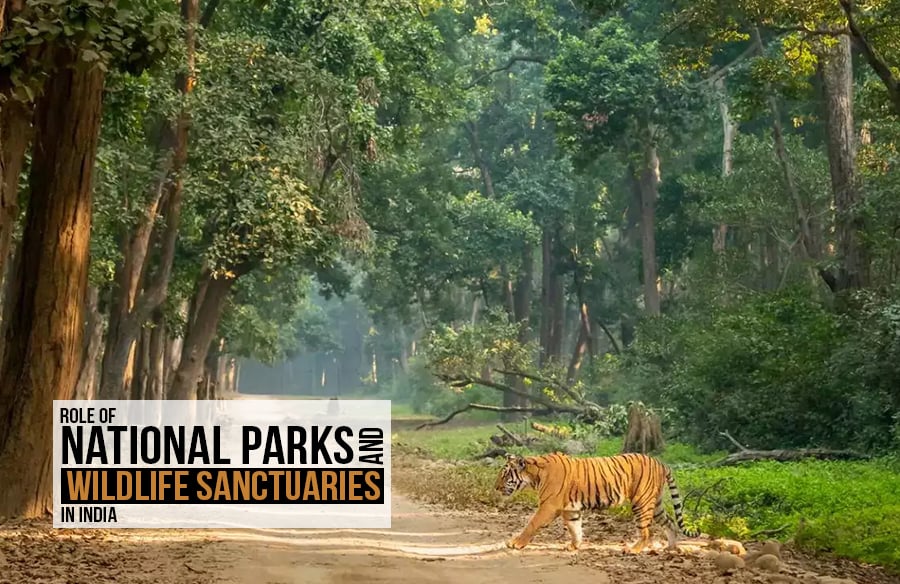
India is a land with diverse natural landscapes of shocking biodiversity with many national parks and wetlands. From the snowy peaks of the Himalayas to the thick vegetated Western Ghats, these are important sanctuaries for several endangered or threatened animals. Animals that are native to India have a significant role in the culture history and identity of India. The Royal Bengal Tiger usually comes to mind when talking about India, as it is a renowned iconic symbol for this country. Other animals like lions, bears, and elephants symbolize the grandeur of India and are foundational to their cultural identity. Establishing national parks as well as wetland reserves not only helps achieve the safeguarding of Indian cultural identity but also fights climate change. This article will consider how this plays an important role and highlight some recent difficulties that have arisen from preserving these beautiful areas for future generations.


Definition of National Parks and Wetlands
National parks in India are unique as they have many governmental restrictions compared to wildlife sanctuaries. As per India’s Wildlife Protection Act of 1972, national parks are to preserve naturally existing ecosystems and biodiversity, and the parks’ boundaries are managed and controlled by the national government. The amount of interaction between humans and nature is limited by controlling the number of visitors, tourists, and researchers. This interaction is essential for India for its educational, cultural, and economic value. Wetlands are also important to India and internationally because their natural ecosystems support a rich diversity of plants and animals. They are also crucial to human survival. For example, wetlands can store floodwater during hurricanes and also purify water. Mangroves in India have aerial roots and unique floral species that can store immense amounts of carbon in the atmosphere. Wetlands are therefore important in the fight against climate change. The Convention on Wetlands has recognized wetlands of international importance, of which India maintains over 80 Ramsar Sites.
If you find yourself in India, you can enjoy some of its most wonderful national parks, including the Jim Corbett National Park, famous for its Bengal tigers, or Periyar National Park, which has a beautiful lake, forests, and diverse wildlife such as elephants, lion-tailed macaques, and sambar deer. For wetlands, some of the most notable spots in India include Keoladeo National Park and Wular Lake, renowned for its largest freshwater lake and rare animal species like snow leopards and hangul (Kashmir stag).

Human and Nature Symbiotic Relationship
Biodiversity conservation and human well-being have a close, symbiotic relationship. If our natural ecosystem erodes, humanity’s quality of life also deteriorates. The World Resource Institute reports that about 700 million people in India rely on forests and agriculture for sustenance. Forests are a resource for firewood and food for livestock, while tree cover promotes good soil fertility, which is necessary to support local agriculture that feeds local communities. In areas where the population is poor and lives below the poverty level line, such as regions in the Sidhi district, the maintenance of forests is essential for survival and healthy well-being.
The United Nations predicts that India’s population will exceed China’s population around April 2023 (to be confirmed by national census data). In contrast, National parks in India take up approximately 1.35% of the nation’s geographical area. Less than 5% of the country’s land overall is protected for conservation through India’s network of Protected Areas, which include 106 National Parks, 573 Wildlife sanctuaries, 115 Conservation Reserves, and 220 Community Reserves. Different types of Protected Areas have different degrees of protection. Some have strict rules that restrict human intervention, while others allow sustainable land use or limited resource extraction.

Recent Conservation Challenges
The Wildlife Protection Act of 1972 is the legal framework that makes national parks and wetland reserves possible in India. For example, India’s state government cannot make adjustments to the boundary of national parks without the approval of the National Board. Unfortunately, there has been an amount of illegal construction and unplanned urbanization which has led to a loss of nearly 30 percent of wetlands in India. In some areas, water security and degradation of the natural environment are at risk. This occurrence is mostly due to a general lack of knowledge on wetlands and how to properly preserve them. Deforestation of trees in national parks and wetlands leads to soil erosion and is detrimental to the nature and human symbiotic relationship.
Improvements to enhance conservation methods include strengthening national conservation laws and regulations, increasing community engagement to increase awareness and general knowledge, and restoration initiatives, such as planting trees. Some local governments in India have started taking action. For example, the National Mission for Clean Ganga created a toolkit for wetland management in January 2021. The Delhi Development Authority is also creating a Master Plan Delhi 2041, which includes strategies to protect and maintain a network of “green and blue assets” in Delhi to preserve the biodiversity and microclimates within the capital. As the urbanization in India will only continue to grow as the most populous country in the world, these initiatives and national regulations will become evermore important.
References :
EDUBABA. (2023). National Parks of India. [online] Available at: https://edubaba.in/national-parks-of-india/ [Accessed 24 Mar. 2024].
Jagranjosh.com. (2020). What are National Parks?- Definition, History, Objectives, Importance, and more. [online] Available at: https://www.jagranjosh.com/general-knowledge/national-parks-1599466000-1 [Accessed 24 Mar. 2024].
Jain, Animesh. “The State of India’s Urban Wetlands and Why They Need to Be Protected Urgently.” Www.downtoearth.org.in, 31 Aug. 2021, www.downtoearth.org.in/blog/environment/the-state-of-india-s-urban-wetlands-and-why-they-need-to-be-protected-urgently-78456. [Accessed 24 Mar. 2024].
Silver, L., Huang, C. and Clancy, L. (2023). Key facts as India surpasses China as the world’s most populous country. [online] Pew Research Center. Available at: https://www.pewresearch.org/short-reads/2023/02/09/key-facts-as-india-surpasses-china-as-the-worlds-most-populous-country/ [Accessed 24 Mar. 2024].
Singh, R., Shelar, K., Chaturvedi, R., Duraisami, M. and Gautam, R.S. (2020). Restoring Landscapes in India for Climate and Communities. www.wri.org. [online] Available at: https://www.wri.org/research/restoring-landscapes-india-climate-and-communities [Accessed 24 Mar. 2024].
Srivathsa, A., et al. (2023). Prioritizing India’s landscapes for biodiversity, ecosystem services, and human well-being. Nature Sustainability, [online] pp.1–10. doi:https://doi.org/10.1038/s41893-023-01063-2 [Accessed 24 Mar. 2024].
wii.gov.in. (n.d.). National Wildlife Database Cell. [online] Available at: https://wii.gov.in/nwdc_aboutus [Accessed 24 Mar. 2024].
www.ramsar.org. (n.d.). The importance of wetlands | The Convention on Wetlands, [online] Available at: https://www.ramsar.org/about/our-mission/importance-wetlands [Accessed 24 Mar. 2024].