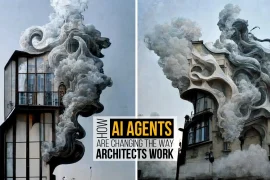
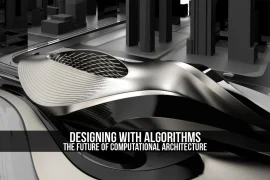
Architecture, as a discipline, is constantly changing to adapt new technologies to meet the demands of its time. The profession has transitioned from hand-drawing floor plans to digital modeling, and architectural education has followed. In recent years, Artificial Intelligence (AI) has dramatically reshaped architectural practice. The impact of AI has been prominent in the educational system, changing the way design studios function. Long gone are the days of intensive laborious hand-drawn concepts. Today students can present multiple iterations in a matter of minutes by using AI to rapidly generate their ideas into comprehensible concepts. The point of AI isn’t about speed or automation, but how it can be used to expand the boundaries of creativity, ingrained in the student’s head, treating the tool as a critical collaborator rather than a shortcut.

The Impact of AI
Architecture school is known for being rigorous and intensive – a relentless cycle of sleepless nights, last-minute revisions, and the pressure to innovate under impossible deadlines. Graduate students are tasked with an insurmountable workload which can be overwhelming for even the most experienced architect. AI can reduce the stress of getting through this task and increase productivity. It acts as a boundless idea generator, prompting explorations into avenues that the student wouldn’t have come across or considered.
But with this power comes a critical dilemma: If everyone relies on the same algorithms, do we risk homogenizing creativity? The same tools that liberate students from drudgery could also flatten the diversity of thought that makes architecture vibrant. As we embrace AI’s potential, we must also confront its pitfalls—because innovation shouldn’t come at the cost of originality.
The AI Design Assistant
Generative design, a method of using AI algorithms to generate and evaluate multiple design alternatives based on input from the user, is one of the most notable applications of AI in design studios. The collaboration of a designer’s sketches with data-driven algorithms can lead to incredible ideas. The role of AI is not to replace architects or take over the design process for the students, but to be the ultimate assistant that can take a conceptual idea and translate it into a complex environmental study or pump out multiple structural possibilities.
Architectural studios in graduate schools run on an intensive time crunch. The purpose of the studio is to push the limits of the student’s architectural ideation in a limited time. The pragmatic use of AI can help focus energy on the curation of the design rather than creating repetitive iterations. It can help streamline the process to enable learning – giving feedback that students can translate into their work.
Schools like AA London now teach “AI literacy,” where students learn to interrogate outputs rather than accept them blindly. The best designs emerge when the human says, “I see what you’re suggesting, but my idea is different.” “We’re now introducing these programs in our undergraduate program as early as the second year,” says Omar Khan, the head of Carnegie Mellon University’s School of Architecture, “but they are framed in a way that is critical.”
David Ruy, who leads the postgraduate program at the Southern California Institute of Architecture (SCI-Arc) and has been working with AI in his advanced studios for years, sees a possible positive outcome to the widespread use of such technology. Many trace the profession’s attachment to long working hours to architecture school’s studio culture, and he believes that AI’s time-saving capabilities could kick-start a value shift. “When you can type in a prompt and get a rendering that’s better than what you could have produced after a week of work, you have to acknowledge that the real value in education comes in judgment and curation, not elbow grease,” he says.

The Ethical Considerations
The use of AI goes beyond just studio and that is where the ethical line becomes grey. Its influence extends to theory and academic writing, which is not discussed often but is critical to the academic journey. For students racing against deadlines, tools like ChatGPT offer a lifeline, for summarizing dense texts or refining arguments. For international students, who are not proficient in the English language, such tools are the best way to understand complex readings.
While AI can be used to articulate ideas into concise statements, the line between assisted writing and AI-dependent plagiarism is fine. Institutions like the Southern California Institute of Architecture (SCI-Arc) became aware of the rash AI-aided “plagiarism” in writing assignments, a problem that has only become more prominent with the use of ChatGPT. The challenge now, for educational institutions, is to teach students to use it transparently – a tool used to “help” and not “cheat”. This will enable students to learn from the software, rather than replacing or banning it altogether.

The Future
The addition of AI in the education system, whether as part of the curriculum or not, is not about a revolution, rather it points to an evolution. It doesn’t change what architecture is at a fundamental level, it just provides a new way to get to the best version of the design. The ideal graduate is the one who can comprehend the intricacies of using AI and can master the program. They will know when to use AI, what to look for, and more importantly what to ignore. Eventually, the architect wields the pen; with precision, intention, and a clear mandate of what their intention is.
References:
Ai in architectural education: Preparing the next generation (no date) AI’s Role in Shaping the Future of Architectural Education. Available at: https://www.realspace3d.com/blog/ai-in-architectural-education-preparing-the-next-generation/ (Accessed: 28 March 2025).
What is generative design?:Generative Design Software (2024) PTC. Available at: https://www.ptc.com/en/technologies/cad/generative-design#:~:text=Generative%20design%20is%20a%20method,materials%20to%20generate%20optimized%20designs (Accessed: 28 March 2025).
Schulman, P. (2023) Learning AI: Are architecture schools ready?, Architectural Record RSS. Available at: https://www.architecturalrecord.com/articles/16470-learning-ai-are-architecture-schools-ready (Accessed: 28 March 2025).
Lehr, F. (2024) How the creative fields are starting to use AI… an architecture project with a little help from Ai – ARTriculate – college consulting for creative students, ARTriculate. Available at: https://www.artriculate.com/blog/architecture-and-ai (Accessed: 28 March 2025).