This article endeavours to highlight the role of social media in architecture, thus the aims of this article pertain to acknowledging aesthetics and the ‘Socio Digital’ aspects of architecture.
Defining The Aesthetic:
Firstly, it is imperative to recognise the ‘Concept of the Aesthetic’ (Shelley, 2022), which is described as a phrase that addresses a particular attitude, experience or value (Shelley, 2022). The concept of the aesthetic is derived from the concept of taste. This term is well encapsulated by the ‘immediacy thesis’ (Shelley, 2022), wherein people do not come to the ‘conclusion that things are beautiful, but rather “sense” that they are’ (Shelley, 2022), perhaps referring to an innate bias that humans have collectively towards picturesque literature, architecture or artwork.
Representing The Architectural Aesthetic:
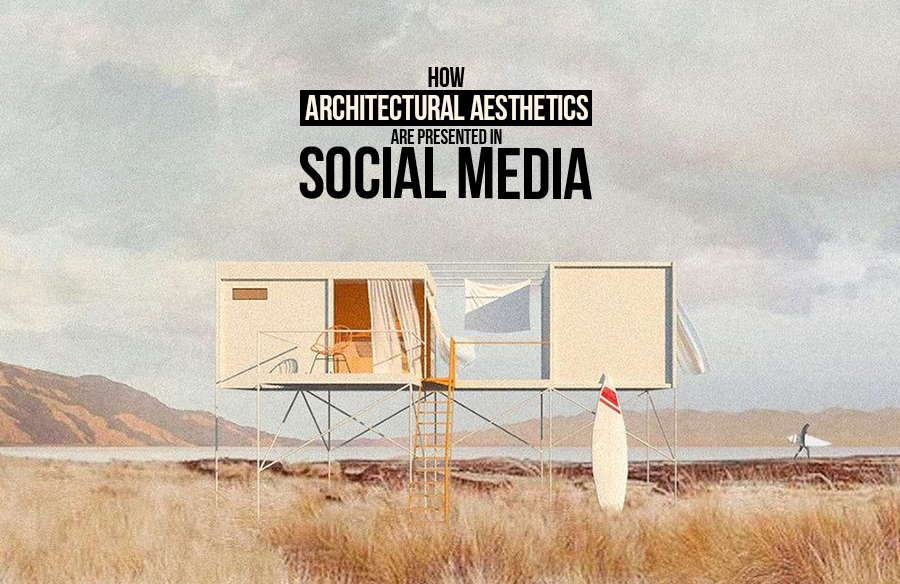
Given that the use of illustrative software has now been implemented into the everyday practice of an architect or designer, representing the architectural aesthetic in social media has predominantly been done through post-digital collages, renders and diagrammatic drawings to help aid the viewer in understanding architectural schemes. Using modelling software and rendering software to capture certain views can help understand architectural schemes better. Below is an example of a post-digital collage, titled ‘The Small Cabin’, by Klaudia Radlinska.

Linking the digital age to architectural representations of the past, how post-digital collages are regarded now can equate to traditional attitudes towards The Picturesque. Writer Christopher Hussey claims that The Picturesque was the ‘relation of all arts to one another, through the pictorial appreciation of nature’ (Ross, 1987, p.271). Although it doesn’t directly relate to natural connotations, the closest equivalent attitude from modern-day architecture, in terms of representing The Picturesque, and thereby the architectural aesthetic, is the concept of Atmospherics. In other words, this involves representing the architectural scheme through visuals that communicate the atmosphere of a space through the ‘interpersonal concept and as a holistic notion of experience’ (Hulmi, 2022). Given the digital age, this particular method of atmospheric representation is convenient for social media, as they operate via current/long-term sustaining trends or algorithms, acting as a platform for architectural firms to market their schemes.
Architectural Aesthetics on Social Media:
Interestingly, most architectural aesthetics tend to develop from lifestyle themes, for example, minimalism. The key characteristic of this sub-genre of architecture, (initially influenced by designs inspired by Cubism and Bauhaus) is the fact that the structures lack ornamentation (Puisis, 2022). The spatial language created by the lack of ornamentation is symbolic of the fact that the physical form of the structure is ‘self-referential’ (Design4Retail, 2023). Here, the term ‘self-referential’ is key, as its relevance within the digital realm is due to the idea that social media platforms are essentially opportunities for self-expression (either individual or collective), hence bridging the narrative between this particular architectural style and its representation in social media.

Thus, it is appropriate to assume that the ongoing thread that connects social media and various architectural styles is the aforementioned idea of self-reference and self-expression. Furthermore, it is important to note the differences between the observations of an architect and the user when assessing the spatial values of a certain type of architecture. For example, a study, which analysed the general public’s views towards an architectural photo given on social media, stated the differences in the approach to understanding contemporary architecture between an architect and general society. Here, the former’s perception of contemporary architecture is of aesthetic value, whereas the latter’s perception of contemporary architecture is that of an ‘experiential utilitarian dimension’ (Bianco, 2018, p.265). One would assume that the opinions would be reversed, however, according to the conclusions of the study, ‘it is imperative that the building stands and functions’ (Bianco, 2018, p.270). Although the study didn’t necessarily present the photo as an architectural aesthetic, one could argue that there are no clear deliverables that an aesthetic needs to meet, to be labelled as one.

In conclusion, the architectural aesthetics posted on social media are, oftentimes, to represent an idea of a scheme, proposed by architectural professionals. However, an aspect that hasn’t necessarily been proposed before in this article, is the idea of WIP (work-in-progress) diagrams being posted on social media to show the viewer about the process of the scheme’s formation and the aesthetic that it inherently creates. Doing so will feed into the marketing of an architectural scheme, as it links to the perennial nature of all architectural projects to have a narrative, thus creating a bespoke atmospheric representation. In recent times, WIPs have been shown through architectural illustration, mind-maps, informative reels/clips and infographic posts. Furthermore, one could argue that by representing architectural aesthetics through photography, which is the predominant means by which the general public views design schemes, as opposed to post-digital collages or rendering, a more holistic atmosphere is communicated. Perhaps, this is because, if you communicate to people in a way that they are familiar with, for example, through photography that captures visuals which are representative of what the human eye sees, they are much more likely to relate to architectural schemes better.
References:
- Bianco, L. (2018). Social Media: Third-Person Perceptions of Architecture. Urbanism. Architecture Constructions, 9(3), 265-272 [online] Available at: https://www.researchgate.net/publication/326684572_Social_media_Third-person_perceptions_of_architecture [Accessed 16/12/24]
- Design4Retail. (2023) Minimalism: A Trend or Timeless? [online] Available at: https://www.design4retail.co.uk/news-blog/minimalism-a-trend-or-timeless/ [Accessed 16/12/24]
- Hulmi, J.M. (2022) Resonance and Atmosphere in Architectural Aesthetics. 20(2022) [online] Available at: https://contempaesthetics.org/2022/12/15/resonance-and-atmosphere-in-architectural-aesthetics/ [Accessed 16/12/24]
- Puisis, E. (2022) What Is Minimalist Architecture? [online] Available at: https://www.thespruce.com/what-is-minimalist-architecture-5224419 [Accessed 16/12/24]
- Ross, S. (1987). The Picturesque: An Eighteenth-Century Debate. The Journal of Aesthetics and Art Criticism, 46(2), 271–279. Available at: https://doi.org/10.2307/431865 [Accessed 16/12/24]
- Shelley, J. (2022). ‘The Concept of the Aesthetic’, The Stanford Encyclopedia of Philosophy (Spring 2022 Edition), Edward N. Zalta (ed.), Available at: https://plato.stanford.edu/archives/spr2022/entries/aesthetic-concept/ [Accessed 16/12/24]
Image URLs:
- https://postdigitalarchitecture.com/blogs/articles/best-architectural-collage-of-2022
- https://cibiandsimeon.com/minimalism-in-modern-architecture/
- https://uxdesign.cc/form-vs-function-when-is-it-okay-for-design-to-be-weird-aa8e97703bc9