“…Man, as an adjective, natural, physical, sensitive being, he is a suffering, dependent and limited being…, that is, the objects of his instincts exist outside of him, independent of him, but are the objects of his need, indispensable and essential for the realisation and confirmation of his substantial powers.”
– Karl Marx, Economic and Philosophic Manuscripts of 18441
As capitalism continues to overpower the socialist economy all around the globe, uncertainty in terms of economic stability and inflation create a major negative impact on housing solutions including rental and mortgage costs. Both housing development activity and home ownership are contingent on the availability and cost of capital. Housing costs are directly affected by financial markets on national and global levels and thus a chain gets created which affects all categories of citizens. Not only is it extremely inconvenient to purchase a house for yourself, but rents and mortgages are also increasingly unaffordable which leads a typical citizen to live an alienated life. An alienated life is a concept which is very transfused with how financial stability – or lack thereof – affects daily lives in a manner that people don’t find comfort in either the outside world or their own homes since they’re constantly loaded by the never-ending saga of responsibilities to fulfil.
Affordable Housing and Architecture
With increasing urbanisation of residential and social spaces, as well as heightening demands of affordable housing options; it is now a requirement to work according to cost-effective design principles. The architectural industry requires designs that kill two birds with one stone: following the steps of sustainability and affordability while making sure that emerging trends and modern amenities are kept in mind.

Simply put, affordable housing refers to housing units that are affordable by that section of society whose income is below the median household income.2 But moving past that, it casually affects all sections of the society. It is a funda that revolves around the concepts of wages, liabilities, financial pressures and capitalism, among others. In India, it becomes critical to fill the gaps in the country’s urban infrastructure, specifically housing. With an annual growth rate of about 2.8% in the country’s population, the influx of a significant amount of this population migrating to urban civilizations increases exponentially – factors like better living standards, better facilities and need for status becoming the driving forces into making such decisions.3 That is also highly effective on day-to-day operations in the urban areas as we deal financial crisis on varying degrees: finding a stable housing solution being one of the major issues.
Sustaining Design Strategies: The Path to Stability
While conquering capitalist markets with better and more socially conscious architecture could come across as a far-fetched idea; it can be a small yet significant step towards lessening the financial burdens for the working classes. Cost-effective design principles can be the lead to creating architecture that sustains.
Achieving Space Optimization Through Multi-Functional Areas
By introducing flexibility as a core element in designs, designers can guarantee space utilisation in the most efficient ways possible. A great example would be how during the Covid pandemic, everyone brought their creativity forward in order to create functional working spaces in their homes when they were left with not much otherwise. Maximum optimization of exterior and interior spaces in housing can empower the residents to make the most of their living situations, adapting to the varying needs and amenities.
The Concept of Sustainability
Embracing energy-efficient design practices does not only reduce negative environmental impacts but also creates the path to long-term cost savings. Integrating sustainable elements into affordable housing projects promotes resilience and affordability over time, which guarantees stability for the residents.4 Various kinds of strategies can bring in the sustainable attitude in building architecture – passive designing, using recyclable materials, optimising energy usage, renewable energy usage, and efficient lighting being few of them. Sustainability, as a requirement, challenges architects to craft designs that excel in not only form and function, but also bring integrated solutions that keep environmental betterment at the core of it all.
Conclusion: What’s Next?
“That a country of wealth cannot provide sound housing for those in need is a national embarrassment.”
– Sam Savis, The Architecture of Affordable Housing (1995)5

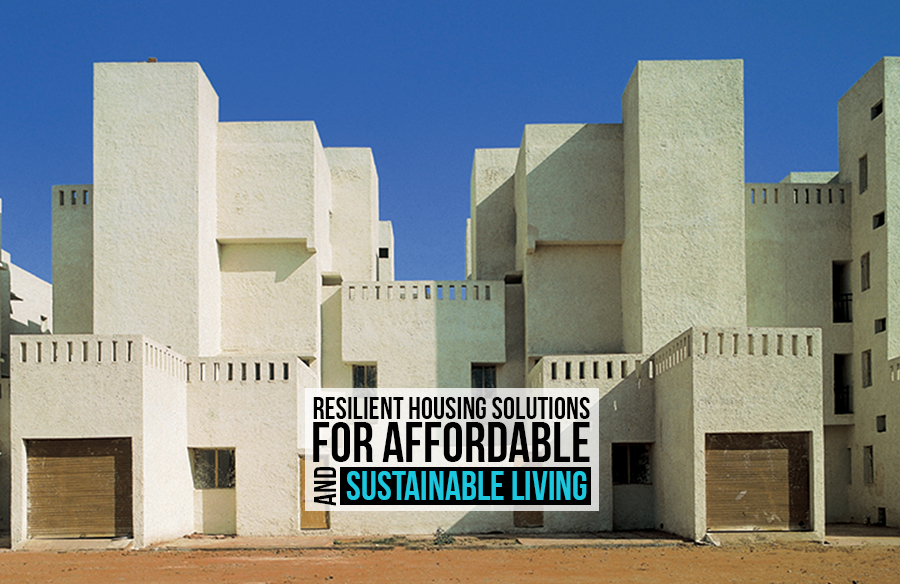
Although written almost three decades ago, this quote by Sam Davis still stands true on deserving citizens not being able to find affordable and dignified housing. To deal with this very relevant issue of the lack of affordable housing, many architectural establishments have been diligently working towards taking a more sustainable and cost-effective approach towards architecture, creating ideal examples for generations to follow. Alongside the efforts made by the government – like the Pradhan Mantri Awas Yojana (2015) – numerous Indian architects like Raj Rewal Associates and Vastu Shilpa Consultants are also creating the footprint for affordable housing and smarter designs. It is safe to say that the architectural industry can and should pave the way for destroying the financial burdens from the common men’s shoulders by providing an affordable roof, literally and figuratively.
REFERENCE LIST:
IMAGES :
- Colliers, Liases Foras. Rising Housing Prices. Outlook Money. [Graph]. (https://www.outlookmoney.com/conscent-story/affordable-bargain-can-low-cost-housing-be-a-plausible-choice-1183)
- (1982). Sheikh Sarai Housing – New Delhi. Raj Rewal Associates. [Photograph]. (https://rajrewal.in/portfolio/sheikh-sarai-housing-new-delhi/)
BIBLIOGRAPHY/EXTERNAL LINKS :
- McLellan, D., Chambre, H. (2024). Analysis of society. Britannica. Available at: https://www.britannica.com/topic/Marxism/Analysis-of-society [Accessed 19 August 2024.]
- 2024. What is ‘Affordable Housing’. The Economic Times. Available at: https://economictimes.indiatimes.com/definition/affordable-housing [Accessed 24 August 2024.]
- Wahi, G., Sharma, K. (2016). Affordable Housing in India. ICC. Available at: https://smartnet.niua.org/sites/default/files/resources/Affordable%20Housing-ICC%20-%20Final.pdf [Accessed 24 August 2024.]
- AEC Associates. Innovative Design Strategies For Affordable Housing Projects: The Power Of Architectural CAD And BIM Services. LinkedIn. Available at: https://www.linkedin.com/pulse/innovative-design-strategies-affordable-housing-projects-6g93c/ [Accessed 25 August 2024.]
- Davis, S. (1995). The Architecture of Affordable Housing. Los Angeles: University of California Press.