Since the beginning of civilization, nature has been our greatest teacher, demonstrating how to build resilient, efficient, and harmonious systems. However, over the years, rapid and unsustainable development has distanced us from nature’s wisdom. The Built Environment industry has a lot of potential for sustainable development through nature’s wisdom. This article explores how nature’s principles can transform the built environment into a more resilient, regenerative, and sustainable system.
Why the Built Environment Must Change
Since ancient times, nature has been humanity’s greatest teacher, offering solutions to complex challenges. Nature offers profound inspiration for almost every aspect of human life. During the pre-industrial era, nature-inspired buildings, such as mud houses (reflecting nature’s principle of existence on local environmental conditions) in the extreme tropical climate of Yazd city in Iran, and the technique of igloo houses in extreme cold conditions.
But in the post-industrial era, the world has lost the wisdom of nature and degraded the quality of life. Because of the continuous destruction of natural resources, the Earth’s temperature is soaring high and has put many lives at risk. According to the research, by the end of the century, many essential species in the ecosystem will be extinct.
This raises an important question: can we relearn nature’s principles to address one of the greatest challenges of our time – Climate Change?
Climate change is the major concern of today’s world. Every year, millions of people lose their lives because of pollution, natural disasters, and extreme climatic conditions. It has a direct impact on the quality of food production and the well-being of all the species on Earth. The built environment plays a vital role in both contributing to and addressing this crisis.
One of the largest contributors to this crisis is the built environment, making it one of the most important sectors for climate action.
According to the United Nations Environment Programme (UNEP), the buildings and construction sector accounts for approximately 37% of global carbon emissions and nearly 34% of global energy demand. (United Nations, n.d.)
In 2024, global building floor area increased by 1.7% to reach 273 billion square meters. This growth is roughly equivalent to approximately land area five times the size of Nairobi, or two times Delhi, four times Berlin, or New York, respectively, or three times the size of Rio de Janeiro. (Global ABC & United Nations Environment Programme, 2025, #)
All the species, especially the vulnerable communities, are victims of this drastic Built Environment impact, such as air, water, and soil pollution, reduced productivity, declining mental well-being, and many other health-related concerns. Implementing nature-based solutions can help reverse many of these effects while improving ecological and human health. Achieving a low-carbon built environment requires adopting bioclimatic design principles.
Bio-inspired or bioclimatic design integrates biomimicry and biophilia to embed ecological intelligence into the Built Environment. When biomimicry combines with bioclimatic principles, it creates energy efficiency, reduces embodied carbon, and fosters resilience by harmonising the Built Environment with ecosystems, offering a practical pathway toward a regenerative and low-carbon future.
Let’s understand the role of nature’s principles in the Built Environment.
Ecosystems are natural models for designers to create robust, flexible, and adaptable systems. Learning from natural ecosystems enables the built environment to function as an interconnected, adaptive system rather than as isolated buildings and infrastructure.
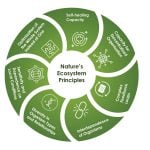
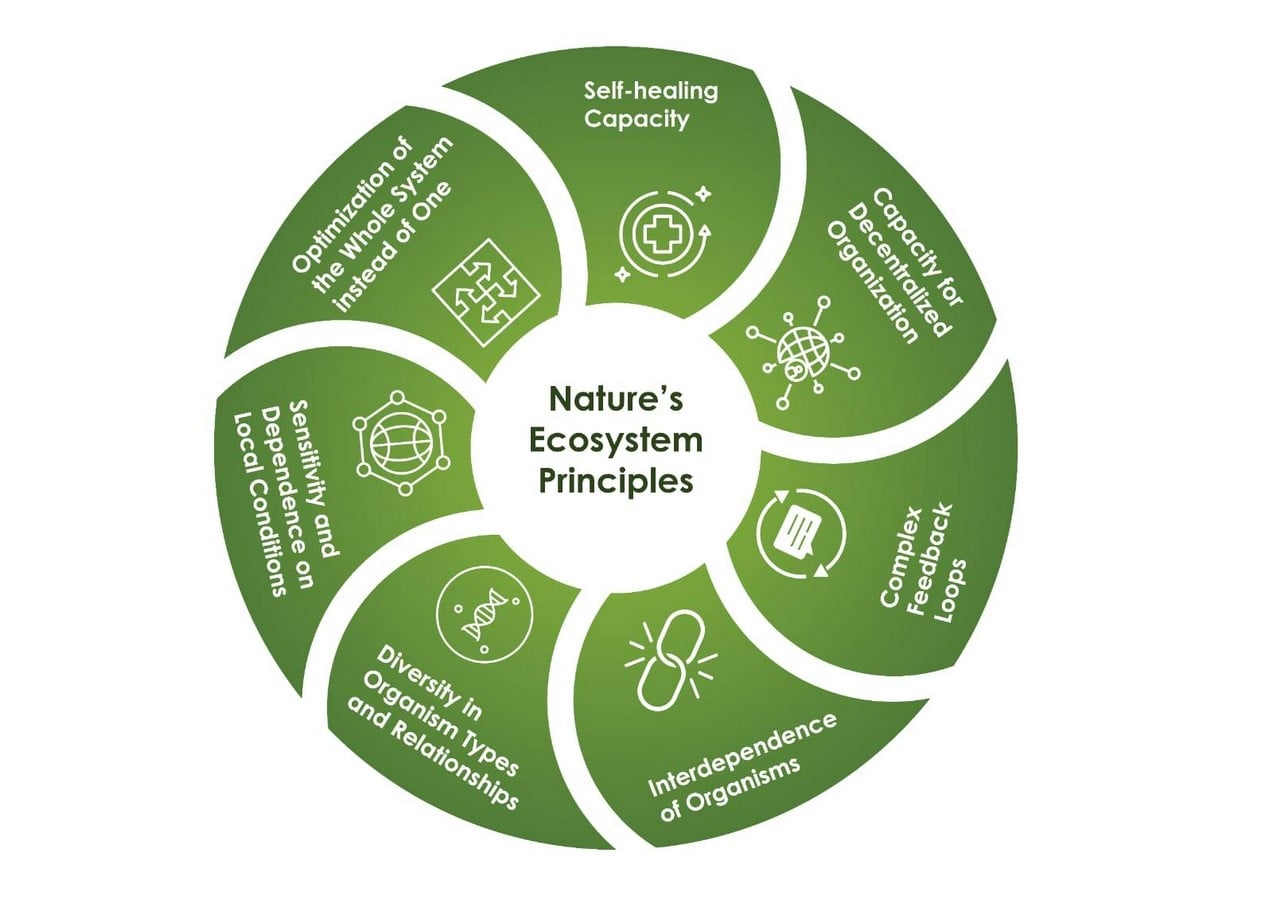
Nature’s Design Principles
- Self-healing capacity
- Capacity for decentralized organization
- Complex feedback loops
- Interdependence of organisms
- Diversity in organism types and relationships
- Sensitivity and dependence on local conditions
- Optimization of the entire system instead of one piece
(Gul, 2022)
Applying Nature’s Wisdom in Design Practice
One of nature’s remarkable characteristics is its ability to heal and regenerate. Instead of heavy maintenance structures, the Built Environment industry can adapt this approach to materials and techniques that repair and regenerate automatically. Bio-concrete is an excellent example. It incorporates limestone-producing bacteria into the concrete mix. When cracks develop and moisture enters, the bacteria become active and produce calcium carbonate, naturally sealing the cracks before they expand.
Nature also demonstrates the power of decentralized systems. Urban areas can also adopt distributed water management using constructed wetlands, bioswales, rain gardens, and rainwater harvesting systems, enabling them to treat and reuse water near its source.
Integrating localized ecosystems allows distributed water management to approach the principle of decentralized organization: on-site constructed wetlands, bioswales, and rain gardens to filter stormwater and reuse water for vertical farming. In the biophilia approach, designers can integrate native vegetation, modular nesting poles, and bat walls, bringing non-human species directly into urban habitats.
In nature, nothing becomes waste. Every waste from one organism becomes a resource for another, creating continuous circular cycles. Likewise, buildings and cities can be designed to function as living ecosystems – adapting to changing climatic conditions, harvesting renewable resources, recycling waste, and continuously regenerating environmental value.
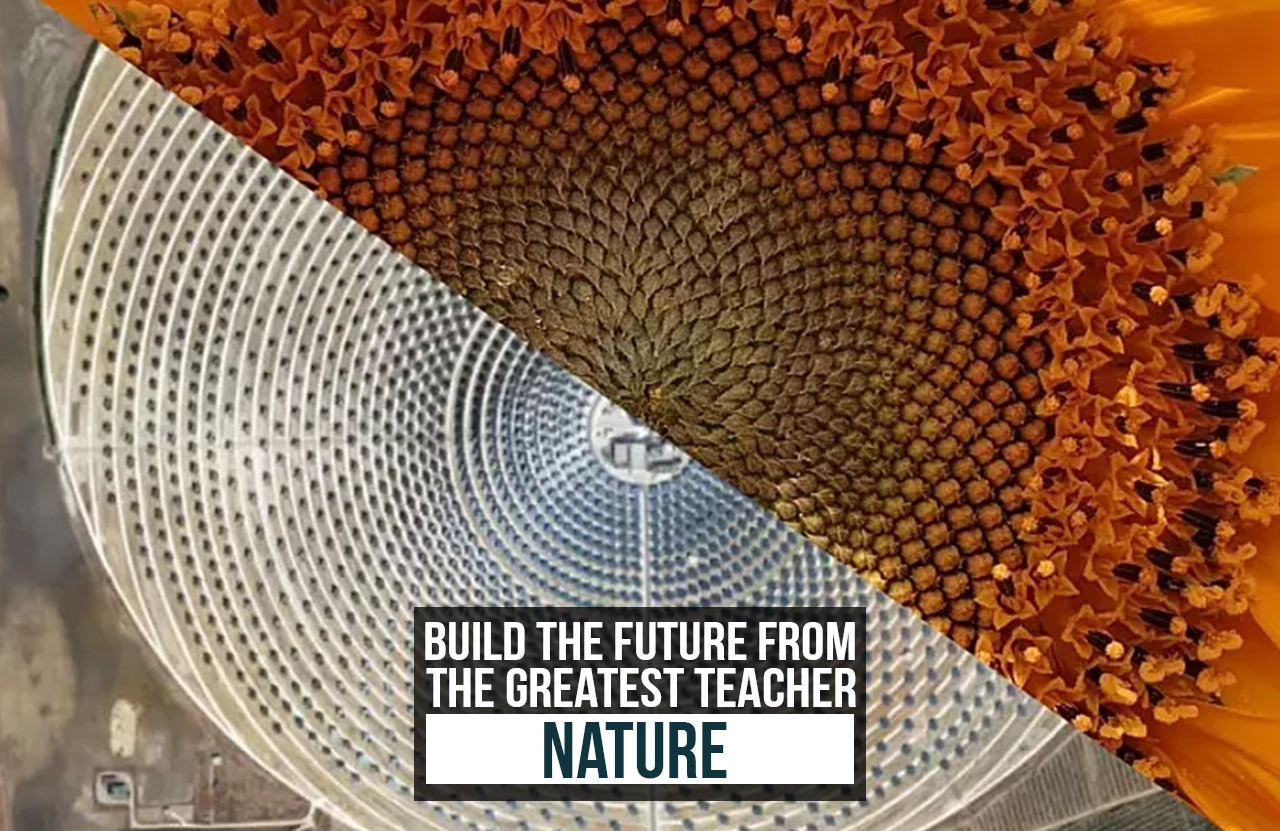
For billions of years, nature has been refining systems that are resilient, adaptive, regenerative, and efficient. Rather than considering nature as something separate from our cities and buildings, designers must begin to see it as a mentor for the future of design. The built environment can no longer be taken as a collection of structures; it must develop into an interconnected ecosystem that works with nature rather than against it.
By integrating principles such as self-healing, decentralization, circularity, diversity, and adaptation to local conditions, architects, planners, engineers, and policymakers can create spaces that restore ecosystems while enhancing human well-being. Building the future is not about inventing entirely new solutions. It is about rediscovering the intelligence that nature has demonstrated for millions of years. The path toward a regenerative, low-carbon future begins by learning from the greatest teacher we have ever known: Nature.
References:
Global ABC, & United Nations Environment Programme. (2025). Executive Summary. In Building Fast, Falling Short (p. 15). United Nations Environment Programme. https://globalabc.org/sites/default/files/resources/2026-05/global-status-report-for-buildings-and-construction-2025_2026.pdf
Gul, A. (2022). NATURE-BASED SOLUTIONS FOR THE DESIGN OF THE BUILT ENVIRONMENT IN THE FRAMEWORK OF CLIMATE CHANGE ADAPTATION. Academia.edu. https://www.academia.edu/95992353/NATURE_BASED_SOLUTIONS_FOR_THE_DESIGN_OF_THE_BUILT_ENVIRONMENT_IN_THE_FRAMEWORK_OF_CLIMATE_CHANGE_ADAPTATION
United Nations. (n.d.). Buildings. United Nations Environment Programme. https://www.unep.org/topics/energy/buildings