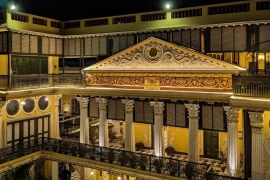
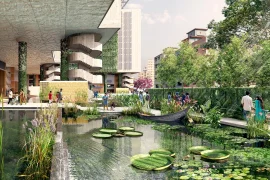
The world filled with modernity is not paying much attention to basics, yet there are very few visionary architects restoring these longstanding methods. They are not merely seen as practitioners for saving the heritage or culture but lean towards making these practices viable for an adaptive scenario, formulating designs that become innovative and sustainable. From bamboo structures for naturally ventilated homes in Southeast Asia to mud-brick, solar-shaded taproom blocks in sub-Saharan Africa, the messages put craft and materiality first. These projects demonstrate that architecture must be sustainable at the source and engaged within the community. Below is a selection of 10 projects that best illustrate the harmonious combination of tradition and modernity, proving every day the validity of age-old practices in today’s architectural world.
Project List
1. Anandaloy by Anna Heringer (Bangladesh)

Anandaloy is a community building with a workshop located in Rudrapur, Bangladesh; the design was by Anna Heringer, an architect noted for her innovative use of sustainable methods in architecture.
Anandaloy means “place of deep joy” and it is structured with a mixed approach, joining the traditional construction of mud and bamboo with contemporary design approaches. Its biomimetic undulating form can be derived right out of nature or from local clay architecture, in a manner by which the built environment just melds as one with its surroundings. Another key advantage is that the application involves the use of readily available materials and technologies within the local economic context, making the building responsive to the regional climate and culture. The work of Heringer challenges the traditional view of architecture, stressing that local knowledge and skills should be associated with promoting the value of created space, rendering it relevant to culture and sustainability.
2. The Songtsam Lodges by Hangzhou Architect & Design Research Institute (China)

Songtsam Lodges are an upscale lodge group in the Tibetan region of China designed by Hangzhou Architect & Design Research Institute. The resort is designed in a modern reincarnation of the traditional construction of Tibet, built by rammed earth and wood construction.
The design integrates appropriately with the natural environmental setup.
The lodges are constructed with local building materials using local methods of building, which helps conserve traditional practices of building and reduces the accommodation’s environmental degradation. The architecture of the Songtsam Lodges is deeply respectful of Tibetan culture and offers an immersive experience that connects guests to the local heritage.
3. Hoshinoya Kyoto by Azuma Architect & Associates (Japan)

Hoshinoya Kyoto, created by Azuma Architect & Associates, is a luxurious resort based in the historic city of Kyoto, Japan. The modern answer to traditional Japanese ryokan inn smoothly integrates the contextual natural flow into its architecture. True to the use of local materials such as wood and stone and building with traditional Japanese techniques, this is created for the visitor in a tranquil and immersive manner.
But for nature and respect to details in the architecture, everything is ideally placed for Hoshinoya Kyoto, meaning every structure is set for the maximum beauty of the landscape.
The result is a resort that perpetuates the power of classic Japanese design and how it can be translated into the modern without a fuss.
4. The Great Wall House by Kengo Kuma (China)

Adjacent to the Great Wall of China, The Great Wall House by Kengo Kuma is a definition that superimposes conventional Chinese materials with contemporary design elements. Kuma is known for his philosophy of “anti-object” architecture and had the idea to create a structure that respects the historical context of its location while being very modern in rendering a living space. It uses traditional Chinese materials, in terms of brick and wood, in such a way that their natural beauty and historical value get showcased. The ample windows and interiors thus get breathtaking views of the Great Wall, and the interior is well connected to the external landscape.
Kuma’s work reflects the contemporary possibilities of traditional materials and techniques in making architecture that is respectful of the past and forward-looking.
5. Green School by PT Bambu (Bali, Indonesia)

Located in Bali, Indonesia, the Green School is one of the most innovative projects that prove to the world how an educational enclave can be built using almost entirely bamboo. Designed by PT Bambu, the project gives an excellent example of the possibilities of the material in realising a sustainable building. The material is not only very environmentally friendly but also very strong and flexible due to the suitable density of bamboo present in the region. The Green School’s design takes inspiration from traditional Balinese architecture; classrooms are open air and thatched with roofs that manifest a natural blend with the rest of the surroundings. Now it stands as a completed project representing a sustainable education model across the globe about using traditional material in modern ethos for creating eco-friendly and aesthetic space.
6. The Stone House Carl Fredrik Svenstedt Architect

Located within the English countryside, The Stone House sees Carl Turner Architects insert modern architectural interventions into traditional dry stone walling. The house reflects an architectural language blending with the rural context of its location: within the designs, the use of locally quarried stone and traditional building techniques applied in the locality over the centuries. Inside, there is a minimalist living space, which is modern but firmly located in the locality; the detailing is precise and restrained. It is a rich example of how traditional materials and techniques, when adapted, represent architecture not only sustainable but relevant to the contemporary world.
7. Teshima Art Museum by Ryue Nishizawa, Japan

Located on Teshima Island, Japan, the Teshima Art Museum narrates a tale of setting up a building that settles down into the landscape with a language that is both that of traditional Japanese aesthetics and contemporary design.
The organic form of the museum is inspired by the natural landscape and traditional Japanese garden design, creating a space that is both calm and integrated into the surroundings.
The concrete, a very modern material, is softened by the fluidity of the building form that echoes the curves of the hill on the island. The Teshima Art Museum truly is one of those projects where contemporary architecture can take traditional lessons and create new spaces that feel somehow modern and so much a part of the place.
8. Mapungubwe Interpretation Centre by Peter Rich Architects (South Africa)

This structure is found in the Mapungubwe National Park of South Africa; it has been done by Peter Rich Architects using traditional masonry techniques coupled with materials sourced from the immediate location. The derivation of its design is from ancient stone structures within the region built through a special form of building known as “vaulted earth,” which entails local stone and earth.
The design of this centre gives tribute to the heritage of the region through sustainability; thus, it is a design that uses passive cooling and natural materials to bring out a building that rhymes with the environment.
The general reflection of traditional building techniques that the Mapungubwe Interpretation Centre is supposed to bring out is one that is reinterpreted to be delivered as a deeply contemporary piece of architecture tied strongly to its cultural context.
9. Yingliang Stone Natural History Museum by Atelier Alter, China

Located in Xiamen, China, the Yingliang Stone Natural History Museum is a project that brings out the junction between tradition and modernity. Atelier Alter designed the museum within a reused stone factory that forwarded the industrial heritage of the site while adding its touch of modernity. Traditional methods of stone carving—a craft deeply rooted in the history of this region—have been used in developing intricate façades and interior spaces for this design. The aim of this project is the preservation of cultural heritage and the application of traditional craftsmanship within contemporary architecture.
10. NLÉ Architects’ Makoko Floating School, Nigeria

The Makoko Floating School is a powerful response by NLÉ Architects and Kunlé Adeyemi to the challenges posed by the waterfront community of Makoko in Lagos, Nigeria. This pilot project serves as a prototype for a floating structure built from locally sourced wood and other affordable and sustainable materials. The design of the school draws from the traditional Makoko community water-based living practices and provides a solution to the climate change imperative for adaptable, resilient architecture. It is symbolic of how traditional knowledge and practice can be used to inform contemporary sustainable design solutions in vulnerable environments.
Each of these projects is an epitome of honouring cultural heritage with profound respect and, at the same time, challenges the extremities of a contemporary architectural field. The architects actually prove that lessons from tradition sustained or taught values of community and a place’s importance. Such projects present, in a small world palate, the enormous diversity and richness of architectural tradition from all over the world at a time in which architecture has been constantly seen as a globalised, homogenised practice and their continued importance for the future building environment.