Cities rarely remember themselves all at once. More than historical accounts, they quietly do so through their living fragments. A familiar street, a festival, an evening prayer, or a building that quietly survives while everything around it changes is what builds the story of a city’s true character.
Hidden within the Rajwada precinct of Indore, Gopal Mandir is one such fragment.
Built nearly two centuries ago, it has witnessed royal patronage, changing civic priorities, dilapidation, restoration and, today, a renewed sense of public ownership. What now stands as one of Indore’s most cherished heritage landmarks is not merely a restored temple, but an evolving public place where architecture, heritage and everyday life continue to intersect.
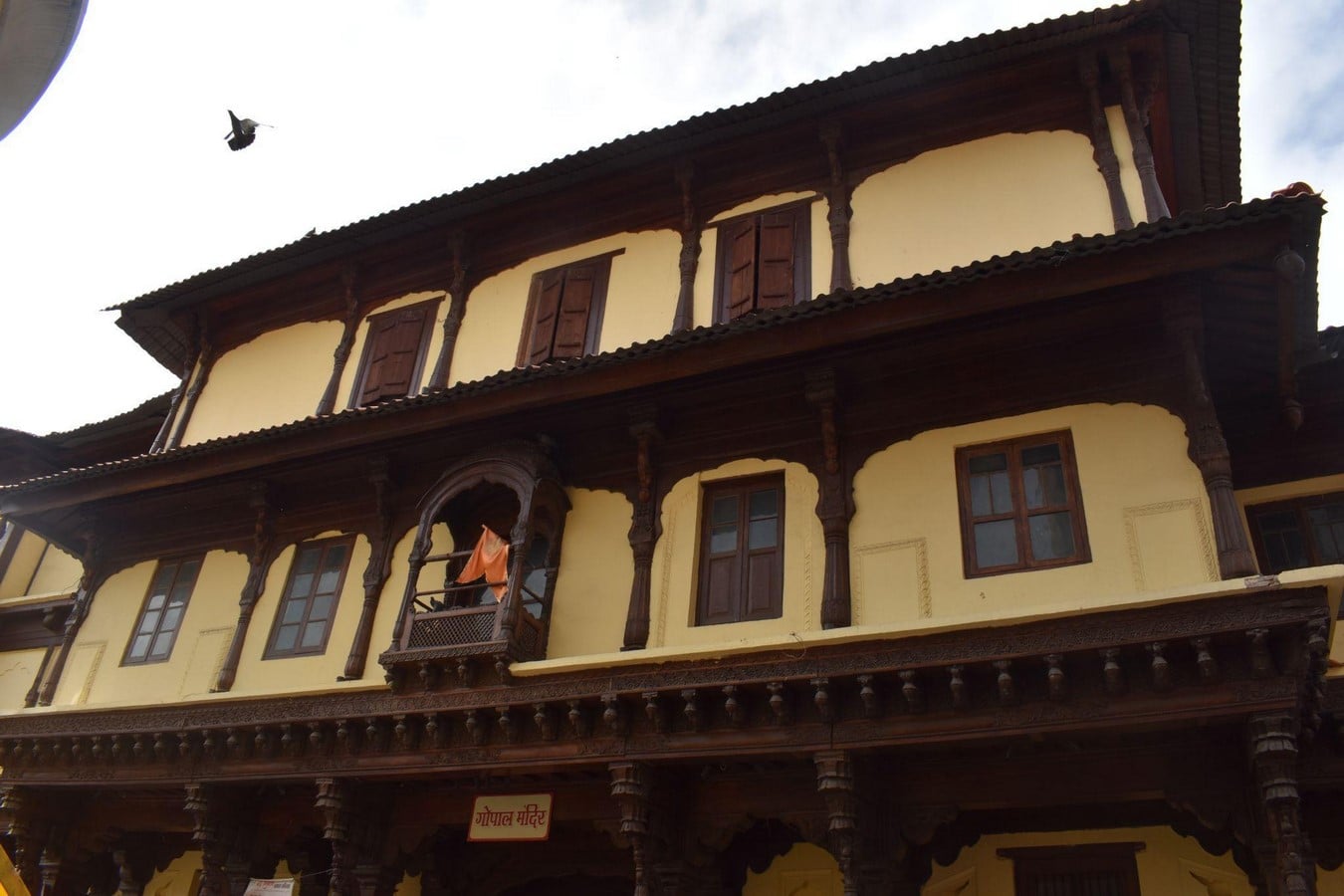
More Than a Temple: A Civic Landmark
While Gopal Mandir is often noted for its religious significance in the city’s history, its original vision extended far beyond that of a place of worship.
Completed in 1832 under the patronage of Maharani Krishnabai Holkar, the temple stands beside Rajwada, the royal residence of the Holkars, within the historic core that once formed the political, commercial and social heart of the Indore State. More than a religious landmark, it occupied a strategic position where royal administration, bustling markets and everyday public life naturally converged.
The Temple Complex was envisioned as a shared civic space that welcomed devotees, merchants and travellers alike. The premises included a grand Annakshetra, where freshly prepared meals were served to all visitors, reflecting the state’s long-standing tradition of public welfare by providing food and shelter to those in need.
Owing to its location and adjoining amenities, rather than existing as an isolated religious monument, Gopal Mandir became deeply interwoven with the everyday rhythms of the city, embodying a characteristic seen across many Holkar-era structures, where architecture nurtured faith, community and public life in equal measure.
It is perhaps this enduring relationship between the temple and its people that explains why its legacy continues to resonate nearly two centuries later.
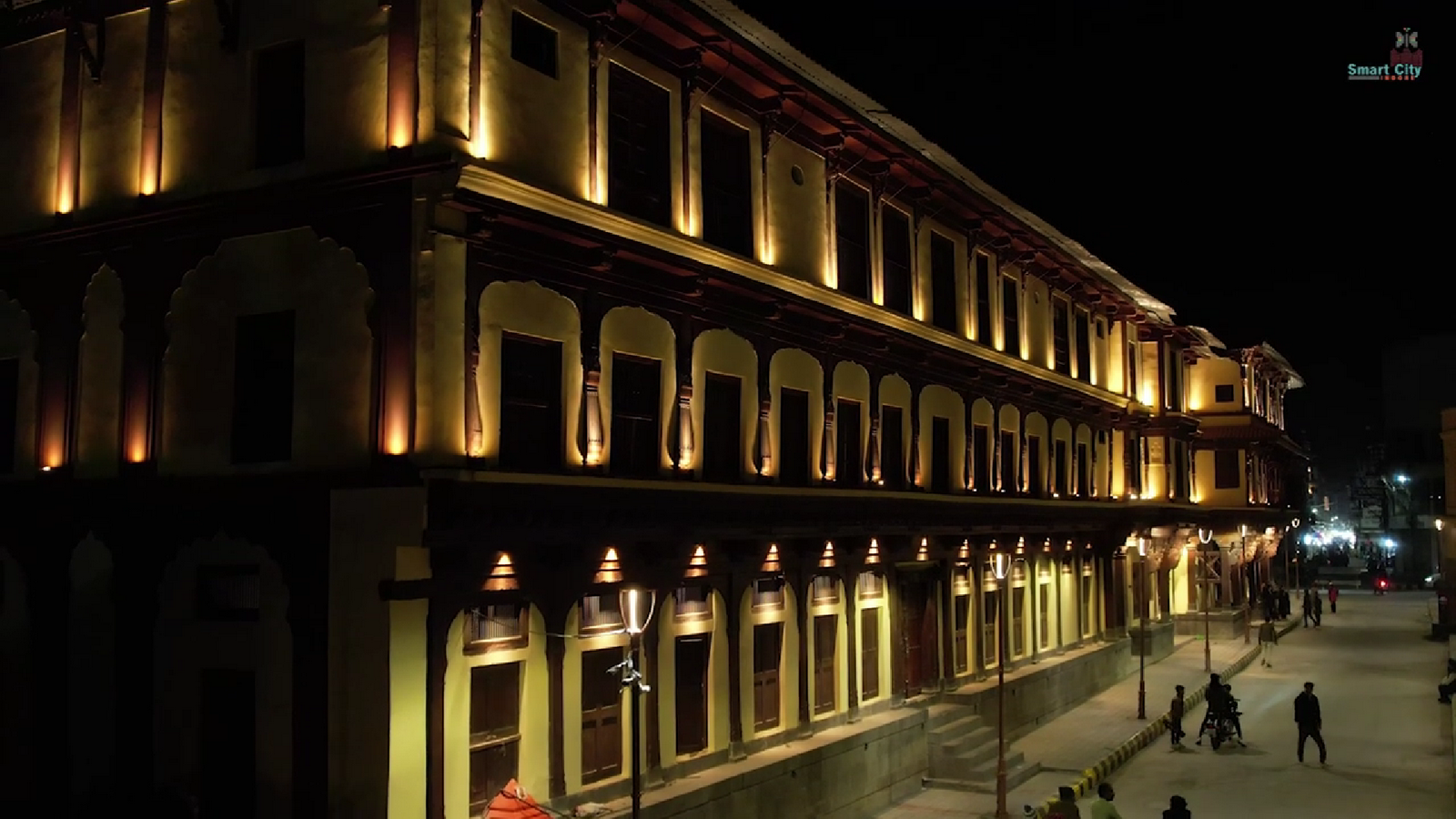
Through the Threshold
The architectural character of Gopal Mandir is a refined expression of Maratha architecture, accentuated by its ornamentation and through the spatial experience it creates.
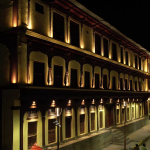
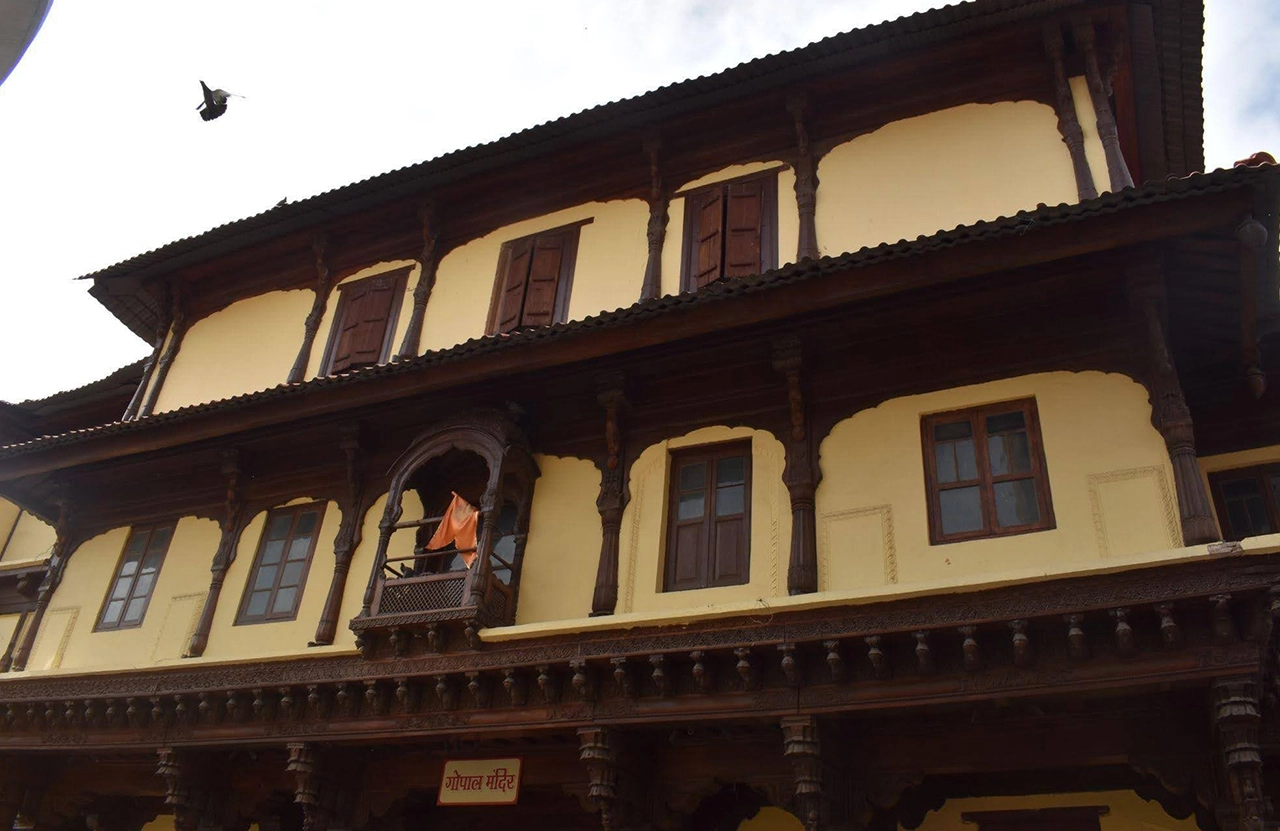
The street leading to the temple runs between the side façade of the Rajwada and the temple’s imposing front façade, which features numerous wooden doors and windows.
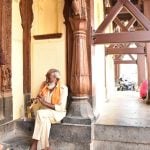
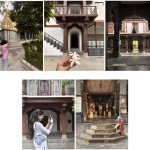
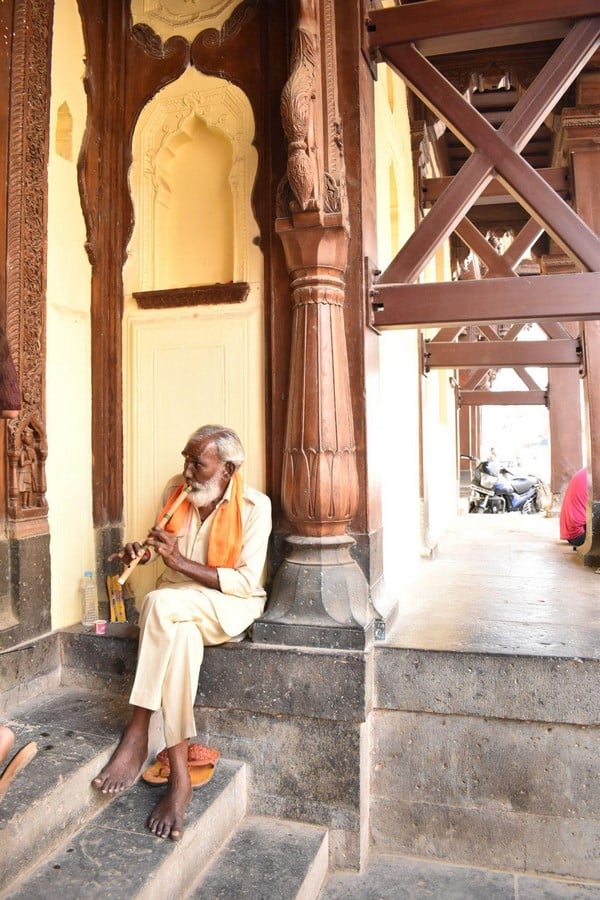
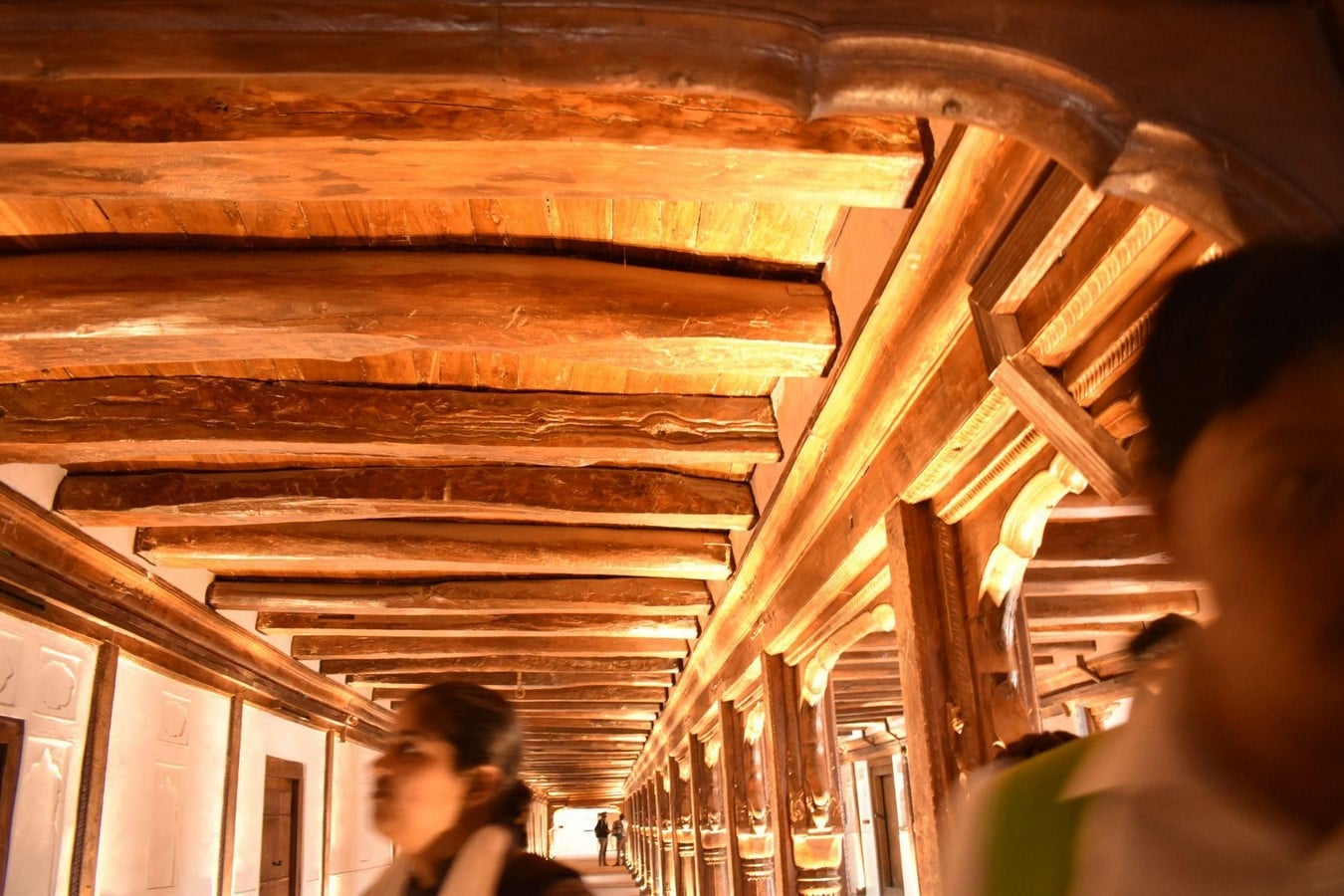
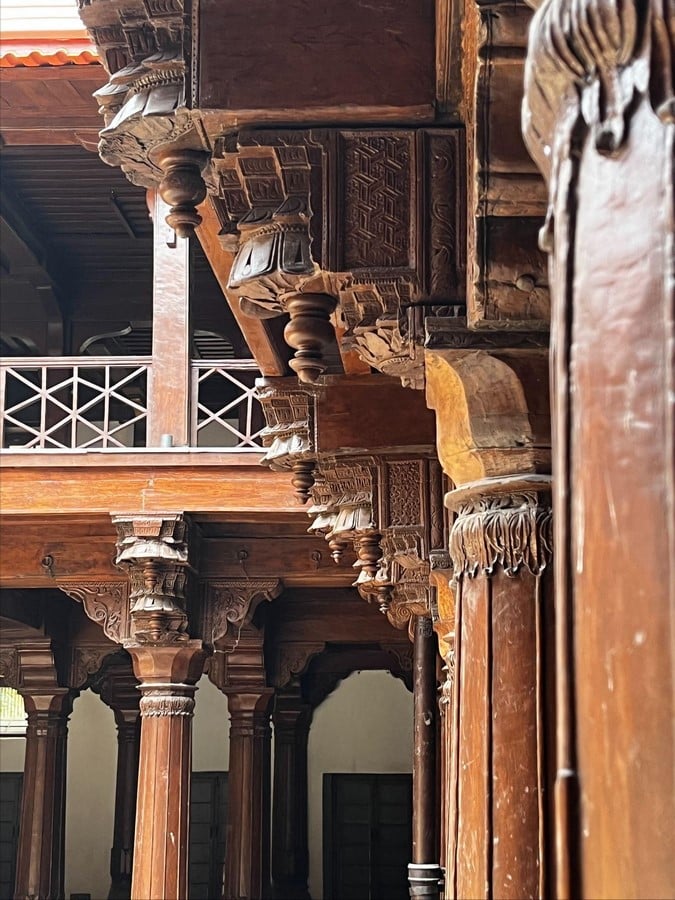
A shaded verandah marked by timber columns, richly carved wooden brackets and deep projecting chajjas marks the entrance gateway of the temple.
A gentle flight of stone steps lifts the visitor from the street to the entrance, where a wooden doorway marks the threshold into the complex.
Yet, even after stepping inside, the journey is only beginning.
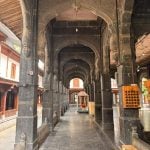
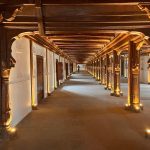
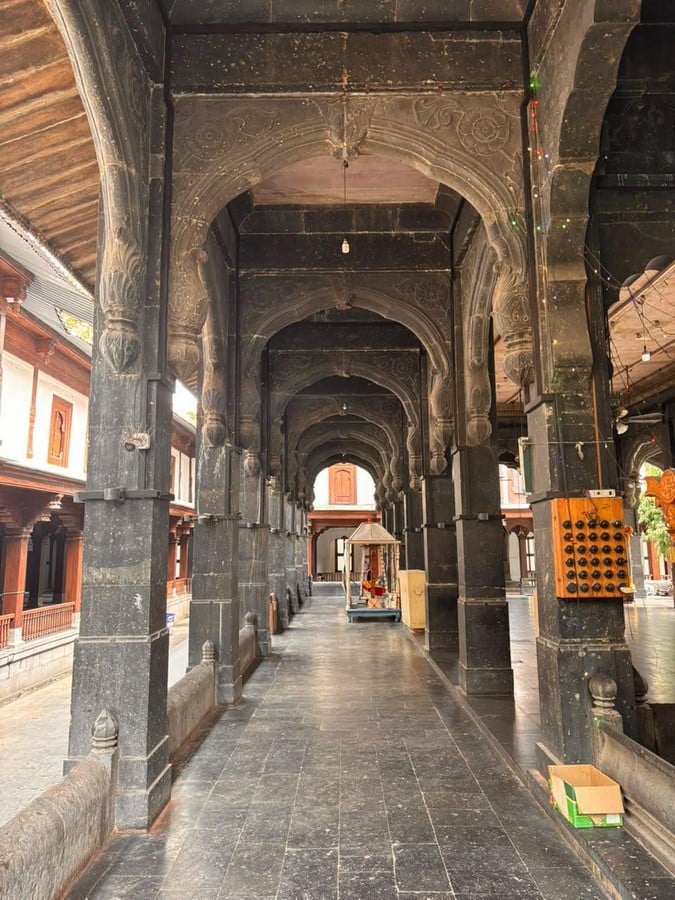
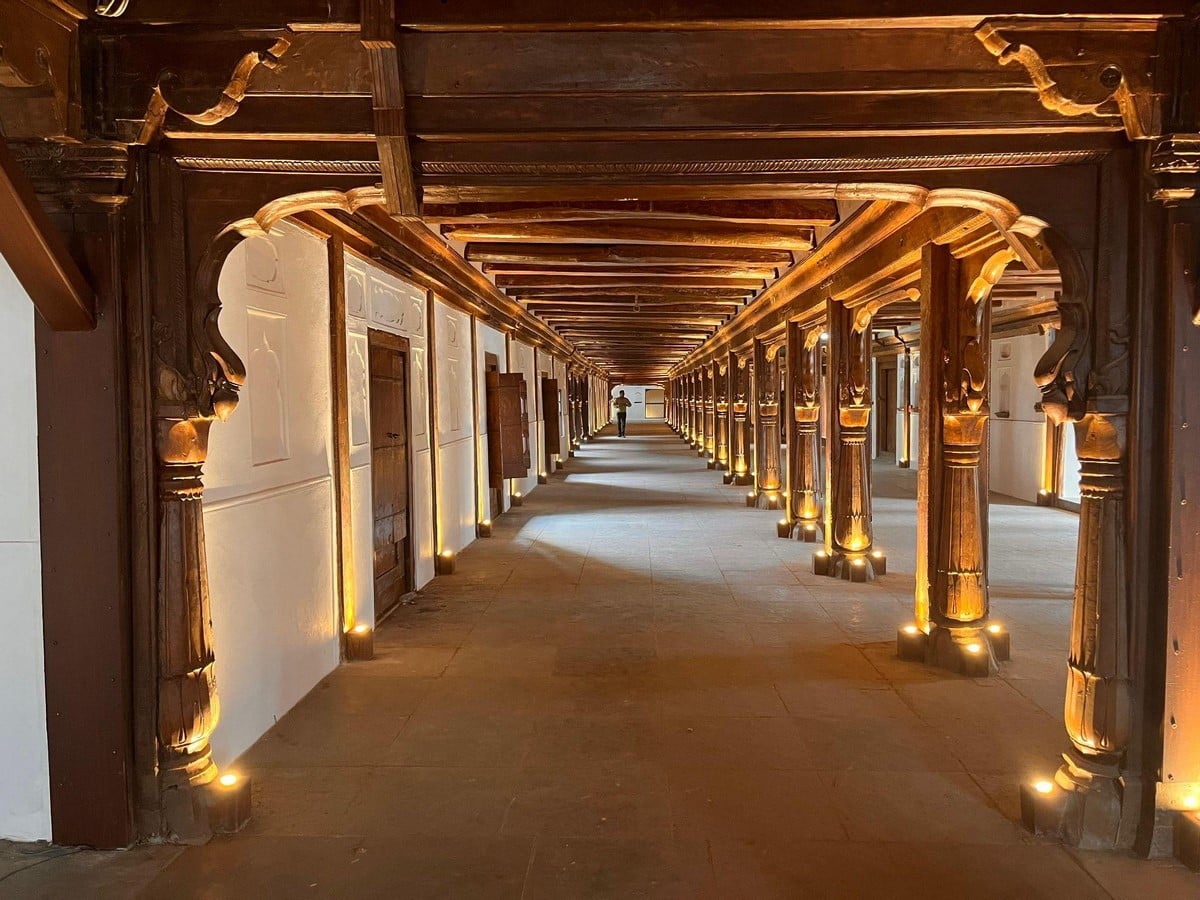
On either side, timber colonnades stand elevated on raised basalt plinths.
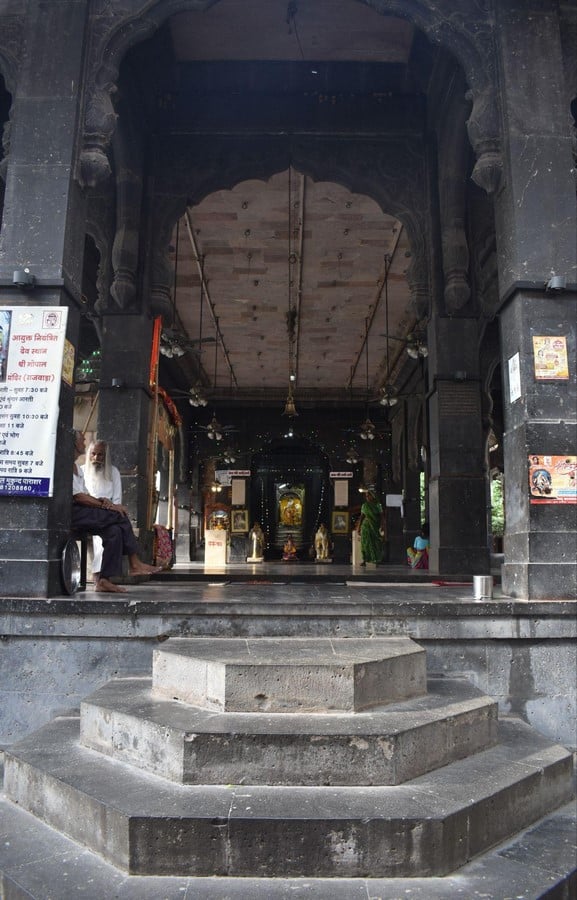
Moving ahead, the visitor gradually descends to the open courtyard before ascending once again to the temple’s Sabhamandapa, all along a perfectly aligned central axis that culminates at the Garbhagriha, where the marble idols of Devi Radha and Shri Krishna are enshrined.
So precise is this alignment that even a passer-by, standing directly opposite the entrance on the street, can glimpse the deities clearly without entering the complex.
A Subtle Pause
Once inside, the overall composition finally reveals itself.
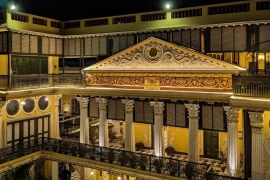
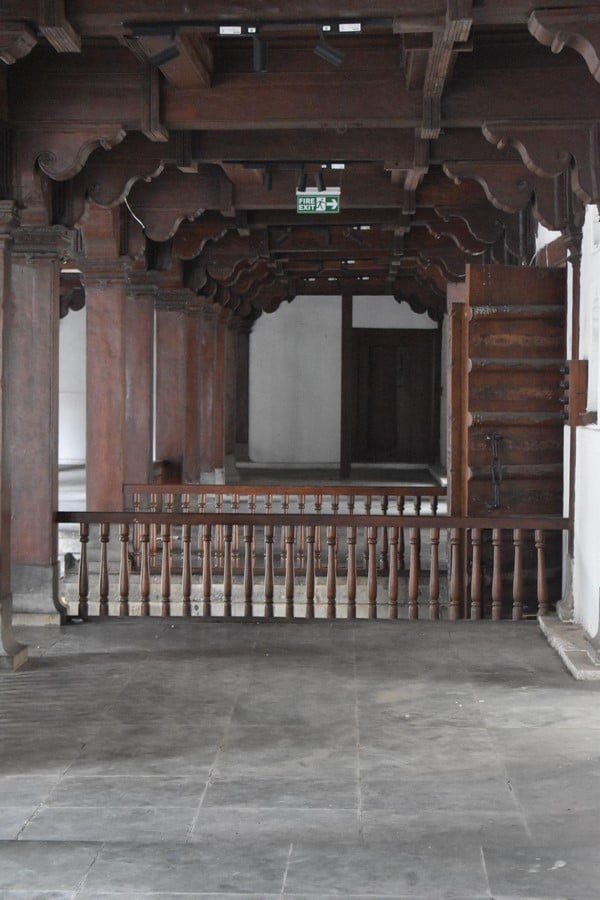
Standing at the heart of the courtyard is the black basalt temple, while three timber colonnades, rising to two floors and resting on raised basalt plinths, embrace the courtyard on three sides. Completing the fourth edge of the complex are two ancillary blocks that historically accommodated the Gopal Mandir Annakshetra, building a spatial composition that seamlessly integrated worship with community life and public welfare.
Intricately carved timber brackets animate the rhythm in these colonnades on the ground level, while the temple’s stone arcades frame the circumambulatory path around the sanctum, constantly offering new perspectives across the complex.
The carefully layered sequence of ascent and descent, open and enclosed spaces, light and shade creates an environment that feels remarkably soothing, quietening the bustling marketplace beyond its walls.
Thick masonry, stone and timber construction and semi-open corridors naturally temper the micro-climate, making the complex comfortable throughout the day.
It is here that Gopal Mandir reveals its greatest architectural achievement – not in monumental scale or elaborate ornamentation – but in its quiet ability to influence human behaviour.
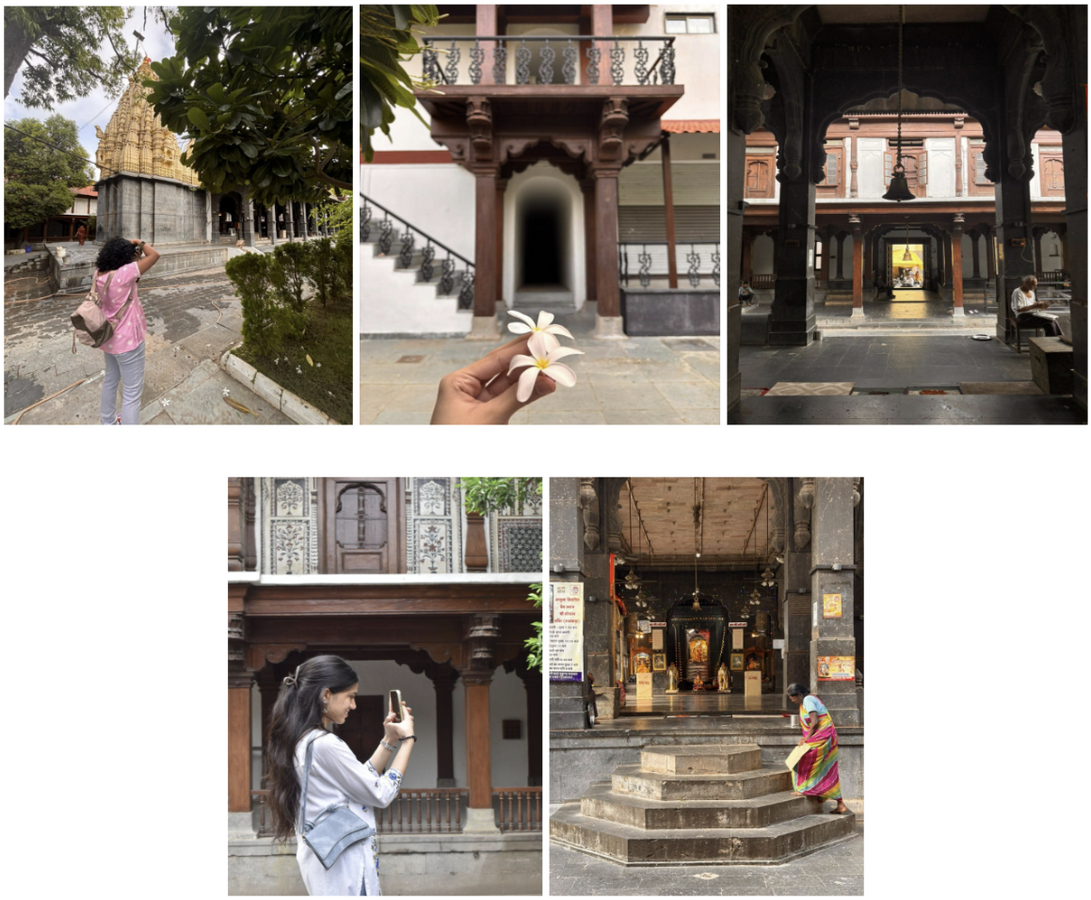
Families gather beneath the shaded colonnades, elderly devotees pause after aartis to sing devotional songs, children enliven the courtyard, and visitors instinctively slow down, allowing architecture to shape experience, almost without being noticed.
Hidden in Plain Sight
This account, however, is possible only because much of what once defined Gopal Mandir gradually disappeared beneath nearly two centuries of change.
For much of the nineteenth century, the temple complex remained deeply woven into the civic life of the Rajwada precinct.
Following India’s Independence and the accession of the Holkar State to the Indian Union, the administrative landscape of the city evolved, and so did the temple complex’s functions.
Parts of the historic Annakshetra were adapted to house the Rajya Printing Press, allowing the premises to continue serving the public in a different capacity.
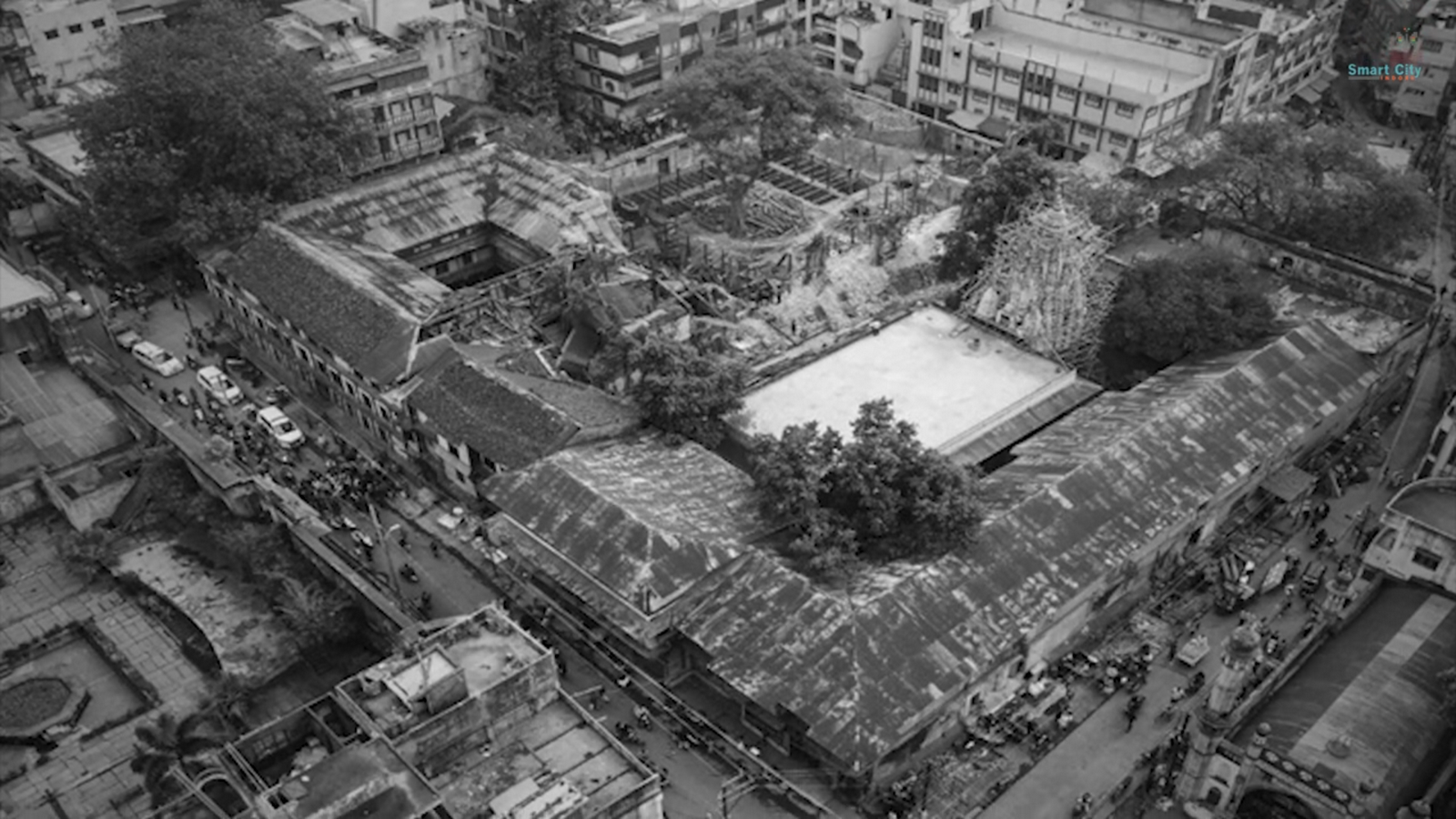
Unfortunately, the heavy printing machinery generated constant vibrations that weakened the structure’s traditional timber joinery, eventually contributing to its structural distress and partial collapse within the historic building.
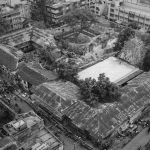
As the Rajwada simultaneously emerged as one of Indore’s busiest commercial districts, the temple’s surrounding edges were progressively occupied by more than 150 informal commercial establishments.
These changes reflected the precinct’s growing economic vitality, but they also obscured the visual presence of Gopal Mandir, to the extent that many lifelong residents remained unaware that a nineteenth-century Holkar temple complex stood behind the bustling marketplace.
Years of weathering, dilapidation, neglect and changing patterns of use slowly concealed, rather than erased, one of Indore’s most significant civic landmarks.
Restoration Beyond Conservation
The challenge, therefore, was never simply to restore a temple, but to recover the architectural, historical and civic significance of an entire complex that had gradually become obscured over time.
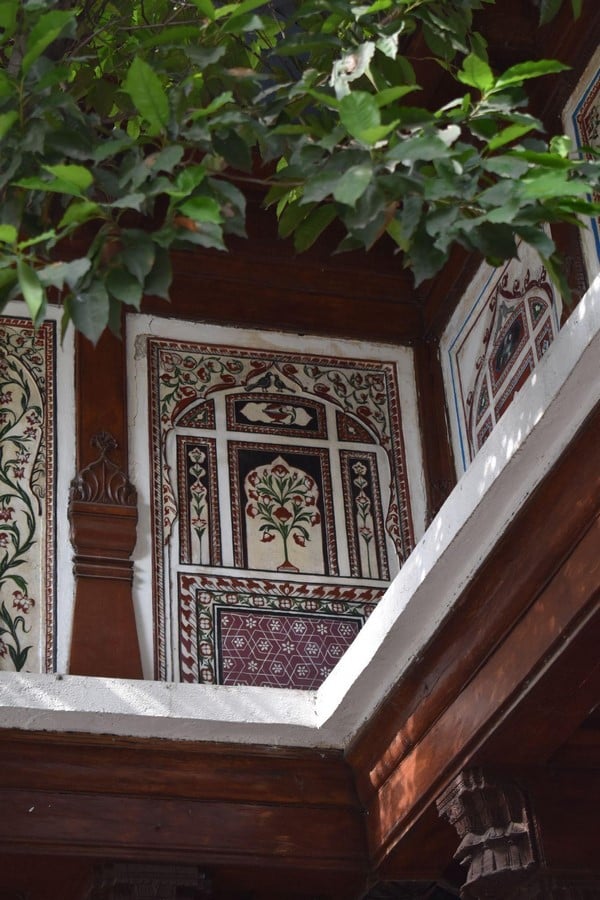
Undertaken by the local governing bodies (ISCDL and IMC), the restoration project approached Gopal Mandir not merely as a conservation effort, but as an opportunity to recover its architectural integrity through a careful synthesis of traditional craftsmanship and modern conservation science.
Spanning a restoration area of approximately 70,000 square feet, surviving timber members, basalt stone elements and decorative features were carefully retained and repaired, while traditional compounds prepared using chuna, gud, methidana, bel fruit and urad dal replaced the use of commercial cement.
Modern investigations, including ultrasonic testing, pulse velocity analysis and continuous crack monitoring, were thoughtfully combined with traditional techniques such as reinforcing roof slabs with inverted earthen pots to reduce structural load while improving thermal comfort.
Equally significant was the collaborative approach that shaped the project, bringing together architects, conservation specialists, traditional karigars, historians, engineers, archaeologists, elected representatives and local citizens.
More than 150 commercial establishments were rehabilitated within a newly developed shopping complex adjoining the site, safeguarding existing livelihoods while revealing the temple’s historic edges once again.
In doing so, Gopal Mandir emerged as an example of how conservation, governance and public participation can together restore not only a historic structure, but also a shared sense of civic ownership.
A Cultural Nexus
It is remarkable that Gopal Mandir’s story is not confined to the conservation of its historic fabric, and extends into re-imagining how the complex could continue serving the city in the twenty-first century.
Guided by the principles of adaptive reuse, spaces that had fallen into disuse were carefully transformed into contemporary public infrastructure while remaining rooted in their historic context.
The historic Annakshetra now houses the Gita Bhavan, a cultural and spiritual learning centre envisioned as a place where knowledge, dialogue and community life continue to flourish.
Developed within the restored complex, it includes a 550-seat state-of-the-art auditorium for cultural programmes, discourses and academic events, a 50-seat reading hall, a digital library containing literature on the Bhagavad Gita, Indian philosophy, yoga and culture, exhibition galleries, and access to digital archives and online learning resources.
Landscaped lawns, shaded seating and improved public amenities further encourage the complex to remain active beyond hours of worship.
Four years after the completion of its restoration, the success of Gopal Mandir is measured not only through conserved walls, but through renewed routines.
Worshippers, students, artists, historians, residents and visitors have once again made the complex part of everyday civic life, reaffirming that the most enduring heritage is that which continues to be lived.
Lessons in Utilitarian Architecture
Perhaps the greatest lesson Gopal Mandir offers contemporary cities is that successful public architecture is measured less by spectacle than by the everyday lives it continues to support.
Nearly two centuries after its construction, children still play in its courtyard, elderly residents gather beneath its colonnades, devotees return as part of their daily routines, and visitors instinctively linger within its quiet spaces. Few buildings remain this relevant for so long.
Its endurance lies in the fact that every generation has found a different reason to keep it alive.
For the Holkars, it embodied public welfare and civic life; for conservation professionals, it became a lesson in restoring authenticity; and for the people of Indore today, it stands as a reminder that heritage is preserved not through stone alone, but through continued use, care and collective memory.
In reconnecting architecture with its people, Gopal Mandir has restored far more than a historic monument. It has reaffirmed the enduring role of heritage as a living part of the city’s cultural identity
References
Smartcityindore.org. (2017). Smart City Indore | Significance. [online] Available at: https://www.smartcityindore.org/significance/ [Accessed 18 July 2026].
Safe, Inclusive, Resilient and Sustainable INDORE Towards INDORE MUNICIPAL CORPORATION. (n.d.). [online] Available at: https://uncrd.un.org/sites/default/files/8th-3r_ms-1-p2.pdf [Accessed 14 July 2026].
Indore Smart City Development Limited (ISCDL) (2022). Gopal Mandir. Youtube. Available at: https://youtu.be/iGPNqIO3Kuk?si=YTtK_m9_RhKjTEe4 [Accessed 17 July 2026].
Staff Reporter (2025). Indore News: CM Inaugurates State’s First Modern Gita Bhavan; Announces Construction Of Gita Bhavans In. [online] Free Press Journal. Available at: https://www.freepressjournal.in/indore/indore-news-cm-inaugurates-states-first-modern-gita-bhavan-announces-construction-of-gita-bhavans-in-every-city-of-the-state [Accessed 18 July 2026].
देवेश जायसवाल (2025). इंदौर में खुलेगा मध्य प्रदेश का पहला सरकारी गीता भवन, 550 सीटों वाला सभागृह और लाइब्रेरी तैयार. [online] News18 हिंदी. Available at: https://hindi.news18.com/news/madhya-pradesh/indore-madhya-pradesh-first-government-run-gita-bhavan-to-open-in-indore-local18-ws-d-9928226.html [Accessed 18 July 2026].
Khan, Z. (2026). A Journey to Revitalise a Heritage Icon_20251110_174012_0000. [online] Scribd. Available at: https://www.scribd.com/document/946717614/a-journey-to-revitalize-a-heritage-icon-20251110-174012-0000 [Accessed 14 July 2026].
TNN (2025). State’s first modern Gita Bhavan opened at Gopal temple complex. [online] The Times of India. Available at: https://timesofindia.indiatimes.com/city/indore/states-first-modern-gita-bhavan-opened-at-gopal-temple-complex/articleshow/125702520.cms [Accessed 14 July 2026].
Billore, Soniya. (2021). Cultural Consumption and Citizen Engagement—Strategies for Built Heritage Conservation and Sustainable Development. A Case Study of Indore City, India. Sustainability. 13. 2878. 10.3390/su13052878.
Deshpande, S. (2022). Heritage Of Indore: इंदौर का गोपाल मंदिर की छत की मजबूती देखने के लिए उस पर चलाया था हाथी. [online] Nai Dunia. Available at: https://www.naidunia.com/madhya-pradesh/indore-to-see-strength-of-roof-of-gopal-temple-of-indore-an-elephant-was-run-on-it-7569729 [Accessed 14 July 2026].
Ali, H. (2020). PHOTOS : इंदौर में दिसंबर से निखरे स्वरूप में देख सकेंगे गोपाल मंदिर की विरासत. [online] Patrika News. Available at: https://www.patrika.com/indore-news/gopal-mandir-renovation-in-indore-6455363 [Accessed 18 July 2026].
Smart Cities Mission (2024). The restoration of Gopal Mandir at Indore Smart City. Youtube. Available at: https://youtu.be/mLuHXTllsG8?si=ZRHkTojtMPJedCT- [Accessed 14 July 2026].
Philips Lighting (2025). Gopal Mandir. Facebook. Available at: https://www.facebook.com/watch/?v=1182584993572249 [Accessed 13 July 2026].
The Times Of India (2025). In charge officer, temple manager responsible for allowing marriage function in Gopal Mandir. [online] The Times of India. Available at: https://timesofindia.indiatimes.com/city/indore/in-charge-officer-temple-manager-responsible-for-allowing-marriage-function-in-gopal-mandir/articleshow/117214458.cms [Accessed 18 July 2026].
PTI (2025). Wedding at 200-year-old Indore temple inconveniences devotees; probe ordered – The Tribune. [online] The Tribune. Available at: https://www.tribuneindia.com/news/madhya-pradesh/wedding-at-200-year-old-indore-temple-inconveniences-devotees-probe-ordered/ [Accessed 18 July 2026].
Pandey, P. (2025). इंदौर में 193 वर्ष पुराने गोपाल मंदिर में विवाह, जांच के आदेश. [online] Nai Dunia. Available at: https://www.naidunia.com/madhya-pradesh/indore-gopal-mandir-indore-193-year-old-gopal-temple-rented-for-wedding-8375968 [Accessed 18 July 2026].
Sharma, S. (2024). GOPAL MANDIR INDORE. Youtube. Available at: https://www.youtube.com/watch?v=nP5vGRE5gXQ [Accessed 15 July 2026].
Indore Smart City Development Limited (ISCDL), Indore Municipal Corporation (IMC), Midas Touch Advertising and Malviya, D. (2026). Gopal Mandir Conservation Project | Indore’s Cultural Heritage. Youtube. Available at: https://youtu.be/9GUvKkwrJ5I?si=YW2WODGVVV9mu2XZ [Accessed 19 July 2026].