Cities today are not merely built environments; they are confluences of movement, memory, aspiration and contradiction. Walk through any contemporary metropolis and the signs are unmistakable. Migrant kitchens reinvent neighbourhood markets. Glass towers rise through capital that arrives and disappears faster than the people who inhabit them. Screens and images collapse distant cultures into the immediacy of everyday life. The city feels global and intimate at once, as if it is unfolding in multiple directions simultaneously. Architecture attempts to give this condition coherence, but the forces shaping it often lie far beyond the reach of physical form.
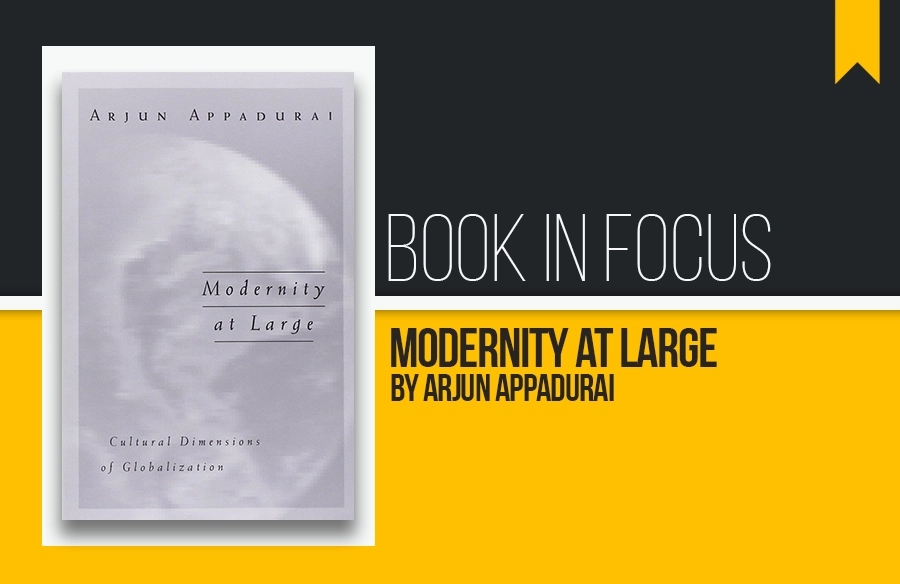
Modernity at Large: Cultural Dimensions of Globalization (First published in 1996), Arjun Appadurai’s seminal work on globalization and cultural flow, offers a language with which to understand this restless urban condition. Through his framework of ethnoscapes, technoscapes, financescapes, mediascapes and ideoscapes, he shifts attention from structures to movements. And within these movements runs an even more elusive thread: imagination. Not imagination as a private escape but as a shared and active force that motivates migration, shapes aspirations and continually remakes the city. Approaching the book through a spatial lens opens up a reading of Modernity at Large that speaks directly to architecture and urbanism. It positions the city not as a fixed design outcome but as the cumulative expression of circulating people and circulating dreams.
Modernity as a Condition of Uneven Movements
What Appadurai offers in Modernity at Large is a way to think about modernity without relying on the clichés that often dominate discussions of globalization. He moves past the simplistic story of the global overwhelming the local and instead presents a world composed of movements that are neither coordinated nor symmetrical. The forces shaping contemporary life do not march together. Technology accelerates while politics hesitates. People move even as borders tighten. Images proliferate even in the midst of material scarcity. Modernity, in Appadurai’s formulation, is a condition defined by these inconsistencies and imbalances.
This unevenness finds its most potent expression in the imagination. Appadurai argues that imagination today is not a solitary indulgence but a collective, world-making force. It drives people to migrate, to reinvent cultural practices, to form new solidarities, and to reach for possibilities that exceed their immediate realities. The book is filled with moments where individuals and communities respond to global forces not passively but with anticipation, creativity or resistance. A televised narrative can influence how a community sees itself. A rumour can redraw migratory routes. A shared story can bind a dispersed population into a coherent diasporic public. Imagination becomes a kind of agency, shaping lives as concretely as any economic or political structure.
Imagination and the City’s Invisible Currents
This perspective speaks quietly yet profoundly to how we understand cities. The physical city is the most visible layer, but beneath and around it lie the imaginative currents that Appadurai describes. A neighbourhood formed by migrants is shaped as much by the memories and futures they carry as by the buildings they inhabit. A skyline often manifests fantasies of global belonging as much as financial calculation. A street market invents its own rhythms through acts of improvisation that defy formal planning. These urban conditions are not adequately explained by design or economics alone. They emerge from negotiations between desires and constraints, between what people inherit and what they hope for.
Appadurai’s framework allows us to recognize these negotiations without reducing them to simple binaries. His view of locality reinforces this point. Locality, he argues, is not a static inheritance but a continuously produced achievement. In a globalized world, the local does not disappear; it is enacted through everyday practices that affirm a sense of place even as it is transformed by external influences.

Locality as a Daily Practice
This has significant implications for how we read urban life. It suggests that the vitality of a neighbourhood lies not in its resistance to global forces but in the ways its inhabitants reinterpret and reassemble their locality amid those forces. It also disrupts the fantasy of the universally designed city, pointing instead to the granular, lived practices through which people shape their environments. Throughout the book, Appadurai resists nostalgic thinking. He does not lament the loss of older worlds but questions whether such worlds were ever as coherent or insulated as we imagine.
Modernity generates new forms of attachment, new forms of publicness and new forms of identity that are no less meaningful for being hybrid or mobile. His case studies vary widely in geography and context, yet they are united by an insistence that people continually invent ways to inhabit modernity. It is not global forces alone that shape the present; it is the countless everyday acts through which individuals absorb, interpret or transform those forces.
Reading Modernity Through Its Textures
This, ultimately, is where the intellectual depth of Modernity at Large resides. The book is not simply a description of globalization; it is an exploration of its textures and contradictions. It shows how deeply global forces permeate everyday life, yet it refuses the fatalistic idea that such forces operate unilaterally. Appadurai preserves complexity without drifting into abstraction. He shows how cultural forms persist, mutate and sometimes flourish even under immense pressure.