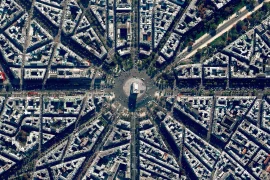
The theory we know all about architectural life is Pluto’s concept of complete and absolute harmony or innate beauty, the idea of the Renaissance that beauty in architecture is the proportions. What if beauty is relative and what if there is more to architecture than just beauty alone?

About Beauty
Hutcheson characterizes beauty as an intrinsic sensation that exists in every person rather than as an external quality in his 1725 essay “An Inquiry into the Original of Our Ideas of Beauty and Virtue.” In other words, absolute beauty is a characteristic of the human mind rather than an objective attribute. Hutcheson employed this technique to circumvent Lockean notions of sensation, referring to beauty as an internal sense rather than an outward response to what our senses detect. Another Irish philosopher, George Berkeley, sharply criticized these notions. Berkeley was a Lockean empiricist, but in contrast to other philosophers, he placed more emphasis on human reason and perception than on instinctive feeling or lofty ideas.
Also, people have argued about beauty being relative to our personal experience and often we as people have similar experiences and have similar philosophical makeup making us find similar things beautiful.

Empiricism and its impact on architecture
Term empiricism comes from the ancient Greek word emporia which directly translates to experience
In philosophy, empiricism is a theory that states that knowledge comes only from sensory experience, the best way to gain knowledge is to see, hear, touch feel, and sense things
It is also a fundamental part of the scientific method that all hypotheses and theories must be tested against observations of the natural world rather than resting solely on a priori reasoning.
The discipline of landscape architecture was the first to formally investigate this idea; even before Locke’s works, this field was expressing frustration with the highly controlled, Platonically-inspired gardening style that the British had taken up from the French tradition.
These French gardens’ entire philosophy and goal was to bring nature under control, tame it, and examine it mathematically and proportionately. Shaftesbury, like Pope, uses the word ‘nature’ in various ways, including ‘unnatural’ to describe a painter who strictly copies life, and ‘nature’ to describe the scene he copies. He believes that a painter’s genius is reflected in their understanding of the truth and unity of design and that they are unnatural when they strictly copy nature too closely.

Villa Capra by Andrea Palladio, close to Vicenza. The design, which combined the square and the circle, was founded on the idea of harmonic proportion. Buildings were able to interact with the “nature” of the outside world through the architectural copy of these “forms.”
This conflict with Shaftesbury’s remark that he will no longer resist the passion for natural things is due to a strong empiricism in his rationalist philosophy. He believed t by studying the particulars that compose the visible world can increase our knowledge of the world. A visual symbol of this truth could be a Palladian villa, based on the circle and square, set in a wild and irregular landscape. Shaftesbury’s ideas can be seen in illustrations at Mereworth Castle and Chiswick Houare based on Andrea Palladio’s design for Villa Capra at Vicenza.

Gordon Cullen is a member of the Neo-Empirical group. He explains the components of architecture and its surroundings that make it exciting. He believed that there should always be the possibility of a fresh perspective forming within a space and that we should be aware of alternative spaces all around us. The intricacy of the architectural design, together with the materials, textures, and layout, should highlight how distinctive it is. “The idea is to imply that there should be a pleasing amount of complexity and choice that, while remaining within a logical framework, permits the individual to choose his path.”

Form and function
When it comes to answering this precedence dilemma, theory and practice could differ. It is evident from practice that some architecture is primarily concerned with form, while others are primarily concerned with function and the performance of buildings, regardless of how this is defined (occupationally, economically, or in terms of durability, etc.). For example, the expectations placed on commemorative architecture in terms of symbolism and memorability usually lead to designs that prioritize form. Of course, one must also engage in a type of functionalist, or performative, reasoning to expect a monument or memorial to evoke memories and ideas about the past. The two components are difficult to tell Most of the discussion in modern architecture and design has likely centered around the idea that “form follows function,” which was popularized by architect Louis Sullivan, who was in charge of creating the Chicago skyscraper building in the late 19th century. Known for his contributions to the Gothic revival, Augustus Pugin essentially made the same argument. He opposed architectural elements that had no bearing on a building’s intended use. According to Sullivan, the idea was a normative form of a natural rule with a metaphysical foundation.
Whether architecture or at least certain buildings, is art is the main question—though not the only one—when it comes to aesthetics. Assuming that architecture may be considered art in some form, questions about the relationship between architecture as an art form and ethics can and have been posed. The question “Is architecture an art form?” also draws attention to the ethical concerns that architecture has.

Future of aesthetics in architecture
It appears that philosophical aesthetics enthusiasts are more interested in this subject than architects or architectural theorists. Still, it is essential to the architecture’s ideology. The specific definitions of what constitutes a piece of art, or the aesthetician’s or architectural theorist’s ontology, if any, will dictate how they answer this question. Almost all architectural creations would be disqualified as works of art if an artwork is defined as inherently non-functional.In a multidisciplinary subject, aesthetics is not the sole means of tying philosophy and architecture together. In addition, it is frequently the primary tool used to create and instruct architectural history, educate design and evaluate design results, and frequently, to place a student’s goals at “the cutting edge” of design. Being aware of how historical, social, and political circumstances affect how we view “design” necessitates being more accepting of the “aesthetic-ethical” exercises that the activity, as well as associated metaphors and techniques, frequently involve. These include a variety of prejudices and perspectives that make the built environment something that should be thought about, commented upon, and addressed—not only in the design studio but also more widely and consistently throughout society.
Citations:
Architecture Iconographic Encyclopædia of Science, Literature, and Art. Available at: https://www.c82.net/iconography/architecture
Aesthetic Experiences of architecture M AY C catapults us into a TR … Available at: https://www.researchgate.net/figure/1-Aesthetic-e-xperiences-of-architecture-m-ay-c-atapult-us-into-a-tr-anscendental_fig1_298662711
Lancelot Brown and the Serpentine style of Garden Design. Available at: https://www.gardenvisit.com/history_theory/library_online_ebooks/tom_turner_english_garden_design/serpentine_style_of_garden_design
Empiricism (2023) YouTube. Available at: https://www.youtube.com/watch?v=9tub7gwR20s
Mcmansionhell (2017) MMH does architectural theory part 5: Empiricism & the Picturesque (conclusion), Tumblr. Available at: https://mcmansionhell.com/post/161514422581/mmh-does-architectural-theory-part-5-empiricism