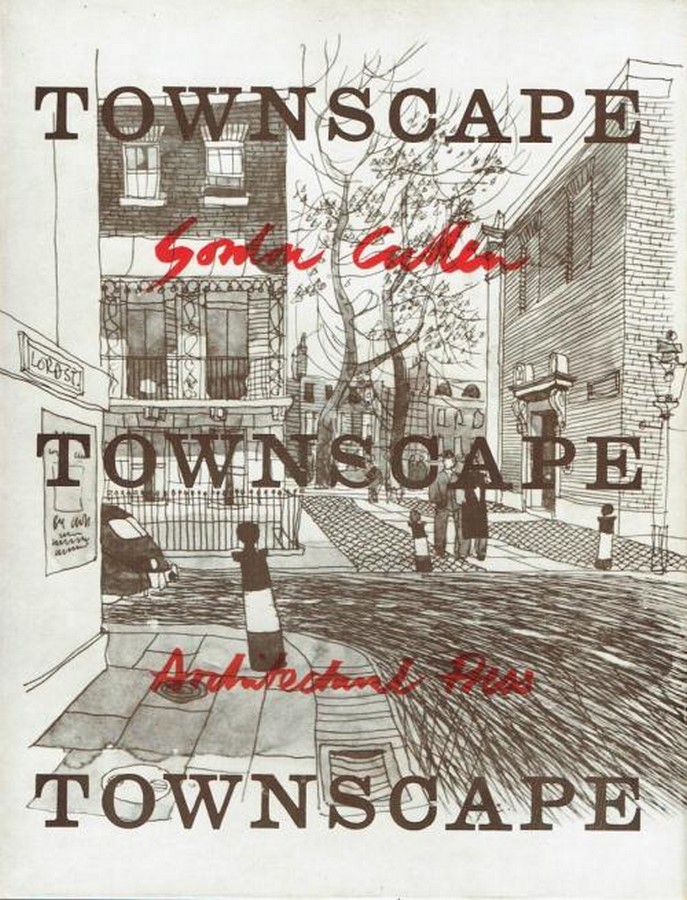
‘The Concise Townscape’ by British architect Gordon Cullen is a groundbreaking work in the field of urban design. The book introduced the idea of ‘townscape’ and threw light on the elements that make experiencing a city and it’s design visually interesting and enjoyable. By outlining how a person perceives and analyses a city, Gordon provided a comprehensive blueprint for creating cohesive and thoughtfully crafted towns in this book. The book was first published in 1961 and titled ‘Townscape’. Later shortened editions were published under the title ‘The Concise Townscape’.
About the Author
Thomas Gordon Cullen (1914-1994) was a British architect and urban designer, who dedicated his life to studying the improvement of urban environments, driven by a passion for creating cities that are more livable and enjoyable for inhabitants. During his writing career at the Architectural Review journal, he authored many influential editorials and case studies on the theory of urban design. These policies caused many improvements in the urban as well as rural environment of Britain during the 1950s and 60s.

He was also renowned for his architectural illustrations, which is evident in this book. His influence endures and he continues to inspire architects, urban designers and design enthusiasts with his distinct perspective of the urban landscape.
Book Review
As mentioned above, The Concise Townscape is a seminal work in the field of urban design that explores the art and principles behind the design and perception of the ‘townscape’. In this work, Cullen presented a new theory and methodology for urban visual analysis and design based on the psychology of perception, such as the human need for visual stimulation and the notions of time and space. Cullen’s writing captivates readers, drawing them into the fascinating realm of urban planning and architecture. He remarks that just as there is an art of architecture, there exists an ‘art of relationship’ among the various elements creating an urban environment- such as buildings, trees, nature, traffic, advertisements, and more; each of which has to be interconnected in a manner so that it unleashes some drama, one that he encourages the readers to observe. He further explains his points with numerous case studies and illustrations.

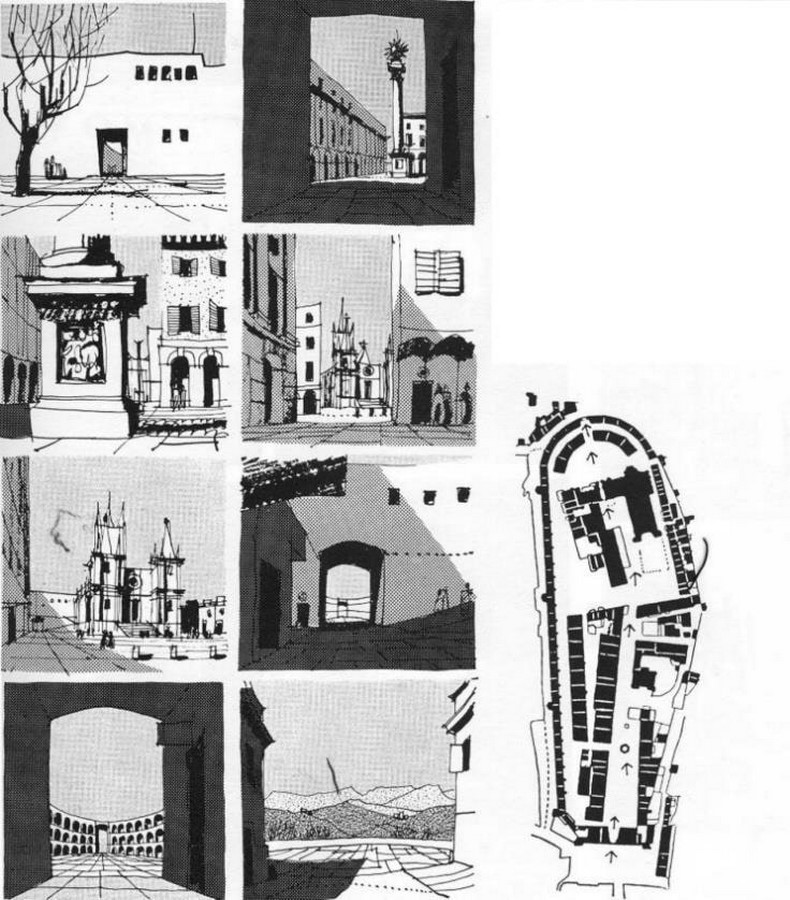
Another fascinating idea that Cullen introduced in this book is that of “serial vision,” which stands as a fundamental principle of his townscape philosophy. It is about creating a sense of continuity in the visual experience of a space, allowing people to feel connected to their surroundings. An example given in the book is that of a pedestrian; although he walks through the town at a uniform speed, the scenery of town is revealed in a series of jerks or revelations. Cullen called this ‘Serial Vision’, a concept that is widely used today by architects and urban designers alike. Designing from the perspective of the user is a common and effective design strategy.
A few other major highlights discussed in this book are as follows:
- Path and Place:
Paths delineate the pathways through which individuals move within a town, whereas places signify the areas where people pause, engage, and create memories. Paths are like veins of a city while the places are the soul that gives each city a personality and a sense of identity.

- Scale and Proportion:
Cullen emphasizes the importance of human scale in urban design. He discusses how the sizes of forms of all the elements- buildings, streets, public squares- affect a city’s identity and urban fabric.
- Character and Identity
The book explores how the unique character and identity of a town or city emerge from its architectural features, historical context, and the interplay of various urban elements. A visual story that is unique to each town. Adding that for designers to build structures that blend in harmoniously, a good awareness of the story and reputation of the town/ city is an added advantage.
- Order and Complexity
Cullen’s urban design philosophy emphasizes balancing order and complexity. While towns should be easily navigable with a clear layout, there’s also a need for a little complexity that brings about visual diversity adding to the urban experience.
He states that urban landscapes are dynamic and evolving and not formed by static things, but rather by varying requirements, cultural changes, and contemporary advancements. Majorly focusing on how people ‘visually perceive’ the urban landscape or ‘townscape’, he points out the tiny details the people as well as designers often overlook, and describes the art of relationship that ties them together, with intricate concepts like nostalgia, intimacy, punctuation, fluctuation, ‘hereness’ and ‘thereness’, to name a few. Since what we visually perceive affects our minds and memories, the psychological aspect is discussed as well. He explains how well-designed towns can positively affect people’s emotions, behavior, and well-being, along with the functional aspects. To put it in a nutshell, Cullen advised a holistic approach to urban design, considering both the aesthetic and functional aspects of the same through his book The Concise Townscape. Another much-appreciated fact about the book is the simplicity and poetic beauty of the language used. Compared with the first book ‘Townscape’, this book conveys a lot of concepts in a single spread- the text is summarized and brief, but very informative. Cullen’s whimsical sense of humor is reflected in much of the text.
Conclusion: The Legacy
As mentioned, the ideas put forth by Cullen in his book decades ago continue to inspire and motivate modern urban designers. His theories influence placemaking, transportation planning, and the emotional perception of cities. Like any work, this book has also gained many appreciations, but not without criticism. Critics argue that his human-centric design principles are overly idealistic and challenging to execute in some urban settings. They emphasize that there is little harmony between Cullen’s idealistic concepts and requirements of the real world. Some others assume the expense might be very high. Many stress that his ideas don’t entirely resolve the urgent social and economic problems in cities like the stark contrast of inequality, affordable housing, and access to basic services. Regardless of the criticisms, it is an inarguable fact that Gordon Cullen’s principles have influenced modern urban design to a great extent. The timeless concepts still serve as a beacon for urban designers to design towns that are an enriching and enjoyable experience for their inhabitants.
References
Cullen, G. (1961). The Concise Townscape. Great Britain: Architectural Press, Elsevier.
Donald, A. (2013). The Urban Design Library #7- Townscape. URBAN DESIGN (125), 6. Retrieved December 07, 2023, from https://www.udg.org.uk/publications/udlibrary/townscape
Lab, U. D. (2023, July 28). Book Review: The Concise Townscape by Gordon Cullen. Retrieved December 07, 2023, from Urban Design Lab: https://urbandesignlab.in/book-review-the-concise-townscape-by-gordon-cullen/
Images
- Cover of the 1961 book ‘Townscape’ by Gordon Cullen_© www.udg.org.uk
- Gordon Cullen_© Cullen Family Archive
- Various scales used for illustrations in the book_© Gordon Cullen, The Concise Townscape
- Set of sketches used to describe serial vision- the views as one move through a place_© Gordon Cullen, The Concise Townscape
- A sketch of a ‘popular square’ when describing the different types of squares in a town by Cullen_©The Concise Townscape