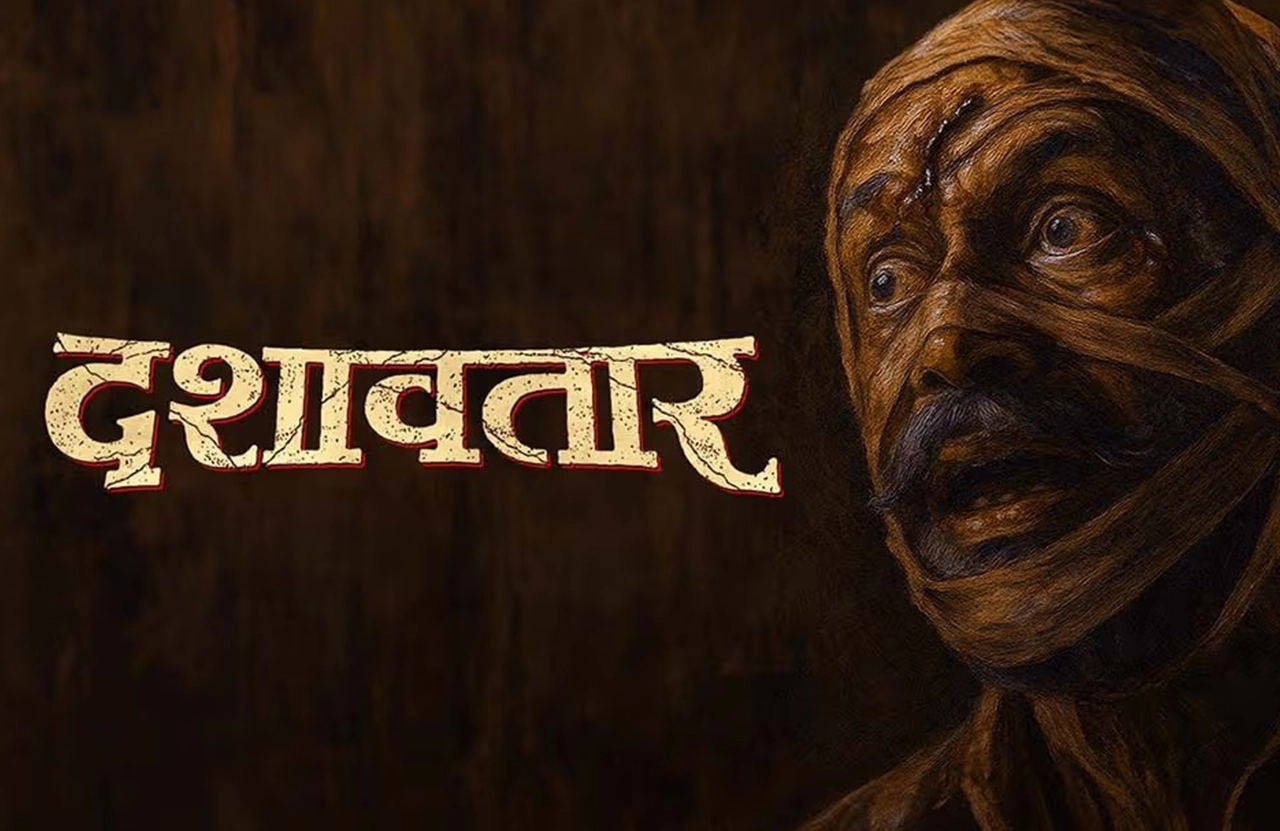
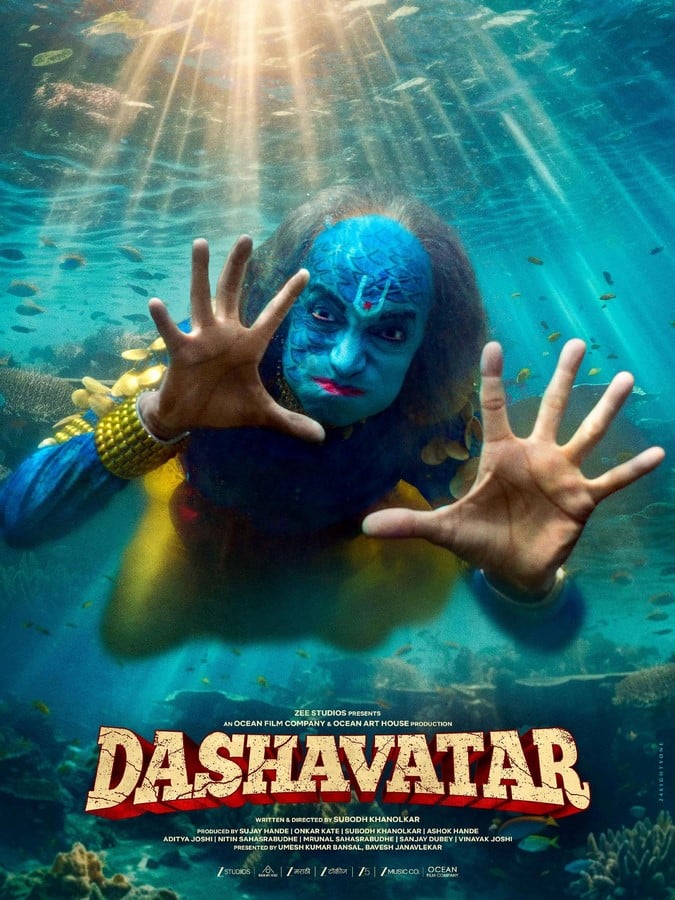
Cinema, at its most architecturally literate, does not merely use space as backdrop — it interrogates it. Dashavatar (2025), the Marathi suspense thriller directed by Shekhar Popatkar, belongs to this rare category. Set against the laterite hills and coastal forests of the Konkan region of Maharashtra, the film follows Babuli Mestri (played by the legendary Dilip Prabhavalkar), an ageing folk-theatre artist preparing his farewell performance of the traditional Dashavatar play — a ritualistic dance-drama enacting the ten avatars of Lord Vishnu. When a predatory mining mafia arrives to strip the community’s ancestral land, Babuli transforms his final performance into an act of cultural resistance, collapsing the distance between mythological narrative and lived ecological crisis. For the architectural viewer, Dashavatar is not simply a film about theatre or land rights. It is a sustained meditation on the spatial politics of the Konkan vernacular, the architecture of ritual performance, and the terrifying fragility of a landscape that is itself a heritage structure — one built not from stone but from centuries of human dwelling.
The Konkan Vernacular as Spatial Protagonist
The most architecturally immediate quality of Dashavatar is its profound rootedness in the built environment of the Konkan coast. Cinematographer Amol Gole’s camera treats the laterite-walled, Mangalore-tiled wada (ancestral home) of the Mestri family not as a film set but as a living document. The Konkan wada is one of the most climatically intelligent vernacular typologies on the Indian subcontinent: its deep verandahs (otee) mediate between the high-humidity exterior and the cool interior; its steeply pitched roofs with wide overhangs manage the extraordinary rainfall of the region — Konkan receives an average of 3,000 mm annually — while the laterite masonry, quarried locally, provides thermal mass and a muted ochre palette that reads as an extension of the soil itself. In Dashavatar, the wada is not merely a setting. It is the primary spatial argument of the film.
The film’s production design, led by art director Prashant Vichare, demonstrates a rigorous understanding of the spatial hierarchy of the traditional Konkan home. The tulsi vrindavan (sacred basil plinth) in the central courtyard, the deval (household shrine) recessed into the inner wall, the grain storage above the sleeping quarters — each element is spatially accurate and narratively deployed. When the mining mafia surveys the land from beyond the compound wall, the architectural threshold becomes the literal boundary between the community’s sacred domesticity and the extractive violence that threatens it. This is spatial storytelling of a high order, and it offers architectural practitioners a masterclass in how vernacular typologies encode social structure, climate response, and cultural memory simultaneously.
Equally significant is the film’s treatment of the devrai — the sacred grove that adjoins the Mestri property. The devrai is a forest patch preserved by tradition as the dwelling of the village deity, left untouched by agricultural and construction activity for generations. As an architectural concept, the devrai is perhaps Maharashtra’s most ancient form of landscape conservation: a community-maintained green infrastructure that predates every modern planning framework by several centuries. The threat posed by the mining company in Dashavatar is not merely economic. It is a spatial threat — the destruction of a sacred landscape typology that has no equivalent or replacement. The film’s central conflict is, in the deepest sense, an architectural one.
The Dashavatar Stage: Ephemeral Architecture and Ritual Space
The second major architectural register of Dashavatar is the performance space of the Dashavatar theatre itself. The traditional Dashavatar natak (play) is performed on a temporary wooden stage — a mandap — erected in the village maidan or temple courtyard during the monsoon and post-monsoon festival season. This stage is, in the strictest typological sense, a piece of temporary architecture: it is constructed, inhabited, and dismantled within days, yet during its brief life it is the spatial centre of the entire community. The mandap in Dashavatar is designed with ethnographic accuracy — the tiered performance platform, the elaborate fabric canopy, the oil-lamp illumination, and the painted backdrop depicting Mount Meru all correspond to the documented conventions of Konkan Dashavatar theatre as studied by folklorists including Dr. Prabhaker Marathe.
For the architectural reader, the mandap raises important questions about the spatial and cultural value of ephemeral architecture — questions that resonate with contemporary discourse around temporary structures, pop-up urbanism, and festival infrastructure. The Dashavatar stage is, unlike its contemporary counterparts, deeply embedded in its landscape: its orientation is determined by the deity’s facing direction, its materiality is sourced from local timber, and its audience arrangement — gender-segregated, caste-aware, and community-organised — reflects the social structure of the village. It is a perfect example of what the architectural theorist Juhani Pallasmaa has called “architecture of the senses”: a space defined not by its material permanence but by its capacity to produce an overwhelming phenomenological experience through light, sound, scent, and collective embodied presence.
The director’s decision to stage the film’s climax on this mandap is thus not merely a dramatic choice. It is an architectural argument: by bringing the real-world conflict of land, ecology, and community identity onto the traditional performance stage, Popatkar suggests that the mandap — like the wada, like the devrai — is a form of built heritage, and its destruction or disappearance would represent a loss no less significant than the demolition of a monument. Dashavatar asks its audience, architectural or otherwise, to recognise the heritage value of the intangible spatial practices that surround traditional performance: the gathering, the processing, the collective looking.
Landscape as Heritage: Mining, Memory, and the Politics of Conservation
The third and most politically charged architectural dimension of Dashavatar concerns the landscape itself as a heritage artefact. The Konkan region — stretching along the western coast of Maharashtra between the Western Ghats and the Arabian Sea — is one of the world’s biodiversity hotspots, and its geological substratum of laterite and basalt supports ecosystems, agricultural systems, and settlement patterns of extraordinary complexity. The threat posed by the mining mafia in the film is, in reality, a well-documented contemporary crisis: the laterite quarrying industry in Sindhudurg, Ratnagiri, and Goa has caused significant landscape destruction, undermining the hydrological systems, sacred groves, and agricultural terraces that have been maintained by Konkan communities for centuries.
From a conservation architecture perspective, Dashavatar is a rare mainstream cultural text that takes seriously the concept of cultural landscape — the idea, enshrined in the 1992 revision of the UNESCO World Heritage Convention, that landscapes shaped by the long interaction of human communities with their natural environment have heritage value equivalent to that of individual built monuments. The film implicitly argues what conservation professionals have been arguing in technical documents for decades: that the Konkan’s sacred groves, terraced ricefields, laterite-built villages, and folk performance traditions constitute an integrated cultural landscape, and that extractive industry destroys not merely ecology but architectural heritage in its fullest sense.
The film’s narrative resolution — in which Babuli’s theatrical performance becomes the instrument of community mobilisation and legal resistance — also carries an architectural lesson. Heritage conservation in India has historically been dominated by the monument paradigm: the isolated building, protected by an ASI notification, separated from its living context by a buffer zone. Dashavatar’s great spatial intelligence lies in its insistence that this paradigm is inadequate. The wada, the devrai, the mandap, and the agricultural landscape are not separable. They are a system, and the system’s survival requires not the conservation of any single element but the conservation of the relationships between all of them — the social, ritual, and ecological practices that keep the system alive. This is the central insight of cultural landscape conservation, and it is delivered here not through a policy document but through a Marathi suspense thriller.
What Designers Can Take From Dashavatar
Dashavatar is not a film that announces its architectural literacy. It wears its spatial intelligence quietly, in the grain of a laterite wall, in the angle of a verandah shadow, in the way an oil lamp turns a temporary wooden stage into a cosmological map. For architectural practitioners, it offers several specific and actionable lessons.
The first is the lesson of climatic intelligence embedded in vernacular form. The Konkan wada’s otee, its tiled roof, its courtyard and its orientation are not aesthetic choices but climate responses evolved over centuries. Contemporary architecture in the Konkan — and across coastal India — has largely abandoned these responses in favour of RCC construction with mechanical cooling. Dashavatar’s careful documentation of the wada as a living typology makes a quiet case for the relevance of this vernacular intelligence to contemporary sustainable design.
The second lesson concerns the architecture of the ephemeral. The Dashavatar mandap is constructed, used, and dismantled — yet it is more spatially and experientially rich than most permanent contemporary structures. Designers working in the growing field of temporary and event architecture would benefit from studying the spatial logic of the traditional mandap: its community-sourced materiality, its deep relationship to site and orientation, its capacity to generate intense collective experience without any of the resources that contemporary event design typically considers essential.
The third and perhaps most urgent lesson is political. As the film makes clear, architecture and landscape in the Konkan are under active threat from extractive industry, unchecked tourism development, and the replacement of laterite construction with imported materials. The architects working in this region — and by extension in any landscape of living vernacular heritage — have a professional responsibility to engage with the conservation of cultural landscapes that extends beyond the individual building commission. Dashavatar is a reminder that the built environment is a commons, and that its defence sometimes requires the same imaginative courage that Babuli Mestri brings to his final performance.
A Film Worth Watching Twice
Dashavatar (2025) is, on its surface, a suspense thriller about an old actor and a corrupt mining company. Beneath that surface, it is one of the most architecturally serious Indian films of recent years — a film that understands the built environment as a political, cultural, and ecological system rather than a visual backdrop. Dilip Prabhavalkar’s performance as Babuli Mestri is, as one has come to expect, a masterclass in restraint, and the film’s production design and cinematography together create a portrait of the Konkan vernacular that is worth studying frame by frame.
For the architectural community, it is essential viewing — not because it will teach design techniques or formal languages, but because it asks the question that every architect working in a context of living heritage must eventually answer: whose landscape is this, who has the right to transform it, and at what cost? Babuli Mestri’s answer is delivered in full costume, under oil lamps, on a temporary wooden stage. It is the right answer, and it is delivered beautifully.
References:
- Association for Asian Studies. (2023). Folk Performance and Sacred Space in South Asia. Journal of Asian Studies, 82(1), pp. 45–68. Available at: www.cambridge.org/core/journals/journal-of-asian-studies [Accessed: 25 June 2026].
- Bahulkar, S. (2005). Vernacular Architecture of the Konkan Coast. Journal of the Indian Institute of Architects, 70(3), pp. 22–28.
- Bhanage, M. (2025). Dashavatar Movie Review: A visual spectacle high on performances. The Times of India, 12 September 2025. Available at: www.timesofindia.indiatimes.com [Accessed: 25 June 2026].
- Dashavatar. (2025). [Film]. Directed by S. Popatkar. Maharashtra: Dashavatar Film Productions.
- Das, T. (2025). Kantara, Dashavatar to Lokah — how tribal representation in films is changing. ThePrint, 22 October 2025. Available at: www.theprint.in [Accessed: 25 June 2026].
- Gadgil, M. and Vartak, V.D. (1976). Sacred Groves of Western Ghats in India. Economic Botany, 30(2), pp. 152–160. Available at: www.jstor.org/stable/4253927 [Accessed: 25 June 2026].
- ICOMOS. (2005). Xi’an Declaration on the Conservation of the Setting of Heritage Structures, Sites and Areas. Paris: ICOMOS. Available at: www.icomos.org/images/DOCUMENTS/Charters/xian-declaration.pdf [Accessed: 25 June 2026].
- Karhadkar, A. (2025). Not just local: How the Marathi film ‘Dashavatar’ became a pan-India hit. The Hindu, 20 September 2025. ISSN 0971-751X. Available at: www.thehindu.com [Accessed: 25 June 2026].
- Maharashtra Tourism. (n.d.). Konkan Region — Cultural and Heritage Overview. [online]. Available at: www.maharashtratourism.gov.in/destination/konkan [Accessed: 25 June 2026].
- Marathe, P. (1998). Dashavatar: The Folk Theatre of the Konkan. Pune: Maharashtra Rajya Sahitya ani Sanskriti Mandal.
- Ministry of Environment, Forest and Climate Change, Government of India. (2013). National Biodiversity Action Plan. New Delhi: MoEFCC. Available at: www.moef.gov.in [Accessed: 25 June 2026].
- Pallasmaa, J. (2012). The Eyes of the Skin: Architecture and the Senses. 3rd ed. Chichester: Wiley.
- Popatkar, S. (dir.) and Prabhavalkar, D. (perf.). (2025). Dashavatar [Film]. Maharashtra: Dashavatar Film Productions.
- Ranade, A. (2006). Stage Music of Maharashtra. New Delhi: Sangeet Natak Akademi.
- Tirodkar, A. (2025). Dashavatar Marathi Film: Konkan’s Ecology vs Development Battle. Frontline, The Hindu, 27 September 2025. Available at: www.frontline.thehindu.com [Accessed: 25 June 2026].
- UNESCO World Heritage Centre. (1992). Operational Guidelines for the Implementation of the World Heritage Convention: Cultural Landscapes. Paris: UNESCO. Available at: whc.unesco.org/en/guidelines [Accessed: 25 June 2026].
- Western Ghats Ecology Expert Panel. (2011). Report of the Western Ghats Ecology Expert Panel [Gadgil Report]. New Delhi: Ministry of Environment and Forests, Government of India. Available at: www.moef.gov.in/sites/default/files/wg-23052012.pdf [Accessed: 25 June 2026].
Rethinking the Future | Movie / Show Review | Architectural Review | Dashavatar Marathi Cinema, 2025