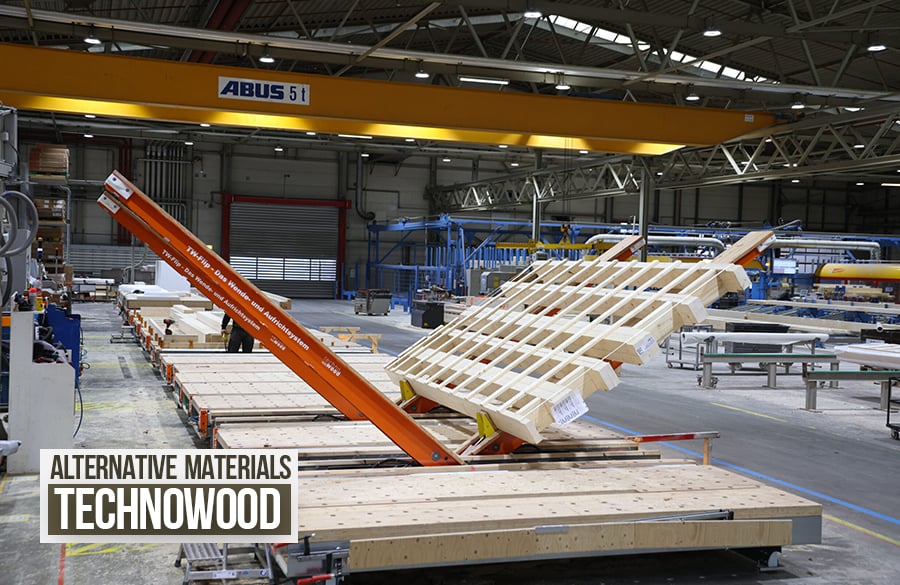
Today, with the rapid evolution of the architectural profession, the demand for sustainable and eco-friendly materials has never been greater, and designers are compelled to “innovate” against environmental responsibility. As temperatures rise around the globe and natural resources dwindle, architects must find an exciting and responsible way to balance the two. Technowood is an innovative material, one that combines the look and feel of natural wood with the strength and resilience of modern composite materials.
Technowood is far from just a new engineered product, but it is also something more of a bridge between tradition and technology that promises a future where construction doesn’t compromise the planet. It marks a change-over toward conscious sustainable design and pushes the boundaries of how people conceive their building materials. But what really is Technowood? How is it produced, and what makes it so intriguing for architects all over the world?

What is Technowood?
At first glance, Technowood looks and feels like natural timber. Rich grains, tactile texture, and organic warmth conjure the timeless appeal of wood that has been part of construction for centuries. But at first glance that promise lives on as a hybrid material designed to outperform its more traditional counterpart in both durability and sustainability.
Technowood is derived from the thin veneer of natural timber that is placed over the high-tech aluminium or composite substrate. This enables architects to gain the aesthetic of natural wood and benefit from its superior strength, weather resistance, and lightweight property of aluminium. Only a fraction of the amount of wood that would otherwise be utilised is required in making Technowood, which significantly reduces logging requirements and consequently the general environmental impact of construction projects.
However, although Technowood looks and feels like wood, the truth remains that it is much more than that. Having a hybrid configuration, the basic essence of Technowood is not only to mimic the aesthetic and tactile qualities of wood but to exceed them. Buildings can carry the aesthetic of wood without its associated disadvantages—rot, warping, vulnerability to termites, and frequent maintenance. To cut off all these aspects, Technowood offers architects a material that is as low-maintenance as it is sustainable.
Production Process and Factors in Sustainability
The production process is one of the most important sustainability aspects of the product from Technowood. Starting with timber veneers sourced from certified sustainable forests, laminating them onto a base of either aluminium or composite in eco-friendly adhesives, makes for a product that retains all the beauty of natural wood but reduces the embodied energy inherent in traditional wood production to a great extent.

Embodied energy The total amount of energy which is required for harvesting, production, transportation, and installation of a material. Technowood uses much less wood, so much less energy goes into processing wood to supply the needs of a project or structure. In contrast, aluminium certainly takes a lot to produce, but it never degrades, hence aluminium can be recycled as many times as the supply is wanted; thus, life cycle energy of Technowood is much less than regular wood.
Additionally, carbon emissions are lower in the production stages of Technowood as opposed to the exploitation and processing of massive natural timber, hence its impacts on greenhouse gas are lower. This alone puts it ahead and promising for a material in this fight against climate change, especially on building and construction industries, an area responsible for a large percentage of global carbon emissions.
Durability Meets Aesthetic Appeal
Strength is one of the main advantages of Technowood. Natural timber is beautiful but a nightmare to maintain over the years. Exposure of natural timber to the weather may cause warping, fading, cracking, and ultimately, rottenness. All these apprehensions are ruled out by the composite base of Technowood since it is watertight and shows high resistance to environmental stresses.

Technowood is also fire-resistant, which is always a concern factor where wildfires might occur or in cases with strict fire safety requirements. It’s lightweight, hence easier to install, thereby lowering labour costs and construction time. Technowood still manages to offer the warmth and elegance architects have come to love about natural timber while still being a product of such advanced engineering.
Applications in Architecture
These have opened their doors to several architectural projects. Technowood can be applied in any kind of architectural design, starting from commercial buildings to residential houses and even public infrastructures. For example, Zorlu Center in Istanbul, a mixed use development with an attempt to achieve sleekness and modernity along with a reduced environmental footprint by using Technowood cladding. This material helped in the unification of visual attractiveness pertaining to wood with structural benefits as concerning aluminium, thus creating a dynamic and sustainable façade that can withstand the varied climate of the city.

Another important project that comes to mind is the Wind Towers in Dubai. There, the company was well utilised for shading systems and exterior cladding. Technowood Light and Resistant Properties Against Harsh Weather Conditions, proved to be the perfect solution for such surfaces in a city with high values of heat and sunshine: it provided ornate wooden finishes while offering solar protection. Technowood represents a very practical but also aesthetic choice where the skies touch the earth, realising an insurmountable dream.
Technowood is also very suitable for smaller house building projects. The Eco-Friendly Villa in southern France is the epitome of how Technowood may breathe warmth and natural grace on a cold modern structure-all from strict sustainability perspectives. The villa’s designers held back Technowood cladding in the exterior for true blending into wooded settings with minimal environmental footprint due to its construction process.
Future of Technowood in Sustainable Architecture
Technowood continues to lead the pack when it comes to innovation. It represents a material that can serve as an answer to architects who are looking for a product which can combine performance and sustainability in one. Its less embodied energy, significant minimal impact on the environment, and low requirements for maintenance make it a perfect choice for projects pushing for the green certification like LEED or BREEAM. Due to the integration of both traditional and modern design, Technowood can be used in most varied applications ranging from façades and cladding to shading systems, decking, and even interior finishes.

Regarding sustainable urban development, because the style of housing will be one that coexists with nature rather than depleting resources, this style from Technowood becomes a pathway for architects regarding what can be done today.
Mixing wood’s timeless appeal with modern composites, with their durability and sustainability, makes one rethink building for the future.
A Spellbinding Alternative
In short, Technowood represents a revolution in the design thinking of an architect: innovation and sustainability hand in hand. It dares architects and designers to dream anew in terms of material usage, think beyond limitations, and live instead with reduced impact on the earth. In many ways, Technowood can be considered to be more than a mere building material; it is a vision of what architecture can be when one gives equal importance to beauty, functionality, and sustainability.

In a world where the call for sustainable solutions is more persuasive than ever, materials such as Technowood give us a glimmer of hope. As architects, engineers, and designers increasingly depend on alternative materials, the future of construction is not only more efficient but in harmony with the environment we strive to protect.
Technowood doesn’t build structures; it builds tomorrow.