The recent passing of master Frank Gehry at the age of 92 on December 5, 2025, marked a moment of quiet reflection across the architecture/design community. With the recent loss, Gehry’s work feels even more important to revisit. His projects were never just about design but also about how people think about cities, spaces, creativity, and materials. His legacy shows us that architecture doesn’t always have to behave, but can simply be expressed. Known for his association with Deconstructivism, He transforms buildings into dynamic forms that appear fluid and alive.
Numerous architects solve problems, and some architects ask better questions about what a building is permitted to express, what a city is permitted to dream, and what the relationship between a human body and a constructed space is permitted to become. Frank Owen Gehry was, without question, the second kind.
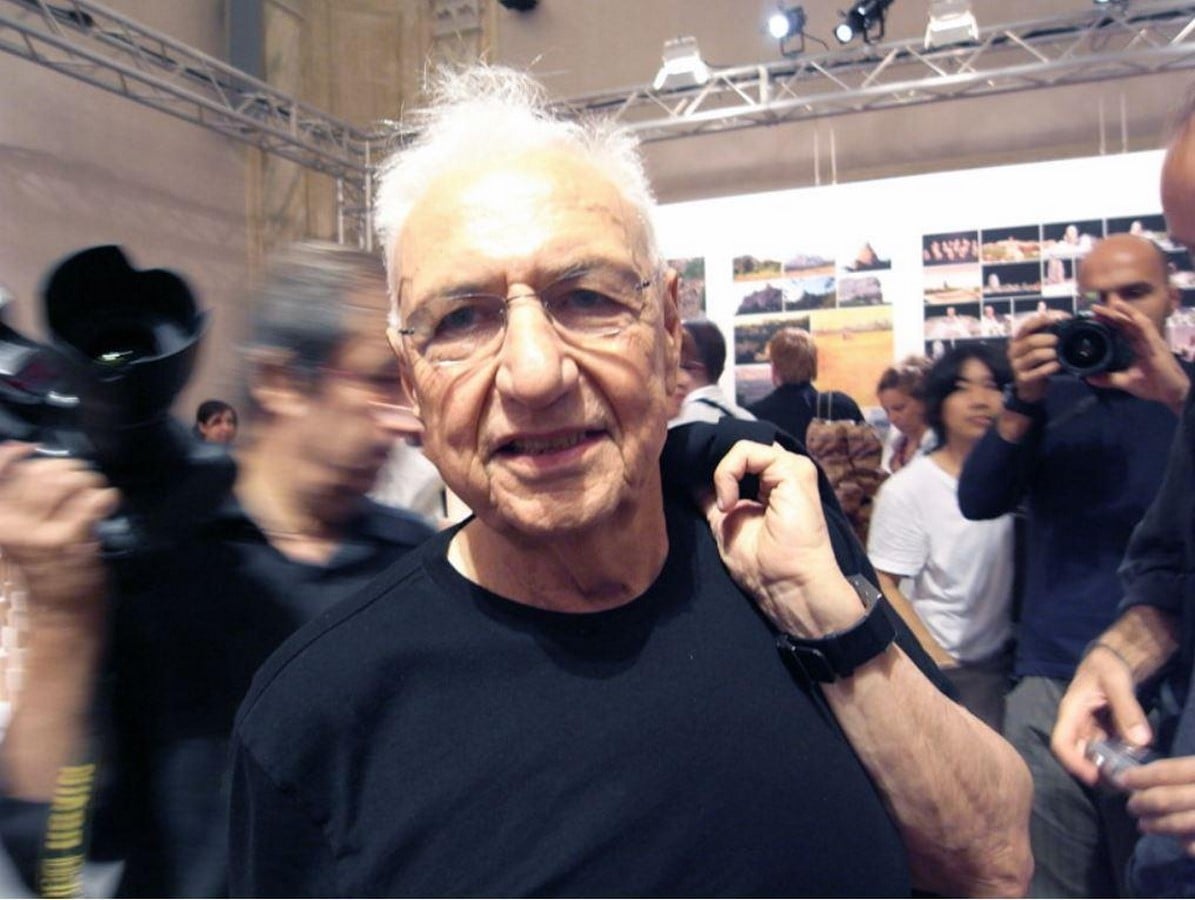
Born in Toronto in 1929, Gehry grew up spending long hours in his grandfather’s hardware store. It was his grandmother who encouraged him in various creative endeavors, and with whom he built small city models out of scraps of wood. He spent time drawing with his father, and his mother introduced him to the world of art. As he himself says, “So the creative genes were there.”
Before his name became associated with iconic structures, Gehry’s early encounters with ordinary materials like metal fragments, imperfect forms, and discarded objects quietly shaped the way he understood design. He learned not to see things as they were, but as what they could become.
The Beginning: Gehry Residence, Santa Monica.
Before the titanium and the concert halls, there was a house that confused almost everyone.
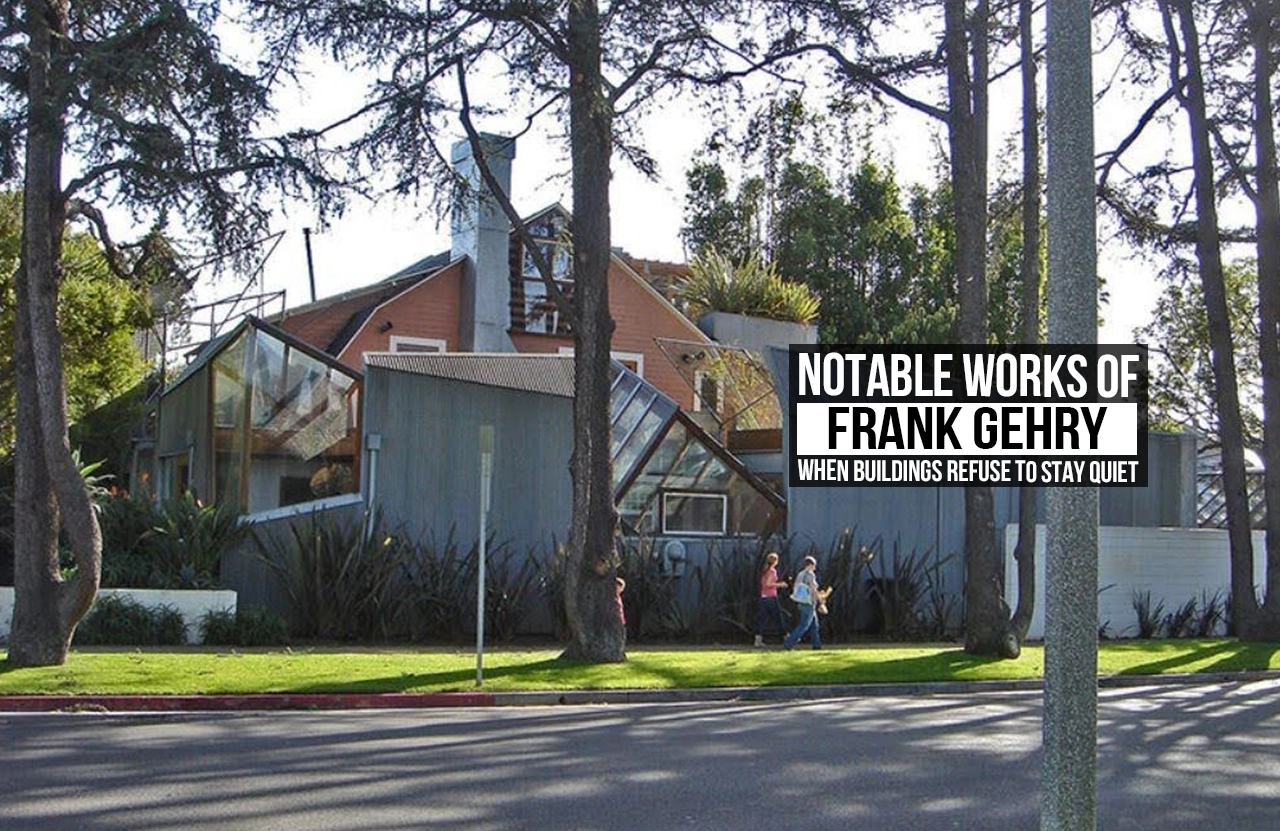
In 1977, Gehry bought a modest house in Santa Monica. What he did next was not renovation. It was more like an argument, a loud, physical, unapologetic argument with every idea about what domestic architecture was supposed to be. He wrapped the existing house inside a new structure made of corrugated metal, chain-link fencing, plywood, and glass.
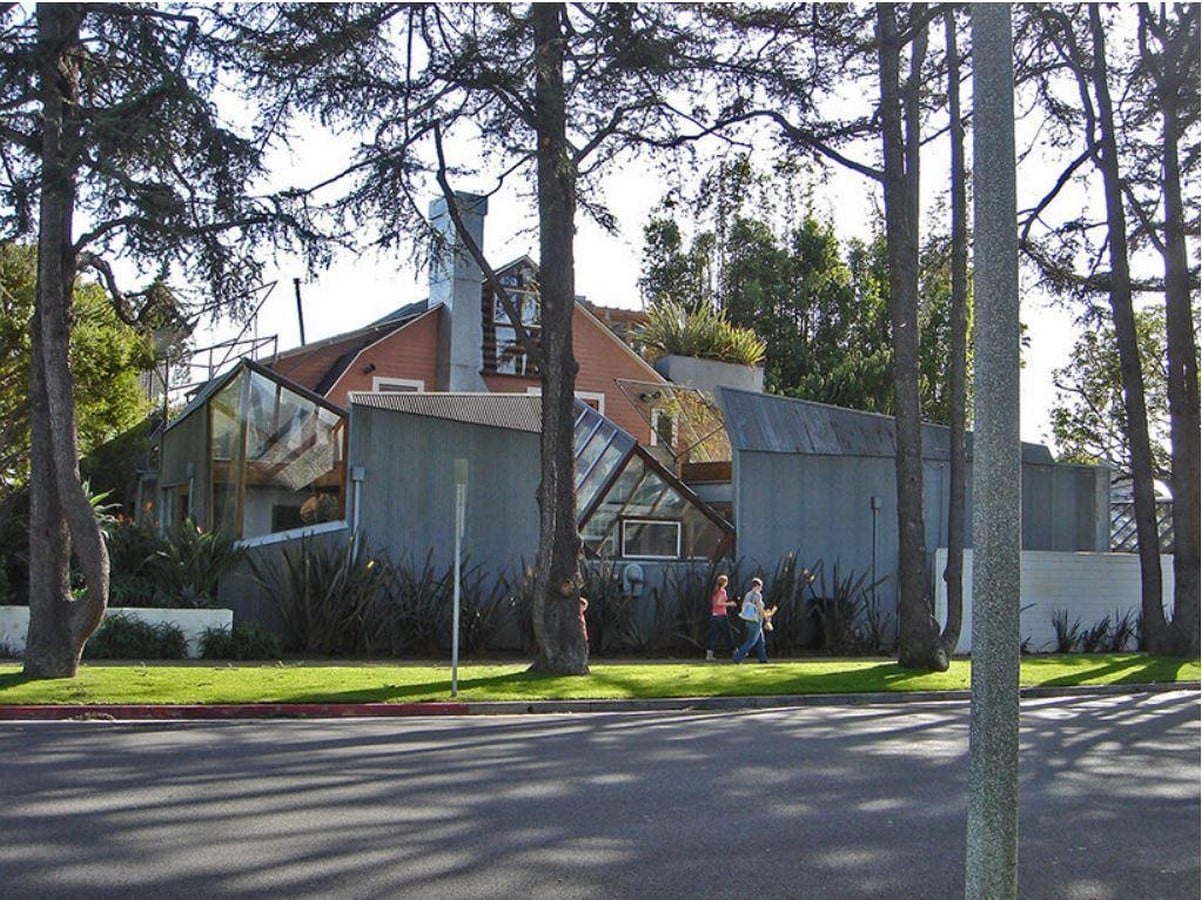
This project became the foundation of Gehry’s philosophy. He challenged the idea that houses needed to be clean, neat, and predictable. By breaking the traditional image of a home, he introduced a new way of thinking about architecture as experimentation. He left the original pink house deliberately visible inside the new one.
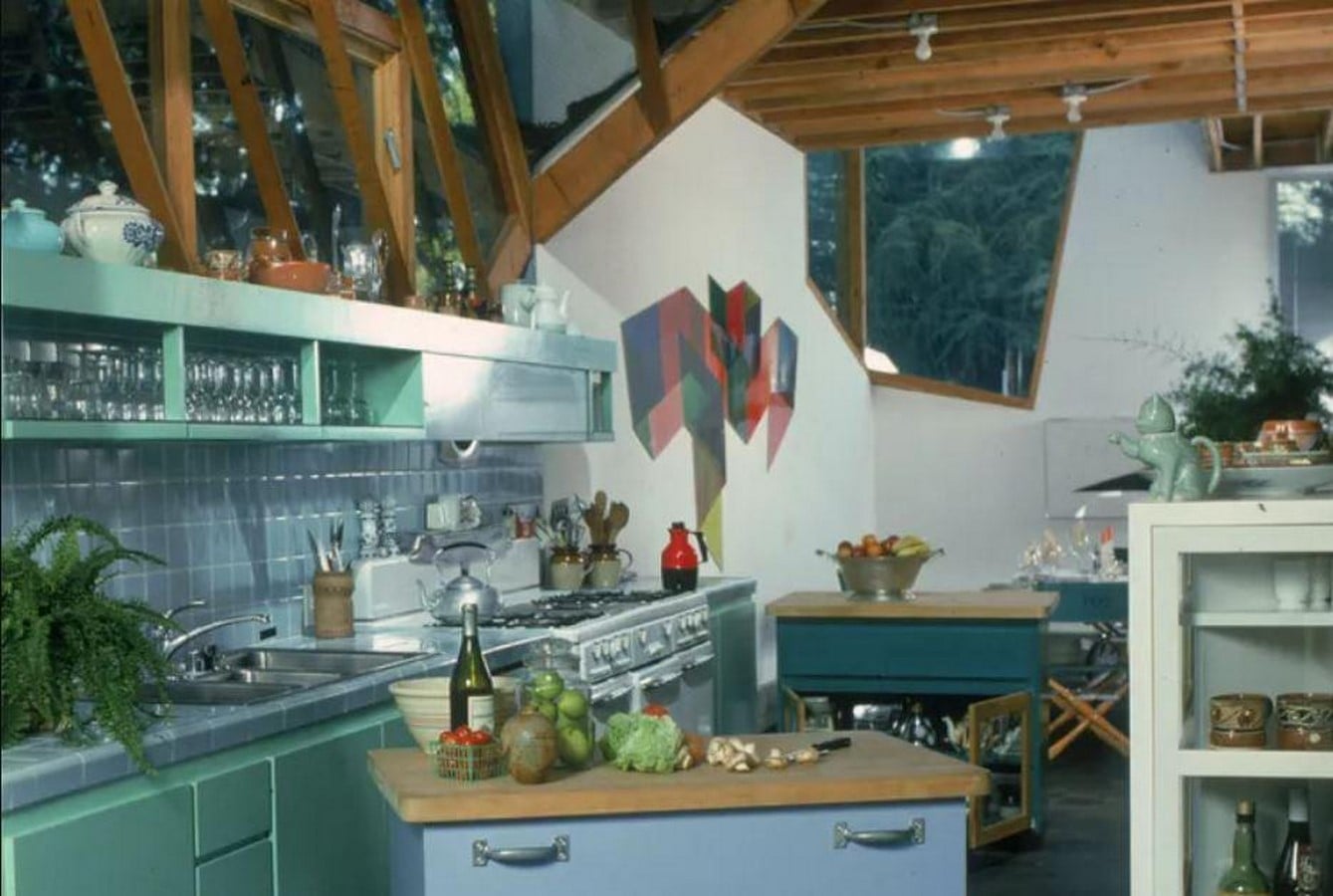
Architecturally, the house is a composition of additions rather than replacements. The geometry is intentionally fragmented and non-orthogonal. Walls don’t align cleanly, corners feel unresolved, and volumes intersect in unexpected ways. Instead of symmetry, Gehry explored the collision and overlap of forms.
Structurally, the project is quite simple at its core, the original load-bearing system of the bungalow remains functional. The additions are relatively lightweight, acting more as an independent layer rather than a heavy structural intervention. This contrast between a stable core and a chaotic exterior is what gives the project its conceptual strength.
A Museum that saved a city: Guggenheim Bilbao
The Guggenheim Museum in Bilbao is perhaps Gehry’s most celebrated work, often credited with transforming the city’s economy and global identity. Designed with titanium panels that reflect light dynamically, the building appears to shift form depending on the viewer’s perspective. Its fluid geometry rejects traditional symmetry, creating an architectural language that feels almost organic.
Some buildings arrive quietly, earning their place over time. When it opened on October 18, 1997, on the banks of the Nervión River in a Basque city that had been struggling for decades after the collapse of its industrial economy, the building did not merely open, it transformed the entire area. This project introduced the idea of the “Bilbao Effect,” where a single iconic structure can revitalize an entire urban region.
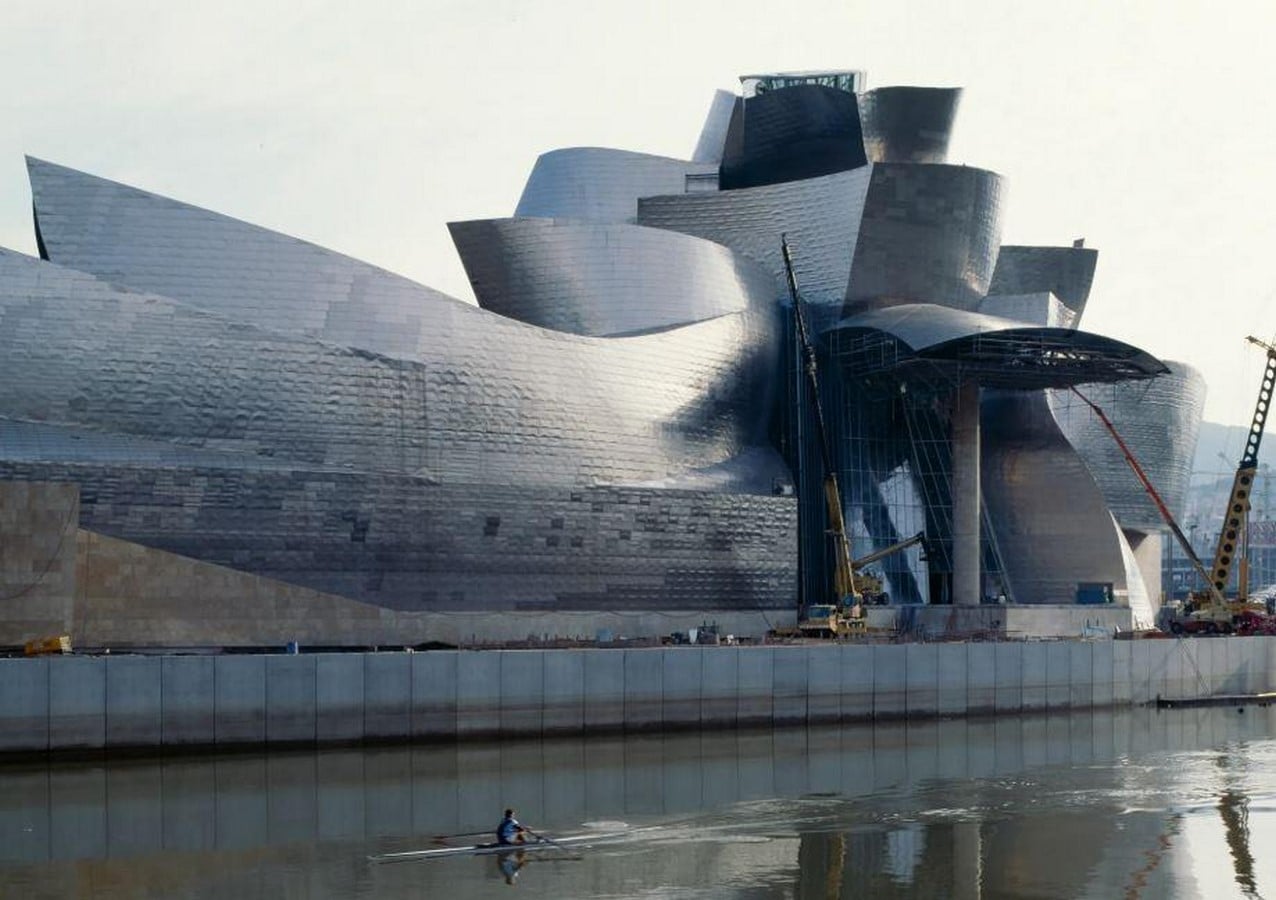
The Guggenheim Bilbao is clad in approximately 33,000 panels of titanium, each one unique, each one custom-cut, each one installed by hand in a three-dimensional puzzle that took two years to complete. Gehry had chosen titanium after pinning a sample outside his office and watching how it responded to daylight over time, how it shifted from silver to gold to rose depending on the weather and the hour. The panels are extraordinarily thin, applied with a locked seam method that creates a gentle, almost biological undulation across the surface. The building seems to have scales, not panels. It seems to breathe.
He described the curves as intentionally random and designed specifically to catch the light. The construction of this scale and form was very complex at the time, thought to be nearly impossible. Then Gehry’s team adopted CATIA software, originally developed for aerospace engineering. Every curve, every panel, every structural connection was mapped in three dimensions before a single piece of steel was cut. The museum was completed on time, a fact that remains remarkable for a building of such geometric complexity.
When Music Became Architecture: Walt Disney Concert Hall
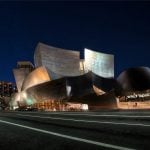
The Walt Disney Concert Hall in Los Angeles reflects Gehry’s ability to merge performance and architecture. Its stainless steel exterior curves dramatically, resembling frozen waves or unfolding petals. Inside, the design prioritises acoustics, proving that expressive form can coexist with technical precision.
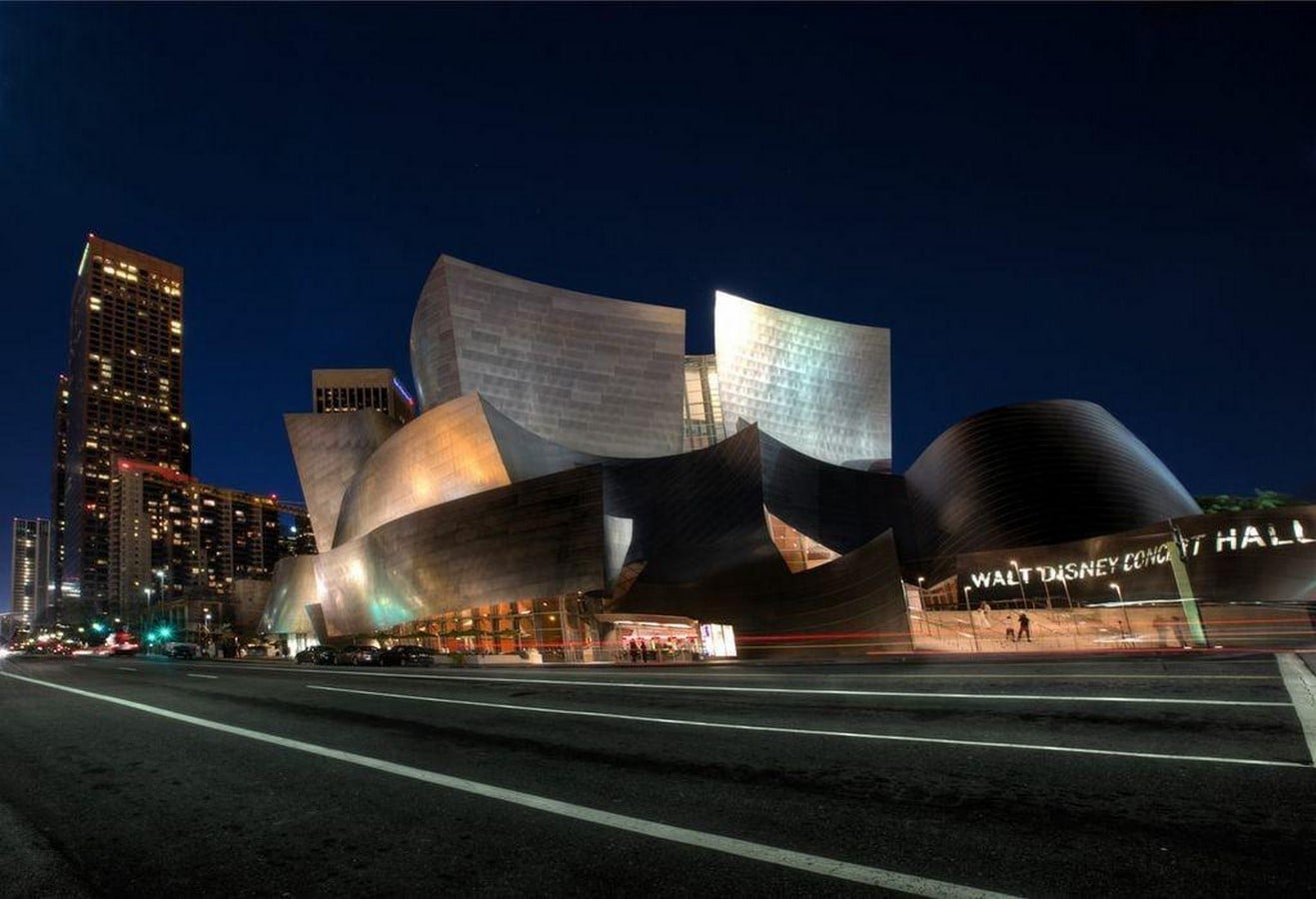
The Walt Disney Concert Hall in Los Angeles stands as a clear example of Frank Gehry’s ability to merge sculptural expression with performance-driven design. Its stainless steel exterior is composed of sweeping, curved surfaces that resemble unfolding petals or waves in motion, creating a dynamic visual identity that shifts with light and perspective. The building resists any fixed reading, it appears constantly in motion.
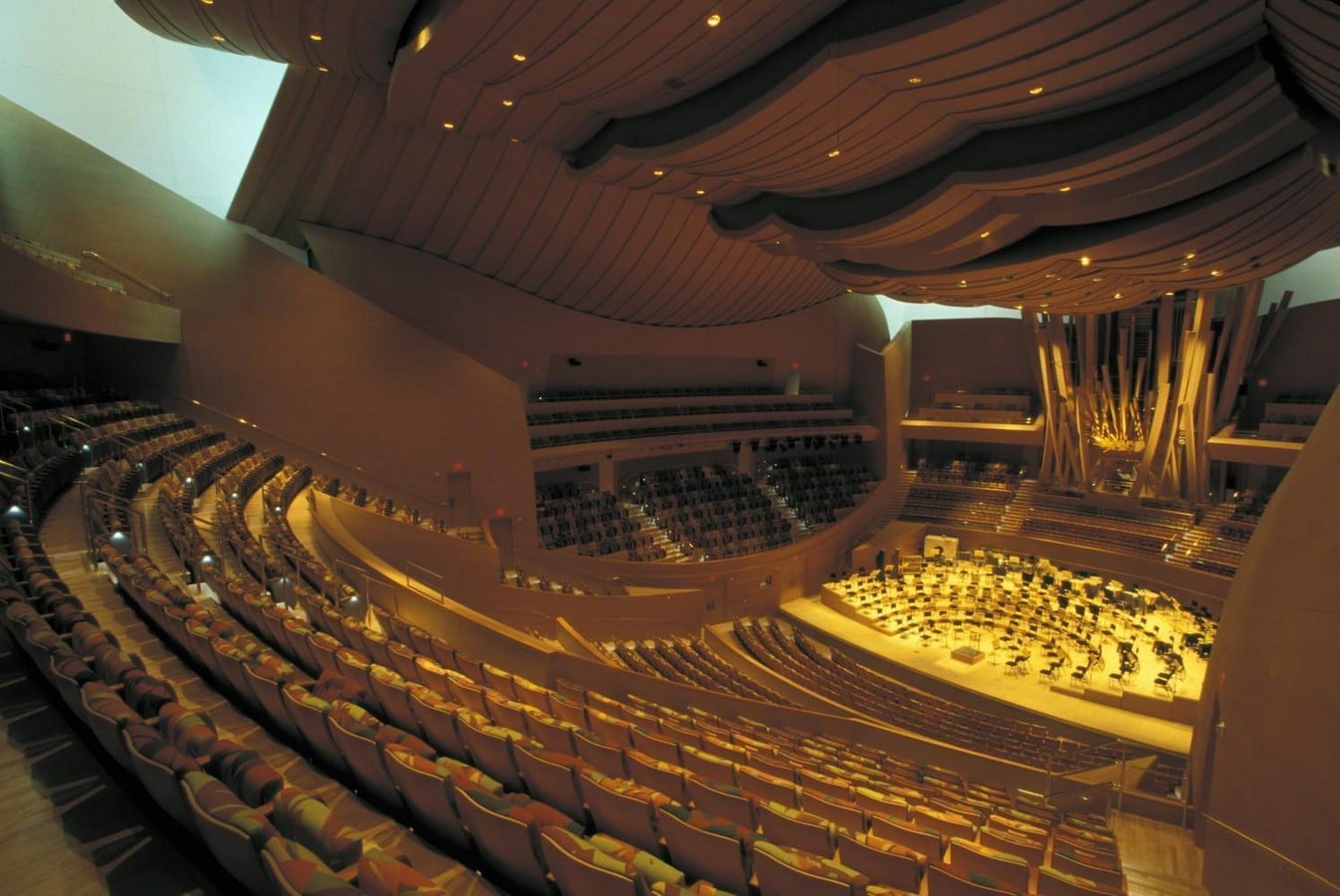
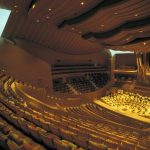
Beyond its expressive exterior, the interior is meticulously designed for acoustic precision. The auditorium follows a vineyard-style seating arrangement, allowing sound to travel evenly across the space. Warm timber finishes and carefully calibrated surfaces enhance sound quality, proving that complex form can coexist with technical performance. This project highlights Gehry’s ability to balance artistic freedom with functional responsibility.
Two Buildings, One Dance: The Dancing House
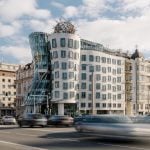
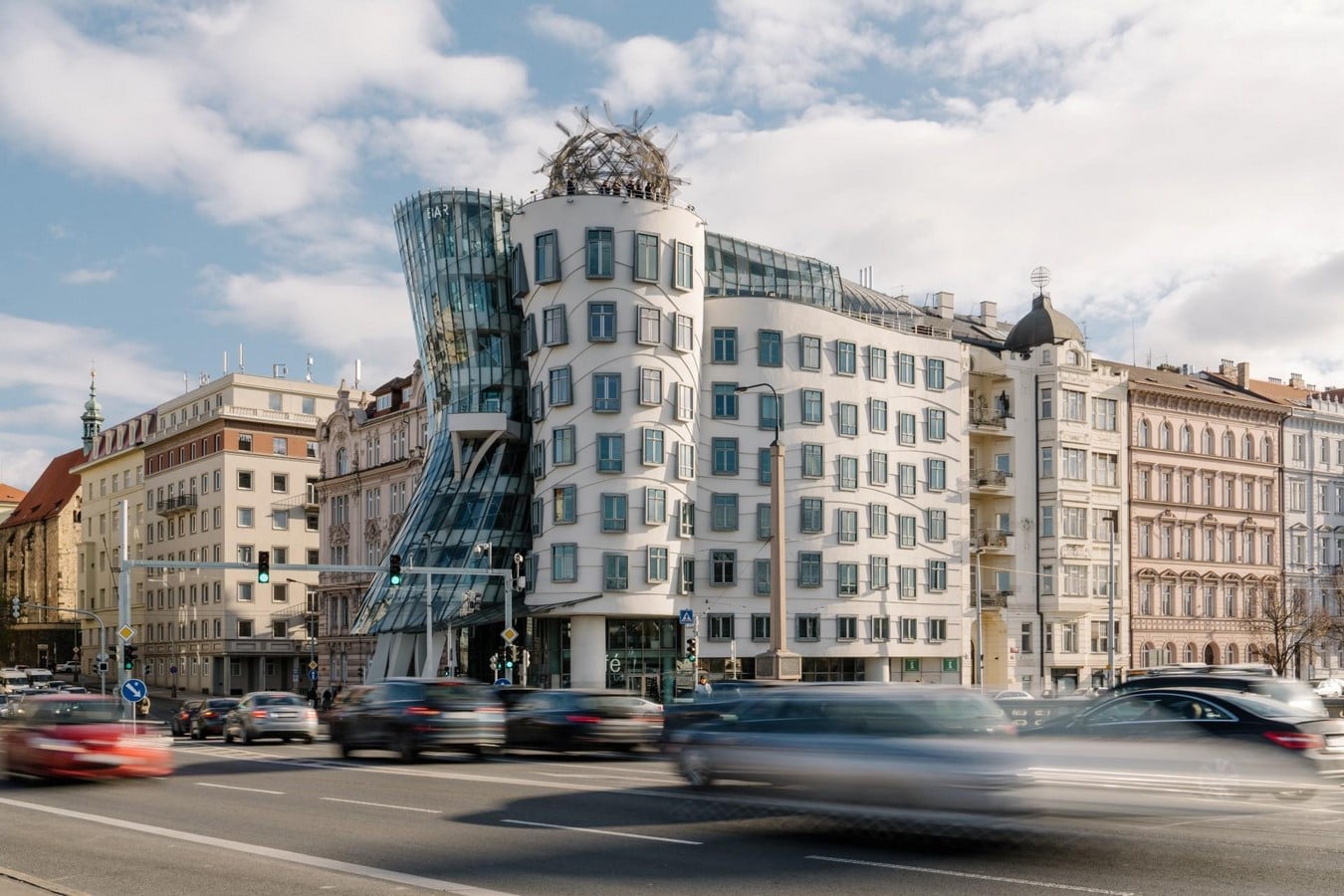
In Prague, Gehry designed the iconic Dancing House, a structure that visually represents two figures in motion, often referred to as “Fred and Ginger.” The building is composed of two contrasting volumes: one rigid and rectilinear, the other fluid and curvilinear. This deliberate contrast creates a sense of movement, as if the structure itself is mid-dance.
The glass tower curves inward while the adjacent solid mass maintains a more stable form, producing a dialogue between stability and motion. Structurally, this is achieved through a combination of concrete framing and a non-linear facade system. Set within a historically rigid urban fabric, the building stands out not as a disruption, but as a reinterpretation of context, introducing dynamism into an otherwise static streetscape.
Where It All Started: Vitra Design Museum
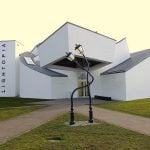
The Vitra Design Museum represents an early exploration of Frank Gehry’s architectural language. The building is composed of intersecting white volumes, cubic and curvilinear forms that twist, overlap, and extend beyond conventional geometry.
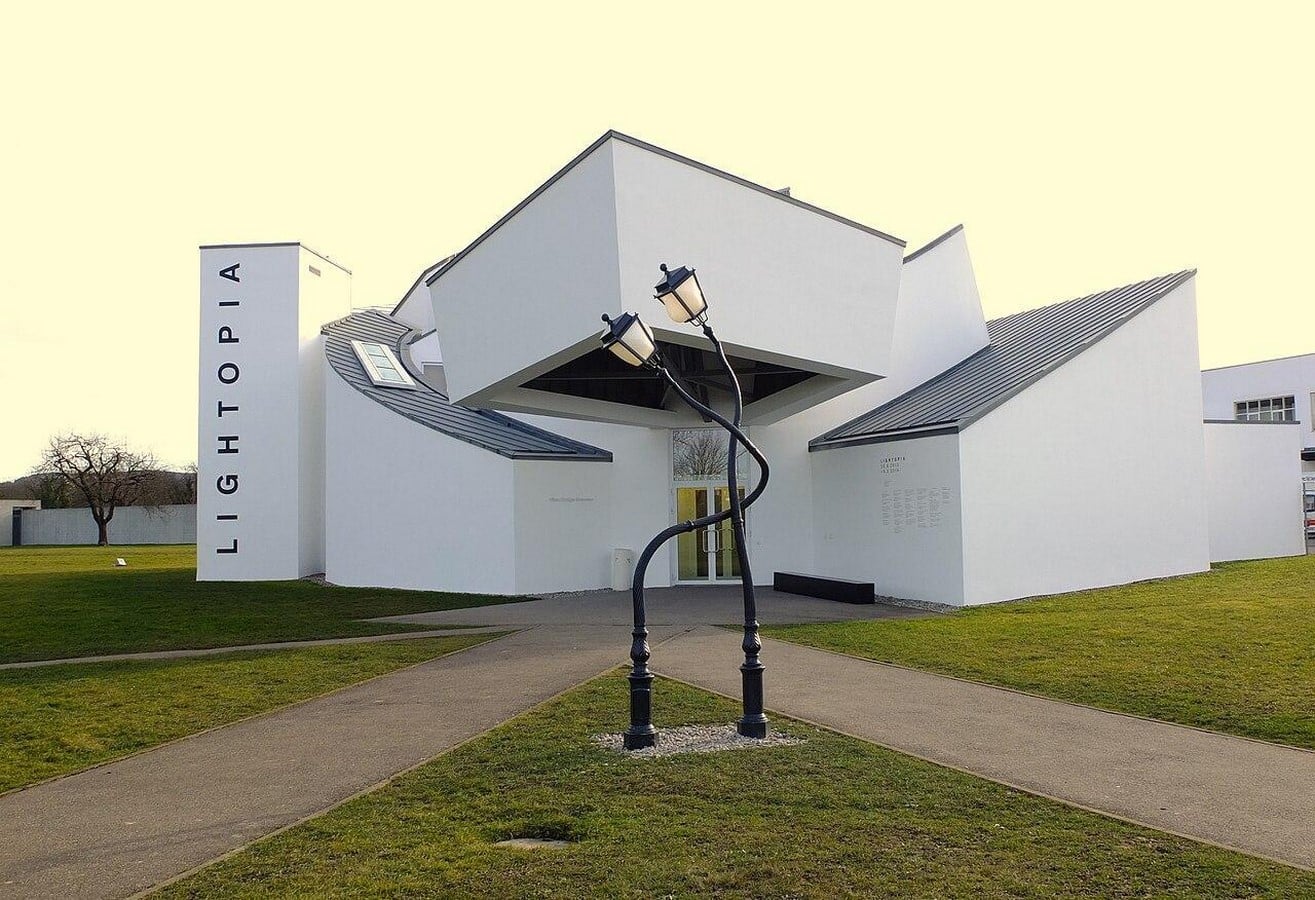
Its plastered surfaces emphasize light and shadow, allowing the form to shift visually throughout the day. Internally, the spatial arrangement reflects this fragmentation, with galleries unfolding through irregular volumes and varied ceiling heights. Circulation is non-linear, encouraging movement that feels exploratory rather than predetermined.
While structurally straightforward, the building introduces ideas of controlled fragmentation and sculptural composition. It serves as a conceptual starting point, where Gehry begins to move away from traditional orthogonal design toward a more expressive and experimental architectural approach.
This way of thinking carried into his architectural journey, where stability was often replaced with movement and rigid geometry gave way to fluid expression. His work reflects a continuous exploration of form, material, and imagination, demonstrating how temporary ideas and experimental approaches can transform into lasting architectural language. In this sense, Gehry’s buildings do not simply occupy space, they challenge it, reshape it, and invite people to experience architecture differently.
The works of Gehry redefine architecture as a form of artistic expression rather than mere construction. His buildings challenge traditional ideas of form, structure, and function, demonstrating that architecture can be both experimental and impactful. Through projects that range from museums to concert halls, Gehry continues to push boundaries, proving that the built environment can be as dynamic and imaginative as the people who inhabit it.
References:
- Getty Research Institute (n.d.) Frank Gehry exhibition accessibility. Available at: https://gehry.getty.edu/accessibility
- ThoughtCo (n.d.) A closer look at Frank Gehry’s house. https://www.thoughtco.com/a-closer-look-at-rank-gehrys-house-177994
- Wikipedia (n.d.) Frank Gehry. https://en.wikipedia.org/wiki/Frank_Gehry
- Time (2002) Frank Gehry: Architect of the Guggenheim Bilbao.https://web.archive.org/web/20120118051935/http://www.time.com/time/magazine/article/0,9171,997295-2,00.html
- Archisoup (n.d.) Frank Gehry: Biography and works.https://www.archisoup.com/frank-gehry
- First In Architecture (n.d.) How to develop architectural conceptshttps://www.firstinarchitecture.co.uk/how-to-develop-architectural-concepts/
- Bellamy, W. (n.d.) Frank Gehry influences.https://williambellamyinfluences.blogspot.com/