Public parks promise universal belonging. Yet the inclusivity of public parks, when examined honestly, reveals a fundamental contradiction: every design choice simultaneously includes and excludes. This contradiction sits at the heart of every urban park ever built, and it does not resolve neatly. The more a park attempts to welcome everyone, the more it risks serving no one well.
Compromise
Architecture begins with programming – understanding who will use a space and how. A theatre serves performers and audiences; a hospital serves clinicians and patients; a library serves readers. The user is specific. The use case is bounded. But when the typology is a public park, the brief collapses into something unmanageable: design for everybody.
The inclusivity of public parks demands reconciling genuinely incompatible spatial needs within a single boundary. Loose gravel paths that create romantic pastoral aesthetics make manual wheelchairs impassable (ASLA, 2020). Shade canopies that protect elderly visitors from the sun obscure the sightlines parents need to supervise children. Water features that create acoustic privacy for one group become sensory overload for another. Every design decision is a negotiation – and in spatial terms, negotiation almost always means compromise. Compromises satisfy no single condition fully and frequently fail multiple conditions simultaneously.
For No One
Research by the American Society of Landscape Architects found that whilst seniors represent 20 per cent of the population, they account for only four per cent of park visitors (ASLA, 2020). This reflects design organised around an implicit default user: able-bodied, mobile, and relatively young. The language of universal design emerged to challenge this default, but largely produced a checklist mentality. Ticking the ADA compliance box does not make a park inclusive; it makes a park technically permissible. The inclusivity of public parks requires considerably more than technical compliance.
When Inclusive Ambition Fails
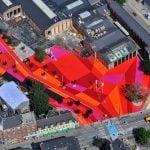
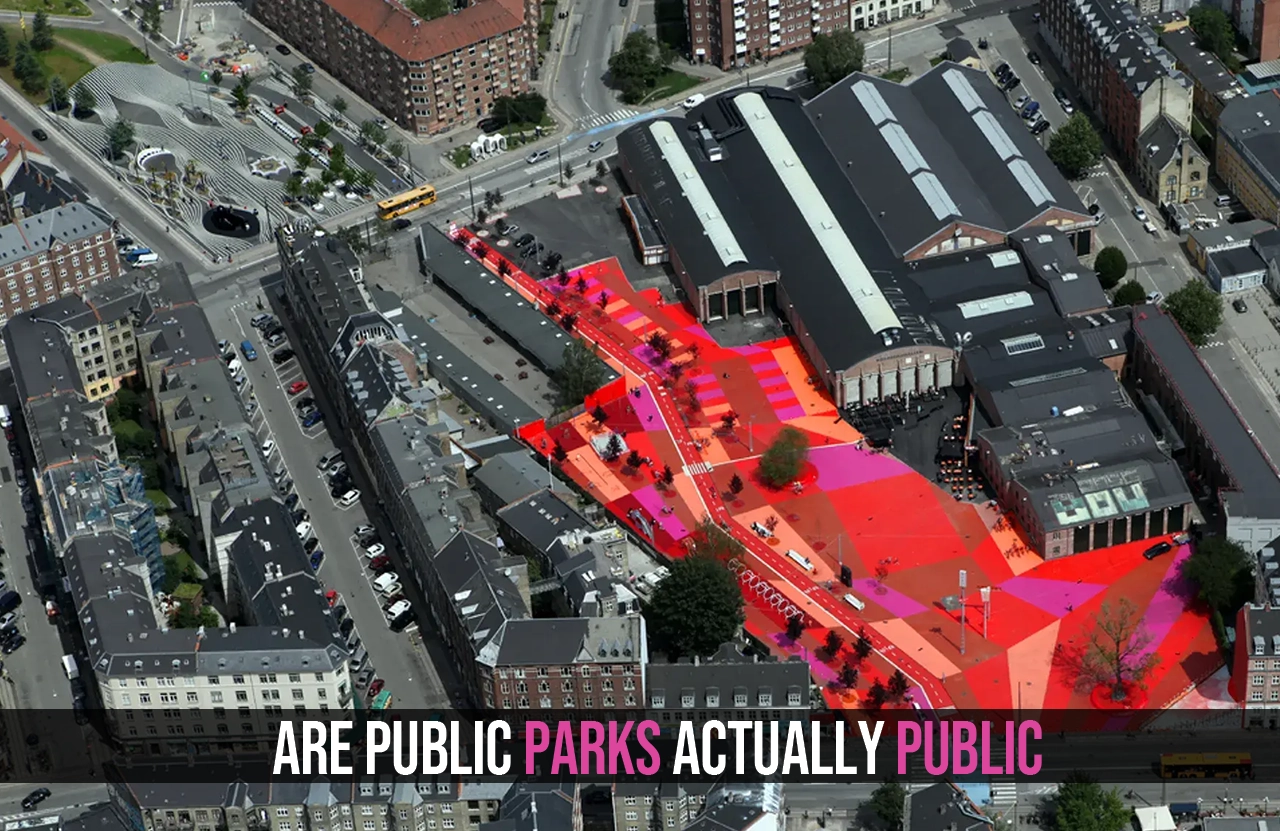
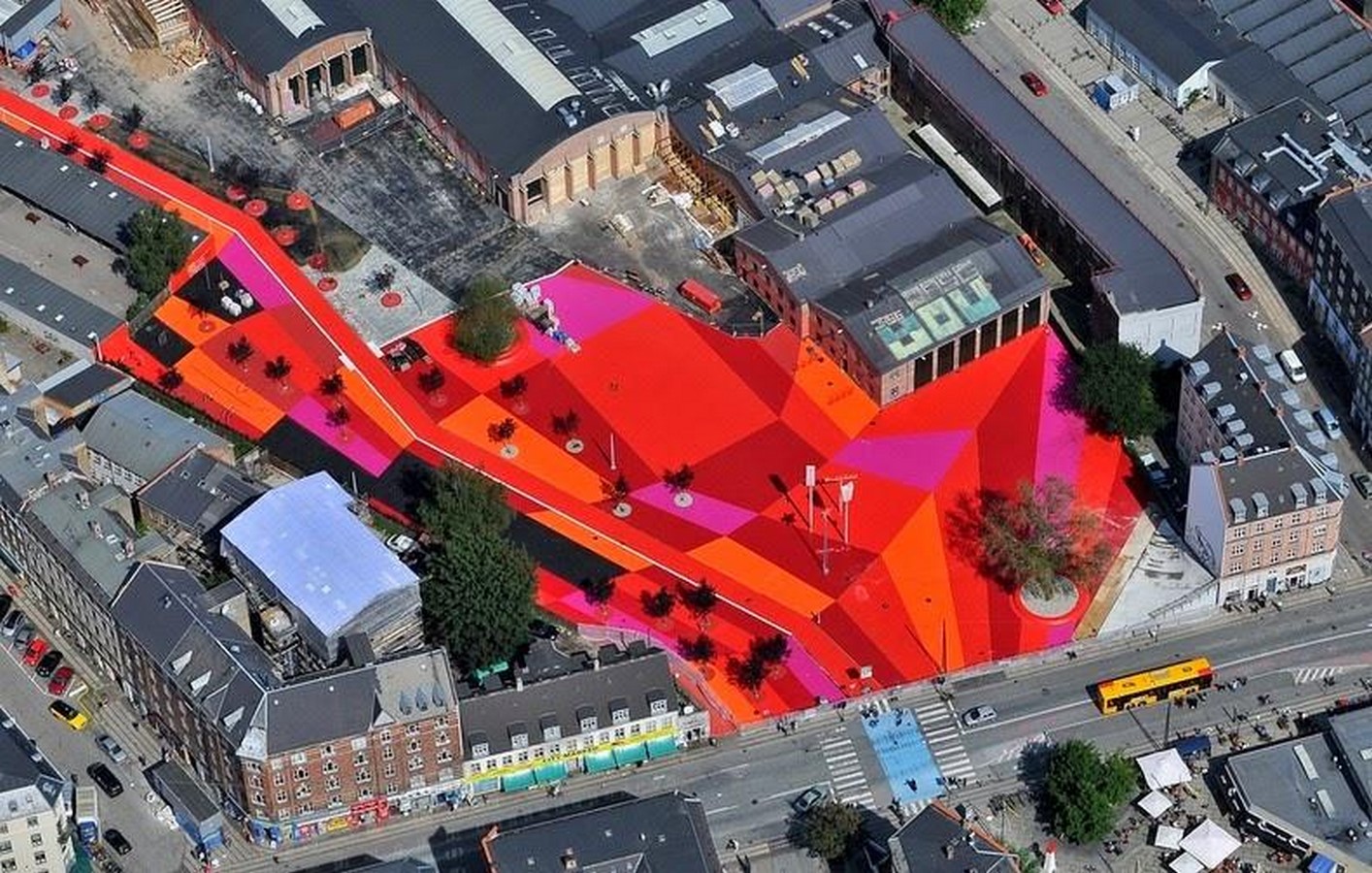
Superkilen in Copenhagen‘s Nørrebro district illustrates the gap between inclusive intention and spatial reality. Designed by BIG, TOPOTEK1, and SUPERFLEX, the 30,000-square-metre linear park celebrated the neighbourhood’s multicultural demographic through 108 imported objects – benches from Iraq, a fountain from Morocco, a boxing ring from Thailand (The Urbanist, 2023). The project received international design awards as a model of culturally inclusive urban design. Local residents, however, had largely requested a greener, softer, more traditional park – trees, grass, room for quiet (Reddit, 2025). What they received was an aggressively graphic, hard-surfaced spectacle. The red paint wore quickly, and several imported pieces were broken within years of installation (4Cities, 2012). More fundamentally, the design team had curated the neighbourhood’s diversity from outside, turning lived immigrant experience into aesthetic content for an international audience (Academia, 2023). Residents of every background passed through Superkilen; few lingered.
Specificity as Strength
Paley Park in Midtown Manhattan, opened in 1967, demonstrates what becomes possible when a park accepts clear limits (Paley Park, 2018). At only 400 square metres, it made no attempt to accommodate cyclists, dog walkers, skateboarders, or team sports. Its entire logic served one condition: providing an adult pedestrian in a dense urban environment with genuine psychological escape. A 20-foot waterfall generates white noise that masks street sound entirely. Moveable chairs and tables give visitors direct control over their immediate space. The result remains one of New York City’s most successful small public spaces – not because it served everybody, but precisely because it did not try to. The inclusivity of public parks may be better served by honest specificity than by exhausting universalism.
The Hostile Design Paradox
Anti-homeless design – benches with central armrests that prevent lying down, sloped seating, metal spikes on ledges, motion-sensor sprinklers activated at night – makes the politics of inclusivity visible by negation (Cambridge University Press, 2025). When Love Park in Philadelphia was redesigned, officials described new divided benches as encouraging people to share the space (Street Roots, 2019). The euphemism is instructive: share the space with whom, under whose terms, enforced by whose geometry? Every park is programmed for specific users – and that programming excludes someone. When the excluded user is a wheelchair user, the exclusion is called design failure. When the excluded user is an unhoused person, the exclusion is called urban management. What a bad joke.
One User Seriously
The argument is not that park designers should abandon inclusion – it is that the claim to total inclusivity is architecturally dishonest. When a park attempts to serve every user simultaneously, the result is typically a design organised around the lowest common denominator: flat, surfaced, passive, and inert. Real inclusion requires making choices. The more productive model is a network of specificity: a city whose parks are individually designed around particular users and uses, collectively creating genuine diversity across the urban landscape. A park optimised for elderly residents – low-impact paths, abundant seating, sheltered from wind, designed for slow circulation and social encounter – is not exclusive; it takes one user seriously. A park designed around teenage athletes, with challenging terrain and programmable surfaces, takes another user seriously. The inclusivity of public parks, understood systemically, is a quality of the urban network rather than of any individual site.
References:
ASLA (2020) ‘Universal Design: Parks and Plazas’, American Society of Landscape Architects. Available at: https://www.asla.org/focus-areas/diversity,-equity,-inclusion/universal-design-guide/universal-design-guide-parksplazas
4Cities (2012) ‘Which Public Square? And for Whom?’ Available at: https://www.4cities.eu/which-public-square-and-for-whom/
Academia.edu (2023) ‘Atmospheres of Designed Diversity? The Spatial Politics of Superkilen in Copenhagen’. Available at: https://www.academia.edu/55917567
Cambridge University Press (2025) ‘Anti-Homeless Hostile Design as Wrongful Discrimination’, British Journal of Political Science. Available at: https://www.cambridge.org/core/journals/british-journal-of-political-science/article/antihomeless-hostile-design-as-wrongful-discrimination
Paley Park (2018) About Paley Park. Available at: https://www.paleypark.org/about
Reddit/r/Copenhagen (2025) Question about Superkilen Park. Available at: https://www.reddit.com/r/copenhagen/comments/1p7zwbq/question_about_superkilen_park/
Street Roots (2019) ‘You Are Not Welcome Here: Anti-Homeless Architecture Crops Up Nationwide’, Street Roots, 7 June. Available at: https://www.streetroots.org/news-stories/2019/06/07/you-are-not-welcome-here-anti-homeless-architecture-crops-nationwide
The Urbanist (2023) ‘Copenhagen’s Superkilen: A Model for Culturally Diverse Public Spaces’. Available at: https://www.theurbanist.org/copenhagens-superkilen-a-model-for-culturally-diverse-public-spaces/