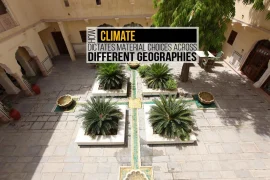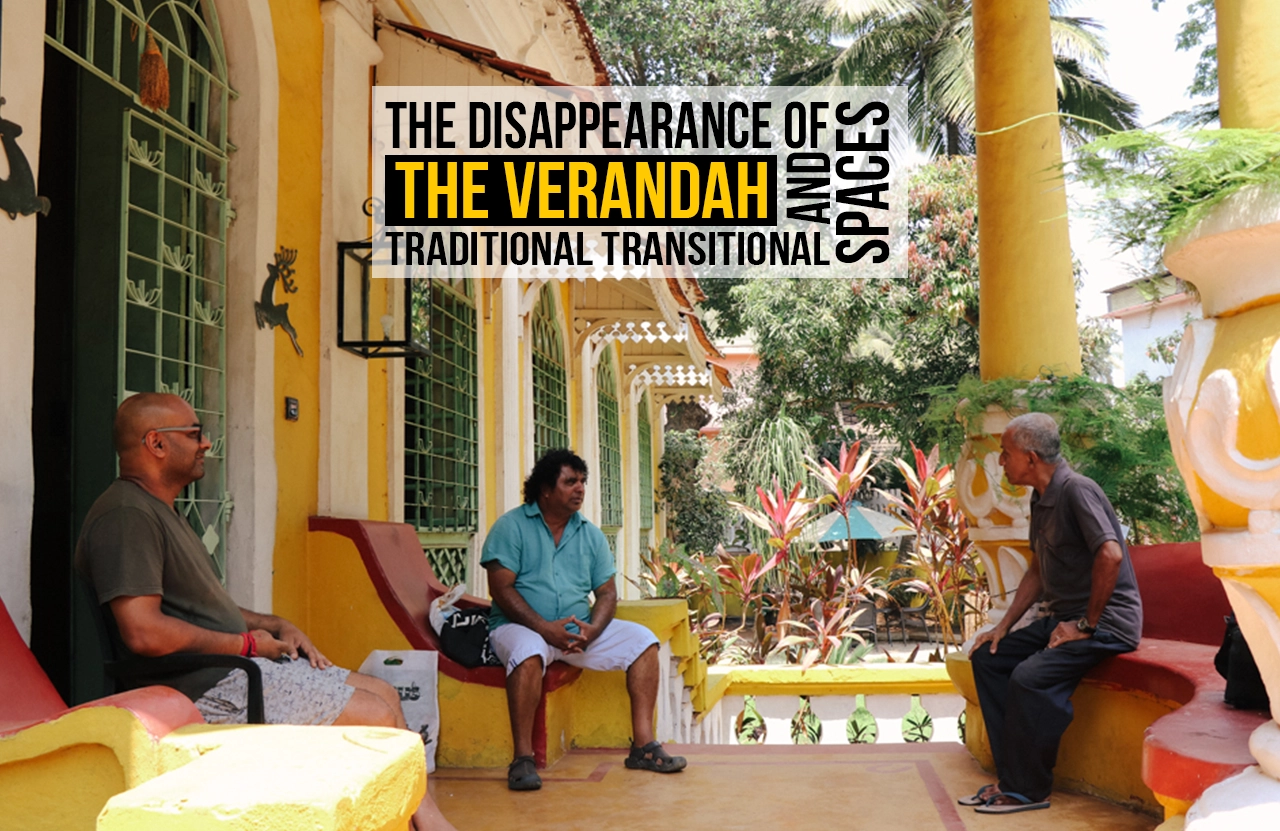
Transitional spaces commonly refer to areas that serve as zones of transition or separation between two distinct environments or settings. In architectural terminology, transitional spaces are generally defined as the zones between outdoor and indoor environments. Verandahs and courtyards are examples of such spaces, acting as buffers while also bridging interior and exterior atmospheres, facilitating interaction and movement between them. This article briefly discusses the gradual elimination of these unique traditional transitional spaces in modern residential design trends and evaluates the underlying causes.
Transitional spaces – Design element and significance
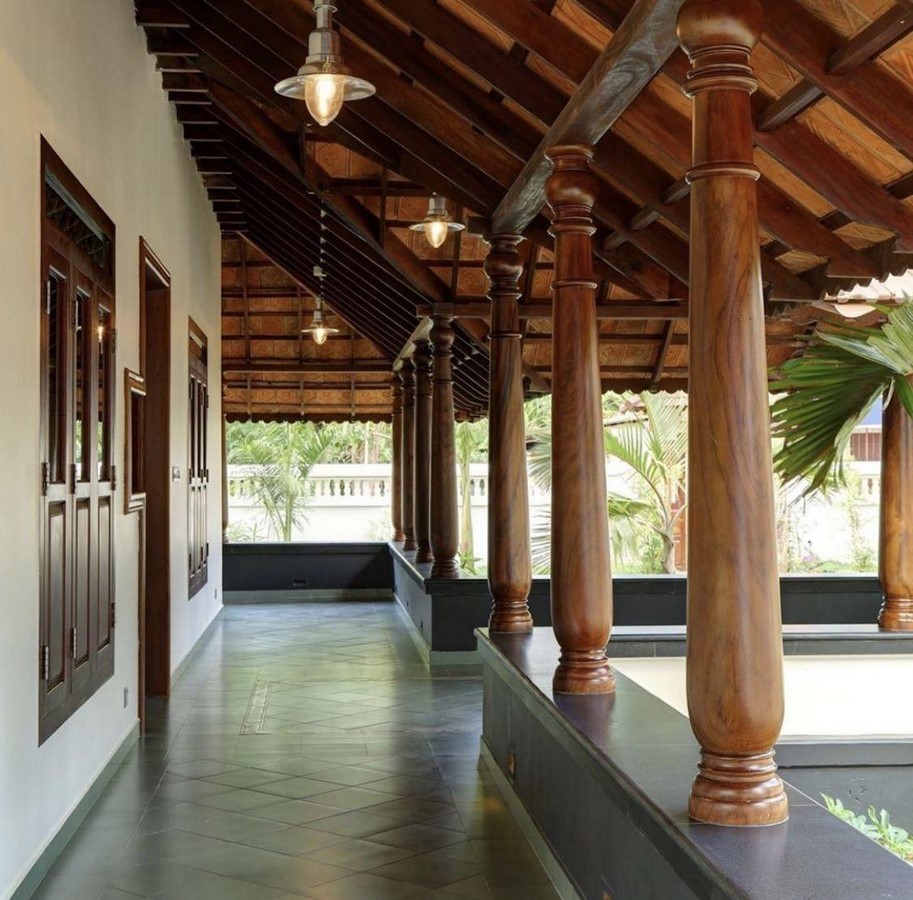
Transitional spaces are not merely leftover areas at the junction of indoors and outdoors. In fact, they are thoughtfully designed elements that offer various functional and social benefits. Traditional transitional spaces have been an integral part of building practices for centuries. The verandah, a typical Indian architectural element, reflects the country’s traditions while fostering communal well-being and functionality.
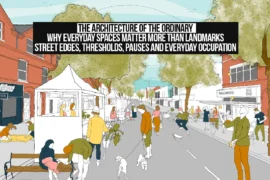
These traditional transitional spaces remained points of interaction with neighbourhoods while performing transit. It was like a place to meet while passing by or doing routine work, and to have some gossip. People got a chance to meet and greet their nearby ones. This reveals a societal approach to design—building spaces to build society.
Another tactful implication of this design strategy was ensuring safety and security. People would spend their casual time or do household chores in this space, which would lead to continuous presence, and thus, streets would be kept under watch. Any suspicious activity would become noticeable. Roads and streets were enhanced with liveliness rather than being lonely and uninteresting. From a societal perspective, these spaces stood as intersections between people’s lives, aiding communal growth and societal connectivity.
Functional advantages of these spaces include climatic efficiency and heat-resistant design. These roof-supported spaces would prevent solar radiation from directly interacting with the main walls of the house or building. They acted as a means of preventing direct solar heating, which is very common in tropical climates such as India, where solar radiation is nearly perpendicular. Long corridors would provide passage for cool breezes. Thus, they also served as passive cooling systems.
Disappearance of Verandah – Traditional Transitional spaces
The trend of traditional transitional spaces seems to have begun to decline, ultimately with the modern design approach. It is no longer part of construction as often as it was in earlier times. These tactics do not withstand the requirements and needs of the present times. There are various reasons and causes pertaining to it, as noted down.
Modern society prefers a more private life over community engagement. In the design field, more impetus is given to building and designing a private atmosphere. A site vulnerable to the eyes of others gives a feeling of threat and danger. Designers focus on mitigating these vulnerabilities through the creation of closed, private spaces. In today’s world, social involvement is more prevalent on digital devices than in physical meetups.
In present scenarios, even the sights of roads and streets are not very pleasing and do not hold much worth looking at. Roads and streets are always cluttered by vehicular activity, creating nuisance and disorder. The chaotic atmosphere feels very unhealthy and can also be painful at times. Filthy conditions and overcrowding make the views undesirable for roadside residences. This forces people to choose privacy and peace over societal cohesiveness.
The surrounding atmosphere also remains polluted with dirt and contaminants. People may still prefer backyards and courtyards, but these traditional transitional spaces often become unsuitable in certain settings and surroundings, and in this way, their glory fades. Such exposed elements also tend to attract attention, making them vulnerable to suspicious and ill-intentioned activities.
With rapid urbanisation and immense population growth, housing needs and demands are becoming very crucial aspects. Homelessness is a major issue in this age. Therefore, more focus is placed on increasing residential spaces. This leads to design approaches that waste almost negligible space and allow for maximum utilisation. In addition, today’s rate of consumption is also higher, which creates a need for more space to store belongings, further increasing the demand for space.
Revival of Traditional Design & Way Forward
Considering the above aspects, traditional transitional spaces may seem unlikely to be included in modern design practices. However, residential colonies and housing parks do not necessarily face such adverse conditions. Distances and commutes in these settings can be shorter, giving traditional transitional spaces a renewed opportunity. A well-intentioned societal and communal approach is all that is required. Fading communal relationships can be re-emerged.
Modern buildings already accommodate sufficient specialised space for parking bikes and cars. If that is possible, these traditional transitional spaces should also remain a significant element. Avoiding them is merely an indication of poor design strategy.
Communal and societal well-being is of utmost importance for human life, as humans are social animals. Therefore, architects and designers must consciously favour such elements and adopt this approach.
Alexander, C., Ishikawa, S. and Silverstein, M. (1977) A Pattern Language: Towns, Buildings, Construction. New York: Oxford University Press.
Gehl, J. (2011) Life Between Buildings: Using Public Space. Washington, DC: Island Press.
Jacobs, J. (1961) The Death and Life of Great American Cities. New York: Random House.
Rapoport, A. (1969) House Form and Culture. Englewood Cliffs, NJ: Prentice-Hall.