London has many attractions, from lavish museums to grand monuments scattered around the place. Archaeological treasures adorning the city attract tourists from all around.
One such treasure is the Rose and Globe theaters of the Tudor and Elizabethan era in London. Archaeologists discovered that these theaters were associated with the infamous writer Shakespeare. The Globe Theatre has been reconstructed near its original site.
The Rose Theatre
The vigorous change in the theaters of the Elizabethan era is often referred to as the ‘golden age’ of English drama. The Rose Theatre served as the focal of the flourishing drama taking place in London during the Tudor period.
It was the fourth of the public theaters to be built, after The Theatre (1576), the Curtain (1577), and the theater at Newington Butts, and the first of many playhouses to be constructed in Bankside, Southwark.
The Rose was constructed by Philp Henslowe and by a grocer named John Cholmley in 1587. Its name derived from a messuage (a dwelling house) that Henslowe had leased from the parish of St. Mildred in 1585. It had lush rose gardens and two buildings. A group of actors resided in the Rose in February of 1592. Henslowe had to enlarge the theater for the new troupe, moving the stage back (two meters) to accommodate 500 extra spectators. Initially, Rose was smaller than other theaters, only about two-thirds of the size of the original theater built almost 11 years back. Its original shape was of a regular polygon with 14 sides and after the renovation, it took the shape of a distorted egg or a bulging tulip.
The Rose was unique from other theaters of that time as it housed large stage scenes on two levels. Rose, however, rose to the occasion and had mastered this particularity of stagecraft. As it had balconies that helped solve this problem for the actors.
The Threat
The Rose in 1599 faced a crisis leading to its abandonment in 1605. When the Globe Theatre was built on the Bankside in 1599 there were many complaints from city officials. In June 1600 the government released a decree stating that only two theaters would be hosting the plays: The Globe in Bankside and the Fortune Theatre in Middlesex. This had put the once cherished theater in jeopardy. The Rose was used briefly in 1602 and 1603 till its lease ran out in 1605. Then it was demolished.
In 1989 the remains of the place were under the threat of destruction because of a new development project. However, after many campaigns it was decided to build over the theater, leaving them underneath. The foundations of the Rose Theatre are covered in a few inches of water to prevent the ground from developing cracks. In 1999, the site was reopened to the people. The work there continues to excavate the remains of the marvel so that its artifacts can be stored in the museum to secure its future.


The Globe Theatre
The Globe Theatre was built in the autumn of 1599 in Southwark, on the south bank of the river Thames in the area that is now called Bankside. It was one of the major theaters including the Roe, The Hope, and The Swan.
The globe was built of timber reused from an earlier theater. In June 1613, The Globe caught fire during the performance of Henry VIII. A theatrical cannon was set off during the performance, the misfire ignited the wooden beams and the thatch causing the whole place to blow up. According to the surviving documents no one got major injuries during the mishap.
The Globe suffered the same fate as the other theaters and was shut down by the Puritans in 1642. It was later in 1644 destroyed to make room for apartment houses and other dwellings. Its exact location wasn’t discovered until remains of its foundation were found in 1989 under the car park of Anchor Terrace on Park Street.
The Structure
The actual dimensions are still a mystery but its shape and size were inquired about approximately over the last two centuries. The evidence suggests that it was a three-story, open-air Amphitheatre between 29.6m- 31.1m in diameter and could house up to 3000 people. Eventually in 1998 after uncovering a small portion of its foundation it was found out that it was a polygon of 18 or 20 sides.
At the bottom of the stage, was an area called the pit, where people would stand and eagerly watch the performance. During the excavation, the archaeologists found some nutshells preserved in the dirt suggesting that people would eat hazelnuts while enjoying the performance. There were three levels of stadium-style seats as well.
A rectangular stage platform known as the ‘apron stage’ was also in the middle of the open-air theatre yard. The measurements of the stage were approximately 13.1m wide, 8.2m deep, and 1.52m high. On the stage was a trap door as well which could be used by the performers to enter and exit the stage from the area beneath during their performances. Large columns on either side acted as a structural member supporting the stage and the roof. The ceiling under the roof was called the ‘heavens’ suggesting that there may have been painting of clouds and sky. There was a trap door on the ceiling as well. The back wall of the stage had two to three doors on the main level, with a curtained inner area in the center and a balcony above it. The doors opened into the backstage area where actors and actresses would get ready. The balcony had space for the musicians and could also be used for scenes requiring a pedestal.
The Modern Globe
A new Globe Theatre was built according to the original plan. The design team comprised Theo Crosby of Pentagram as the architect, Buro Happold as the structural and services engineers, and Boyden & Co. as the quantity surveyors. It was inaugurated as ‘Shakespeare’s Globe Theatre’ and now hosts plays every summer. In the winter the theater is used for educational purposes.
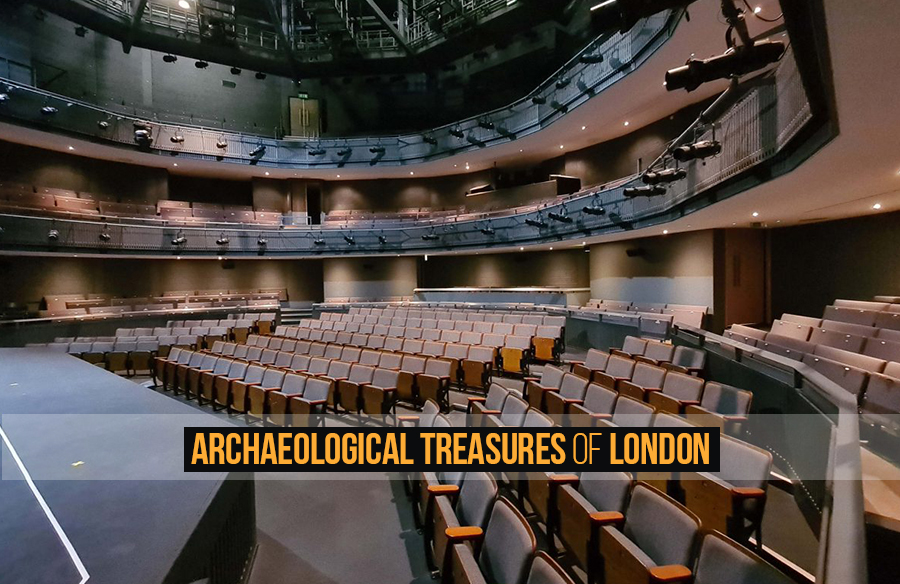
Sticking to the original design, the Globe is open to the sky and has a stage that projects into a large circular yard surrounded by three ties of steeply raked seating. There is a standing area in the yard as well. The only sheltered parts are the stage and the seated areas.
The reconstruction of the place was carefully worked and researched upon, focusing on replicating it to the original piece. Modern adjustments were still made like adding making the place a safer place for the public. Addition of sprinklers on the roof for protection against fire, fire safety exits, etc. Ramps and lobbies were also added to make the space accessible for everyone.

Celebrating its old heritage, London with pride hides these gems which are often less talked about, but they must be celebrated as they still preserve the essence of the original structure and stay relevant with time.
Article Source:
https://www.playshakespeare.com/study/elizabethan-theatres
https://nosweatshakespeare.com/resources/theatres/the-rose-theatre/