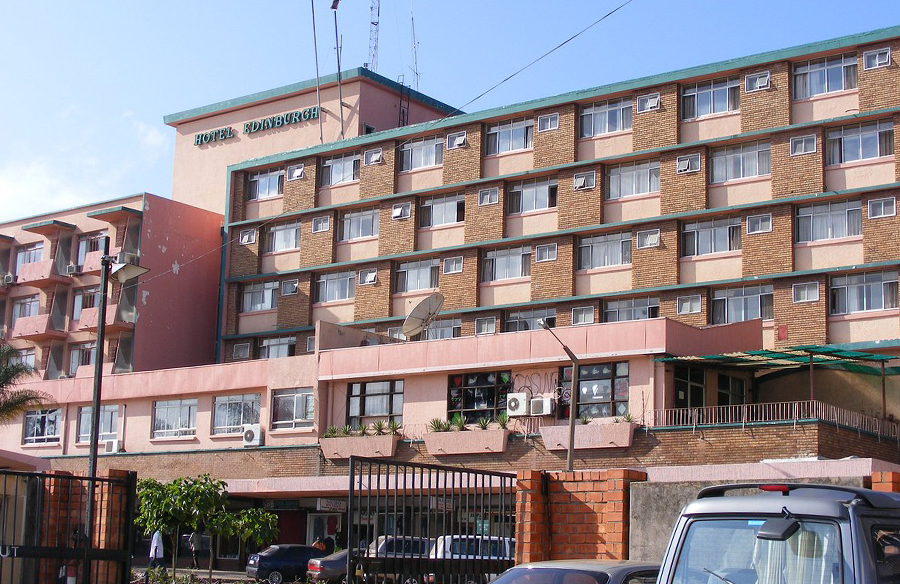
The Australian architect Hans Pawlik designed the Hotel Edinburgh in Kitwe, Copperbelt Zambia and it was completed in 1957. The hotel is known for its modernist architectural design. It is a landmark in Kitwe and reflects the mid-century modern design characteristics the designer was known for. The Hotel Edinburgh was opened in 1960 just before independence. The hotel is an example of modernist architecture, distinguished by its simple geometric style, contemporary materials, and practical layout. To reflect the era’s architectural style, its construction style is an enduring monument in Kitwe that adds to the historical and cultural character of the city.

Social and Political Importance
Social Importance
Considering the mid-century period, it was built, the Hotel Edinburgh Kitwe holds significant social and political importance. Constructed in 1957, during a notable phase of development in Zambia (Northern Rhodesia), the hotel represented the modernization and advancement of the Copperbelt area. Zambia’s mining sector, which was very important to the colonial economy, was centred on the Copperbelt. During the colonial era, the hotel served as a social hub for both the local aristocracy and the European expatriate community.
Political Significance
The Hotel Edinburgh Kitwe served as a meeting place for politicians during the late colonial era. As Zambia attained independence in 1964, these areas became hubs for important political conversations. With its contemporary architectural style and Western conveniences, the hotel served as a reminder of the colonial influence in the area. It reflected the social-political dynamics of the day and catered mostly to the European community. The Hotel Edinburgh remained a significant landmark in Kitwe even after Zambia gained its independence, albeit its function changed due to the change in the country’s political and social structure. It became more available to a wider range of people, signifying the advancement and development of the country. Hotel Edinburgh represents significance in both the country and the city, and over time it has blended with the city’s cultural and historical legacy. Beyond serving as a hotel, the Hotel Edinburgh has significant social and political significance as a representation of Kitwe’s development and the digger historical shift in Zambia to post-independence eras.

Cultural Heritage
Apart from being a notable architectural landmark, the Hotel Edinburgh in Kitwe, Zambia is also an important cultural heritage monument. Its social role, historical background, and ongoing legacy throughout the community are the foundations of its cultural heritage. The Hotel Edinburgh has come to represent Kitwe’s development into a contemporary metropolis. Its existence is a treatment to the development and optimism during the middle of the 20th century when Kitwe emerged as a major industrial hub in Zambia. The Edinburgh hotel is a symbol of a bygone age for many people in Kitwe and beyond. It is a cultural relic that captures the dreams, ambitions and difficulties of a time when Zambia was becoming an independent country after being a colonial province. In present days the hotel serves as both a place of lodging and a cultural landmark. It draws tourists who are curious about Kitwe and the Copperbelt region’s history and culture. Maintaining the hotel’s history and cultural legacy is important to Kitwe’s cultural heritage. The history of the hotel is interwoven with the large tale of Zambia’s progress and modernization.

Impact on Urban Fabric
An important aspect of Zambia’s growth, social dynamics, and architectural landscape have all been impacted by the Hotel Edinburgh. The Hotel contributed to Kitwe’s identity by becoming a noticeable building. It reflected the city’s goals for growth and modernization in the 20th century, enhancing Kitwe’s standing as a developing metropolis in Zambia’s Copperbelt. Urban development considerations were impacted by the Hotel’s Kitwe location since roads and utilities were built to accommodate the hotel and the neighbourhood. This helped with the city’s general layout and structure. Both residents and urban planners used the Hotel Edinburgh as a reference point because of its pivotal position within Kitwe’s urban environment. With key thoroughfares and locations frequently centred on or leading to the hotel, its presence assisted in defining the shape of the city.
Style relevance
When it was built in Kitwe, Zambia in the late 1950s, the Hotel Edinburgh was a highly significant architectural statement. Its architectural design was representative of the region’s goals at the time and mirrored wider worldwide trends. This is how fashion at the time was looked at. The architectural trends that dominated construction in the middle 20th century were used in the design of the Hotel Edinburgh. Modernism placed a strong emphasis on utility, simplicity, and the application of novel building materials and methods. This was part of an international movement that aimed to replace old ostentatious architectural styles with simple functional designs.
Historical Importance
The Hotel Edinburgh has considerable historical significance because of its influence on the political, social, and economic climate of the area, especially in the middle of the 20th century. The history of the hotel is a reflection of Zambia’s more general historical transition from colonial to independence and beyond. Being an important historical artefact, it has observed and adapted to the nation’s social and political developments. The Hotel Edinburgh is significant historically because it was an important social and cultural centre, a political hotspot, an architectural icon, a symbol of modernism throughout the colonial era.
A very good example of modernist architecture that reflects the design philosophies of the mid-20th century is the Hotel Edinburgh in Kitwe Zambia. A major component of the building’s architectural and historical significance is its structure. The structure design of the Hotel Edinburgh is a quintessential example of modernist architecture, distinguished by its simple geometric style, contemporary materials, and practical layout. In addition to reflecting the era’s architectural style. Its construction is an enduring monument in Kitwe that adds to the historical and cultural character of the city.
References:
Chola, M. I. (1989). Modern Architecture in Zambia: The Case of Kitwe.
Gordon, D. (2012). Invisible Agents: Spirits in a Central African History. Anthens: Ohio University Press.
Roberts, A. (1976). A History of Zambia. New York: Africana Publishing Company.