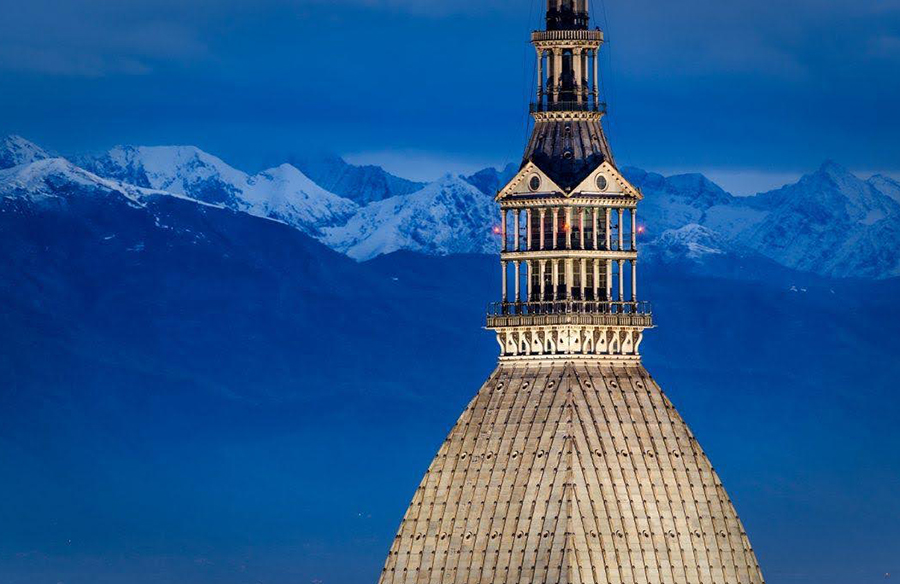
A major tourist attraction, offering visitors a panoramic elevator ride with stunning views of the city and the surrounding Alps, the Mole Antonelliana is an iconic symbol of the city of Turin. The Mole Antonelliana was originally proposed as a synagogue by the Jewish community of Turin. It was designed by architect Alessandro Antonelli, a significant figure in Italian architecture.

Having a height of 167.5 metres and being recognized as the tallest brick building in Europe at that time, its construction began in 1863 as a synagogue in the heart of the city by the Jewish community. Later, due to disagreements over the height, initially planned to be 47 metres and the following rise in cost, the Jewish community withdrew from the project. Following the year 1873, the city of Turin took over the construction, later the completion took place in 1889 after modifications in the original plan.
Design Philosophy and Planning
Originally designed to serve as a synagogue for Turin’s Jewish community, Antonelli was commissioned to design a building that reflected the architectural expression of synagogues at that time which were passive in manner through pressures of dominant tastes as well as economic and religious constraints.

Open to exploration, Antonelli moved forward from an exotic style and aimed at the distinction of the reflection of the religious institution, beginning with the functional disposition of the aimed spaces and structures as per the requirement. The initial planning began by piling up a few uniform levels and flexible modular floor areas on the proposed lot with the meeting hall on the top as per the client’s requirement. For the hall to remain open he proposed a dome to cover the hall rising from the square plan in four curved planes. Keeping his principles clear, Antonelli was fixated on a skeletal system that would permit an infinite extension of the composition and a variety of interior spaces. He worked fluidly, while his projects were open to continual modifications as he rethought the design possibilities, dismantling the old-fashioned idea of stylistic coherence. The open modifications didn’t always sit well with the client’s as they often resulted in design modification and higher costs and thus the transfer was conducted between the previous Jewish commission and the city of Turin.
Architectural Style and Influences

Antonelli synthesised his understanding of Gothic and classical traditions, combining these as continuously related structural possibilities One can observe a blend of various architectural styles in the Mole Antonelliana, making it an eclectic masterpiece. Incorporating elements of neoclassicism through symmetrical proportions and detailing, the style is also reflected in the base of the building. The grandeur and vertical emphasis are also atypical of neoclassicism.
Construction, Materials, and Innovative Engineering

Though being aware of the advances in iron technology, Antonelli wanted to explore the potentials of traditional masonry, with a clear preference for it over rusting metal and rotting wood by analysing the durability and cost-effectiveness in the longer run.
The construction spanned over several decades, with significant advancements in Engineering. To achieve the unprecedented height of the structure, use of iron and brick was done.
The exterior part of the structure is predominantly constructed of brick, supporting the immense vertical load. Internally, iron was used to provide structural integrity ultimately contributing to the impressive height. The lightweight iron framework within the brick structure, considered a pioneering technique of the time, has been incorporated into the design. The core of the Mole Antonelliana is the structural mesh on an orthogonal grid with a honeycomb structure. The spire of the building required precise engineering to sustain wind forces and provide stability.
Technological Advancements
The panoramic elevator, inaugurated in 1961, during the celebration of the Italian Unification went under renovation in 1999. This technological marvel ascends through the centre of the building to an observation deck, running transparent and providing amazing panoramic views of the city and the Alps.
Impact on Urban Fabric
With a significant impact on Turin’s skyline, The Mole Antonelliana serves as a focal point and a landmark often serving in navigation through the city. Its amazing height dominated the cityscape, integrating historical architecture with the surrounding urban environment. Adding to the aesthetic value of the city, it has become a major tourist attraction and has been successfully able to represent Turin’s image as a centre of art and culture. The Mole Antonella has significantly contributed to the development of the surrounding area attracting economic and cultural growth, ultimately revitalising urban activity.
Historical Importance

The mid-19th century saw Turin undergoing significant social changes, including the integration and emancipation of the Jewish community. The initial commission of the Mole Antonelliana by the Jewish community as a synagogue represents this social progress and the desire for identification.
Turin is well known as the first capital of the united Italy from 1861 to 1865. The construction of Mole Antonelliana had begun within this period and reflected the aspirations of a newly unified nation.
Importance in Modern Era

The Mole Antonelliana symbolises the city’s forward-thinking spirit. Representing the city’s rich history and architectural innovation, its representation on the Italian 2-cent euro coin justifies its significance to Italian identity.
Today, the Mole Antonelliana is the house for the National Museum of Cinema (Museo Nazionale del Cinema), a significant film museum globally. The architectural grandeur of the building is not only a tourist attraction but also a centre for educational and cultural hubs, a space for hosting events and exhibitions for cinema enthusiasts.
The Mole Antonelliana is a product of the culmination of a continuous Italian tradition in construction and the ultimate expression of the age of Romanticism.
References:
Kirk, T. (2005) The architecture of Modern Italy Vol 1. New York: Princeton Architectural Press (The Challenge of Tradition,1750–1900).
Mole Antonelliana (2022) The National Museum of Cinema. Available at: https://www.museocinema.it/en/museum-and-ma-prolo-foundation/mole-antonelliana (Accessed: 01 August 2024).
Re, L. (2003) The work of Alessandro Antonell and Crescentino Caselli between the Architecture of the Raison and the architecture raisonnée, pp. 1709–1719.
Sadler, P. (2022) 5 unusual and eye-catching buildings in Turin, Italy, on. Available at: https://www.adventuresofacarryon.com/5-unusual-and-eye-catching-buildings-in-turin-italy/ (Accessed: 01 August 2024).
Sasso, D. (2012) ‘Historical, Industrial, Touristic Turin: The Many Seasons of a City’, in KULTURA I TURYSTYKA – WSPÓLNE KORZENIE. New York: Gaetano Salvemini Institute of Historical Studies, pp. 199–210.