Flora Borsi‘s Suffocating Truth is a provocation wrapped in restraint: a figure consumed by a black latex hood, a solitary flame erupting at the jaw line, bare shoulders emerging from near-total darkness. The image is simultaneously claustrophobic and incandescent, placing suppressed interiority in direct confrontation with the body’s insistence on heat and light. When translated into architectural space, it demands a room that mirrors precisely this tension: absolute material control on the surface, volatile energy held captive beneath it.
So how to construct the design concept that will perfectly fit the impression of the art?
Flora Borsi: Identity in Digital Surrealism
Born in Budapest in 1993, Flora Borsi is one of the most singular voices in contemporary fine-art photography. A graduate of the Moholy-Nagy University of Art and Design, she taught herself digital manipulation from the age of eleven and has since exhibited internationally across Europe and the United States, with work featured by BBC Culture and Vice and acquired by private collectors worldwide. Borsi works almost exclusively through the self-portrait, using her own body as a philosophical testing ground for questions of female identity, psychological concealment, and the uncanny frontier between interior emotion and exterior presentation.
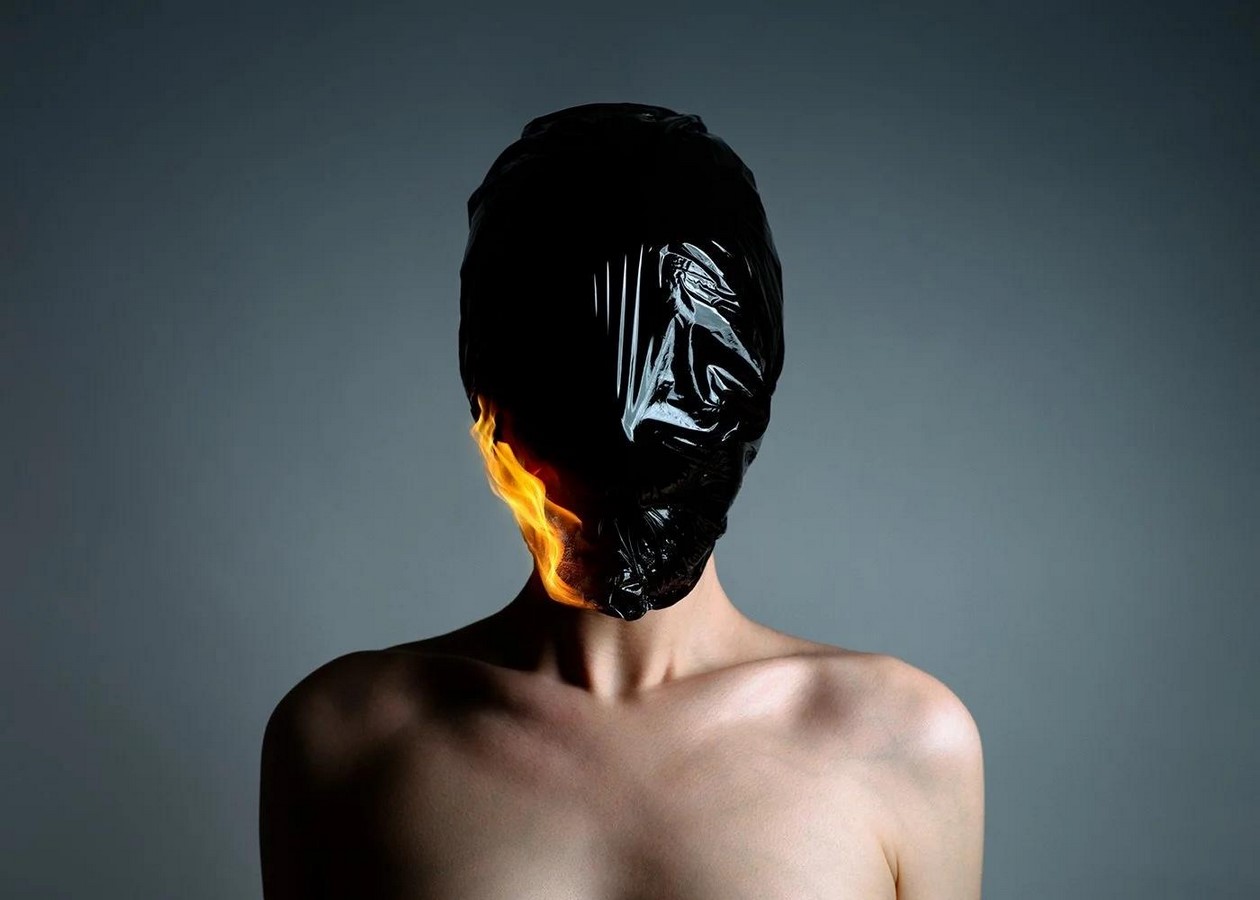
Suffocating Truth belongs to a recurring strand in Borsi’s practice: the deliberate erasure of the face. Where conventional portraiture anchors identity in the eyes, Borsi denies that anchor entirely. The black latex hood, tightly moulded and architecturally smooth, does not read as violence; it reads as chosen armour. The flame at the jaw is not destruction but disclosure: something truthful and uncontainable escaping from within. The cool grey-blue ground refuses melodrama. Together, these choices articulate a precisely calibrated visual argument: that suppression and revelation are not opposites but accomplices.
Room Type
The space is classified as a luxury bondage-style intimate bedroom, not in the reductive sense of a dungeon aesthetic but in the precise architectural sense: a room where power exchange, sensory control, and curated restraint are embedded into the spatial logic itself rather than applied as theatrical decoration. The target audience is mixed-gender adult couples of discernment, specifically those who approach erotic experience as a designed event rather than a spontaneous one. The room presupposes sophistication, consent, and an appetite for beauty as a precondition of desire rather than its consequence.
Spatial Layout
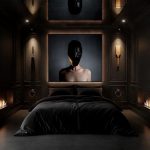
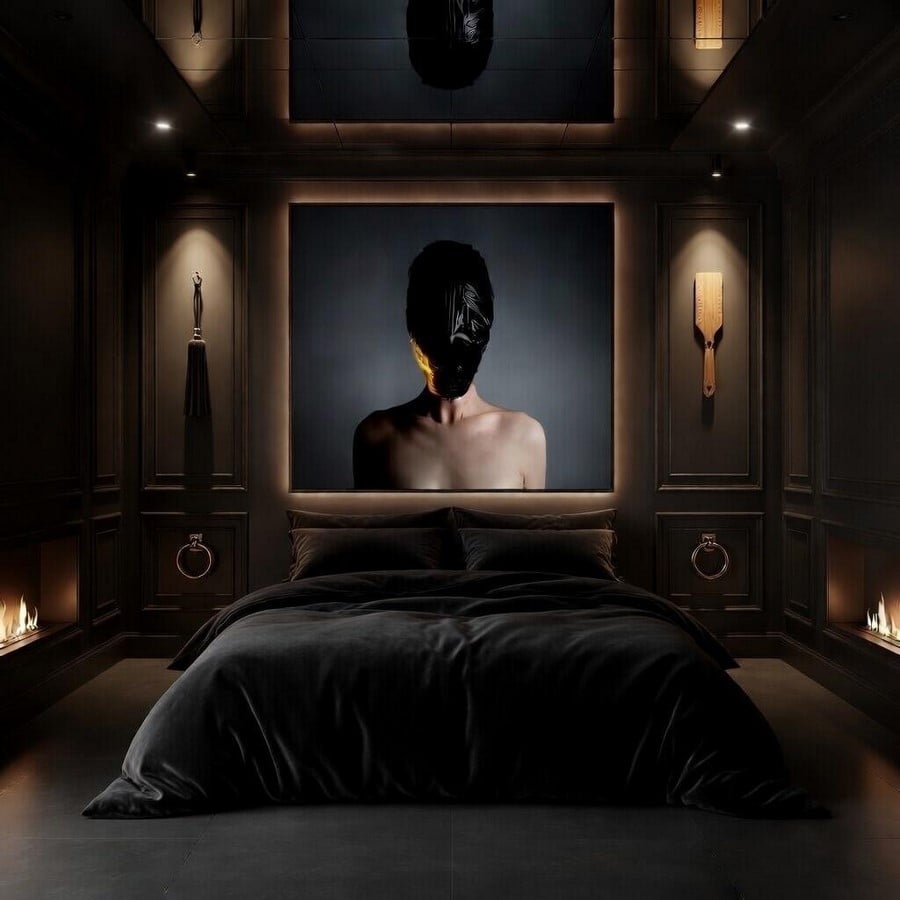
The room follows strict bilateral symmetry anchored on a single axis that runs from the entrance threshold to the centrepiece artwork: a large-format print of Suffocating Truth, back-lit within a recessed wall niche above the bed head. This axis is intentional. The eye is drawn forward, and the entire room orchestrates a processional approach to the image and, by extension, to the bed. The floor plan is rectangular, with a ceiling height of no less than 3 metres to allow the coffered black ceiling panel above the bed to read as a distinct architectural element: a frame within a frame, mirroring the image’s own tight compositional cropping. The entrance is positioned at the foot-end of the bed axis so that one enters directly into the full visual weight of the artwork.
Three distinct functional zones occupy the space. The central zone is the sleeping and primary intimate area: a low-profile platform bed of 200 by 200 cm, positioned on the room’s central axis and upholstered entirely in black silk velvet. The platform extends 30 cm beyond the mattress perimeter on all sides, providing a continuous surface at seat height that causes the bed to read as an architectural plinth rather than a domestic object. The two symmetrical lateral zones each contain a recessed bioethanol fireplace at floor level, providing the sole amber chromatic accent, along with wall-mounted cast-bronze rings. These rings are structural fixtures integrated into the panelled wall rather than theatrical props; their scale and patina ensure they read as architectural detail first. Above each fireplace, a recessed wall niche displays a single sculptural object: one a leather flogger, the other a paddle, both museum-lit from above by tight-beam halogen spotlights.
A fourth ancillary zone occupies the ceiling directly above the bed: a large coffered panel clad in black-tinted mirror glass, framed by a deep shadow-gap. This element performs two spatial functions simultaneously. Architecturally, it compresses the perceived height above the bed; perceptually, the mirror reflects the artwork below, dissolving the boundary between the image on the wall and the space of the body beneath it. No other reflective surfaces are introduced into the room.
Colour Palette
The dominant palette of the room is achromatic: deep obsidian black, warm charcoal, and a desaturated blue-grey ground that inhabits the cool-neutral threshold as the zone of maximum psychological suspension. Against this near-total suppression of chromatic information, the single amber-orange flame registers not merely as contrast but as rupture.
For the interior, this translates into a palette of matte obsidian black surfaces broken by a single warm amber accent deployed only through living fire: twin bioethanol fireplaces flanking the bed. Walls, ceiling, floor, and all textiles remain within the achromatic register: charcoal velvet, smoked concrete, patinated bronze hardware. The amber occupies approximately ten per cent of total surface area, which amplifies rather than dilutes its emotional voltage. Any expansion of amber into upholstery, cushions, or decorative objects would dissolve the tension Borsi’s image constructs so deliberately.
Structure, Materiality, and Furniture
All four walls are clad in deep charcoal-stained solid oak panelling with full-height raised-and-fielded moulding, finished in satin rather than gloss lacquer to absorb light rather than scatter it. The floor is large-format honed black basalt tile, laid in a running bond with no visible grout lines, ensuring the ground plane reads as monolithic rather than gridded. The ceiling is stretched black acoustic fabric within a recessed perimeter frame, broken only by the coffered mirror panel above the bed. All structural elements are concealed; no exposed beams, no visible fixings, no hardware beyond patinated bronze or matte black powder-coat appears anywhere.
The platform bed is custom-fabricated, its apparent weightlessness providing a productive contradiction against the room’s psychological heaviness. The mattress is wrapped in black silk velvet. Four oversized black velvet cushions are the only visible bedding. No decorative throw, no patterned textile, and no contrasting piping is permitted. A seating element is deliberately absent; this is not a room for lingering conversation.
Lighting Concept
Lighting operates across three strictly separated layers. The primary layer is the back-lit artwork niche: LED strip lighting concealed within the reveal produces a warm 2,700K halo around the print, rendering the image luminous against the surrounding darkness and serving as the room’s sole broad ambient light source. The secondary layer consists of tight-beam 10-degree halogen spotlights recessed into the ceiling, calibrated to illuminate the sculptural objects in their flanking niches without any spill onto surrounding wall surfaces. The tertiary layer is the living fire of the twin bioethanol fireplaces, providing the only dynamic chromatic event in the space. No overhead general lighting exists. No table lamps, pendant lights, or LED strips under the bed platform are introduced. The room must never be fully illuminated; partial visibility is a spatial condition, not a technical deficiency.
Room Space As An Invitation to Dialogue
The room’s symbolic programme is deliberate and complete. The artwork is the primary erotic statement; everything else exists in service of it. The paddle is displayed with the same institutional care applied to a sculpture in a commercial gallery: isolated, lit from above, given sufficient negative space on the wall to breathe. When fetish objects are curated with the same discipline applied to contemporary art, they cease to perform vulgarity and begin to perform intelligence. This is the spatial argument the room constructs: that desire, when edited with rigour and furnished with integrity, is one of the most sophisticated aesthetic positions available to a designer.
Whether this interior succeeds in its ambition to make restraint itself the most provocative object in the room is ultimately a question for those who inhabit it.