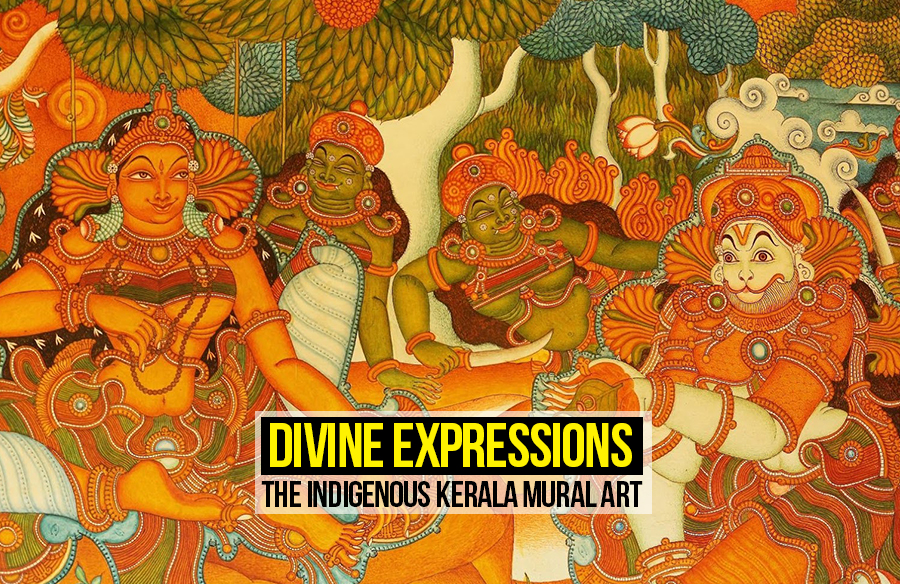
Since the dawn of civilization, humans have depended on diverse mural artwork to express their opinions and emotions, leaving lasting traces on the canvas of time. Among these is the Kerala Mural Art, which has a huge collection of significant paintings, second only to those in Rajasthan. Kerala mural paintings, deeply ingrained in the temple architecture of Kerala, are easily identified by their vibrant colours and excellent craftsmanship. However, these go beyond simple decorations and provide significant perspectives into Kerala’s cultural and spiritual character. Originating in the eighth century, Kerala mural art is believed to have reached its zenith during the fifteenth and sixteenth centuries under the patronage of Travancore and the Zamorin of Calicut. It draws inspiration from the Hindu epics such as the Ramayana, Mahabharata, and ancient scriptures, and adorned the temples and palace walls as visual chronicles of religious and mythological narratives. Kerala mural arts also gained momentum in its growth due to the Bhakti movement, during which the local rulers and landlords would commission these masterpieces as expressions of their devotion and reverence. Kerala mural paintings hence portrayed not just gods, goddesses, and mythological stories, but also embodied intellectual views, preserving the cultural past through their everlasting beauty and symbolism.

History
Kerala Mural Art dates back to the eighth century, with the Thirunandhikkara Cave temple in Kanyakumari believed to house the oldest murals. These were basic line drawings that reflected the early development of the art form. The evolution of Kerala Mural art is seen through three phases. The initial phase, from the tenth to the eleventh century, was defined by simple line drawings that lacked the vibrancy that would characterise subsequent decades, as seen at Padmanabhaswamy Temple in Thiruvananthapuram.
Murals evolved and became more elaborate during the second phase, between the 11th and 14th centuries.
A few of the paintings at Thrissur’s Vadakkumnathan Temple and Kochi’s Mattancherry Palace depict this. The rich and elaborate murals that characterise the art form today first appeared during the third phase, which lasted from the 14th to the 19th century. A notable example of this phase is the famous “Gajendra Moksham” at Krishnapuram Palace near Kayamkulam. Through time, these artworks adorned not just the temple walls but also spread to palaces and churches across the state. With each phase, Kerala mural paintings embraced new influences and elements, while retaining its unique identity, reflecting the rich heritage of the region.
Symbolism and Techniques

Kerala Mural Art holds immense significance in religious and cultural growth. It conveyed religious teachings and stories to the common people. The temple murals further helped in enhancing the spiritual experience of the devotees. Every element of this art holds intricate symbolism, which when studied in detail can provide deeper insights into the mythology and traditions of Kerala. Everything from the colours to the proportions and postures of the Image s, worked together to symbolize deeper meanings and create an overall narrative.
Kerala mural paintings are created through tedious procedure that showcases the painters’ expertise and craftsmanship. Guided by ancient skills passed down through centuries, each stage of the process contributes to the finished masterpiece. The artistic journey involves six distinct stages.
The first stage, known as Lekhya Karma, involves sketching by pencil or crayon on a white background fabric, where the contours and curves of the motifs are outlined. Following this, the second stage, Rekha Karma, enhances the outlines of the sketching, refining the shapes and forms. In the third stage, Varna Karma, colours are carefully filled in, breathing life into the painting. The colours go by their virtue, the spiritual and divine characters are depicted in shades of green, those influenced towards power and materialistic wealth are painted in shades of red to golden yellow. The evil, wicked, and mean characters are generally painted in black or white. The fourth stage, Vartana Karma, involves shading to add depth and dimension to the painting. The fifth stage, Lekha Karma, finalizes the outline of the painting, usually in black, bringing it to its completed form. Finally, in the sixth stage, Dvika Karma, the finishing touches are applied, adding detail and refinement to the artwork.

At the heart of this process lies the Panchvarna, or the five-colour scheme, comprising yellow, red, green, black, and white. These colours are made from mineral pigments and vegetables, with each hue imbued with symbolic significance. Yellow and red hues come from minerals, and the artists create black paint from soot, which they obtain by burning sesame oil inside a mud pot. They crush the powdered leaves of Neel Amari and Eravikkara to create shades of green, and white from lime, serving as the base. Blending these colours is an art in itself, done in a wooden bowl with tender coconut water and exuded from neem trees.
Famous Kerala Mural Paintings
Some of the prominent Kerala Mural Paintings are at the Mattancherry Palace in Kochi, Vadakkumnathan Temple in Thrissur, Shiva Temple in Ettumanoor, and Krishnapuram Palace in Alappuzha. The collection of paintings on the walls of Mattancherry Palace is among the finest examples of this art style. These 16th-century paintings feature vivid depictions of individuals in rich colours, gracefully conveying stories from the Ramayana and Krishna Lila. This palace is the home to some of the finest paintings in this type of art and attracts many tourists with its compelling narratives and cultural significance.

Another famous artwork lies in the Krishnapuram Palace in Kayamkulam. “Gajendra Moksham”, which dates back to the 18th century is renowned for its details and graceful storytelling of a legend from the Bhagavad Puranas. This 3-metre-high painting which entirely spans the wall, is the largest single-panel mural painting found to date. The painting tells the tale of an Elephant King who is saved from a crocodile’s clutches by lord Vishnu. The artwork is further detailed through elements like mythological creations, forest plants, and saints, all enclosed by a beautiful floral border.
Kerala mural art, once confined to the walls of historic palaces and temples, has broadened into a vibrant art form. Today, it adorns not only magnificent structures but also modern paintings and fashion. The modern world saw a resurgence of this traditional art form, serving as a powerful symbol of Kerala’s rich cultural history. Currently, Kerala mural painting has earned a reputation as an esteemed part of Kerala’s cultural legacy owing to its vivid colours and intricate details that offer a look into a world where creativity and tradition collide.