Architecture has gradually changed from traditional 2D drawings and physical models in recent years. Immersive technologies, commonly used in gaming and entertainment, have become integral to architectural design, altering how spaces are envisioned.
Immersive technologies consist of various tools and methods that enable architects, builders, engineers, and clients to interact within blended reality environments collaboratively. The immersive and interactive approach reduces misunderstandings, saves time and costs and streamlines the creative process.
This article focuses on immersive technology trends in architecture, distinguishing them from the broader concept of immersive design, which involves the design of an environment where the user interacts with a realistic yet digital atmosphere.
Immersive technology in architectural design allows the creation of virtual project representations where space use can be optimised and potential design problems can be identified. Additionally, these technologies contribute to preserving cultural heritage by envisioning historical structures and collaborative virtual design environments that enable team collaboration across geographical distances. As technological advances expand, these immersive experiences reshape the ever-growing architectural field.
Virtual Reality (VR) in Architecture:
Virtual reality has expanded the creative possibilities and significantly improved the interaction with architectural spaces, as a digital environment replaces the user’s physical surroundings. Architects can use this for conducting user studies, presenting collaborative designs, building management, and design education.
As a storytelling medium for architects, virtual reality allows individuals to immerse themselves in the atmosphere, explore and interact with the functionality and purpose of a digital representation of a proposed design, and gain a realistic understanding of its size and space.
Virtual reality enables architects to design immersive 3D environments, helping to identify defects in floor plans and assess how the surrounding environment influences the structure, providing a holistic design view.
Virtual reality helps to showcase interior and exterior designs, offering precise simulations of light distribution, materiality, and colour. Real-time experimentation with design concepts is enabled, resulting in well-informed decision-making by easily adjusting forms, textures, and colours.
There are two main trends in virtual reality technology: wired and mobile solutions, where wired virtual reality is ideal for real-time rendering and 3D navigation, requiring external hardware. Mobile virtual reality, on the other hand, offers accessibility through various devices, such as smartphones and standalone headsets.
Virtual reality also enables remote collaboration, allowing architects and stakeholders to meet in the same virtual environment regardless of their physical locations.
Virtual reality’s future lies in narrative and simulation, creating experiences that convincingly simulate physical reality and transport users to compelling new worlds.
For architects to maximise the use of virtual reality, it should be embraced as a tool for storytelling rather than just demonstrating a product. It enhances the ability to convey a building’s unique narrative.
A Virtual Reality Project
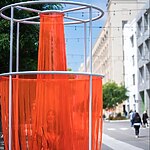
Designed by SomePeople for the LA Design Festival in 2019, The Sky Gazing Tower is an installation designed to provide personal space for individuals living in crowded urban environments, addressing issues like social anxiety, stress, and agoraphobia.
It combines a physical structure with a virtual reality environment and user interface to empower users to design a personal, comfortable space.

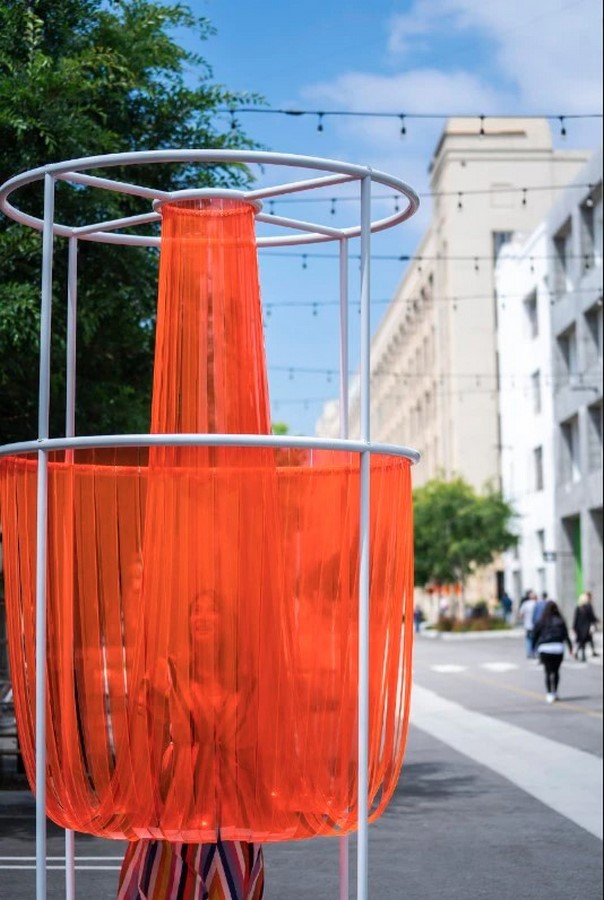
In this case, the immersive technology, virtual reality, enhances the project by allowing users to tailor their personal space within the installation virtually. It encourages self-expression, customisation, and the exploration of individual needs, offering a retreat from the challenges of crowded urban living.
Augmented Reality (AR)
Augmented reality is digital content superimposed over a live stream of the physical environment, offering an enhanced view of architectural models and designs within a physical environment. It is useful for site analysis and design visualisation.
Augmented reality is the combination of two worlds. One is the real world in which we exist, and our actions have dangerous structural implications. Two, the digital world where mistakes can be made and undone without danger and tasks made more efficient by automation or duplication.
Already in use by architecture, construction, design, and engineering professionals, augmented reality can be utilised for client communications in the same universal way that email, video calls, and 3D design software have in the past. A common feature in professional design toolkits, augmented reality tools transform how the industry operates, learns, and interacts with the environment.
Online video tutorials and experiential learning have advanced greatly with integrated onsite augmented reality guidance as walkthrough video assistance for DIY amateurs. Augmented reality technology will likely further revolutionise experiential learning in collaboration with AI software and hands-free hardware.
GAMMA Augmented reality
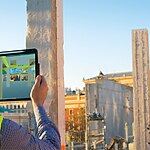
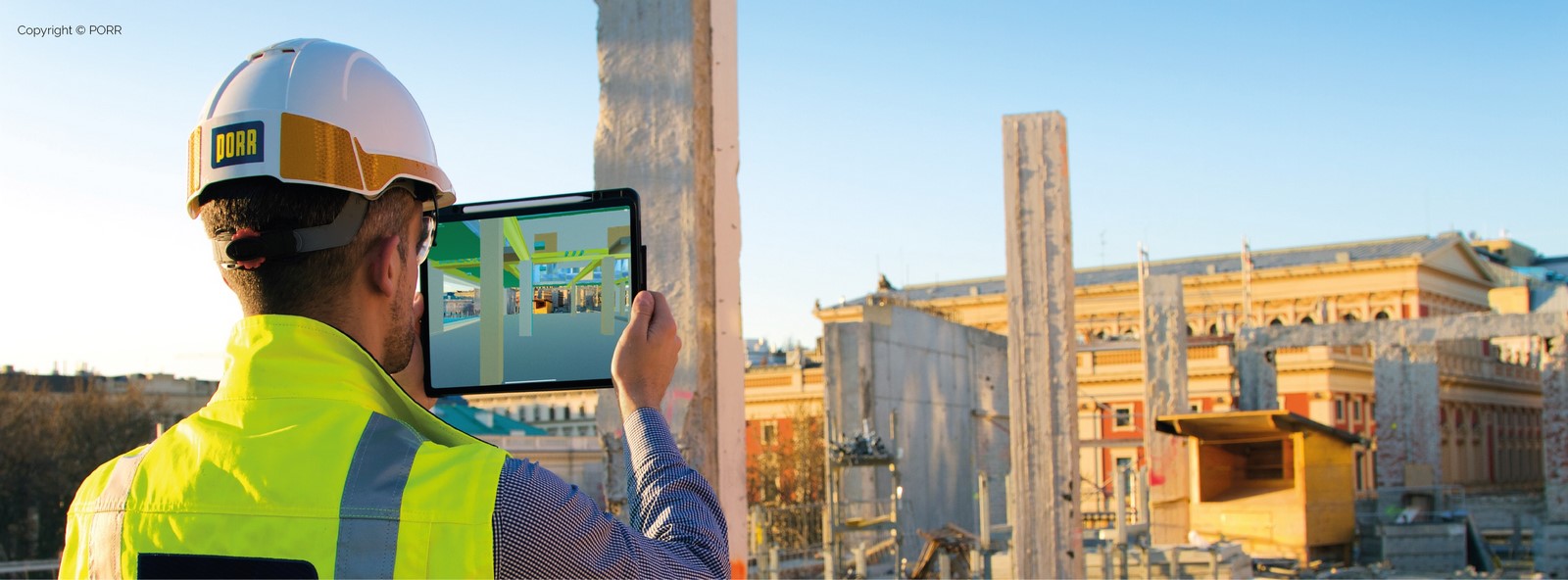
GAMMA Augmented Reality is a building site monitoring application that uses augmented reality technology to overlay BIM 3D buildings via smartphones or tablets. It enables 3D BIM models to be viewed before and during the building process, creating an understanding of planning, avoiding errors, and reducing construction costs.
Through the use of a helmet or pair of glasses linked to the augmented reality app to overlay a 3D image, structural, electrical, or plumbing networks can be viewed, assessed, or altered before or after installation, making on-the-job training far less daunting.
An Augmented Reality Project
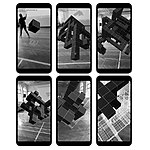
The VoxelCO – Playing with Collaborative Objects project was exhibited at the ‘Artificial Realities: Virtual as an Aesthetic Medium for Architectural Ideation’ at the Lisbon Architecture Triennale in 2019.
The project explores the potential of playful encounters with objects in real, augmented, and mixed realities in the VoxelCO platform for interactive and social exploration of these objects. As a multi-player, cross-platform application for desktop and mobile devices, it offers different playgrounds for engagement: Digital, Augmented, and Real Playgrounds.
Users can collaboratively interact with voxel formations in the three formats to create voxel structures, allowing for deep interaction and social extension.
Immersive technology, particularly augmented reality, plays a significant role in VoxelCO, enabling users to interact with collaborative objects across different realities. This project promotes user participation and social interaction in architectural design through playful engagement.
Mixed reality (MR)
Mixed reality combines the real-world environment and a virtual content world, enabling architects to collaborate in real time using holograms. Design teams in different locations can meet in a shared mixed reality space to collaborate on architectural projects.
Mixed reality applications benefit from real-world awareness while providing additional visual information.
Where virtual reality is understood as a digital stereoscopic visual experience, mixed reality covers all other types of immersive visualisations.
Immersive technologies provide an improved means of communicating the experience of unbuilt designs to clients who cannot always envision a spatial experience from 2D representations.
While virtual reality tools are more available to architects, mixed reality is still relatively uncommon in architectural practice. Still, many software companies are working hard to make this technology as accessible as virtual reality. Currently, most cases of mixed reality used in architectural design are one-offs and are still very experimental.

Other Growing Immersive Technologies
Holograph/Hologram
A hologram or holograph is a projection of a 3D image in space. These projections can be explored from all angles and potentially merge virtual and physical spaces, as shown by the Augment Platform. This application transforms a plan into a 3D model hologram simulating life-size products. Users can upload 2D images and specs to view 3D models in real-time and on the right scale.
360-Degree rendering
360-degree rendering is another immersive tool architects use, providing clients with panoramic views of a space, enabling them to explore the design from various angles. This technology is especially useful for presenting interior spaces and exteriors.
TelePresence
Telepresence is a virtual presence in a robot remotely controlled over the internet with the user in a different location.
FPV drones
FPV (First person view) drones are when cameras on an unmanned aerial vehicle (UAV) are used, connected to a headset, goggles, a mobile device or a computer, to display the environment around the area the drone is flying In.
Supporting Technologies
Immersive technology tools and software often need other supporting technologies like headsets, 3D displays, 3D audio, gesture recognition readers, spatial sensing, speech recognition devices, haptics, drones, cameras, and omnidirectional treadmills that are used to fully connect with the various immersive technologies discussed in this article.
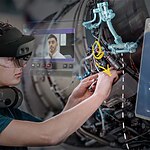
Image 6_Microsoft’s mixed reality headset, HoloLens 2, can open a holographic window that can be used for hands-free training, guidance and collaboration_©Microsoft, 2023
Conclusion
As immersive technologies impact architectural practice at all project phases, they help accelerate the architecture design process, enhancing collaboration and faster iteration while reducing the need for travel and contributing to sustainability. These immersive technologies also aid sustainability through environmental impact assessments, predicting energy usage and lighting conditions, leading to eco-friendly and sustainable designs.
Although immersive technologies come with challenges like cost and technical expertise, with the expected increase of integration of immersive tools as the technology advances, it will become more accessible, with lower costs, better hardware, and more user-friendly software. Despite the potential downsides, such as the cost of the technology and the potential for unrealistic expectations, these tools have so much potential.
As virtual, augmented and mixed reality technologies continue to advance and be integrated into the architecture industry, there may be a learning curve involved for many in the industry. Understanding immersive technology’s impact on architectural education and practice is vital as next-generation architects and clients will use it more frequently.
However, it’s important to balance using immersive technologies to enhance the design process and address other important design considerations.
Bibliography
Reference List
Autodesk (2022). Immersive Technologies for Design and Construction. [online] Autodesk University. Available at: https://www.autodesk.com/autodesk-university/ru/node/135670 [Accessed 31 Oct. 2023].
Clews-de Castella, T. (2023). VR, AI & Architecture: How Immersive Technologies are Transforming the Future. [online] Linkedin.com. Available at: https://www.linkedin.com/pulse/vr-ai-architecture-how-immersive-technologies-future-trent/ [Accessed 3 Nov. 2023].
Cuningham.com (2020). Immersive Technologies: How Architects Can Position Themselves For Future Success. [online] Cuningham. Available at: https://cuningham.com/2020/01/15/immersive-technologies-architects-position-themselves-success [Accessed 31 Oct. 2023].
Cutillas, J.G. (2023). Architecture and virtual reality, an immersive experience. [online] Amusement Logic. Available at: https://amusementlogic.com/general-news/architecture-and-virtual-reality-an-immersive-experience/ [Accessed 3 Nov. 2023].
Eloy, S., Kreutzberg, A. and Ioanna Symeonidou (2021). Virtual Aesthetics in Architecture. [online] Routledge. Available at: https://www.perlego.com/book/2555129/virtual-aesthetics-in-architecture-designing-in-mixed-realities-pdf [Accessed 31 Oct. 2023].
Grillo, F. (2019). A public installation to face social anxiety. [online] Domusweb.it. Available at: https://www.domusweb.it/en/news/gallery/2019/07/31/a-public-installation-to-face-social-anxiety.html [Accessed 5 Nov. 2023].
Hiverlab (2020). The Amazing Ways Immersive Technology Improves Architecture Design – Hiverlab Blog. [online] Hiverlab Blog. Available at: https://blog.hiverlab.com/2020/02/29/the-amazing-ways-immersive-technology-improves-architecture-design/ [Accessed 31 Oct. 2023].
Jenek, W. (2018). Architecture with Immersive Technologies * Next Generation Architects and Clients. [online] Available at: https://eprints.qut.edu.au/129850/13/Ozchi%2B2018%2Bworkshop%2Bpaper-Architecture%2Bwith%2BImmersive%2BTechnologies.pdf [Accessed 31 Oct. 2023].
Mario, S. (2023). AR/VR Revolution: Transforming Architecture and Design with Immersive Technologies. [online] Medium. Available at: https://medium.com/@stevancartal/ar-vr-revolution-transforming-architecture-and-design-with-immersive-technologies-fe9964f1e510 [Accessed 3 Nov. 2023].
Marx, J. (2023). Next Generation Goggles: Augmented Reality Meets Virtual Reality. [online] ArchDaily. Available at: https://www.archdaily.com/1003707/personal-metaverse-immersion-devices-unlocking-the-potential-of-ar-and-vr?ad_source=search&ad_medium=projects_tab&ad_source=search&ad_medium=search_result_all [Accessed 31 Oct. 2023].
Mohamed, A. (2021). Immersive Virtual Reality and The Appreciation of Architectural Aesthetics. [online] Dicle University Li. International Architecture Symposium 11-12 October 2021 D. Ü – Diyarbakir, Türkiye. Available at: https://www.academia.edu/69509857/IMMERSIVE_VIRTUAL_REALITY_AND_THE_APPRECIATION_OF_ARCHITECTURAL_AESTHETICS [Accessed 1 Nov. 2023].
Prabhakaran, A., Mahamadu, A.-M. and Mahdjoubi, L. (2022). Understanding the challenges of immersive technology use in the architecture and construction industry: A… [online] ResearchGate. Available at: https://www.researchgate.net/publication/359579267_Understanding_the_challenges_of_immersive_technology_use_in_the_architecture_and_construction_industry_A_systematic_review [Accessed 31 Oct. 2023].
Souza, E. (2019). 9 Augmented Reality Technologies for Architecture and Construction. [online] ArchDaily. Available at: https://www.archdaily.com/914501/9-augmented-reality-technologies-for-architecture-and-construction?ad_medium=widget&ad_name=related-article&ad_content=1004256 [Accessed 3 Nov. 2023].
Wigmore, I. (2018). Definition: Immersive Technology. [online] WhatIs.com. Available at: https://www.techtarget.com/whatis/definition/immersive-technology#:~:text=Supporting%20technologies%20for%20immersive%20experiences,drones%2C%20cameras%20and%20omnidirectional%20treadmills. [Accessed 3 Nov. 2023].
Wormald, J. (2023). Explore the Future of Architecture with Augmented Reality. [online] ArchDaily. Available at: https://www.archdaily.com/1004256/explore-the-future-of-architecture-with-augmented-reality [Accessed 3 Nov. 2023].
Image List
- Personal space variations estimated by SomePeople, creators of the installation, Sky Gazing Tower.
Vu, P. (2019b). Personal Space Variations. Domusweb.it. Domusweb. Available at: https://www.domusweb.it/en/news/gallery/2019/07/31/a-public-installation-to-face-social-anxiety.html [Accessed 5 Nov. 2023].
- Here, a girl stands inside the public installation, Sky Gazing Tower.
Vu, P. (2019a). Girl standing in public installation. Domusweb.it. Domusweb. Available at: https://www.domusweb.it/en/news/gallery/2019/07/31/a-public-installation-to-face-social-anxiety.html [Accessed 5 Nov. 2023].
- Incorporating augmented reality into the construction process could prevent mistakes and misunderstandings.
PORR (2023). GAMMA AR. Facebook.com. Available at: https://www.facebook.com/gammaar/photos [Accessed 8 Nov. 2023].
- VoxelCO is aimed to be highly accessible through developing it for various mobile devices.
Grasser, A. (2019). VoxelCO. Alexandergrasser.com. Available at: https://alexandergrasser.com/VoxelCO [Accessed 5 Nov. 2023].
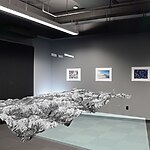
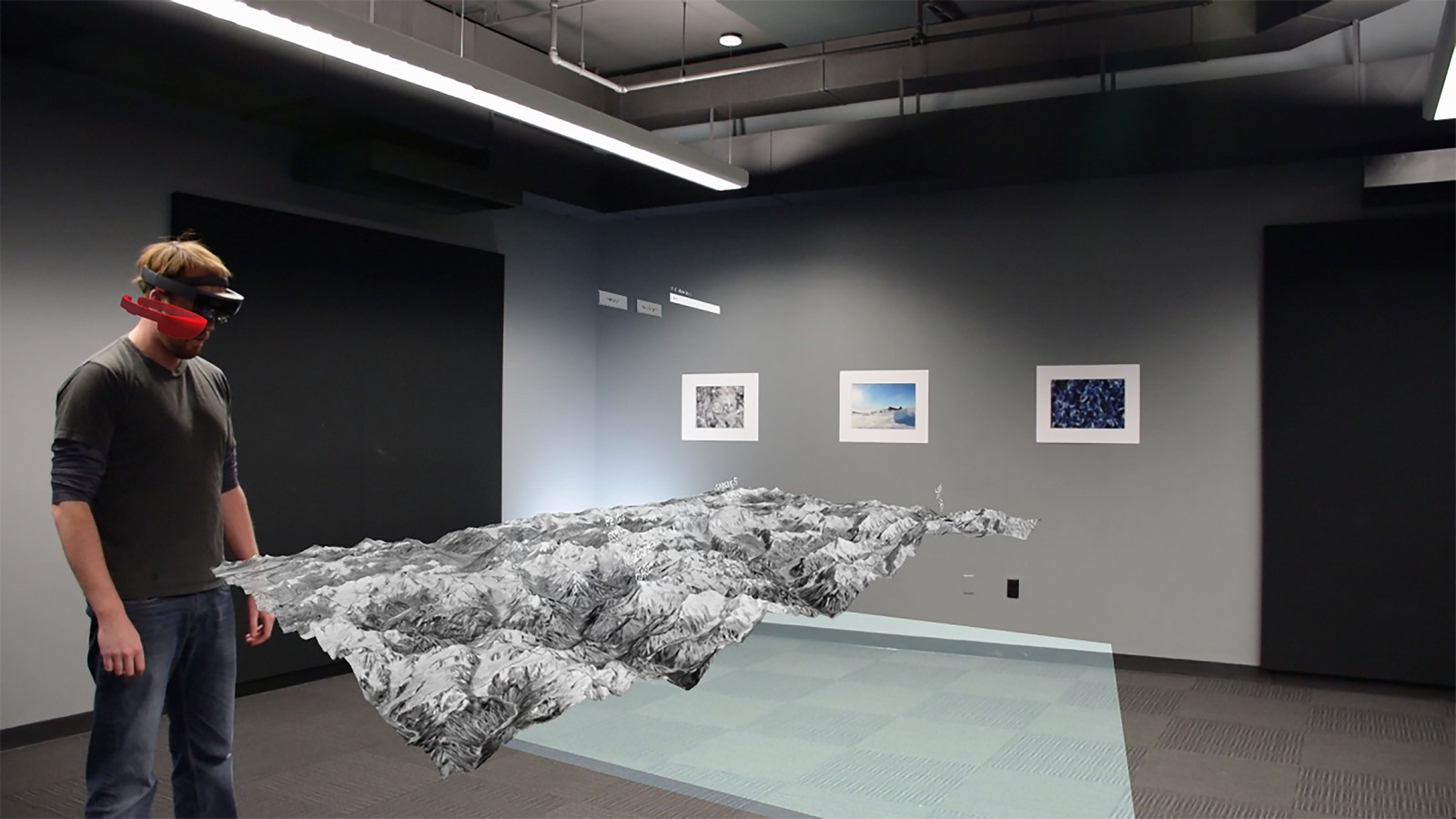
- The Fossett Lab allows users to explore 3D features on the HoloLens, here, a user is looking at the surface texture of regions of the Himalayas.
Fogerty, C. (2018). Fossett Laboratory for Virtual Planetary Exploration launches new augmented reality app. [online] Arts & Sciences. Available at: https://artsci.wustl.edu/ampersand/fossett-laboratory-virtual-planetary-exploration-launches-new-augmented-reality-app [Accessed 8 Nov. 2023].
- Microsoft’s mixed reality headset, HoloLens 2, can open a holographic window that can be used for hands-free training, guidance and collaboration.
Microsoft (2023). HoloLens 2 Brings New Immersive Collaboration Tools to Industrial Metaverse Customers. Source. Available at: https://news.microsoft.com/source/features/innovation/hololens-2-industrial-metaverse/ [Accessed 8 Nov. 2023].